 Iceland’s senate narrowly voted to begin talks for the island nation to join the EU on Thursday, and already there are those in Brussels saying the accession could be fast-tracked so quickly that Iceland would be a member by the end of next year. But with the current anti-expansion mood in Brussels, Iceland’s bid could raise uncomfortable divisions and a fundamental question for the anti-expansionists: in the heated debate over whether to take on new members states, does Iceland really count?
There’s plenty of reasons to argue that Iceland is almost irrelevant to the expansion argument. As a member of the European Economic Area (along with Norway, Liechtenstein and pseudo-member Switzerland), is it already beholden to most EU legislation and has been for some time. The EEA countries and Switzerland have worked out an arrangement with the EU where they are effectively members but are not restricted in certain areas in which they don’t want to be regulated. For Switzerland and Liechtenstein that issue has been banking secrecy (among others). For Norway the issue has been their offshore oil. And for Iceland the issue has been fishing. The trade-off is they then don’t get any representation in EU lawmaking, meaning they end up being governed by laws they had no hand in shaping. All of these countries are members of the EU’s borderless Schengen Zone (but confusingly EU member states Ireland and the UK are not).
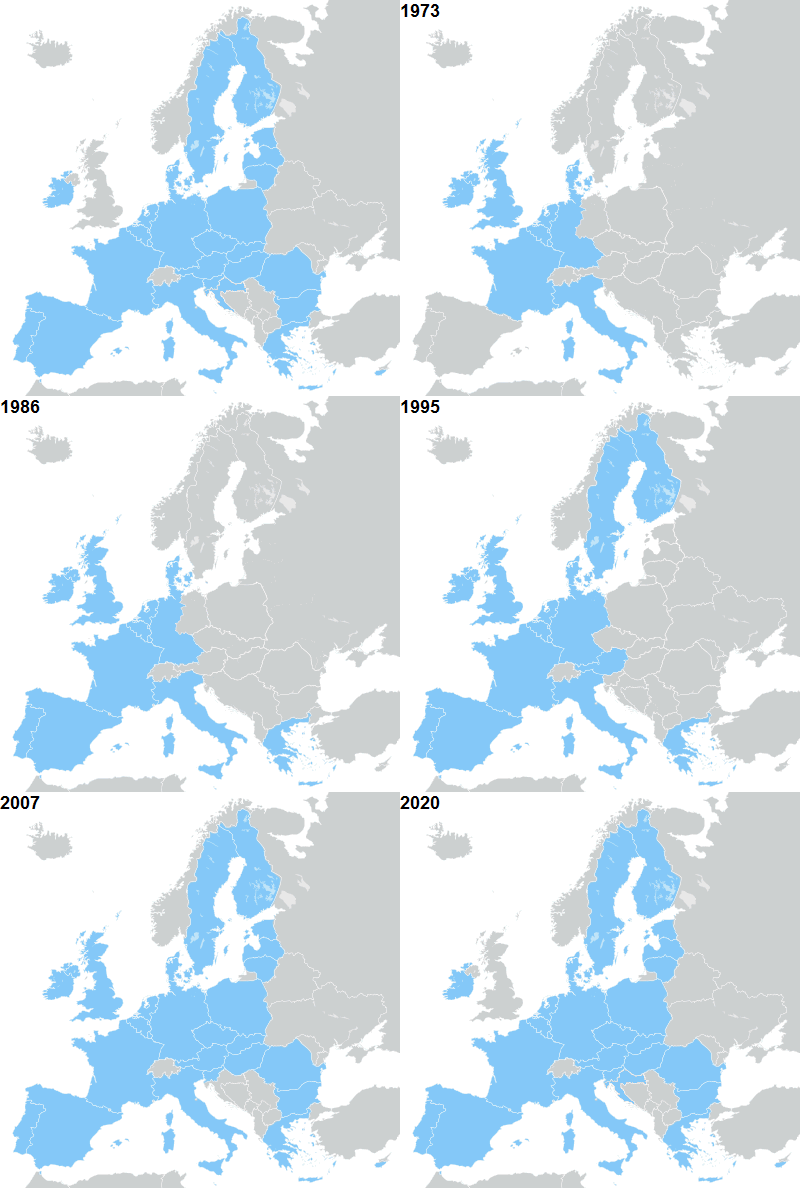 Following the latest enlargement with the accession of Romania and Bulgaria, which many saw as an over-ambitious strategic mistake, the popular feeling among politicians on the continent now is that expansion needs to be halted for the time being. One of the most vocal opponents of further EU enlargement has been French President Nicolas Sarkozy, particularly with regards to Turkey. Angela Merkel is also opposed to further expansion. Croatia’s long-impending accession has been delayed because of a border dispute with Slovenia (which entered the EU in 2004), and it now looks like timing may not be on Croatia’s side. The border dispute doesn’t seem to be anywhere near a solution, and the current mood means that Brussels is only too happy to continue delaying their entry as long as the border issue is outstanding.
There is of course a pro-expansion camp as well, but it tends to come from countries which have less influence in Brussels. The UK has been a tireless advocate of almost unrestrained expansion, as well as Poland. The United States has also stuck its nose in and said the EU should continue to enlarge. Of course it’s not hard to see why – further expansion, especially to Turkey, would make the EU unworkable as anything even remotely resembling a federal entity. Since the anti-federalists (particularly the British) want the EU to be only a free trade zone, they logically want the common market to be open to as many people as possible. Arguments about the difficulty in integrating western Balkan states or Turkey into an EU political framework are irrelevant to the anti-federalists, because they don’t want there to be an EU political framework.
So where does Iceland fit into this debate? Neither side should really have any objection to it, as bringing in Iceland will give the anti-federalists more consumers in the common market, and the federalists know that as a traditional Western democracy there wont be any trouble integrating Iceland politically and culturally into the EU. Considering Iceland is already an EEA country, bringing it into the EU would require minimal work, as opposed to the colossal amount of effort and difficulty encountered during the 2004 and 2007 expansions into Eastern Europe.
But already it appears that the anti-expansionists, while not concerned about the substance of Iceland’s entry, are very much concerned about the message it will send. After all, there is a risk that the anti-expansionists will look like hypocrites, or possibly even racists, if they’re seen to welcome Iceland with open arms but insist expansion must be halted as soon as the discussion turns to countries with a darker skin complexion or a different religion. There is also a risk that Iceland’s accession will send a message to the western Balkan states and Turkey that the EU is in expansion mode, at a time when most in Brussels would insist it certainly is not. Additionally, what kind of message is sent by the fact that Iceland held out from joining during the good times, but has only now changed its tune after the country’s economic collapse?
 Already divisions are emerging on the issue. Bavaria’s centre right party the Christian Social Union (the Bavarian counterpart of Angela Merkels Christian Democratic Union), has already spoken out against the accession. The head of CSU members in the European Parliament told German newspaper Suedduetsche over the weekend, "The EU cannot play saviour to Iceland's economic crisis,” – setting themselves up for a conflict with their CDU partners who strongly support Iceland’s entry.
Though there are going to be some difficult negotiations over fishing rights, by all accounts it seems likely Iceland’s entry will be fast-track approved by the EU. The entry would then have to pass a public referendum in Iceland. Given that this is such a small country that is already part of the EEA, the entry won’t have much of a practical effect on the EU. However the implications of allowing this entry in the midst of a general call for a halt to expansion could have important symbolic significance, and could cause a headache for the anti-expansionists down the line when they seek to block the entry of countries like Serbia, Albania or Turkey.

2 comments:
The desperation of the CSU is starting to become a headache for the CDU in Germany.
But the EEA countries form a special category of potential entrants, in my view, since they fulfil the main Copenhagen criteria before the negotiations start.
Even if the membership negotiations with Iceland can be concluded quickly, there are no guarantees that the Icelanders will actually join.
The nearest points of reference are:
Norway rejected EU membership twice and Greenland is the only territory to have seceded from the European Union.
The EU has started a revision of its common fisheries policy, but it is too early to tell if it will be able to create a sustainable policy as a whole, let alone satisfactory to Iceland.
I agree with Grahnlaw about the special case of EEA countries. However, there is a useful continuation of the Icelandic EU membership bid, eg see:
www.voxeu.org/index.php?q=node/3795
where Jon Danielson gives a more sober "across-the-board assessment of the likelihood of Iceland's membership bid.
Post a Comment