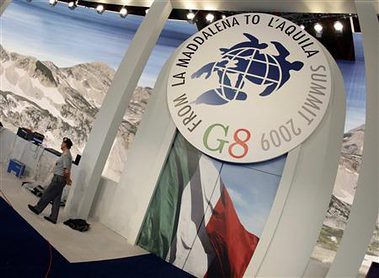
 As the G8 summit in L’Aquila, Italy wraps up, it would seem that initial predictions for the meeting’s lack of accomplishment have been born out. In the area of climate change, though a 2 degree temperature rise cap was theoretically agreed, the leaders failed to pass a climate bill which would mandate halving global emissions by 2050. The G8 also failed to agree a concerted strategy to boost the global economy, and they could not agree to any new sanctions on Iran or North Korea.
The timing of the summit, sandwiched as it is between two important G20 meetings, is of course partly to blame for the inaction. But many on the ground are blaming the failures on the country leading this year’s meeting, Italy. In the run-up to the summit there was a great deal of press about how the US had been forced to take the reigns of at the last minute after Italy failed to show any real leadership. But it was a report in Monday’s Guardian which stirred up the most controversy, alleging that senior officials from the other G8 nations were saying that Italy’s organisation of the event was so bad, the group should consider expelling it as a member.
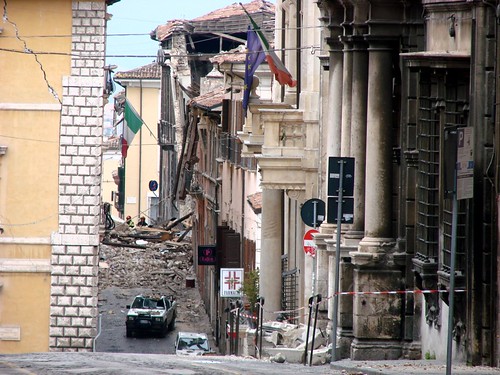
The newspaper quotes senior officials as saying that in the last few weeks leading up to the summit, Washington was forced to organise “sherpa calls” at the last minute in order to give the summit some kind of purpose, as the Italians had seemingly failed to propose any substantive initiatives. For a country other than the host to organize these calls is “unprecedented”, one official told the paper. It was the US that organized the food security initiative, perhaps the only substantial thing to come out of the meeting. The paper also said that moving the summit from Sardinia to the recently earthquake-ravaged area of L'Aquila had created a logistical nightmare, with both officials and press unable to get around and telecommunications limited. And that’s not to mention the danger posed to the visiting heads of state as the area is still experiencing aftershocks.
 The Guardian’s article was met with shock and consternation from Italian officials this week, some of it rather amusing. Foreign Minister Franco Frattini reacted to the assertion that some are calling for Italy to be kicked out of the G8 by saying it is The Guardian which should be “expelled from the list of great newspapers!” Italian Prime Minister Silvio Berlusconi himself even gave his take on the article, saying it was a "load of rubbish" from a "small newspaper". Well which is it, a small newspaper or a great newspaper?
But disorganisation – an admitted national stereotype - isn’t the only accusation being levelled at Italy. Yesterday news emerged of a developing spy row in L’Aquila as people claimed the Italians were trying to use headphones to listen in on other negotiations. Berlusconi’s aids were also accused of having looked into using an audio device to communicate messages to him during secret meetings.
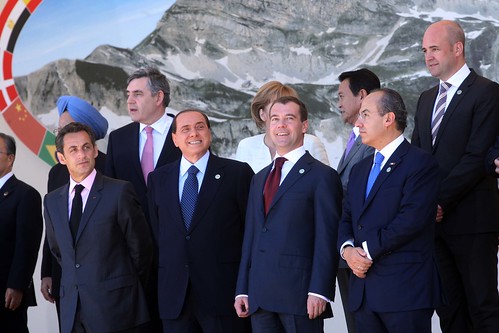 If the chaos and corruption being reported on the ground is true, it will not help Italy’s case for staying in the G8 or its successor body as a growing chorus of people call for the G8’s dissolution. There has been talk of replacing Italy with Spain, which now has a higher per capita national income than Italy and gives a greater percentage of GDP in aid. But US officials oppose this, believing that the group is already too Euro-centric. It may be that Britain, France and Germany are a bit nervous about the prospect of seeing Italy get the boot, because they know that they could eventually be next. The world has changed a great deal since the G8 was formed, as Spain’s emergence from the dark ages of the Franco era attests.
Many in the US think that a new group should be formed where all European nations are represented by a single EU seat (especially considering the EU already has an unofficial seat in the G8, effectively giving the European nations double representation). Individual EU countries would surely resist this, but the reality is they may have to accept it eventually. A more logical “G6” grouping in the future might be the US, the EU, China, Russia, India and Brazil.
Sex on Their Minds
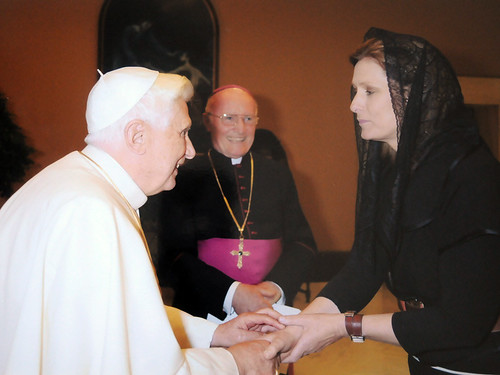 Of course everyone gathered in Italy for the G8 summit can’t escape the Berlusconi sex scandal lurking in the background that has coloured the whole event. Wednesday saw the bizarre spectacle of five first ladies visiting the pope, all wearing veils - including Britain’s Sarah Brown - except for the first lady of Brazil - the largest Catholic country on earth. (Side note – can someone explain to me why non-Catholic women were compelled to wear a veil while meeting the pope?).
They were led by a former topless model (also veiled) who was standing in for the first lady of Italy, who is currently in divorce proceedings with her philandering husband Silvio Berlusconi. The stand-in for Italian first lady was Mara Carfagna, a former topless model appointed by Berlusconi to be – get this- his equal opportunities minister. The first wives had been asked to boycott the summit by a group of Italian university professors in response to, “the way women are treated in public and private by the Italian prime minister.” None of the wives agreed to the boycott but interestingly the most high-profile ones – Michelle Obama and Carla Bruni – were conveniently not available for the pope introduction led by the topless model.
 None of the leaders or their wives have offered direct comment on the scandal, but Obama seemed to offer veiled disapproval of Berlusconi earlier this week following his meeting with Italy’s president. He lavished praise on President Napolitano (a mere figurehead in the Italian system of government) while offering none for Berlusconi.
President Napolitano had called on politicians and the media to take a break on discussing the sex allegations against Berlusconi during the summit so as to spare Italy any further embarrassment, but now that the meeting is coming to an end it looks like new allegations will keep emerging. New photos will reportedly be revealed in the next few days showing two topless women kissing in front of the prime minister for his amusement.
As G8 summits go, this year’s was, if not the most productive, at least the most sexy.

5 comments:
Dave, re G8 and emissions, there is no doubt that emission reduction could be much simpler!
Sufficient first phase 2020/2030 emission reduction is achieved by acting on ELECTRICITY generation (coal, gas) and TRANSPORT (mainly automobiles) alone, since these 2 sectors typically (as in the USA) account for 80% of greenhouse gas emissions.
The focus on electricity and transport gives several advantages - apart from lowering CO2 emissions:
1. Local environmental benefit from less pollution of sulphur and all else that’s in the emissions, regardless of the less certain or immediate global benefit from CO2 reduction.
2. Electricity supply alternatives which together with improved grid distribution gives better competition and keeps down electricity bills for consumers.
3. Transport alternatives (using electricity, hydrogen and other energy sources), which give variety of choice and competition advantages for consumers, additionally reducing the dependency on oil imports.
4. No trade problems: Unlike Cap and Trade, which involves cement, steel and other industries having to face imports from unregulated countries, the here suggested electricity and transport changes are not just more limited, but also largely local. Since there is little competition between say utility companies internationally, "best practice" results can be compared and shared.
Funding and Impact
Equity and long term loan finance can be used: Long term industrial loans from financial institutions, particularly if federal/state guaranteed, give low yearly interest repayments and lessen the effect on electricity bills or transport cost.
Compare with
today’s all-encompassing Cap and Trade (emission trading) suggestions, with unpredictability, expense, and needless disruption from normal business practice on one hand, or unnecessary profiteering from free allowance handouts with little actual emission reduction on the other hand - together with extensive -and unnecessary- regulation on what people can or can’t buy and use.
Understanding why proposed Cap and Trade is bad, in USA and elsewhere
http://www.ceolas.net/#cce5x
Basic Idea — Offsets — Tree Planting — Manufacture Shift — Fair Trade — Surreal Market — Real Market — Allowances: Auctions + Hand-Outs — Allowance Trading — Companies: Business Stability + Business Cost — In Conclusion
The Way Forward
http://www.ceolas.net/#cc10x
Introduction — Funding and Impact —No Energy Efficiency Regulation — A New Electric World
Electricity Generation — Distribution
Transport Power Generation — Regulation — Taxation
I was supposed to be there this week but couldn't get there from Rome! So I had to do my work covering the G8 from there, there was literally no way to get me there! It was really ridiculous.
The only people allowed to wear white in the presence of the pope, never mind a veil, are Catholic monarchs and the Catholic wives of Catholic monarchs - a protocol known as the "privilège du blanc." http://en.wikipedia.org/wiki/Privilège_du_blanc
But even Jackie Kennedy, though Catholic, was not a monarch or monarch's wives, so she also wore her black.
But it's suggested, and not required, which could explain the First Lady of Brazil...
Ah that's very interesting. I'm surprised that a first lady from England, with its anti-Catholic history, would then opt to wear the veil if it was optional. Probably just goes to show the minimal influence religion has on public life in the UK these days.
I see Michel Obama also wore the veil... http://www.herald-dispatch.com/entertainment/x1227380519/Gallery-The-Obamas-visit-to-the-Vatican
Post a Comment