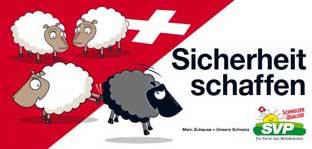
The Swiss People's Party may have scored another victory yesterday in their campaign against the "black sheep" within Swiss society, but judging by the reaction of the European press today it may be the Swiss themselves who are becoming the real black sheep. In a referendum held Sunday, 53% of the Swiss endorsed a far-right initiative to automatically expel foreign residents who have committed a crime, following their time served in a Swiss prison.
According to the AFP, Austrian website news.at announced the news with the headline, "Switzerland is now the black sheep -- majority for tougher rules against foreigers." The headline is a reference to the notorious advertising used by the far-right Swiss People's Party (SVP) showing a group of white sheep kicking a black sheep out of Switzerland. The imagery, which helped propel the SVP to a huge election win in 2007, was again brought out in the SVP's campaign for the expulsion initiative (but this time with a new twist, one of the white sheep has been stabbed!). The Austrian press wasn't the only one criticising the referendum outcome. Belgian newspaper Le Soir noted today that the Swiss are increasingly choosing a "radical road". German newspaper Sueddeutsche Zeitung wrote that once again Switzerland is "sending a signal to the world that it doesn't care what others think of it." Many of the papers are noting that the vote comes exactly one year after the Swiss voted to ban minarets on mosques.
Showing posts with label free movement. Show all posts
Monday, 29 November 2010
Saturday, 28 August 2010
France's 'gypsy deportation' is becoming the EU's problem
The controversy over France’s deportation of Roma (gypsies) who are Romanian nationals continued unabated this week, as Sarkozy prepares to host what some are calling an “anti-gypsy summit” in Paris next week between 5 of the EU’s biggest powers. France’s deportations are not only drawing fire from human rights groups – they are also coming very close to violating EU law, since Romanian nationals are now EU citizens and, in theory, have the right to live anywhere in the EU. The deportations are calling into question what the limits of “free movement” really are. And there are signs that some rightist politicians in Europe may be looking for an opening to make those EU guarantees of free movement more restrictive.
France’s Roma deportations are actually nothing new. France has been closing down illegal Roma camps and sending their inhabitants home for years - and if those inhabitants’ homes happened to be in another country, that’s where they were sent. Last year 10,000 Roma were sent back to Romania and Bulgaria. These Roma have been paid to leave, and the government has always said they were being sent home voluntarily (although they were involuntarily removed from their illegal camps).
Monday, 9 February 2009
The Swiss Say Yes to Europe
The vote is being called a "broad yes" by the Swiss to economic collaboration with Europe, and a mandate for pro-European parties in the Swiss government to increase ties. The news is already being taken as a sign that the financial crisis may lead to a more receptive attitude toward the EU and coordinated pan-European policies. With the Irish revote on the Lisbon Treaty just around the corner, many in Brussels are hoping this is a trend that will continue. But is the vote's outcome the result of changing EU attitudes in the face of the financial crisis, or was it simply the result of a skillful vote mobilisation effort on the ground by pro-EU groups?
Switzerland has a rather unusual arrangement with the EU. While it's not a member, it has a series of seven 'special accords' with the block that make it effectively a shadow member. It isn't an official member, so it doesn't have any representation in the European Parliament or Commission, but the accords oblige Switzerland to follow many areas of EU legislation. Free movement, which allows any EU citizen to work in any EU country, is one of those areas. However, now that EU membership hassuch a change must be put to a public vote (they basically have to have a public vote for everything in Switzerland). But here's where it gets tricky. The EU has made clear that Switzerland doesn't have the right to 'pick and choose' which parts of EU law it will follow, and under the infamous "guillotine clause," if the Swiss voted no to extending free movement to Bulgaria and Romania, all of their agreements with the EU would be torn up. Considering that the vast majority of Switzerland's trade is with the EU, and that non-Swiss EU citizens make up a huge percentage of its skilled workforce, a collapse in the accords would be catastrophic for the country's economy. So one has to ask, is this really a vote for increased EU ties, or a desire to maintain the status quo? And if it's now economically impossible for the Swiss to vote against policies enacted in Brussels, isn't this really just an illusory independence anyway?
A Sign of the Times?
So does the wide victory in Switzerland mean that people's fears about the financial crisis are going to make them less likely to snub the EU, for fear of the economic consequences? I've speculated that the economic turmoil in Ireland will likely make the Irish too scared to vote against the Lisbon Treaty again when the revote occurs later this year. It seems likely that the hold-up in approval by the Czech Parliament may also be resolved quickly now that the future looks so uncertain. On the other hand, many commentators have speculated that the recession could lead to an increase in populism and protectionism, which could put the European single market in jeopardy. The recent walk-outs in the UK and the one-day strike in France have certainly been a worrying sign in that direction.
For now though, Brussels has reason to be encouraged by the Swiss result.
Subscribe to:
Comments (Atom)