Showing posts with label labor. Show all posts

Friday, 20 January 2012

The biggest American political story Europeans haven't heard of

The US presidential primary race has attracted its usual amount of fascination here in Europe, and yesterday’s developments - with the Iowa race being re-called for Santorum and Rick Perry dropping out - were front page material. But behind the spectacle of the drawn-out US primaries, there is a far more interesting story going on in the state capitals.

Of course it’s not surprising that the European media is ignoring these huge developments at state level, because the Washington beltway media has also ignored them. They also ignored the unprecedented political revolution in 2010 that the recent events are a reaction to. While in Europe the media tends to ignore ‘federal’ (EU) politics and focus only on member state politics, in the US it is the opposite. The US media (even local state media) tends to focus on federal politics in Washington and there is little interest in what goes on in state capitals.

Thus, when the Republicans enjoyed an unprecedented victory in the 2010 midterm elections, the focus was almost entirely on the fact that they had taken control of the US House of Representatives. What was largely ignored was the fact that they had at the same time taken over state legislatures with unprecedented majorities – giving Republicans the most power in state governments they have had in decades. Republicans wrested six governorships from Democrats, giving them control of 30 of the 50 state executives. Five states saw both legislative chambers (state senate and state house) switch from Democrat to Republican majorities. In seven other states they gave themselves control of the entire legislature by picking up huge majorities in an additional chamber. The elections left Republicans controlling the entire government of half of US states, leaving them with Hungary-like majorities capable of passing whatever state legislation they like.

Tuesday, 3 January 2012

Protest over Ikea meatballs - welcome back to Absurdistan

I’m back in Brussels after spending the Christmas break home in the US. It was yet another trip where I spent most of the time regaling people with the insane stories of the strange place I now find myself living in. I’m pretty sure most of my American friends think I’m making this stuff up. I only wish.

After describing the impromptu general strike three days before Christmas which forced me to pay $500 to rebook my flight home, I moved on to describing to my friends the other union strikes I have witnessed since moving here. From the impromptu metro driver strike that was called after a driver claimed he was punched by a passenger (it turned out the driver had punched the passenger) to the October garbage strike in which the garbagemen went around town lighting the trash bags on fire and throwing them into the street, there’s plenty to describe. And let's not forget the time the taxi drivers blockaded Brussels Airport because an unlicensed taxi driver had been grazed by a bullet while he fled from police during a high-speed chase.

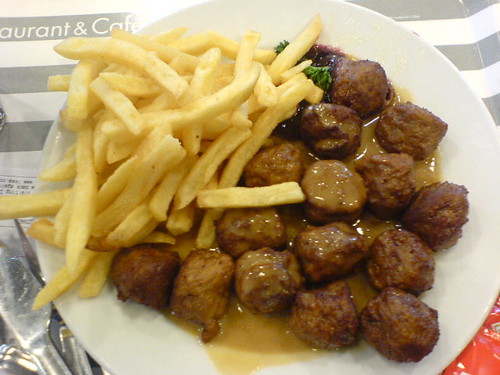
Today I learned about a whole new anecdote of insanity I could have described to my perplexed American friends. According to this story by Belgian news station RTL, the restaurant owners association in Belgium (Horeca) is busing homeless people to Ikea as a protest against their low meatball prices. When I first saw this story I assumed it had to be a joke. Clearly I’ve been in the US too long! Because I forgot that when you hear about something this absurd happening in Belgium, it’s probably true.

Thursday, 24 March 2011

Anti-austerity protests shut down EU Quarter

As one of the last remaining Socialist governments in Europe collapses today, the left is taking to the streets in Brussels in what seems like a last-ditch effort to stop the massive austerity cuts to government spending taking place across Europe.

This morning I had the arduous task of trying to make my way to work through the massive union demonstrations by the European Trade Union Confederation that have closed off the EU Quarter. While some parts of the protests seemed relatively peaceful and good-natured, I could already observe danger signs. The security forces are wearing body armour, riot gear and gas masks. Youths with bandanas around their faces were everywhere, particularly on the side streets. Many of the older demonstrators are already intoxicated. I saw eggs being pelted at the windows of buildings on Rue de la Loi. Firecrackers were exploding all over the place (my suitcase got hit by one in fact!). My friend tells me a window in her office was smashed by a rock. It's going to be a fun day…

Wednesday, 23 February 2011

American labour fights back

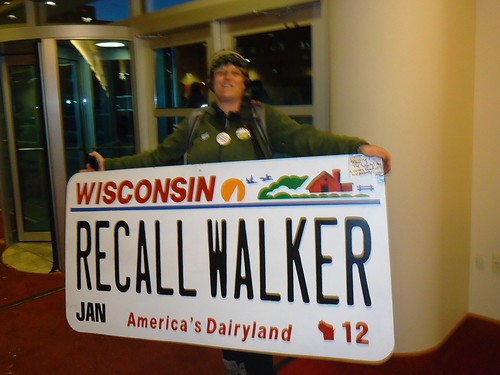
As the Middle East continues to be rocked by protests, in America the Middle West is experiencing its own protest movement spreading like prairie fire. It started in Wisconsin last week, where the newly-elected Republican governor is trying to pass a union-busting bill that would strip collective bargaining rights from public employees. Union public employees - teachers, prison guards, firefighters - took over the Wisconsin state capital building in Madison and haven't left the area since. And the 14 Democratic senators in the state's senate have left the state so that a quorum can't be reached to vote on the bill.

Since then the protests have spread to other states where Republican governors are trying to push through anti-union bills. Democratic lawmakers in Indiana fled their state yesterday to prevent a vote on a similar bill. Also yesterday thousands of protesters converged on the statehouse in Ohio to protest an anti-union bill there. And in Michigan protests broke out in the state capital of Lansing against that state's union-busting bill.

This isn't all part of a coordinated nation-wide union movement. Rather, it is captal-by-capital rection to a coordinated effort by Republican governors and state representatives to introduce bills which they say are needed to balance the state budgets. But these bills also contain, in the fine print, provisions to strip union organising rights from state public employees. They say the state governments, which are largely broke due to the economic crisis, can no longer afford to pay out the benefits the labor unions have spent decades negotiating for. And in large part, they're right. But in addition to proposing to cut salaries and benefits for public employees, the Republican governors and legislators are also pursuing a secondary tactic: strip the unions of their right to collectively bargain, or their ability to even exist at all. And that is what has attracted the protests.

Monday, 9 February 2009

The Swiss Say Yes to Europe

Brussels was breathing a sigh of relief today as the news of yesterday's Swiss referendum result reached people's desks. There had been some apprehension about the vote, which extends free-movement rules to new EU entrants Bulgaria and Romania, as opinion polls taken before the vote seemed to suggest that it would have a razor-thin margin. In the end, a massive 60 percent of voters said 'JA.' Only four of Switzerland's 26 cantons voted no.

The vote is being called a "broad yes" by the Swiss to economic collaboration with Europe, and a mandate for pro-European parties in the Swiss government to increase ties. The news is already being taken as a sign that the financial crisis may lead to a more receptive attitude toward the EU and coordinated pan-European policies. With the Irish revote on the Lisbon Treaty just around the corner, many in Brussels are hoping this is a trend that will continue. But is the vote's outcome the result of changing EU attitudes in the face of the financial crisis, or was it simply the result of a skillful vote mobilisation effort on the ground by pro-EU groups?

Switzerland has a rather unusual arrangement with the EU. While it's not a member, it has a series of seven 'special accords' with the block that make it effectively a shadow member. It isn't an official member, so it doesn't have any representation in the European Parliament or Commission, but the accords oblige Switzerland to follow many areas of EU legislation. Free movement, which allows any EU citizen to work in any EU country, is one of those areas. However, now that EU membership hassuch a change must be put to a public vote (they basically have to have a public vote for everything in Switzerland). But here's where it gets tricky. The EU has made clear that Switzerland doesn't have the right to 'pick and choose' which parts of EU law it will follow, and under the infamous "guillotine clause," if the Swiss voted no to extending free movement to Bulgaria and Romania, all of their agreements with the EU would be torn up. Considering that the vast majority of Switzerland's trade is with the EU, and that non-Swiss EU citizens make up a huge percentage of its skilled workforce, a collapse in the accords would be catastrophic for the country's economy. So one has to ask, is this really a vote for increased EU ties, or a desire to maintain the status quo? And if it's now economically impossible for the Swiss to vote against policies enacted in Brussels, isn't this really just an illusory independence anyway?


Switzerland's biggest political party, the rightist Swiss People's Party, had waged an aggressive ad campaign urging people to vote no, arguing that the two new EU entrants were too poor to be allowed unfettered access to Swiss jobs. (this photo is of one of their billboards that was on the street outside my parents' house). The issue was complicated by the fact that Switzerland has had a less than smooth history with immigration from the Balkans. During the 1990's the country took in many refugees from the former Yugoslavia as the Balkan wars raged on. Now the country has a sizable former Yugoslav population, particularly in Zurich, which hasn't integrated with the wider Swiss society and who treated with much hostility from the native Swiss population (complete with a nasty epithet that I won't repeat here). Many, particularly in German-speaking Switzerland, aren't crazy about the idea of taking in more immigrants from Serbia's neighbors in the Balkans.

A Sign of the Times?

So does the wide victory in Switzerland mean that people's fears about the financial crisis are going to make them less likely to snub the EU, for fear of the economic consequences? I've speculated that the economic turmoil in Ireland will likely make the Irish too scared to vote against the Lisbon Treaty again when the revote occurs later this year. It seems likely that the hold-up in approval by the Czech Parliament may also be resolved quickly now that the future looks so uncertain. On the other hand, many commentators have speculated that the recession could lead to an increase in populism and protectionism, which could put the European single market in jeopardy. The recent walk-outs in the UK and the one-day strike in France have certainly been a worrying sign in that direction.

For now though, Brussels has reason to be encouraged by the Swiss result.

Tuesday, 3 February 2009

May you live in interesting times

I've spent the past few days getting settled here in Brussels, and so far things have gone quite well. I've got a great apartment right in Centre Ville next to the Grand Place, and my intensive French class is fantastic. It's an advanced class and there's only seven of us, each from a different country.

Last night I had drinks with a French friend who lives here in Brussels, and we were talking about different things going on the EU these days. There wasn't a shortage of things to discuss. Toward the end of the conversation, we remarked on what a crazy time this is to be living in Brussels reporting on the EU. It feels like we're on the precipice of something, particularly in Europe. Things are about to change, we speculated, and they could possibly go in extreme directions. It looks like we've all been victims of that old purported Chinese curse, "may you live in interesting times." But to continue with the 'mangled cliches claiming to be proverbs theme', the Chinese character for crisis also means opportunity! Could the economic crisis lead to a strengthening of pan-European institutions, or could it just as easily lead to the disintegration of the entire EU project?

Thursday, 22 May 2008

The migration mess

The EU currently finds itself in a conundrum. It is now a unified labour block where EU citizens can work in any member country. The benefits to this system are many, but at the same time Brussels has had to move quickly to harmonize labour rules across the bloc to make sure this unified working block has the same working rules. That has included establishing a minimum amount of days off a year (24), laying out basic human rights for workers, and most recently a proposal to introduce an EU ‘blue card’ that would mirror the US green card and allow an immigrant to work anywhere in the EU.

But the union still has a long way to go, and labour laws still vary widely from state to state. One of the trickier issues around labour has been how each state handles illegal migrant workers. Harmonization of the rules has become urgent not just because of the slow coalescence of labour law but also because of the rapidly expanding Schengen Zone, the zone of European countries that have dismantled their internal borders. Now that someone can travel from Estonia to Lisbon without going through a border check, border security, immigration and work status have become very important issues, particularly for those nations which now find themselves at the periphery of the EU, suddenly tasked with patrolling the borders of all of continental Europe. Malta has had the hardest time, constantly faced with waves of immigrants from Africa coming by boat hoping to reach the EU offshore island in the Mediterranean.

Thursday, 1 May 2008

Labour movements cry 'mayday!'

May 1 is a traditional workers' day holiday across most of Europe, with most of the countries on the continent having the day off (the UK and Ireland save the day off for the following Monday). It coincides with a traditional pagan holiday welcoming spring, and such festivities are a big part of the celebrations. But it is also a traditional day for labour protests, although the intensity of those has tapered off over the years.

Berlin, for example, used to see massive street protests. But over the past five years they've dwindled to almost nothing. In fact May Day in Europe is quickly coming to resemble the watered-down version that is celebrated in September in the United States, Labour Day. The American version was put at that time as a compromise with unions because the government thought the traditional May 1 was too radical). Like in the United States, where few people could tell you what Labor Day celebrates, May 1 in the Europe has now also begun to lose its meaning in Europe.

Tuesday, 11 December 2007

'Permalancers' walk out in US

There was an interesting article in the New York Times today about the "permalancing" concept so popular in the US which I wrote about in my blog entry last week about the new EU protections for temp workers. "Permalancers" are people who work regular full-time hours, but are classified as "freelancers" by their company so they don't have to give them benefits.

Yesterday a large number of freelancers at MTV networks walked off the job to protest the company's cuts to healthcare benefits for the 'permalancers.' The permalancers already have an extreemly low level of healthcare coverage and the new cuts whittle them down to almost nothing.

I have a number of friends who work for MTV as 'freelancers,' one friend has worked there full time under thsi status for 4 years. But they're all tucked away with visions of sugar plums dancing in their head right now so I can't ask if they took part in the walkout. But what's really interesting about this is that it seems to be the first instance of people working udner this status undertaking collective action.

Incidentally, no MTV office in Europe has anything even resembling the "permalancers" system, I'm told.

Tuesday, 4 December 2007

Europe’s temps set for full benefits

It looks like the UK is going to lose the battle in Brussels over a new law that would give temporary workers the same rights as full-time staff.

A government source told The Times today that the issue is being linked in with the working-time directive restricting employees’ hours, and that given the fact that only four EU countries oppose the measure as a whole, Britain will be forced to accept the change under qualified-majority voting rules at a council of ministers meeting tomorrow.

Business interests in the UK have been vocally against the measure, saying that the law could force companies to get rid of as many as 250,000 jobs if they were forced to give full benefits to their temporary employees. However British unions have been busily debunking this argument and have been pressuring the government to drop its opposition to the changes.

Thursday, 25 October 2007

Forget green, go blue!

The EU unveiled its plans for the union-wide “blue card” yesterday. It’s meant to be modeled on, as well as a competitor to, the US green card. Though the card appears to be a logical solution to the problem of hiring skilled labor, it appears to do little to solve the growing problem of illegal immigration in Europe.

The blue card will be like the American green card in that it will be based on a points system that takes into account job skills, language proficiency and the presence of family in the country already. For example someone with an MBA who speaks English and German would have a better chance of getting one of these cards than someone who doesn’t speak any European language and has no family in the EU.

The measure comes at a time when EU countries are facing a severe skills shortage, particularly in the areas of engineering, healthcare and IT. With the EU population aging rapidly, there is an urgent need to bring new immigrants onto the continent. But the way this has been done so far is considered by many to have been not only ineffective, but detrimental to the societies involved.