Showing posts with label Bulgaria. Show all posts

Tuesday, 22 March 2011

Europe leads on Libya, but divisions persist

We are only in day four of the Libya War, but it doesn't seem to have taken long for confusion to settle in over where we go next and who is in charge. As the aerial bombardment tapers off and the skies clear into a no-fly zone over the Libyan desert, questions are now being asked that are not only causing disunity within the European Union but also between Europe and the United States.

"In most of the foreign policy issues we've talked about for decades, the US has been the lead player," conservative New York Times columnist David Brooks noted on PBS Newshour a few days ago. "Here we're clearly not the lead player, it's the UK and France and we're following along on the caboose. Now we feel like the UK often feels, as the secondary player. So the question is how much is the president really supporting this and how much is he being dragged along?"

So far the Obama administration has seemed disinterested in the Libya situation, and this wasn't helped by the fact that at the time military action was launched the US president was on a trip to South America and had to give comments on the war's launch from a shared podium in Brazil. Over the past few days US politicians haven't even made an effort to try to convince the American public that this war is in America's strategic interest.

Wednesday, 13 January 2010

Fiesty exchange over Bulgarian nominee

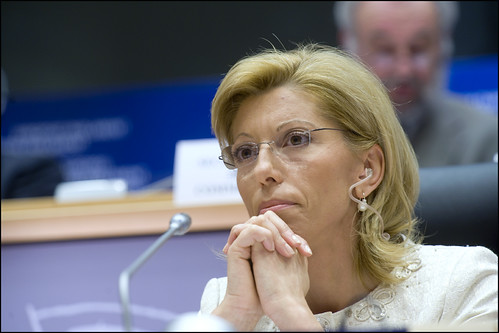
The European Parliament is holding confirmation hearings for the new EU commissioners this week, and by far the most dramatic one yet has been that of Bulgaria’s nominee Rumiana Jeleva, who is being accused of having ties to the Russian mafia. Yesterday’s chaotic hearing reflected the EU’s continuing problem of how to deal with Bulgaria’s corruption, which is so widespread in their political class one isn’t sure who to believe in the dispute over Jeleva’s past.

Accusations were flying back and forth in the hearing yesterday, with Jeleva being called a liar by a rival Bulgarian MEP and Jeleva in turn demanding that an MEP come to Bulgaria to see for himself that she has no ties to the mob. Then each opposing side began furiously handing out paperwork to prove their case, a violation of parliamentary rules. When authorities tried to confiscate the hand-outs, MEPs refused to hand them back. Soon there were calls for the whole hearing to break because of the discord. In the end, the panel could not confirm her and had to put off the confirmation until 24 January.

Tuesday, 28 July 2009

Borisov to the Rescue in Bulgaria?

It’s been interesting to watch the political developments in Bulgaria since I visited the country for my article on vote-buying in February. At the time, everyone was focused on the upcoming summer election and whether any result could rescue the country’s government from the deep morass of political corruption it had sunk into.

As predicted, the newly-created reformist party of the mayor of Sofia won the vote. However though the outcome on election day wasn’t a huge shock, the formation of the government since then has been noteworthy, and can be seen as a positive sign for those both at home and in Brussels who are desperate to see the Bulgarian government change its ways. The new prime minister, Boyko Borisov, officially took the reigns yesterday and introduced the minority government he has formed – remarkably – without entering into a coalition with the hard-right parties in the parliament.

Borisov, a bit of a political celebrity in Bulgaria, formed the new party in 2006 while he was mayor of the country’s capital, calling it “Citizens for European Development of Bulgaria” (known by the acronym GERB in Bulgarian). It’s no doubt a populist party but, as a Bulgarian friend puts it, perhaps “the good kind of populism”. Borisov came to the public with an anti-establishment message, lambasting the ruling Socialists (many of whom are aging former communists) as hopelessly corrupt and saying only he, with his new and independent political party, could tackle the corruption endemic in Bulgaria’s government.

But he’s also been critical of the nationalist parties of the right, refusing to form a clear coalition with the three right-wing parties in parliament– the Blue Coalition; Order, Lawfulness, Justice; and the ultra nationalist anti-Turkish party Ataka (whose billboards, pictured, were all over Sofia when I visited). By not making a coalition he will be forced to rule as a minority government – a fragile position that will likely fall before he can serve out his full term. In practice, he will still depend on the loose support of the three right-wing parties.

Borisov has a steep hill to climb in tackling the corruption issue. Last year the EU froze over €800 million of development aid to Bulgaria because of corruption, mostly out of concern that that money was going directly to regional and local authorities which are sometimes run as fiefdoms of organised crime. EU funds are almost always distributed locally, which presents a problem for a country like Bulgaria where the national government often has little control over regional authorities.

Overall Brussels seems happy with the election result, though Borisov’s ties to the right wing may be worrying. Still, the Bulgarian socialist party has proven itself an unreliable partner for Brussels in the past, and the EU probably feels that for the moment, any change is a good one.

Monday, 2 March 2009

Brussels in Bulgaria

Much ink has been spilled over the accession of Romania and Bulgaria to the EU in 2007, and there are still many questions floating around over the decision. Should they have been admitted, or has the EU bit off more than it can chew in taking on two such poor countries? How can the EU effectively deal with the high level of corruption in the Bulgarian and Romanian governments? And when should the new EU entrants be given the full rights and privileges enjoyed by other EU citizens?

After spending last week in Bulgaria I am perhaps not qualified to offer a solid answer to these questions, but I have come to understand the country much more. For one thing, all this talk about 'Romania and Bulgaria,' as if they were one geopolitical block, seems strange to Bulgarians. When interviewing politicians and NGOs, I would often ask them if the factors they were mentioning in Bulgarian society were present in Romania. They would always respond that they had no idea, and even seemed a bit confused by the question. Though the countries tend to be talked about together now because they entered the EU at the same time with the same set of restrictions, in terms of culture, language and government they're quite different. In fact the photographer in our group was from Romania, and she said she doesn't necessarily feel any kind of strong connection to the country.

The event on Saturday went quite well. In addition to being an EU Debate on the Ground, it was also the official launch of CafeBabel Sofia. The event was hosted by a well-known local radio personality and was in Bulgarian, but the non-Bulgarian journalists had a great simultaneous translator. We had three MEPs there and the Bulgarian Minister for European Affairs, Gergana Grancharova (pictured above left). Essentially it was a debate between EU government officials and the public, designed to foster greater interaction between the European public and Brussels. Coming from Western Europe, it actually seemed to me that Bulgaria has a shockingly high level of interest in EU affairs. The attendees at the event were quite well-informed. Most of the major Bulgarian television networks showed up to film, and it made the nightly news. As I wrote last week, I learned on this trip that three times as many Bulgarians have faith in EU institutions as have faith in the Bulgarian government. This isn't surprising considering the level of dysfunction in the Bulgarian government, but as the MEPs mentioned at the event, the expectations of the Bulgarian public for the EU may need to be ratcheted down quite a bit. After all, the EU can't solve all of Bulgaria's problems, nor is that its intention.

Speaking with the French ambassador to Bulgaria on Friday, I learned this is an increasing concern for Western European nations. The high level of enthusiasm for EU integration in Bulgaria may be flattering for Brussels, but it will liekly lead to inevitable disappointment when the EU is unable to deliver, particularly as the economic crisis hits Bulgaria especially hard. The increasing trend of Bulgarian NGOs and business interests going directly to Brussels to get problems solved, bypassing the national government, is actually a worrying trend, he said. It is the dysfunction of the Bulgarian government that needs to be solved, and if it isn't, it will strengthen the increasingly popular far left and far right. The nationalist, anti-Turkish party Ataka (pictured left), is getting particularly popular, and it's thought that they will gain seats in the June national election as people cast a protest vote against the government.

Having only spent time in Sofia, I can't say I'm qualified to concretely answer any of the questions I posed in the first paragraph after my trip. I can say that while it was a bit rough around the edges, the level of development in Sofia didn't even resemble the post-apocalyptic picture often painted by the British media. As the poorest country in the EU, clearly Bulgaria has a long way to go before it enjoys the same standards of living as its Western counterparts. But at the same time Sofia looked like any other Eastern European capital. We felt perfectly safe walking around on the street at any time of day or night, and the modern conveniences were the same as most other capitals of the East. I'm told that Sofia is extremely different from the rural areas of Bulgaria, but of course that's true for any country.

So all in all it was a very interesting and fun few days, I'm glad I participated in the project. If you're interested in finding out if an EU Debate is coming to your city any time soon, check out the schedule.

Friday, 27 February 2009

Impressions of Sofia

I'm here in Sofia, taking a break at a coffee house in between interviews. So far the trip has been really interesting. My article on vote-buying is shaping up nicely. The political culture here is fascinating. There are something like 400 political parties, which has created a real mess of the government. It would seem they've gone from having too few parties (really only one, the Communist Party) to too many. This has led to widespread dissatisfaction with the political process, so much so that now three times as many Bulgarians say they have faith in EU institutions as say they have faith in their own national government. That's pretty much the reverse of Western European countries. In fact according to the people I've interviewed it's gotten to the point where Bulgarians now see the EU as the real leader of the country, and when NGOs or businesses want something done they bypass the Bulgarian government and go straight to Brussels. But more on that next week.

Sofia itself does remind me a bit of Prague, at least in terms of its eery quietness and the gloomy expressions on everyone's faces. It's interesting how much 50 years of Communism seemed to leave the same effect on such a huge and diverse swath of Europe. Before World War II, the Czechs had little in common with the Bulgarians in terms of their history, other than their shared Slavic ancestry, one being part of the Austrian Empire and the other the Ottoman Empire. Yet now you can observe so much similarity between their behavior and way of life. In my observation the same goes for Hungarians, Romanians, and Lithuanians; it's this sort of post-Warsaw Pact malaise. But you definitely notice it more with the older generation than the younger.

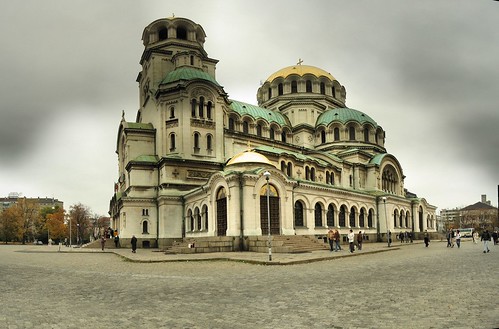
There aren't many tourist attractions in Sofia, really there's only one: The Alexander Nevsky Cathedral. And even that, when I went to visit, didn't have any non-religious visitors inside except me (in fact it was nearly empty). I spent a few hours walking around the city yesterday taking photos, and people seemed to be looking at me with bemusement, with my map and my camera in tow.

It's a shame really, because the city is actually thousands of years old. It was one of the first cities in the Roman Empire to adopt Christianity and was an early stronghold for the spreading religion. It was also an important centre for the Byzantine Empire. But the city centre was almost entirely destroyed during World War II, and over it was built a giant grid of characterless straight streets. There's actually nothing here that's much older than 150 years. And as it only became the capital of Bulgaria about a century ago, the government buildings have a rather rushed, characterless quality.

At the same time, the city is a lot of fun. The seven strangers have been having a great time, our Bulgarian hosts have been showing us some amazingly cool bars and restaurants. A bar we went to last night was down in a deep cellar, lit only by candles. Intense!

I'm actually the only Anglophone in the group, but naturally we've been speaking English as the common language between us all. A large portion of us speak French, but not everyone, so we're not using it. Take a note, France. It's a shame though because it takes away so much of the motivation for us Anglophones to learn foreign languages, when our native language allows us to communicate with most everyone we would need to. Still, I've had to remember to switch over to speaking Continental English instead of my normal way of speaking. Ironically, it's easier for everyone else in the group to understand each other speaking English than it is for them to understand me, since I have a tendency to speak too quickly. I need some Continental English lessons.

I'm about to head to the Parliament Building to interview an MP, she seems like she'll be an interesting character. I found some YouTube clips of her kicking up a fuss and yelling in the Parliament chamber. so she should be quite quotable! Then tomorrow we have our EU Debate on the Ground and the launch of CafeBabel Bulgaria. If you're in Sofia, come join us!

Wednesday, 25 February 2009

Six Strangers in Bulgaria

I'm flying to Sofia, Bulgaria later today to take part in a rather interesting project. CafeBabel, a web site I write for, is sending five journalists and one photographer to live in the city for about a week in order to participate in one of their ongoing EU Debate on the Ground forums. The forums have been taking place once a month in various cities throughout Europe, hosting debates about the EU with the local population as a run-up to the European Parliament elections in June. Several journalists are chosen from various corners of Europe and they assemble in the city, reporting on a specific issue and speaking at the forum. I'll be writing a feature on vote-buying in the country, as well as a second feature looking at how the global economic crisis is likely to effect Bulgaria.

We have quite a diverse group. There will be a Bulgarian from Sofia, a Spaniard living in Berlin, a Romanian living in Paris, an Italian from Turin, a Spaniard living in Paris, and an Italo-American living in Brussels (that's me). None of us know each other, but we'll be staying together in a large hostel room in the center of the city. We'll each be reporting on different issues, but I imagine we'll be swapping observations and ideas throughout the stay.

It should be interesting, it will actually be my first time back in Eastern Europe since I lived in Prague. One thing that's already throwing me is the country's use of the Cyrillic alphabet. It makes it very difficult to locate addresses on Google maps! I have appointments scheduled tomorrow and Friday with various government officials and NGOs, hopefully I've arranged them in some kind of logical order geographically. I learned from reporting in India that in a city with bad traffic, trying to zigzag across town going from interview to interview can quickly spell disaster.

The EU Debate on the Ground panel will take place this weekend. The purpose of the panel is to get a snapshot of the feelings on the ground about the EU, and to analyze those opinions in a way that can be meaningful for the upcoming parliament elections. I'll be particularly curious to hear the impressions of Bulgarians, who were promised much after their entry into the EU two years ago but have seen their economy teeter on the brink of collapse since then as a result of the global economic crisis. After many years of double digit growth in Eastern Europe, the sudden reversal of fortunes could lead Eastern Europeans to be more skeptical about what the EU can do for them. Additionally, Bulgarians were less than impressed with how the EU handled the recent gas crisis in January which left thousands of Bulgarians without heat for several days during a bitter cold snap.

All in all, it should be an enlightening trip.

Friday, 20 February 2009

La Crise Claims Her Second Victim

The Latvian government has become the second European administration to fall as a result of the global economic crisis, following the collapse of Iceland's government last month. Latvia's prime minister resigned today and the government folded as a result of the country's economic crisis, one of the worst in Europe.

Latvia is not in good shape, to say the least. With the country in severe recession, the economy is expected to contract by up to 12 percent in 2009, and unemployment is set to rise by 50 percent. GDP in the final quarter of 2008 fell by 10.5 percent compared to the previous year, and economists are predicting a further drop of 10 percent for this year.

The resignation follows last month's massive protests in Riga, the country's capital, which saw 40 people injured and 100 people arrested.

Latvia's situation is not isolated. The story throughout Eastern Europe is much the same. After years of boom following the east's entry into the EU, economies across the East have come to a crashing halt. Across Europe the countries that have experienced a boom in the past decade are now suffering the worst. The UK, for instance, is suffering severely while in France the effects have been less dramatic because the economy there had been performing poorly for some time before the crisis hit.

The plummeting fortunes of Eastern Europe have sparked fears that a "spring of discontent" is around the corner, a period that will see increasing violence in the young countries of the East and the collapse of several governments. Bulgaria, Romania and the Baltic states have all been hit particularly hard by the crisis. Sofia, Bulgaria has seen recent violence in which 150 people were arrested. I'll be travelling to Sofia next week to work on a story about vote buying and participate in a panel discussion organized by CafeBabel about the parliament elections. While I'm there, I'm also going to see what I can find out about the economic situation and whether the government is concerned about more dramatic protests in the near future. It will be an interesting time to be in the new EU state.

Monday, 9 February 2009

The Swiss Say Yes to Europe

Brussels was breathing a sigh of relief today as the news of yesterday's Swiss referendum result reached people's desks. There had been some apprehension about the vote, which extends free-movement rules to new EU entrants Bulgaria and Romania, as opinion polls taken before the vote seemed to suggest that it would have a razor-thin margin. In the end, a massive 60 percent of voters said 'JA.' Only four of Switzerland's 26 cantons voted no.

The vote is being called a "broad yes" by the Swiss to economic collaboration with Europe, and a mandate for pro-European parties in the Swiss government to increase ties. The news is already being taken as a sign that the financial crisis may lead to a more receptive attitude toward the EU and coordinated pan-European policies. With the Irish revote on the Lisbon Treaty just around the corner, many in Brussels are hoping this is a trend that will continue. But is the vote's outcome the result of changing EU attitudes in the face of the financial crisis, or was it simply the result of a skillful vote mobilisation effort on the ground by pro-EU groups?

Switzerland has a rather unusual arrangement with the EU. While it's not a member, it has a series of seven 'special accords' with the block that make it effectively a shadow member. It isn't an official member, so it doesn't have any representation in the European Parliament or Commission, but the accords oblige Switzerland to follow many areas of EU legislation. Free movement, which allows any EU citizen to work in any EU country, is one of those areas. However, now that EU membership hassuch a change must be put to a public vote (they basically have to have a public vote for everything in Switzerland). But here's where it gets tricky. The EU has made clear that Switzerland doesn't have the right to 'pick and choose' which parts of EU law it will follow, and under the infamous "guillotine clause," if the Swiss voted no to extending free movement to Bulgaria and Romania, all of their agreements with the EU would be torn up. Considering that the vast majority of Switzerland's trade is with the EU, and that non-Swiss EU citizens make up a huge percentage of its skilled workforce, a collapse in the accords would be catastrophic for the country's economy. So one has to ask, is this really a vote for increased EU ties, or a desire to maintain the status quo? And if it's now economically impossible for the Swiss to vote against policies enacted in Brussels, isn't this really just an illusory independence anyway?


Switzerland's biggest political party, the rightist Swiss People's Party, had waged an aggressive ad campaign urging people to vote no, arguing that the two new EU entrants were too poor to be allowed unfettered access to Swiss jobs. (this photo is of one of their billboards that was on the street outside my parents' house). The issue was complicated by the fact that Switzerland has had a less than smooth history with immigration from the Balkans. During the 1990's the country took in many refugees from the former Yugoslavia as the Balkan wars raged on. Now the country has a sizable former Yugoslav population, particularly in Zurich, which hasn't integrated with the wider Swiss society and who treated with much hostility from the native Swiss population (complete with a nasty epithet that I won't repeat here). Many, particularly in German-speaking Switzerland, aren't crazy about the idea of taking in more immigrants from Serbia's neighbors in the Balkans.

A Sign of the Times?

So does the wide victory in Switzerland mean that people's fears about the financial crisis are going to make them less likely to snub the EU, for fear of the economic consequences? I've speculated that the economic turmoil in Ireland will likely make the Irish too scared to vote against the Lisbon Treaty again when the revote occurs later this year. It seems likely that the hold-up in approval by the Czech Parliament may also be resolved quickly now that the future looks so uncertain. On the other hand, many commentators have speculated that the recession could lead to an increase in populism and protectionism, which could put the European single market in jeopardy. The recent walk-outs in the UK and the one-day strike in France have certainly been a worrying sign in that direction.

For now though, Brussels has reason to be encouraged by the Swiss result.

Wednesday, 21 January 2009

Rioting in Iceland

When there's rioting in Iceland, you know we're in trouble. The small Scandinavian country in the middle of the Atlantic isn't usually associated with domestic strife, but rather high quality of life and abundant natural resources. But yesterday thousands of people took to the streets to protest the government's handling of the economy, which has plunged in recent months as a result of the larger global turmoil. Gross national product is down two-thirds, there has been a 45 percent rise in unemployment and the country is defaulting on loan repayments. In October the country's financial system collapsed and its currency plunged under the weight of billions of dollars in foreign debt taken on by its banks.


These weren't just mild demonstrations. Riot police had to fight with a large number of violent protesters outside the country's parliament. Pepper spray was fired at the protesters and 30 arrests were made.

Coming on the heels of the riots in Greece last month, many in Europe are becoming increasingly worried that the economic turmoil could lead to violent clashes between disaffected people and their governments across the continent. Eastern Europe is seen as particularly vulnerable to such violence, with some even predicting a "spring of discontent" in the region to be around the corner.

Eastern Europe has been hit hard by the financial crisis, especially Bulgaria, Romania and the Baltic states - all recent EU entrants. As the Guardian recently reported, incidents have been steadily increasing. Last week police in Vilnius, Lithuania had to tear-gas a crowd of demonstrators protesting tax rises and benefit cuts designed to save the state from bankruptcy. Sofia, Bulgaria has also seen recent widespread violence in which 150 people were arrested. Riga, Latvia has seen street battles as well.

These Eastern European economies are increasingly experiencing unexpected turmoil after years of posting double-digit growth. Their anger will likely be compounded by the fact that they were expecting that growth to continue, particularly after they joined the EU. The post-cold war governments are still new and relatively weak, and could be unprepared to deal with widespread unrest. And the increasing hostility isn't just being directed at the governments. Attacks on minorities are also becoming increasingly common, particularly against Roma (gypsy) communities. Recently 700 members of the far-right Workers' Party in the Czech Republic fought with police when they were prevented from marching on a Roma area.

Of course Iceland is just about as far as you can get from Eastern Europe without leaving the continent. If the global economic turmoil can cause rioting in a country with one of the highest quality of life ratings in the world, could rioting be far behind in the major Western economies? And even if it isn't, how will the major economies of Western Europe respond to growing political unrest to their east, in countries with which they are now united? Clearly the EU has an obligation to help Eastern Europe through the financial turmoil, but if the situation becomes fundamentally dangerous, can the EU do anything to stem the violence without a proper policing military force?

The "spring of discontent" will be an anxious time for Europe.

Wednesday, 7 January 2009

Energy Wars

It's been freezing the past week here in Zurich, a situation I'm sharing with the rest of Europe as a brutal cold snap extends from London to Warsaw. And just as the chill is forcing us all to huddle around our heaters, a crisis is unfolding that could cut off the energy keeping us warm.

Since New Years Day, Russia has been steadily restricting its gas supply to Europe amid a dispute with Ukraine, which it accuses of siphoning off gas in transit. Now seven days later, exports of Russian gas to Europe via Ukraine appear to have completely stopped. With the EU dependant on Russia for about a quarter of its total gas supplies, 80 percent of which is pumped through Ukraine, the situation is quickly becoming a crisis. It is a crisis many have predicted as they have warned of Europe's over-dependence on Russian energy.

Now the Balkans are facing a situation where they could in a matter of days face rolling blackouts. Bulgaria says it has sufficient supplies for just a few more days, and already thousands of Bulgarian homes are without heat as temperatures in some parts of the country hit -16 degrees celcius. Other countries have now dipped into their strategic reserves. Germany and Italy, which together account for nearly 50 percent of the gas consumed in the EU, are also in danger. So far the Ukraine disruption has only been felt in the Balkans and in Greece, but this could change as soon as tomorrow.

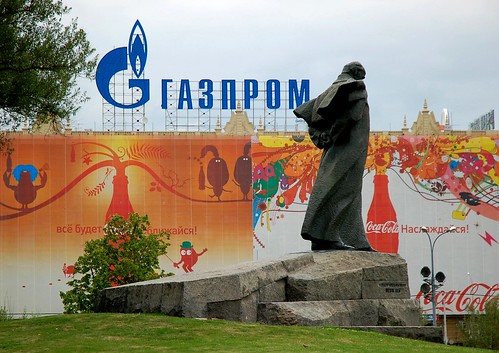
Russia's state-owned energy company Gazprom has accused Ukraine of stealing 15 percent of gas flowing through that country intended for Western Europe, however the Ukrainian government has insisted that amount is being lost through technical malfunctions only.

A Preview of Things to Come

Even if this energy crisis is resolved, it will still likely be an important lesson for the EU. Analysts have been warning that energy independence for the block is the most pressing issue it currently faces. With Russia proving to be an increasingly assertive and sometime hostile neighbor, the fact that the country could, if it wanted, plunge Europe into a deep freeze is very worrying. Even these minor disputes over one pipeline can cause huge disruptions.

Now that Serbia’s government has agreed to sell its oil and gas company, NIS, to Russia’s Gazprom, it looks like Russia will achieve its goal of building a pipeline called "South Stream" to send gas directly into the EU. Gazprom has also done similar deals with EU members Italy, Hungary and Bulgaria, all of which is a direct challenge to the European pipeline project Nabucco, which would bring gas to Europe from Iran and Azerbaijan via Turkey, reducing EU dependence on Russia. But the Nabucco project seems to be going nowhere while Russia's plans to build dedicated pipeways to the EU moves quickly ahead.

Russia insists that the Ukraine siphoning off energy is the real threat to EU gas supplies, but foreign policy analysts know better. It is precisely the fact that the EU is reliant on Russia for energy, no matter how or through whom it is supplied, that is worrying to many here.

Sunday, 4 January 2009

No Passport in Liechtenstein

I'm back in Switzerland after my holidays in New York, and yesterday I decided to take a drive over to the border with Liechtenstein to see if they had set anything up as a result of the Schengen discrepency. As I expected, there is no new passport check along the section of the Rhine seperating the tiny principality from Switzerland, but interestingly, I didn't see any sign of the reported surveilance systems that they've now set up either.

Switzerland joined the Schengen zone, which allows passport-free travel between European countries, last month. However Liechtenstein has not yet joined, because the EU is trying to strong-arm it into cracking down on tax cheats before it will allow the principality in. Liechtenstein, which has had an open border with Switzerland since 1923, is now wedged between two Schengen countries and in theory, Switzerland must now set up border checks with Liechtenstein for the first time. This could be a big headache because for all intents and purposes Liechtenstein is pretty much part of Switzerland. It uses the Swiss franc, relies on Switzerland's military for defense, and many people live in one country and work in the other. Aside from a few small signs at the border, there is little differentiating the principality from its neighbor.

The border guard corps in Eastern Switzerland has said it is setting up a series of surveilance cameras along the bridges in order to comply with Schengen rules, and in theory if any cars look suspicious they have border guards ready to investigate. However I didn't see any sign of such cameras when I was there, and considering I was walking around taking pictures you'd think if anyone was watching they might have come to ask me what I was doing! Perhaps they haven't set them up yet. Interestingly, I've heard that this surveilance system is going to cost several million francs, just to be dismantled once Liechtenstein does eventually join. Liechtenstein has even had to issue Schengen visas free of charge to foreign nationals living there, who would now in theory be legally trapped within the 160 square kilometre country. I guess Brussels has proven that it can make life difficult for the tax havens when it wants to.

I had never been to Liechtenstein before, it's a pretty weird place. It is true that from the prince's palace you can see almost the entire inhabited area of the country. It's really just a small strip of land on one side of the Rhine in a valley. It was a Saturday afternoon and Vaduz, the capital, was completely deserted. It was just me and some Eastern Europeans who seemed to also be there for the novelty factor, taking pictures of every Liechtenstein flag in sight.

On the way back I came across a reminder of another ongoing issue with Switzerland's entry into the Schengen Zone. Switzerland's bilateral agreements with the EU requires that all EU nationals be allowed free movement in and out of the country, but Switzerland is going to vote on whether the two newest entrants, Romania and Bulgaria, will be afforded the same access. That vote will be February 8th, and in St. Gallen I came across this billboard from the FDP urging people to vote yes to giving Romanians and Bulgarians the same rights as other EU citizens. The billboard points out that a no vote, being advocated by the conservative SVP party, would send a hostile signal to Switzerland's neighbors and lead to further isolationism. It shows two people with SVP signs destroying a rail bridge to the rest of Europe. It reminds of the Swiss of the infamous "guillotine clause," which says that if Switzerland renegs on any treaty its already signed with the EU, all of the bilateral treaties will be rendered invalid, effectively completely cutting off the country from its neighbors.

Tonight I noticed that the SVP has put up a contrary billboard right outside my dad's house urging people to vote no (photo below), with their usual motif of dark nefarious foreigners greedily eyeing Switzerland's riches.

Honestly the idea that people would be making decisions on these important issues based on some childish cartoons seems pretty absurd to me, but it's typical of this country's obsession with referendi. Neither of these cartoons clearly conveys what's really at stake with this vote. The SVP ad seems to be suggesting that this is some kind of additional right that the Swiss people can choose to give to their neighbors to the east, when in reality a no vote would be reneging on a treaty that Switzerland has already signed. The EU has made very clear that Switzerland cannot pick and choose which parts its bilateral agreements it's going to obey as if it was some sort of dipomatic buffet. On Saturday Switzerland's EU ambassador Michael Reiterer told the newspaper Tribune de Geneve that if the Swiss refuse to extend the free movement clause to the new entrants it will invalidate the country's entry into the Schengen Zone and the whole agreement will be torn up.

I'll be watching with interest to see what happens in that referendum. After stopping in Leichtenstein I drove over the border with Austria and as expected I found the border check dismantled. If the Swiss vote no in February 8th, those checkpoints may have to be hastily reassembled. And contrary to Reiterer's optimism, I'm not so certain the referendum will pass. A few years ago the referendum to join Schengen did not pass by a large margin, and the recent success of the SVP may reflect the fact that public attitudes on immigration may have continued to harden since then. In the mean time I'll be interested to hear from people here whether they understand what reprocutions a no vote could have.