Nigel Farage's state of the union response suggests UKIP will make climate change denial a centrepiece of their European election campaign.
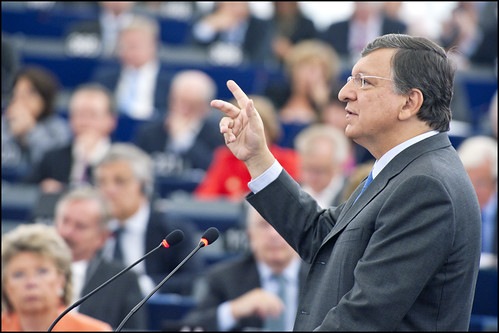
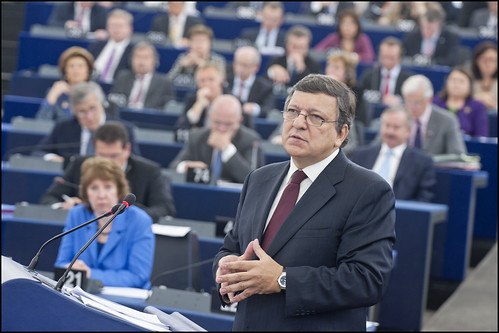
I was a bit taken aback on Wednesday when, during his response to President Barroso's State of the European Union speech in Strasbourg, UKIP leader Nigel Farage devoted almost the entirety of his speech not to warnings about the creeping European super-state, but to an impassioned denial of climate change.
The subject is nothing new for UKIP. The official party line is that there is no proof that climate change is man-made, and this is often brought up by UKIP MEPs. The party has been particularly vocal about renewable energy, blasting “ugly” wind turbines blotting the English countryside and biofuel subsidies it says are responsible for fuel poverty in the UK. This was made clear by UKIP MEPs during Monday's debate on biofuel legislation, which strangely put UKIP on the same side as the Greens.
But it was surprising to see Farage devote so much time to the issue during a big-picture debate on the EU that had nothing to do with climate change. The EU had fallen victim to a “green obsession”, he said. The resulting legislation had driven manufacturing away from the UK and forced people into fuel poverty.
Showing posts with label Jose Mannuel Barroso. Show all posts
Thursday, 12 September 2013
Friday, 1 March 2013
A week of turmoil for Europe
Yesterday was a big news day for EU politics, with a series
of high-profile speeches in reaction to the disastrous election result in Italy on
Monday. But despite the many speeches, the message has been singular: there is
“no alternative” to austerity, and hostility toward the EU in domestic politics is exascerbating the euro crisis.
The day started with a speech by humiliated ‘technocrat’
prime minister Mario Monti at the European Commission. Having been rejected by
his home country, it is perhaps unsurprising that the former European Commissioner wanted
to come to Brussels,
where people understand him. It was Brussels
after all, at the behest of Berlin,
who installed Monti on the Italian throne after forcing out Silvio Berlusconi
at the height of the Italian crisis in 2011.
And it is no coincidence that it was the ‘Italians abroad inEurope’ voting region in which Monti received
his highest share of the vote – 30%. This compares to the 9% of the vote he
received at home – less than half the vote chare received by anti-establishment
comedian Beppe Grillo.
Location:
Brussels, Belgium
Wednesday, 12 September 2012
The peril and promise of a new treaty
European Commission president Jose Manuel Barroso dared to use the ‘F word’ in his state of the union address here in Strasbourg today – federalism.
“Let’s not be afraid of the word, we will need to move towards a federation of nation states,” he told the European Parliament. “Today, I call for a federation of nation states. Not a superstate.” This federation, he continued, will ultimately require a new treaty, as German Chancellor Angela Merkel had suggested last week. EU leaders, still traumatized by the painful experience of ratifying the Lisbon Treaty in the last decade, have been desperate to avoid this.
“Before the next European Parliament elections in 2014, the Commission will present its outline for the shape of the future European Union. And we will put forward explicit ideas for treaty change in time for a debate.”
Barroso has been hesitant to use the word federal in the past when describing the future direction of the European Union, aware of the images of a power-grab it can conjure up in member states. But in his state of the union addresses, a yearly tradition itself created by the Lisbon Treaty, Barroso has been keen to make the European Parliament happy. He clearly thought that by finally using the F-word, he could do it.
“Let’s not be afraid of the word, we will need to move towards a federation of nation states,” he told the European Parliament. “Today, I call for a federation of nation states. Not a superstate.” This federation, he continued, will ultimately require a new treaty, as German Chancellor Angela Merkel had suggested last week. EU leaders, still traumatized by the painful experience of ratifying the Lisbon Treaty in the last decade, have been desperate to avoid this.
“Before the next European Parliament elections in 2014, the Commission will present its outline for the shape of the future European Union. And we will put forward explicit ideas for treaty change in time for a debate.”
Barroso has been hesitant to use the word federal in the past when describing the future direction of the European Union, aware of the images of a power-grab it can conjure up in member states. But in his state of the union addresses, a yearly tradition itself created by the Lisbon Treaty, Barroso has been keen to make the European Parliament happy. He clearly thought that by finally using the F-word, he could do it.
Location:
Strasbourg, France
Wednesday, 9 May 2012
Angela vs. the growth
Coming as it did on the same day that anti-austerity parties in Greece took a majority of the vote, Sunday has been interpreted as a Europe-wide rejection of German Chancellor Angela Merkel and her insistence on austerity and budget cuts. The markets have certainly interpreted it as such. Stock exchanges across the world have taken a dive the last three days, particularly in Europe, over fears that the delicately crafted ‘fiscal union pact’ worked out over the past several months is now about to fall apart.
Whether that actually comes to pass may depend less on Hollande than on how his victory is interpreted in other European capitals. All eyes will be on the new French president’s first meeting with Merkel next week, a day after he is sworn in on 15 May. It is in both of their interests that the meeting goes well. Hollande needs to walk away with something to say that he “renegotiated” the fiscal compact, while Angela needs to reassure the German people that Eurozone countries will still have to adhere to strict budgetary rule while at the same time reassuring the markets that there will be no Franco-German rift.
What will likely be worked out is the addition of a paragraph about stimulating the economy into the compact – something that wouldn’t require new ratifications by national parliaments.
Location:
Paris, France
Friday, 21 October 2011
Indignant occupiers and the EU’s ‘sink or swim’ moment
I was in Italy on Saturday when Rome saw the worst of the violence outside Greece, and the news coverage was clearly unnerved in tone. Everyone is now wondering – where is this all going?
The protests on both sides of the Atlantic are expressing the same frustration: people feel powerless and confused by a North Atlantic economic crisis where solutions seem to be dictated by the all-powerful 'markets'. It's reminiscient of how the Pope in Rome excersised ultimate authority over kings and queens in midieval Europe. Now European and American leaders follow the dictates of 'the markets'. In 2008 following the Lehman Brothers collapse, the US congress was told that it must immediately pass a rescue package for the banks or 'the markets' would panic, causing economic catastrophe. Now European leaders are being told that they must immediately inject an enormous amount of cash into the struggling Southern European economies to prevent 'the markets' from panicing.
Thursday, 29 September 2011
What would the world look like without the EU?
They used to say that when America sneezes, Europe catches a cold. That’s certainly what they (and I) were saying during the 2008 economic crisis, when misadventures on Wall Street and the subsequent collapse of Lehman Brothers created a disaster that quickly spread to Europe. How the tables have turned. Now the US is waiting helplessly to see if Europe can avoid a disaster that would eclipse Lehman Brothers in scale and could throw the US back into recession.
It’s a testament to just how important Europe has become to the global economy that it is now Europe’s sneeze that can give the world a cold. The EU is now a larger market than the United States, and over the past twenty years it has literally become the world’s regulator. Is it conceivable that this entire project could now collapse?
This is the question that is now being asked in the United States. When I was home last weekend I was asked by friends, “Is the EU going to fall apart?” Trying to show a bit of false confidence, I assured them that it is not. Germany is in the end going to suck it up and do what needs to be done to save the euro, I insisted, because the alternative is complete economic meltdown. The vote for the increased bailout fund today in the German parliament seems to go some way in justifying that optimism. The truth is that Europe’s problems are not insurmountable.
It’s a testament to just how important Europe has become to the global economy that it is now Europe’s sneeze that can give the world a cold. The EU is now a larger market than the United States, and over the past twenty years it has literally become the world’s regulator. Is it conceivable that this entire project could now collapse?
This is the question that is now being asked in the United States. When I was home last weekend I was asked by friends, “Is the EU going to fall apart?” Trying to show a bit of false confidence, I assured them that it is not. Germany is in the end going to suck it up and do what needs to be done to save the euro, I insisted, because the alternative is complete economic meltdown. The vote for the increased bailout fund today in the German parliament seems to go some way in justifying that optimism. The truth is that Europe’s problems are not insurmountable.
Location:
Brussels, Belgium
Wednesday, 28 September 2011
EU banker tax? UK says no
With these words European Commission President Jose Manuel Barroso put forward what is bound to be an enormously controversial piece of EU legislation, a transaction tax on bankers and investors who invest in stocks, bonds and derivatives. Speaking to the European Parliament in Strasbourg today for his annual 'state of the union' address, Barroso said the tax would bring in €55 billion per year, starting from 2014.
The language used by the president was clearly populist in nature, emphasising a sense of fairness and responding to a public feeling that the bankers who caused the economic crisis of 2008 have never been called to account and have not been asked to contribute to the recovery from the pain they caused. Stock markets and investment firms have made remarkable recoveries over the past few years, and executive pay has steadily risen. But at the same time the economy as a whole has suffered enormously and continues to suffer.
Thursday, 15 September 2011
Will Europe federate, or separate?
People here in Brussels have cautiously started to use the F word again. Though it has long been banned from people's vocabulary after the traumatic experience of trying to ratify the EU constitution and Lisbon Treaty, ‘federalism’ is again being heard in the corridors of power. The federalist idea – to create a "United States of Europe" – back.
European Commission President Jose Manuel Barroso signalled as much in an impassioned speech to the European Parliament this week in Strasbourg. "What we need now is a new, unifying impulse – a new federalist moment," he told MEPs. "Let’s not be afraid of the word – a federalist moment is indispensable.” Federalist parliamentarians rejoiced. The people may have rejected the idea of a European superstate, but now the markets are stepping in and demanding one. Could it be that the fulfilment of the 'European dream' could be triggered not by Europeans themselves, but by the markets they've created?
The federalist rejoicing may be premature. All that is clear right now is that the EU cannot continue operating the way it has. Europe is at a crossroads, and it is being pulled in two different directions. On one hand, the public has grown weary of the European project and the mood of the day is calling for more local control. There is an increasingly vocal minority in Europe who want to see the EU project walked back or for the institutions Brussels has built up to be dismantled. On the other hand, the economic circumstances and the euro crisis are pushing Europe toward greater federalisation in order to avert a catastrophe. The markets are calling for more integration, and European leaders agree with them.
Friday, 4 March 2011
While the right leads in Helsinki, the left is sidelined in Athens
Europe's two main political groupings – the center-right European People's Party (EPP) and the center-left Party of European Socialists (PES) – are today holding dueling summits in Helsinki and Athens, respectively. The simultaneous timing of the two-day events, a bit like the party conferences in the UK or US – is highly unusual. But they are coinciding because they are both meant to get each side singing from the same hymn sheet at next Friday's incredibly important European Council summit. And given Europe's current political reality, the choice of a Northern capital for the right's meeting and a Southern capital for the left's meeting seems entirely appropriate.
But despite the fact that these are nominally meetings of Europe's two main political groups, the reality is that the Helsinki summit will effectively be a meeting of those running Europe while Athens will be an ignored meeting of those sitting on the sidelines. Because the European left has been pushed to Europe's geographic fringes and marginalized by the debt crisis, the Athens meeting will be a meeting of politicians "in opposition". In Helsinki, German chancellor Angela Merkel will lead a meeting of representatives of the governments of 17 of the 27 EU member states. At the Socialist conference in Athens only five governments will be represented.
In addition to national leaders like Merkel, Berlusconi and Ireland's incoming prime minister Enda Kenny, European Commission President Jose Manuel Barroso and European Council President Herman Van Rompuy– both from the EPP – are also in Helsinki. The president of the European Parliament, EPP politician Jerzy Buzek, may come tomorrow. They will be discussing the Eurozone Competitiveness Pact drawn up by Merkel and Sarkozy as well as the debt relief fund. They will also discuss a united European response to the events in North Africa. In effect it will be a sort of mini European Council summit.
What will they talk about in Athens? Who knows. Who cares? Whatever is on the agenda, it will have little consequence for the direction of EU policy.
But despite the fact that these are nominally meetings of Europe's two main political groups, the reality is that the Helsinki summit will effectively be a meeting of those running Europe while Athens will be an ignored meeting of those sitting on the sidelines. Because the European left has been pushed to Europe's geographic fringes and marginalized by the debt crisis, the Athens meeting will be a meeting of politicians "in opposition". In Helsinki, German chancellor Angela Merkel will lead a meeting of representatives of the governments of 17 of the 27 EU member states. At the Socialist conference in Athens only five governments will be represented.
In addition to national leaders like Merkel, Berlusconi and Ireland's incoming prime minister Enda Kenny, European Commission President Jose Manuel Barroso and European Council President Herman Van Rompuy– both from the EPP – are also in Helsinki. The president of the European Parliament, EPP politician Jerzy Buzek, may come tomorrow. They will be discussing the Eurozone Competitiveness Pact drawn up by Merkel and Sarkozy as well as the debt relief fund. They will also discuss a united European response to the events in North Africa. In effect it will be a sort of mini European Council summit.
What will they talk about in Athens? Who knows. Who cares? Whatever is on the agenda, it will have little consequence for the direction of EU policy.
Thursday, 3 February 2011
Brussels gets a press club
Are press clubs - those storied oak-paneled dens where an elite cadre of journalists meet to smoke cigars and swap gossip - a relic of the past? I found myself wondering this last night at the launch party for the new 'Brussels Press Club' here in the EU Quarter.
For years, long-time Brussels journalists have bemoaned the fact that Brussels has no press club for the many international journalists based here. Though other world capitals like Washington, London or Paris have famous press clubs that have been around for over 100 years, Brussels had nothing. But now the International Press Association (API) has been able to get the backing of the Brussels regional government to establish a club, located just next to the European Council and European Commission headquarters.
Thursday, 9 December 2010
OK, now it's the first Citizens Initiative - or not?
Back in October I wrote about how the first "European Citizens Initiative", a new right to petition the EU enabled by the Lisbon Treaty, was going to be about genetically modified crops - or so-called "Frankenfoods" as the European tabloid press likes to call them. Even though the institutions were still crafting exactly how the citizens initiative was going to work, it was thought at the time that citizens could still submit their petitions in the mean time. Plenty of legal wrangling ensued, and the Commission has come to the opinion that it does not yet have to officially accept petitions. The European Parliament, on the other hand, thinks that they do. The issue has still not been resolved, because the Commission and the Parliament can't agree on how the Citizen's Initiative should work.
Today Greenpeace got fed up with waiting and staged a demonstration outside the commission demanding that Commission President Jose Manuel Barroso come outside and officially accept their petition, which calls on the EU to stop approving GM crops. But instead of the commission president, the only one to emerge was Health Commissioner John Dalli. Meeting the activists on the giant 380 square meter carpet containing all 1 million signatures collected, Dalli said "I can assure you that there is a political will to listen to everybody and one million signatures is a voice that we should listen to." Photos were taken, handshakes were made, and Dalli walked back into the Berlaymont building. The commission then quickly put out a press statement saying that the commissioner had "received" the petition. But speculation soon spread both outside and inside the commission headquarters - what does "received" mean? Did the commission officially accept the petition?
Monday, 6 December 2010
The Wikileaks dump and Europe
While diplomats in Asia were writing about how China may be signalling it will no longer protect North Korea, how Saudi Arabia may be gunning for a war with Iran and how Yemen may be taking credit for US attacks, diplomats in Europe apparently thought it was more interesting that French President is thin-skinned and "an emperor with no clothes" or that Italian Prime Minister Silvio Berlusconi is "feckless, vain and ineffective." The cables from US diplomats in Europe released by Wikileaks so far have often seem dismissive or mocking when speaking about European politicians.
Friday, 19 November 2010
Today’s EU-US 'summit': progress or face-saving?
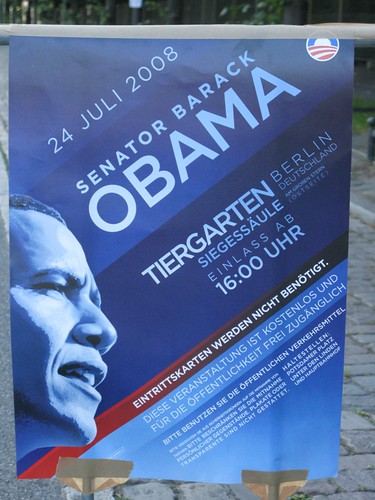
Apparently this is all that US officials were willing to offer the new “EU president” even though the EU was originally thinking they could get a separate day with Obama while he was on the continent for the NATO gathering. But the EU grabbed the opportunity for even a two-hour meeting, eager to avoid another massive humiliation after Obama snubbed the union last May when he suddenly backed out of a planned EU-US summit in Madrid. The entire summit was cancelled after that last incident, and apparently EU officials didn’t want to have to go all of 2010 with the US president not meeting with his new EU counterpart.
Friday, 17 September 2010
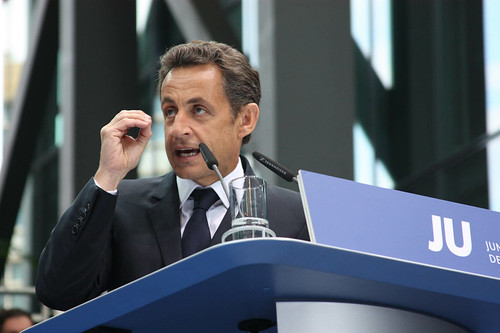
Is Sarkozy losing it?
Toward the end of today there was a flurry of speculation among the journalists at the summit of EU leaders in Brussels, when word got around that the Bulgarian prime minister was telling people a violent altercation between French president Nicolas Sarkozy and European Commission president Jose Manuel Barroso had occurred during lunch. The fight, from the sounds of it, was pretty incredible - apparently Sarkozy was screaming so loudly at Barroso it could be heard all the way down the hall.
The altercation came after Tuesday's shockingly strong condemnation of France's deportation of Roma (gypsies) by Justice Commissioner Viviane Reding. Reding had not only accused France of violating EU anti-discrimination law by targeting an ethnic minority for deportation, but also of violating free movement law by deporting "en masse" gypsies who are Romanian and Bulgarian nationals and therefor EU citizens. But what really seemed to make Sarkozy and his cabinet explode in anger this past week was Reding's comparison of France's recent actions to the country's history of rounding up and disposing of gypsies during World War II. One by one this week French ministers expressed their shock and fury at Reding's words, with the country's Europe minister even declaring "This is not how you treat a great nation like France!" But even after Reding apologized for making the World War II analogy, their anger didn't seem to diminish. And apparently, when Barroso told Sarkozy today that he is backing Reding's condemnation and the commission is united on challenging the legality of what France is doing, that's when Sarko lost it.
Wednesday, 2 June 2010
The European left: an endangered species?
At the moment, Europe is a conservative-dominated continent. The anecdotal evidence that Europeans have been veering to the right at this time of economic crisis has been evident for some time, especially in last year’s European Parliament elections where voters handed a strong majority to the conservative EPP. But the string of centre-right victories over the past few months has demonstrated clearly that the European public is gravitating toward conservative ideologies as their own economic situations become more uncertain. And looking at the geographic location of the few centre-left governments left in Europe, once can see that Europe’s Social Democrats are really in trouble.
This weekend Czechs went to the polls to select a new government. They faced a stark choice between the centre-left Social Democrats who promised during the campaign to increase spending and social benefits, and the centre-right Civic Democratic Party (ODS) who pledged to make drastic budget cuts and reduce the deficit. It is a battle economists have been waging as well. As most countries emerge from recession, is it better to maintain state spending to fuel the recovery or to make drastic cuts to tackle the large deficits and public debt?
Wednesday, 13 January 2010
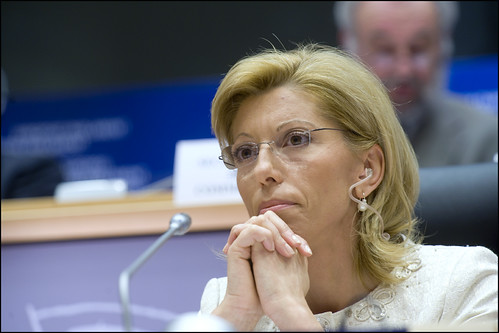
Fiesty exchange over Bulgarian nominee
Accusations were flying back and forth in the hearing yesterday, with Jeleva being called a liar by a rival Bulgarian MEP and Jeleva in turn demanding that an MEP come to Bulgaria to see for himself that she has no ties to the mob. Then each opposing side began furiously handing out paperwork to prove their case, a violation of parliamentary rules. When authorities tried to confiscate the hand-outs, MEPs refused to hand them back. Soon there were calls for the whole hearing to break because of the discord. In the end, the panel could not confirm her and had to put off the confirmation until 24 January.
Monday, 21 December 2009
Europeans and Americans see Copenhagen through different eyes
So, was Copenhagen a failure or not? It would appear the answer depends on which side of the Atlantic you’re on when you ask the question.
The Copenhagen Accord, finalised after hours of intensive negotiations, theoretically recognises a goal of limiting global warming to two degrees Celsius, but contains no targets to achieve that. There are no specific emission reduction actions by developing countries and no specific commitments on long term financing for mitigation and adaptation efforts. Not only is it non-binding, the agreement wasn’t even adopted by all UN countries. Instead it has just been 'noted', which means that countries recognise its existence but don’t necessarily agree with it.
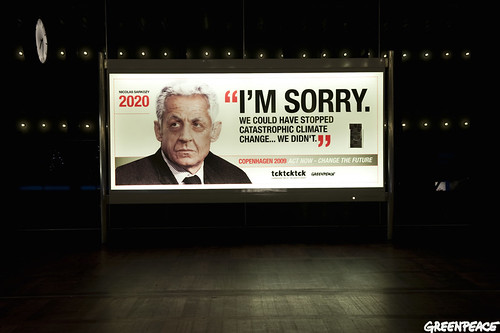
European NGOs and governments were united in their condemnation of the Copenhagen climate summit’s result this weekend, which failed to include any kind of binding agreement and was only able to muster an optional “accord”. Though the language the political leaders were using was obviously more diplomatic than that being used by the climate activists (Greenpeace’s director called Copenhagen a “crime scene”), the basic message is still the same: the summit failed. Swedish prime minister Frederik Reinfeldt, still holding the EU presidency, said the agreement, “will not solve the climate pressures, the climate threat to mankind.” Commission president Jose Manuel Barroso said, "The level of ambition is not what we were hoping for." The British leadership has been railing against the Chinese all weekend, pointing the finger of blame squarely in their court. Brown said that they were, "clinging to their version of what an international organisation should not do,” and British environment minister Ed Milliband delivered the extraordinary charge today that the Chinese hijacked the summit. If there is a mainstream European publication that did not use the word ‘failure’ today to describe the summit, I am not aware of it.
The Copenhagen Accord, finalised after hours of intensive negotiations, theoretically recognises a goal of limiting global warming to two degrees Celsius, but contains no targets to achieve that. There are no specific emission reduction actions by developing countries and no specific commitments on long term financing for mitigation and adaptation efforts. Not only is it non-binding, the agreement wasn’t even adopted by all UN countries. Instead it has just been 'noted', which means that countries recognise its existence but don’t necessarily agree with it.
European NGOs and governments were united in their condemnation of the Copenhagen climate summit’s result this weekend, which failed to include any kind of binding agreement and was only able to muster an optional “accord”. Though the language the political leaders were using was obviously more diplomatic than that being used by the climate activists (Greenpeace’s director called Copenhagen a “crime scene”), the basic message is still the same: the summit failed. Swedish prime minister Frederik Reinfeldt, still holding the EU presidency, said the agreement, “will not solve the climate pressures, the climate threat to mankind.” Commission president Jose Manuel Barroso said, "The level of ambition is not what we were hoping for." The British leadership has been railing against the Chinese all weekend, pointing the finger of blame squarely in their court. Brown said that they were, "clinging to their version of what an international organisation should not do,” and British environment minister Ed Milliband delivered the extraordinary charge today that the Chinese hijacked the summit. If there is a mainstream European publication that did not use the word ‘failure’ today to describe the summit, I am not aware of it.
Monday, 30 November 2009
Zapatero: the left’s last hope?
In the last week the European Council has chosen the first people to occupy the much anticipated President and Foreign Policy High Representative positions, and European Commission president Jose Manuel Barroso has unveiled the faces and portfolios of the new commissioners. Looking at the line-up one thing is clear: the next five years will see an EU dominated by the centre-right.
The Commission presidency, which will likely remain the most powerful position following the council’s decision to go with a low-profile presidency pick, is still occupied by the centre-right former Portuguese prime minister Barroso. Former Belgian prime minister Herman Van Rompuy, chosen as the first Council President (or “EU president” if you like), is also a Conservative. Baroness Ashton of the British Labour party was chosen to be the first foreign minister, but though she is technically in the Socialist camp, New Labour hardly fits comfortably in that grouping and she will be significantly to the right of most Western European Socialist parties. Even if she weren’t, she has already signalled she intends to maintain a low profile.
Following the pan-European conservative victory in the June European Parliament elections, which made the centre-right the largest party in parliament, that body also has a conservative president in Jerzy Buzek of Poland. This means the presidents of all three branches of EU government – the Commission, the Council and the Parliament – are all from the centre-right.
Wanted: a Sarkozy for the left
Contrary to what had been widely reported in the English-language press (I myself was guilty of the misunderstanding as well), the new Council presidency is not replacing the rotating council presidency that is held by a country. Here’s where it gets a little confusing. The European Council is actually made up of many different councils, each focusing on a different subject area. So for instance, there is a council of finance ministers that meets periodically with the finance ministers from each member state. Likewise for environment, agriculture or trade. Those meetings will still be chaired by the country holding the rotating EU presidency. And starting January 1st, that country will be Spain.
However the European Council of national leaders, when all the prime ministers/presidents meet, will no longer be chaired by the rotating country presidency. That all-important group will be chaired by Mr. Van Rompuy. This will take much of the pomp and ceremony out of the rotating presidency, but will leave it intact with practical power. Of course the question remains, how much power will it have? That detail will largely be settled over the coming months by Messieurs Von Rompuy and Zapatero.
It will be a critically important power struggle waged by two low-key, soft-spoken men. The Lisbon Treaty theoretically gives both men significant powers. Van Rompuy can call special summits of EU leaders, draw up the agenda of the meetings, decide on whether to hold a vote and decide if people outside the EU can attend the meetings. However Zapatero will be running the day-to-day running of the council, and the power over the details could end up eclipsing the power over the big picture. In addition the monthly general affairs council, which is extremely powerful, will still be chaired by Spain.
Of course all of this reflects the will of the voters, who have consistently elected conservatives to office in national elections over the past few years with the exception of Iberia and Greece.
Following UK election in April where the Conservatives will likely win, all three of the main EU countries will be under Conservative governments. In this kind of environment, does Zapatero stand a chance of maintaining a place at the table for European socialists? He’s hardly proved himself to be much of an internationalist in the past. Speaking only Spanish, he has largely relegated himself to focusing on Spain’s domestic issues rather than pushing for a Socialist agenda on the European stage. In this way he is almost the polar opposite of his zealous conservative counterpart Nicolas Sarkozy in neighbouring France.
Perhaps Zapatero could defy all expectations and emerge from his shell to become a sort of “Sarkozy of the left”. As the saying goes, cometh the hour cometh the man. Is this the mild-mannered Spanish leader’s time to shine?
Friday, 20 November 2009
EU Low Representatives?
The look on Catherine Ashton’s face last night said it all. Shocked, flustered and almost a little embarrassed, the largely unknown British commissioner chosen to be the EU’s first “foreign minister” said it was a sign of her surprise that she had no acceptance speech prepared. Speaking in a softly reassuring tone, she said she would pursue a “quiet diplomacy” - characteristic of her low-profile approach to politics.
Standing beside her, the expression of the unassuming Belgian prime minister Herman Van Rompuy was equally telling. Constantly switching languages every few minutes, he spoke of his reluctant acceptance of the offer from member state leaders to become the European Council’s first president. Oscillating between English, French and his native Dutch, a portrait emerged of a man who has gained a reputation as a quiet consensus-builder, having rescued the national Belgian government from collapse two years ago.
And with them on the podium stood a beaming European Commission President José Manuel Barroso, a clear winner from last night’s announcement. In these two very low-profile picks Barroso will not have the competition for leadership he feared from a pick like Tony Blair or Jean-Claude Juncker. Since Rompuy will largely relegate his role to being a secretary-coordinator for the European Council, Barroso will continue to be the EU’s de facto leader. And with the demise of the rotating council presidency, he no longer has the prospect of an upstart national leader stealing the show every once in awhile.
Together the three of them have been dubbed by bloggers today as the “Troika of Boredom” - three rather unengaging and unambitious politicians who are unlikely to give the EU the respected high profile it had sought to achieve by creating these new positions. Indeed, the reaction from Brussels blogs last night and this morning has been overwhelmingly unimpressed. Many are seeing the choice of two rather weak personalities as a deliberate effort by Angela Merkel and Nicolas Sarkozy to ensure that there is no strong supranational EU figure that could challenge their authority in the council.
As for the fourth man standing in the group, his body language made it clear where his institution is headed. Frederik Reinfeldt, Prime Minister of Sweden (which currently holds the rotating council presidency), was practically being edged off the stage. The rotating country leadership will still continue to host meetings for the Council of Ministers, but it will no longer have any symbolic leadership role.
Franco-German Stitch-Up
If it were a high-profile person with much political clout, the presidency could become a powerful position capable of speaking with one voice for the EU on the world stage. If it was a low-profile choice, the presidency would become merely a coordinator role, a consensus-builder who would work behind the scenes to get the different leaders of member states to reach agreement. With the selection of Van Rompuy, member state leaders have made a clear decision about which way the presidency should go. His term length may just be two-and-a-half years, but if Rompuy takes a ‘low-profile coordinator’ approach to it as expected, it would be difficult for the next president to fundamentally reshape the precedent the Belgian set.
But is this really what EU leaders wanted? Gordon Brown may have had his differences with Tony Blair in the past, but he seems to have been legitimately insistent that Blair should get the position. Indeed, it appears the choice of Ashton was made as a compromise to Brown in exchange for his abandoning the Blair cause. Sweden’s foreign minister seemed less than enthusiastic about the choice this morning, and many in Eastern Europe have been voicing grumbling discontent with the decision today. Certainly the Socialist leaders of Spain, Portugal and Greece can’t be pleased about it, considering they got the short end of the stick. Ashton is a fairly moderate politician who has little to no foreign policy experience.
This will be largely seen as a Franco-German stitch-up. Merkel had indicated her preference for Van Rompuy early on, and after she persuaded Sarkozy to give up his preference for Tony Blair, the two announced they would be presenting a united front in their selection. This provoked accusations of bullying, with Sweden’s prime minister saying the decision should not be made by just the French and Germans. Certainly, it is a sign of Britain’s lack of influence in Europe that even as one of the ‘big three,’ it was unable to fight against a Franco-German alliance.
“Political Pygmies”
Certainly these two new ‘high representative’ positions were not the only part or even the main part of the Lisbon Treaty. Still, they were a significant part. And after eight long years of fighting for it, this decision has many asking, “What was the point?” The intention of the positions was to give someone the authority and clout to represent the EU on the world stage and stand toe-to-toe with the US and China. These two are unlikely to be able to do that, which bounces authority back to Barroso and back to the status quo, with no united voice for Europe.
Many federalist Europhiles found themselves in the strange position of agreeing with UKIP leader Nigel Farage last night. Bizarrely, he told the BBC, "We've got the appointment of two political pygmies. In terms of a global voice, the European Union will now be much derided by the rest of the world." But…isn’t that exactly what UKIP wants? The cognitive dissonance is even more impressive than usual on this one.
For their part, the Tories praised the decision to go with a low-profile person rather than Tony Blair, with shadow foreign secretary William Hague saying, "I am very pleased that those of us across Europe who said that the president should be a chairman, not a chief, have won the argument.”
Both the Tories and UKIP were also quick to point out that Baroness Ashton has actually never been elected to anything in her life. She spent most of her career working for a charity run by Prince Charles before being appointed as leader of the House of Lords in 2007 by Gordon Brown. When Peter Mandelson left his “Brussels exile” to return to Westminster in 2008, she took his place as EU Commissioner for Trade, where she’s served for about a year. Trade Commissioner is one of the most important roles in the EU and involves a lot of negotiation with foreign trade bodies (particularly those in the US and China). However it doesn’t necessarily involve any areas of foreign policy outside of trade.
For his part, Van Rompuy is being lauded by his supporters as someone who united the warring Flemish and Frencophone factions of the Belgian parliament and brought the national government back from its year-long long shutdown in 2008. He reportedly took that job reluctantly after being asked by the Belgian king, who pleaded with him for 90 minutes. He had been set for retirement, and had already been on a long hiatus from politics. Merkel and Sarkozy have argued that his skills as a quiet consensus builder make him perfectly suited to coordinate the diverse member states of the EU.
But it’s unclear whether this skill will translate to a European level. The disagreements in Belgium are between two parties, not 27. And authority in Belgium has been so devolved to the regions of Flanders and Wallonia by this point that the national government barely does anything at all – as evidenced by the fact that it was barely noticeable when the national government shut down for about a year. Is it that impressive that he was able to bring back to function a body that is largely symbolic by this point anyway? The EU may have it’s problems but it is by no means dysfunctional and is not about to shut down.
Realism
Perhaps the consensus reached last night appropriately reflects the fact that many Europeans are not ready for the notion of an “EU President.” The Liberal Democrats in the UK had an interesting interpretation of the decision yesterday, telling the BBC that the decision would expose the stupidity of the Eurosceptic British media referring to the Lisbon Treaty as if it was solely designed to create a powerful EU presidency for Tony Blair. Foreign affairs spokesman Ed Davey said,
"With low-profile appointees, no-one can take seriously any longer the Eurosceptic deception that these positions would challenge the supremacy of nation states acting together when they agree."From the perspective of the UK and Scandinavia, where the prospect of an “EU President” was most unpopular, this may be true. But what about the many other Europeans who wanted the EU to speak with a stronger, more coherent voice on the world stage? Who now will have the clout to stand up to the United States in situations like the Iraq War? Who now will bring trade power to bear in negotiations over climate change? The decision to choose low-profile people may allay some of the fears expressed in the British media, but does it do so at the expense of offering a solution to the problem the Lisbon Treaty was trying to solve?
Time will tell how these two will use their roles, but it looks like the wild card is more likely to be Ashton than Van Rompuy. She is younger, newer, and there is less known about her political stances on foreign policy issues (she by the way has a very left-of-centre husband I understand). Van Rompuy is unlikely to surprise anyone and will probably stick to a low-profile role. But it she wants to, the Baroness could shape the EU's foreign policy positions to be far more powerful than the presidency.
That is, if she is so inclined.
Wednesday, 16 September 2009
It’s Official – Five More Years of President Barroso
It’s unusual for an EU commission president to serve more than one term, and many in the parliament and member states opposed him. So how exactly did the former Portuguese prime minister squeak by on re-appointment to the EU’s highest office today?The short answer is, there wasn’t really any alternative.
Barroso is from the centre-right European People’s Party (EPP), which currently has a majority in the European Parliament and the leadership of most EU member states (including Germany, France and Italy – and though the current British government is not technically centre-right, Brown strongly supported Barroso’s re-appointment). Still, there was great concern about his re-appointment resulting in a “lame duck” commission presidency for the next five years.
Barroso’s first term as president of the EU’s executive body has been fairly lacklustre, having overseen the defeat of both the EU Constitution and the Lisbon Treaty (although the latter will likely soon pass in the Irish re-vote next month). Many have accused him of not having a “grand vision” for Europe, or even a cohesive idea of where the union should go. His tenure has been marked by a drift into Euro-stasis, a paralysation over the past five years that stands in marked contrast to the gung-ho attitude in Brussels before his tenure at the turn of the millennium.
But the fact that he was re-appointed handily despite all these misgivings (he was even able to obtain an absolute majority of 389 votes today – a big triumph for him) shows just how severe the Brussels leadership crisis is. Despite their intense opposition to Borroso’s re-appointment, the Socialists failed to come up with any candidate to oppose him. No candidate emerged from those who had misgivings on the right either, though France’s prime minister did seem to be toying with the idea for a bit earlier this month.
But considering that they weren’t even able to field an opposition candidate for the commission presidency, who exactly are they thinking they could field for the first “president of Europe”? Tony Blair has been floated as an idea, and as a Labourite he is technically in the PES. But considering his support for the Iraq War and his role as a champion of free-market Anglo-Saxon economics, its doubtful continental PES members would be too pleased with this choice.
If Barroso’s second term does indeed turn out to be a “lame duck presidency” it will be interesting to see how this affects the development of the two new positions created by the Lisbon Treaty. Both of them have been really vaguely defined, and their remit and power will be largely shaped by their first holders. If the offices are held by two socialists in opposition to a weak or irrelevant Barroso, it could have the effect of strengthening the Council at the expense of the Commission. This could go some way in satisfying those who complain about Europe’s “democratic deficit”, as the Commission is an unelected institution.
Subscribe to:
Comments (Atom)