Showing posts with label Federalism. Show all posts

Thursday, 15 September 2011

Will Europe federate, or separate?


People here in Brussels have cautiously started to use the F word again. Though it has long been banned from people's vocabulary after the traumatic experience of trying to ratify the EU constitution and Lisbon Treaty, ‘federalism’ is again being heard in the corridors of power. The federalist idea – to create a "United States of Europe" – back.

European Commission President Jose Manuel Barroso signalled as much in an impassioned speech to the European Parliament this week in Strasbourg. "What we need now is a new, unifying impulse – a new federalist moment," he told MEPs. "Let’s not be afraid of the word – a federalist moment is indispensable.” Federalist parliamentarians rejoiced. The people may have rejected the idea of a European superstate, but now the markets are stepping in and demanding one. Could it be that the fulfilment of the 'European dream' could be triggered not by Europeans themselves, but by the markets they've created?

The federalist rejoicing may be premature. All that is clear right now is that the EU cannot continue operating the way it has. Europe is at a crossroads, and it is being pulled in two different directions. On one hand, the public has grown weary of the European project and the mood of the day is calling for more local control. There is an increasingly vocal minority in Europe who want to see the EU project walked back or for the institutions Brussels has built up to be dismantled. On the other hand, the economic circumstances and the euro crisis are pushing Europe toward greater federalisation in order to avert a catastrophe. The markets are calling for more integration, and European leaders agree with them.

Tuesday, 8 September 2009

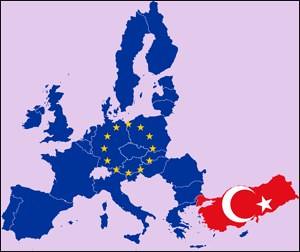
Should Turkey Join the EU?

Yesterday’s much-anticipated report from a high-level commission blasting Brussels for its handling of the Turkey accession issue was predictable in many ways. It was perhaps even a little tiresome in the way it relied so heavily on the oft-repeated claim that racism and xenophobia are what drive opposition to Turkey’s membership. But even more predictable still was the very different way the British and continental media covered the report.

The Independent Commission on Turkey’s denunciation of Brussels’ foot-dragging was a headline-generator in the British media. Yet it received scant attention on the continent - even in France, the country which took the most punches in the document. Google news English finds 30 stories about the report, while Google News French finds only three working links (one of which is actually a blog). France24, Le Monde, and Le Figaro all seem to have ignored the news. Perhaps not surprising considering the continental powers are opposed to Turkey’s membership, while the UK is in favour. Those national media outlets on the continent that did cover it took a very different angle than their British counterparts, proving much more sceptical of the report’s conclusions.

The commission condemns the EU for delaying accession talks with Turkey, saying it is violating its previous promises that Turkey will eventually become a member while many (perhaps most) in Brussels have no intention of ever seeing this become a reality, preferring to string Turkey along in order to make it friendly to EU interests and more inclined to push through pro-Western reforms at home. The report accuses national political leaders (read: Sarkozy) for coming out strongly against Turkey’s membership in order to exploit domestic concerns about immigration, job security and Islam. It even goes so far as to say that this contradiction between what the EU had previously publicly avowed in the 1990’s and what its national leaders are saying today “put in question EU credibility, reliability and the principle…that agreements are to be honoured.”

To an outsider it might seem bizarre that the traditionally euroskeptic UK would be the one pushing most vocally for Turkey to enter the EU. Indeed, in the British media the issue is often presented as a no-brainer. Of course Turkey should enter the EU, people here seem to think. Any efforts to keep them out, according to the Brits, are just due to continental (read: French) racism and Islamophobia.

So it isn’t surprising that I find most people here are a bit confused about the debate, and some of the larger issues involved. So, I thought I’d make a little Q&A based on some of the questions someone was asking me last night. Whether or not Turkey should join is a very complex issue that essentially goes to the heart of the larger question about what the EU should be – a federal union or a free trade zone. Countries have therefore split on Turkey’s accession based on their feelings about European federalism – the idea that the EU should have supranational power in areas outside of trade. The fact is that the day Turkey joins the EU is the day the dream of a federal Europe is over. A federal Europe is simply not possible in a union with Turkey as a member.

Questions? Shoot.

Is Turkey part of Europe?


A very small part of Turkey (about 5%) is geographically within what has historically been considered Europe. Of course, the issue gets a little tricky because unlike its ocean border to the west, Europe’s eastern border is not as clearly defined (owing to the fact that geologically speaking it is more accurately part of a larger Eurasian continent). But the traditional border has been understood to run from the Mediterranean and Aegean, through the Dardanelles and the Bosporus straight, across the Black Sea, and North along the Ural mountains in Russia. This makes Turkey and Russia the only two countries straddling the two continents of Europe and Asia. However the 10% of Turkey that lies in Europe is relatively sparsely populated because it is not very hospitable terrain.

Some argue that because the Ottoman Empire (Turkey’s progenitor) at one time controlled all of the Balkans up to Vienna, it is culturally part of Europe. However this is a tenuous claim because if such logic were applied across the board the states of North Africa should also be invited to join, as their progenitors once controlled Spain. Historically speaking it would have been a tough sell to convince the Austrian emperor (or anyone else in 15th century Europe for that matter) that the Ottomans were “European”. The successful defence of Vienna which halted the Ottoman advance into Western Europe gave the city the nickname as the ‘savior of Europe’ at the time. Their motivations may have been racist or religionist, but there can be no doubt that during the Ottoman Empire’s many centuries of existence, few in Europe would have considered the Turks to be “European”.

Additionally, the Ottomans never took much of an interest in actively governing their Balkan or Greek territories, preferring to leave the actual administration to local rulers. They were much more preoccupied with their Middle Eastern and North African territories, which constituted the majority of the empire.

As a secular nation, isn’t Turkey more linked to Europe than to the Middle East?

It is true that the Turkish state founded by Ataturk is rabidly secular, but unlike in Europe, that secularism has had to be enforced through repression and authoritarianism. To this day religious practice is heavily restricted in Turkish public life by law. Ataturk and his successors have considered this necessary because there is a significant amount of the country that is fervently religious, which the ruling class (mainly the military) fears. The rural population is growing increasingly religious with time, following the revival of Islam that has occurred across the Middle East in the past two decades. The recent success of the openly Islamic AKP party demonstrated how much more powerful Islam is becoming as a political force in the country. The fact that secularism has always hung by a thread in Turkey and has had to be guarded by authoritarian means reflects the fact that Turkish secularism does not even resemble the secularism of Europe, which has arisen naturally among the population and not been enforced by the state.

Turkey is the only stable Muslim democracy in the Middle East. Wouldn’t it integrate seamlessly into the EU?

To hear the proponents of Turkey’s accession talk, you would think Turkey was some kind of earthly paradise of humanism and democracy. But while it is true that Turkey is a democracy, it is anything but stable, particularly at the moment. The country is still involved in two ongoing conflicts, one against Kurdish separatists in the East and the other in the Turkish occupation zone of Cyprus to the west, both still unresolved issues. And just this week Turkey took the first move to establish diplomatic ties with its neighbour Armenia for the first time. That tension is unlikely to be resolved any time soon because Turkey still refuses to acknowledge the genocide of ethnic Armenians that took place during World War I.

Turkey doesn’t just have instability in its foreign relations. Its domestic politics are teetering on a wire at the moment as well. With the Islamist AKP taking civilian power in 2007, there is a constant risk of the army staging a coup to preserve Turkey’s secularist code. In the mean time the country maintains one of the Western World’s most authoritarian regimes in the area of human rights. Press freedom is still severely limited in Turkey, where it is still a crime to insult “Turkishness”. Just yesterday Turkey decided it would be the only country in Europe to refuse to sign a resolution in support of a jailed reporter in Kazakhstan, because it contained a provision which stated that journalists, “should be free to report on all issues of interest to the public, including commentary on how the state is run.” Turkey of course couldn’t sign it, because it can technically be a crime in Turkey to criticize how the state is run.

But the EU is taking in Eastern European countries that also have corruption and human rights problems, but who happen to be Christian. Isn’t this hypocrisy?


It is true that the EU took on the countries of Romania and Bulgaria in 2007 despite complicated corruption problems, with an eye to providing support and guidance to those countries to help them transition to being transparent and stable democracies. This has been referred to as the “transformative” strategy of EU enlargement and has been very controversial as an idea in and of itself, especially now that the appetite for enlargement has waned. But though Sarkozy and other opponents of Turkish entry have said that enlargement should stop for now, they have held the door open for Croatia, Serbia, Bosnia, Macedonia and Albania (a Muslim country, by the way) to join eventually. Obviously, these are countries with some fairly significant, and recent, problems.

But there is one key difference between all of these post-communist countries and Turkey, and it’s not just that they are Christian or all indisputably in Europe. They also all have very small populations. They are therefore more easily manageable for an EU that is taking on a “transformative” role. Additionally, these countries’ entry would not make a big demographic difference to the EU.

Turkey, on the other hand, has a population of 75 million, larger than either Britain or France. If it entered the EU it would become the second biggest member of the block. And given that Turkey’s population is expected to reach 85 million or more by 2020, by the time it could feasibly enter it would probably be the largest member and have the largest voting block in all decisions of the European Parliament.

So this isn’t just a question of saying, “Oh well, it’s Europe-ish, they respect human rights ok I guess, sure let them in, why not?” Turkey’s entry would fundamentally change the nature of the union itself, leading to the bizarre situation where the most powerful country in the EU has only 5% of its territory actually in Europe! There’s no way the rest of the EU member states would accept that scenario in a federal Europe, therefore Turkey’s entry into the EU would mean a federal EU is an impossibility, and it would have to be scaled back to be just a free trade zone like NAFTA. Of course, British Euroskeptics would like nothing more than to see this happen.

So when I see the British media go on and on about how Germany and France’s objection to Turkish entry is motivated by racism and Islamophobia, I’m left rather perplexed. If the Independent Commission on Turkey was being a bit more intellectually honest, they really should have pinned more of the blame for the EU’s Turkey double-speak on the British, who are really the ones stringing the Turks along. Using Turkish entry as a backhanded way of changing the EU is hardly a fair thing to do to Turkey, considering that they are promising them membership in a union that would cease to exist as a result of their very entry.

The commission is right about one thing – Brussels needs to stop stringing Turkey along and give them a firm yes or no. But it is wrong in concluding that the recent vocal objection to Turkey’s entry is some kind of populist political ploy by national leaders. It is a legitimate concern and goes to the very heart of what the EU is meant to be. And in that way, this debate really had very little to do with Turkey and much more to do with the conflict between federalists and euroskeptics. And until that conflict is resolved, it is likely Turkey will continue to be unfairly strung along.

Friday, 28 September 2007

More on Turkey

Reading the Economist's Robin Shepherd's entry today about Turkey's accession prospects, I realized I left a major point out in my previous entry. The biggest, and most practical concern about Turkey entering the union is that given it's monumental size, it would come to dominate the entire system if the EU becomes any further integrated than it is today.

Given that Turky's population is expected to reach 85 million or more by 2020, a scenario where the EU had adopted a weighting voting system and accepted Turkey as a member would mean that by that year, Turkey would have the largest voting block in all European decisions, larger even than Germany's! It would become the pre-emnent voting power in Europe, even though less than five percent of its territory is actually in Europe.

As Shepherd points out, the 27 nations in the EU would never accept this scenario. So, it follows, the only scenario in which Turkey could legitimately find itself a member of the EU is if the Eurosceptics are successful in keeping the integration of the union limited, making it more of a common trading block than a real union. This is why the Euroskeptic UK is so gung-ho about Turkey, while the core state of France and Germany are so opposed. The simple fact is, the question of Turkey is not just a question of what is Europe, or one of culture, religion, or race. It is fundamentally a question about what sort of union the EU is going to be.