Showing posts with label European debt crisis. Show all posts

Friday, 24 June 2016

Welcome to the 1930s

For years, we thought it would be Greece that would trigger Europe's collapse. It turns out it is England that has brought us to the edge of the abyss.

The world woke up to terrifying news this morning. Against the recommendations of nearly all experts and world leaders, against the expectations of the financial markets and the bookies, England has voted to leave the European Union.

As expected, the world's financial markets went into panic mode. The pound lost 8% of its value, hitting a low not seen since 1985. Continental European markets have lost about 8%, US markets are currently down 3%. Analysts expect further losses on Monday. 

It is all reminiscent of the panic after the Lehman Brothers collapse in September 2008, or perhaps more relevant to Europe, the height of the Greek debt crisis of 2011 and 2012.

Tuesday, 23 February 2016

Argentina: Europe on the other side of the world

After three months of travelling, I’ve decided – I’m not giving up on Europe. 

I’m currently halfway across the Atlantic, flying from Argentina back to Brussels after a three-month journey across North and South America. I have to say, it feels good to be going ‘home’. 

This is the longest I’ve been away from Europe since I moved to London ten years ago. It was a nice opportunity to clear my head, to spend some time with my family and to experience a new part of the world. I’ve used the peace and quiet to work on my book about nationalist education and the European project, which I’m happy to report is now nearing completion. 

It is perhaps fitting that I ended my trip in Argentina, a country many describe as the most ‘European’ place in the Americas. In fact, as I was travelling south through Latin America I kept hearing, “Oh, you’re going to Buenos Aires? But maybe it won’t be so interesting for you, since you live in Europe. It’s the same thing.” 

Thursday, 26 November 2015

For the first time, I'm considering leaving Europe

Europe and America are both facing problems, but Europe's governing structures are more vulnerable and seem ready to collapse. It's left me pondering my future.

Since I first moved to Europe ten years ago, I've been surprised by how often I am asked one particular question - "will you ever move back to America?"

It always struck me as unusual, because I don't think a European who moved to America would get that question all the time. But in the four European cities I've lived in, people have seemed genuinely perplexed about why I'm here. Why would someone prefer to be in Europe rather than the United States? The question always annoyed me, and my answer was resolute.

"No, I'm not planning to move back," I responded. "I have a better quality of life here, I'm no longer in an American bubble separated from the rest of the world and, most importantly, I feel more hopeful for the future here than I did in the United States."

As we come to the end of 2015 I have to ask, is there reason for me to feel hopeful for Europe any more?

Monday, 20 May 2013

Is Merkel to blame for Germany's Eurovision loss?

German commentators were wringing their hands on Sunday over the country’s disappointing finish at the Eurovision final Saturday night. The country came 21st out of the 26 countries performing, despite fielding well-known dance act Cascada with a radio-friendly song which the German media had predicted could possibly win.

Others in Germany had, before the final, predicted the opposite – that the high level of anti-German feeling in Europe today over the austerity regimes imposed by Angela Merkel would make it impossible for Germany to win even if they fielded the greatest song eversung by mankind.

Out of the 39 countries voting, 34 refused to give Germany any points at all. Austria, Switzerland, Israel and Albania were the only ones to award the country points, along with bailed-out Spain - which came as a surprise (but could be accounted for by the large amount of German pensioners living in Spain for retirement). Germany received a humiliating score of just 18 points, compared to 281 points for Denmark's winning entry.

The coordinator for Germany’s ARD TV network told German media on Sunday, "There's obviously a political situation to keep in mind - I don't want to say 'this was 18 points for Angela Merkel', but we all have to be aware that it wasn't just Cascada up there on stage, but all of Germany."

Wednesday, 20 March 2013

A Cyprus whodunit

Brussels is in full blame-game mode today following last night’s rejection by the Cypriot parliament of the bailout package offered to the country by the EU. It’s a veritable whodunit mystery, with the answer depending on whether you’re inclined to believe the President of Cyprus, or the rest of Europe.

All sides agree on one thing – the decision taken by European finance ministers in the early hours of Saturday morning to require a one-time levy on all Cypriot bank accounts in exchange for the bail-out was colossally stupid, plunging the Eurozone into a new crisis and risking a bank run in the country. What cannot be agreed upon is whose idea it was.

Raiding people’s savings accounts is an unprecedented move. Such conditions were not imposed on any other country receiving bailout money, and indeed no such idea was ever even discussed. But Cyprus is a special case. As the likelihood of an EU bailout for the small Mediterranean island increased, worry began growing that the move would actually be a bail-out for wealthy Russian oligarchs who use the island for money-laundering or tax-evading.

Tuesday, 26 February 2013

Send in the clowns

There are plenty of people in Europe who hold stereotype-based views about Italy - that it is and has always been an ‘unserious’ country. Italian voters won’t have helped that perception over the weekend, when half of them voted for either a comedian or a clown to lead their country. “Do they think this is a joke?” one exasperated German asked me this morning.

Elections have consequences, and people get the leaders they deserve. Those Italians who insist on re-electing the clownish SilvioBerlusconi despite the ruin and shame he’s brought to Italy - and those Italians who decided they would rather see political anarchy by voting for a comedian who will not even sit in the parliament – will get the future they deserve. The problem is that because of the Eurozone debt crisis, we are all going to get the future they deserve.

Those outside Italy have long been baffled at how such a sizable portion of the Italian population could still support Berlusconi after the corruption allegations, Bunga Bunga parties, dalliances with underage Moroccan prostitutes and – most consequentially – the disastrous handling of the Italian economy. But what is newly shocking is the other surprise winner of this election – an anti-establishment comedian. The fact that so many Italians would vote for what is essentially an anarchist party, led by a comedian who does not even intend to take a seat in the Italian parliament, has rattled the world today.

Wednesday, 12 September 2012

The peril and promise of a new treaty

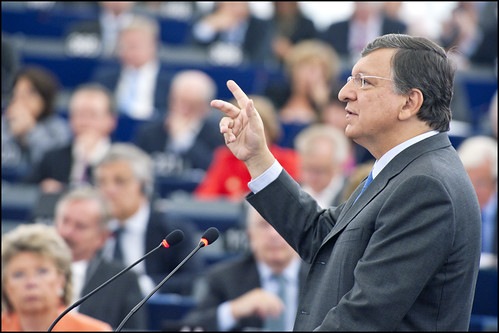
European Commission president Jose Manuel Barroso dared to use the ‘F word’ in his state of the union address here in Strasbourg today – federalism.

“Let’s not be afraid of the word, we will need to move towards a federation of nation states,” he told the European Parliament. “Today, I call for a federation of nation states. Not a superstate.” This federation, he continued, will ultimately require a new treaty, as German Chancellor Angela Merkel had suggested last week. EU leaders, still traumatized by the painful experience of ratifying the Lisbon Treaty in the last decade, have been desperate to avoid this.

“Before the next European Parliament elections in 2014, the Commission will present its outline for the shape of the future European Union. And we will put forward explicit ideas for treaty change in time for a debate.”

Barroso has been hesitant to use the word federal in the past when describing the future direction of the European Union, aware of the images of a power-grab it can conjure up in member states. But in his state of the union addresses, a yearly tradition itself created by the Lisbon Treaty, Barroso has been keen to make the European Parliament happy. He clearly thought that by finally using the F-word, he could do it.

Thursday, 28 June 2012

The showdown: Germany v. Italy

The centre of political gravity may be in Brussels today as EU leaders meet for yet another “make-or-break” summit, but all eyes in Europe will tonight be on Warsaw. The German and Italian football teams will be battling it out to see who will go on to the European Championship final on Sunday.

Like the Germany-Greece game last week, tonight’s game will be fraught with political tension. Thankfully, German Chancellor Angela Merkel will not be at the match tonight to humiliate her Southern neighbours, as she did at the match with Greece. Instead she will be here in Brussels, perhaps watching the match with Italian prime minister Mario Monti. And as the Germans and Italians battle it out on the field in Poland, their leaders will be battling it out here in Brussels.

Monti, the ‘technocrat’ prime minister put into place by EU leaders after they forced disgraced former prime minister Silvio Berlusconi to resign, is coming to Brussels today with a list of demands. He wants the EU to take immediate measures to save the Italian and Spanish economies, which are teetering on the brink of collapse. Specifically, he wants the EU to collectivise debt by issuing ‘eurobonds’ – a joint bond guaranteed by all countries using the euro.

Wednesday, 20 June 2012

In Cypriot hands

When Cyprus was admitted to the European Union in 2004, it was hoped that membership would help unify the divided island into a single state once again. But in an ironic twist of fate, the EU itself may be divided while it is under the leadership of Cyprus over the next six months.

On 1 July Cyprus will take over the rotating 6-month presidency of the European Union from Denmark. It is almost the perfect storm of fragility – the union is set to be led by one of its weakest members at a time when its own weakness threatens to tear it apart.

The Greek Cypriot government, which is the one that will be taking over the presidency, rules over just 800,000 people - fewer than live in the EU’s ‘capital city’ Brussels. This of course excludes the 300,000 Turkish-speaking people in Northern Cyprus, a self-governing break-away territory that has been separate since the country’s civil war in 1974. But as the EU does not recognise the existence of Northern Cyprus, nominally the entire island is taking over the presidency.

Turkey, whose military still occupies Northern Cyprus, is the only country that recognises it as a country. The Greek Cypriot government considers itself to be the ruler of the whole island, as does the EU. But they are effectively two separate countries in an open state of war, but with a cease-fire.

Friday, 8 June 2012

All eyes on Angela

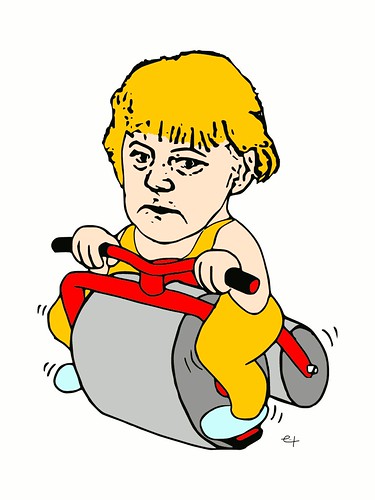
These have been anxious times here in Europe, but this month tensions have risen to a whole new level. The world may be just weeks away from financial collapse. There is an increasing consensus that there is only one person who can prevent the catastrophe – Angela Merkel.

Next Sunday Greeks will return to the polls in a do-over election that is likely to yield the same unacceptable result – a majority in parliament who refuse to abide by the austerity conditions attached to their financial bailout. This means they can no longer receive the bailout, which means they will have to leave the euro, which economists say is very likely to spark a domino effect for other countries like Spain and Italy dropping out. Panic would ensue.

But the world may not have the luxury to wait until the 14th. There are rumours circulating today that Spain is going to have to ask the EU for a bail-out tomorrow. This could set off a financial earthquake globally, as it would be the first large EU country to have to be bailed out (so far only Greece, Ireland and Portugal have received bail-outs).

There is a lot that is uncertain about the way the next three weeks will play out. But there is one thing is certain - only Germany can pull Europe back from the brink. It is the largest European financial power by far, and it is the only one with the heft - and the resources - to stun the debt markets into submission. So far it has resisted every entreaty to do so. But time is running out.

Friday, 18 May 2012

Obama gets tough with Merkel, but is it too late?


Now that German Chancellor Angela Merkel has been hobbled by the loss of her key ally in France, it seems the Obama administration is wasting no time in pressuring her into a course correction. The chorus of anti-austerity (and by extension anti-Merkel) voices is growing louder by the minute.

At next week’s G8 summit at Camp David, Barack Obama is reportedly going to put pressure on Germany to drop its insistence on the Eurozone economies adopting a severe austerity regime. He will ask Merkel to instead pursue a policy of stimulus and growth. He will apparently do so in no uncertain terms – warning Merkel that if she does not change course quickly she risks plunging the world into another deep recession that would be even worse than the Lehman Bros collapse in 2008.

The Guardian reports that the Obama administration is expected to try to forge close ties with new French President Francois Hollande at the first meeting of the two leaders on Tuesday. They are keen to rapidly establish Hollande as an ally in exerting pressure on Merkel to change course.

Obama already has the support of UK Prime Minister David Cameron, who while unwavering in his demand for austerity at home, publicly chastised the German chancellor in a speech yesterday for her lack of flexibility. Saying that the eurozone either had to “make up…or break up”, he said urgent steps are needed quickly to prevent an economic implosion of epic proportions in the coming weeks. He will reportedly tell Merkel this weekend to use Germany's wealth to rescue Southern Europe before it is too late.

Wednesday, 9 May 2012

Angela vs. the growth

As predicted, Socialist Francois Hollande ousted the centre-right Nicolas Sarkozy in French elections on Sunday after a campaign in which he railed against the German-led austerity drive in Europe. He has insisted that Europe needs to end its obsession with austerity to dig its way out of the debt crisis, and instead focus on growth.

Coming as it did on the same day that anti-austerity parties in Greece took a majority of the vote, Sunday has been interpreted as a Europe-wide rejection of German Chancellor Angela Merkel and her insistence on austerity and budget cuts. The markets have certainly interpreted it as such. Stock exchanges across the world have taken a dive the last three days, particularly in Europe, over fears that the delicately crafted ‘fiscal union pact’ worked out over the past several months is now about to fall apart.

Whether that actually comes to pass may depend less on Hollande than on how his victory is interpreted in other European capitals. All eyes will be on the new French president’s first meeting with Merkel next week, a day after he is sworn in on 15 May. It is in both of their interests that the meeting goes well. Hollande needs to walk away with something to say that he “renegotiated” the fiscal compact, while Angela needs to reassure the German people that Eurozone countries will still have to adhere to strict budgetary rule while at the same time reassuring the markets that there will be no Franco-German rift.

What will likely be worked out is the addition of a paragraph about stimulating the economy into the compact – something that wouldn’t require new ratifications by national parliaments.

Thursday, 3 May 2012

Sarko presents a Latin/Germanic choice to France

Someone tuning in to last night’s presidential debate in France might have thought Nicolas Sarkozy was running for president of Germany. Praising the economic model of France’s eastern neighbour, he continually stressed that Germany is more competitive and an easier place to do business.

Even his Socialist challenger Francois Hollande had to agree with him. “Germany in all fields is better than us,” Hollande conceded, with a tone that seemed to imply, ‘if you love it so much, why don’t you go there.’

Germany and its chancellor Angela Merkel loomed large over this debate, although she was never mentioned by name. Sarkozy continually returned to a theme of defending his close partnership with the chancellor and her austerity regime for Europe. He has been accused, both in Germany and France, of being Merkel’s poodle. “We avoided the implosion of the euro,” he spat at Hollande incredulously after he questioned the austerity strategy. “It was hard work, which was founded on the Franco-German partnership. It is irresponsible to want to question it.”

And thus the lines were drawn in precisely the way Sarkozy wanted them. “For me, the example to follow, it is that of Germany rather than that of Greece or Spain,” said the president. He stressed that it was the Socialists who have been in power in Spain during the economic crisis, and today Spain’s economy is on the verge of collapse. Contrast that, he said, with Germany where his fellow conservatives have been in power. Germany has the most successful economy in the EU. Hollande, he warned, would make France like Spain.

Monday, 30 January 2012

What’s wrong with a transfer union?

The eurocrisis has introduced a plethora of strange words into our everyday vocabulary: ‘Contagion’, ‘technocrats’, ‘moral hazard’, ‘austerity’ and of course the derisive description, ‘transfer union’. This last term is used by those in Northern Europe who warn that bailing out the economies of Southern Europe will lead to a European Union where money steadily flows from rich states to poor states and the North loses out. Many argue that, in fact, this is what the EU has always been.

Such feelings are at the core of the German public’s resistance to the Greek bail-outs – emotions that have turned what is normally one of Europe’s most pro-EU countries into a relatively more eurosceptic place these days. “Why should we work hard just to see our money flow to lazy people in the south?” some Germans are asking.

Their resentment is fueled by charts like the interactive diagram below, found in the Guardian newspaper’s new ‘Europa’ section (a truly fantastic project with five other papers that I’m very excited about). It shows which countries are net ‘payers’ into the EU, and which are net ‘receivers’. The statistics are familiar and often brought up when people talk about the European Union – the biggest recipients of EU funds are in Southern and Eastern Europe while the biggest contributors are in Northern Europe.

Monday, 23 January 2012

Croatians vote to join EU

Amidst all the bad news, the EU can feel at least a bit reassured following the strong endorsement given by Croatians this weekend to their country joining the European Union. Though you'd be forgiven for getting the impression from the English-speaking media that the EU is now a toxic project that few want to be associated with, 67% of Croatians voted on Sunday to join the union.

An accession agreement was already signed by the country's government in December, and they are set to become the 28th member state at the end of this year. But the accession required a public referendum to go through. There were some rumblings of concern last year that the eurozone crisis could deliver a surprise no from the Croatian people. Brussels received a pleasant surprise last night when news came that the referendum had not only passed, it had passed by a large majority.

The vote comes a year after Estonia's decision to join the euro currency. Both decisions show that even in the midst of the eurozone crisis, the European project continues to move forward - not backward. Of course, both of these things were planned and in motion before the eurozone crisis hit. The real test may come next year when the people of Iceland vote on whether to move from their status as a pseudo-member-state in the EEA to a full member state of the EU. Opinion polls are already showing that referendum could have a hard time passing, particularly as the Icelandic economy recovers from their crisis as the eurozone slips further into its much larger crisis.

Wednesday, 14 December 2011

This isn’t about the UK any more

The markets have returned to panic mode today as their confidence in national governments to approve the new Eurozone financial consolidation treaty wavered. Ratification has hit some bumps in the road, with Finland’s prime minister expressing dissatisfaction with the transfer of authority over national budgets to the EU on Tuesday. In Ireland, the opposition parties seem keen to force a referendum on the issue even if the country’s legal services rule that one is not required.

The euro fell below $1.30 today, its lowest point in a year. Yields on Italian bonds widened to new highs. It’s a familiar pattern we’ve seen repeated several times now: markets rally upon news of a new European Council agreement, but then crash a few days later when they look at the details and realise it’s not as strong as they’d hoped. The UK's abandonment of Europe may have been the big story on Friday, but now the more important story sets in - the markets have not been satisfied.

But there seems to be some confusion in the British media though about what this all means vis-à-vis the UK’s decision to veto the attempt at treaty change on Friday. The Spectator has run a column from the Eurosceptic think tank Open Europe scolding the British media for describing the UK as isolated as a result of the 26 vs. 1 outcome last week. There isn’t really any such divide, Open Europe insists, because many other member states support the UK’s reticence. As evidence that all is not what it seems, they run through the list of objections to the new treaty being expressed in national capitals this week.

Friday, 9 December 2011

9 December 2011: The day Britain left Europe

David Cameron emerged as the villain of the hour in the early hours of this morning as news broke that after tense all-night discussions, the UK has vetoed treaty change to save the faltering euro. The meeting then went to plan B, forging ahead on a new treaty with just the 17 countries of the eurozone. But nine non-eurozone countries then said they would also sign the new treaty, leaving the UK as the lone one out. This may sound like a small detail, but in reality it is huge. As the world press is reporting this morning, this effectively means the UK has begun the process of leaving Europe. And even the UK’s usual allies in the American media were aghast.

“UK Threatens Eurozone” headlined ABC News this morning. “UK to Euro nations: We’re out, good luck” heralded CBS News this morning. The reason for Cameron’s veto is bound to make him even more unpopular globally. In order to give his assent to the treaty change, which would not have affected Britain but only the countries using the euro, he demanded that the UK be given an opt-out from proposed increased regulation on banks and financial traders. That financial transaction tax (or 'banker tax') proposed by the EU earlier this year had nothing to do with last night's negotiations.

France and Germany balked, and Cameron walked. As one journalist friend noted last night, "The UK has refused to help solve the crisis because it wants to help the banks who started the crisis." Because the other 26 members walked away and went ahead without Britain, it means the financial transaction tax is still on the table, and the situation on that issue is unchanged from what it was before the summit. Cameron walks away with nothing.

Putting the global economy at risk in order to protect London City traders may not be the most popular stance given the current economic crisis. And Sarkozy emerged from the meeting this morning eager to exploit this. “You cannot have an opt-out and then ask to participate in all the discussion about the euro that you did not want to have, and which you also criticised,” Sarkozy declared to the press after emerging from the meeting at 5:30 this morning. It took Cameron a full half-hour after Sarkozy spoke to comport himself and figure out what he was going to say in his own press conference.

Thursday, 8 December 2011

Cameron's choice tonight: will UK be inside or outside the room?

The degree to which the Left has become irrelevant in Europe was in evidence today as the European People’s Party (EPP), the EU grouping of Europe’s centre-right conservative parties, met in Marseille. The annual meeting of centre-right leaders, which coincidentally is this year a day before the final European Council, has toda become a first round in the treaty change talks. US Treasury Secretary Timothy Geithner has been there meeting with Europe's Conservative leaders, helping them to devise a strategy to save the Euro. Every leader who is important in this process was there today.

But it is not only the Left that is noticeable in their absence today in Marseille. Despite being a centre-right conservative leader, David Cameron is not there either. That’s because in 2009 Cameron took the decision to take his Tory party out of the EPP group and create a new, europsceptic grouping called ‘European Conservatives and Reformists’. That group is essentially just the British Conservatives, with a few hard right parties from Eastern Europe thrown in for good measure.

That decision, which was the fulfilment of a promise he made to the Eurosceptic wing of the Tory party in 2005 in order to be appointed party leader, may well be weighing heavily on the British leader’s mind today. He has already been locked out of the discussions amongst Eurozone leaders to devise a strategy to end the euro crisis. Now he is also locked out of the pre-summit meeting today in Marseille where so much of the strategy is being formulated. The later is a self-inflicted wound, and must be particularly hard to take considering it’s hard to see how creating a new EU group has benefitted the Tories in any way.

Tuesday, 6 December 2011

Kicking them while they’re down

It wouldn’t have taken much to make the US-based ratings agencies less popular in Europe. But Standard & Poor’s decision last night to put all 17 countries that use the euro on review for a possible downgrade has left European leaders seething with anger. Just two days before the make-or-break European Summit that was supposed to save the euro, the markets seem to have decided that whatever the European heads of government decide will not be enough.

Just hours before the S&P news broke, German Chancellor Angela Merkel and French President Nicolas Sarkozy had emerged from an emergency meeting in Paris outlining a plan for rapid and fundamental treaty change in order to stem the crisis – to be agreed on Friday. That, combined with Italy’s unveiling of drastic austerity cuts over the weekend, caused European markets to rally and Italy’s long-term borrowing rate to fall below 6% on Monday afternoon – the lowest it’s been since October. But S&P soon put an end to the party by announcing that the AAA ratings of the FANG countries (Finland, Austria, Netherlands and Germany) are in jeopardy. Without that AAA rating these countries can’t hope to bail out the collapsed economies of the PIGS (Portugal, Italy, Greece and Spain).

It’s not hard to see what influenced S&P's decision. Merkozy - I mean, Merkel and Sarkozy - had emerged from their meeting at the Elysee Palace in almost lock step. Sarkozy, who has been pleading with his German counterpart for months to embrace the idea of ‘Eurobonds’ that would collectivise European debt, suddenly did an about-face.

Friday, 18 November 2011

The new Italy: this is what technocracy looks like

Former EU commissioner Mario Monti, appointed as Italian prime minister on Sunday after Silvio Berlusconi was forced by the markets and EU leaders to resign, had his ‘technocrat government’ approved by the Italian parliament today.

Neither Monti nor the members of his cabinet have been elected by the Italian people. They are not politicians but instead experts in their respective fields. The 'government of experts' has been brought in because, it was thought, both within and outside Italy, the Italian political system is so broken that only unelected non-politicians could be trusted to implement the reforms EU leaders say are necessary to prevent the country’s economic collapse.

American readers may be wondering how on earth a national leader in a democracy could come into power without having been elected. It has to do with a quirk in parliamentary democracy. Members of the upper houses of many of Europe’s parliaments (their equivalents of the US Senate) are appointed rather than elected. A prime minister can come from either house, so if the parliament wishes to appoint a leader who has not been elected they simply have the president appoint that person to the senate.