
Elections have consequences, and people get the leaders they
deserve. Those Italians who insist on re-electing the clownish SilvioBerlusconi despite the ruin and shame he’s brought to Italy - and
those Italians who decided they would rather see political anarchy by voting
for a comedian who will not even sit in the parliament – will get the future
they deserve. The problem is that because of the Eurozone debt crisis, we are
all going to get the future they deserve.
Those outside Italy have long been baffled at how
such a sizable portion of the Italian population could still support Berlusconi after the corruption allegations, Bunga Bunga parties, dalliances with
underage Moroccan prostitutes and – most consequentially – the disastrous
handling of the Italian economy. But what is newly shocking is the other surprise winner of this
election – an anti-establishment comedian. The fact that so many Italians would
vote for what is essentially an anarchist party, led by a comedian who does not
even intend to take a seat in the Italian parliament, has rattled the world
today.
The Beppe bomb
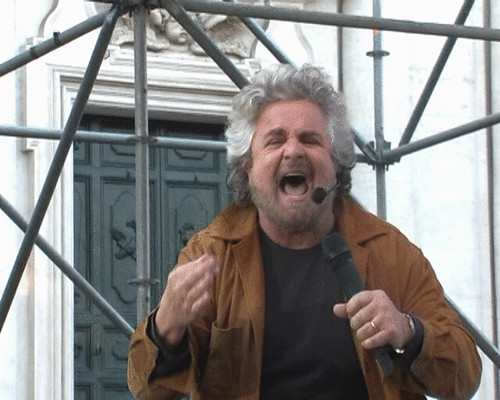
M5S is not unlike the Tea Party in America – a vague
expression of anti-establishment rage with no actual agenda or governing
philosophy. But the comparison only goes so far. The Tea Party Republicans are
a faction within a mainstream party, and they actually take their seats in the
congress. Grillo has refused to join forces with any other party and will not
even participate in the parliament.

That string of events may have started today. In the wake of
the election result yesterday, shares in Italy’s main stock market index
have fallen almost 5% today. Italian banks, which hold large parts of Italy’s state
debt, are down up to 10%. The yield spread on Italy’s debt soared to 330 by
midday Tuesday. The euro as a whole is trading sharply down.
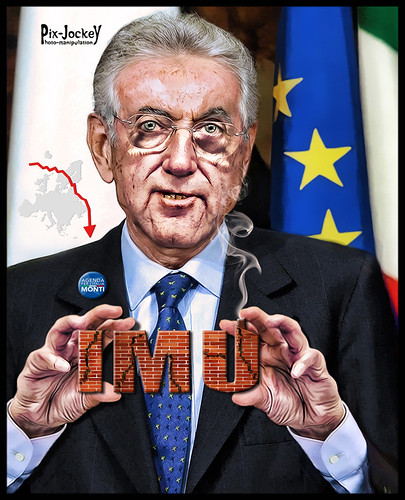 For people here in Brussels,
the situation is exasperating. They would have preferred a victory by former
European Commissioner Mario Monti, the ‘technocrat’ prime minister hand-picked
by Brussels and Berlin to replace Berlusconi after he was
unceremoniously ousted by the combined force of the EU and the markets in 2011.
Once it became clear this was impossible (Monti took the hit with Italian
public opinion for introducing the austerity cuts demanded by Germany), they wanted to see a victory
by centre-left leader Pier Luigi Bersani, possibly in alliance with Monti.
For people here in Brussels,
the situation is exasperating. They would have preferred a victory by former
European Commissioner Mario Monti, the ‘technocrat’ prime minister hand-picked
by Brussels and Berlin to replace Berlusconi after he was
unceremoniously ousted by the combined force of the EU and the markets in 2011.
Once it became clear this was impossible (Monti took the hit with Italian
public opinion for introducing the austerity cuts demanded by Germany), they wanted to see a victory
by centre-left leader Pier Luigi Bersani, possibly in alliance with Monti.
The worst possible outcome for Italy’s European partners was a
return to power for Berlusconi, who at this point is driven only by his lust for
revenge against the EU and his desire to give himself immunity from prosecution
for the many legal charges pending against him. Europe
was spared this catastrophe; though Berlusconi did manage to get the most votes
in the senate, he does not have enough seats to control the senate. But the
actual result – gridlock and chaos – is not much better. In fact, it could be
worse.
A vote for anarchy
A vote for anarchy
Why would so many Italians vote for M5S, a party whose sole
election promise was not to govern? Why would they vote for a comedian who has
called for al-Qaeda to bomb Rome
and kill the Italian political elite? Why, in short, have Italians chosen to
sabotage their own country, and in so doing potentially sabotage all of Europe?

Ironically, it is this disdain for Rome that has historically made Italians one
of the most Europhile populations in the EU. It is a population that is in a
large part happy to have laws be set and enforced by Brussels instead. While knowledge of how the
EU works sits at comparatively low levels (almost reaching British depths of
ignorance), positive feeling about the EU is among the highest in the union.
That is, until recently. This election campaign was marked
by fiercely anti-EU rhetoric. Grillo and Berlusconi both railed against the EU,
Germany
and the euro – and together they received 50% of the vote. Yet neither man
offered any alternative. If the government in Rome
is broken beyond repair, and the government in Brussels is driven by a self-harming German
push for austerity that must be defeated, what does that leave us with?

1 comment:
I think you're too harsh on the population. Europe needs a wake-up call, we have been under Germany's counterproductive austerity rule for too long and people have enough of Merkel's discourse of having no alternative.
I don't sympathise with Grillo, but why should Italians vote for Merkel-led politicians who would continue Italy's way into self-destruction?
Post a Comment