Showing posts with label eurozone. Show all posts

Friday, 10 June 2016

No, the EU does not have 'five presidents'

How many Brits could name John Bercow, Mark Carney or George Osborne? Well these are the equivalents for three of the "five presidents" cited by Michael Gove in the Sky News debate.

During the live Brexit debate on Sky News last week, 'out' campaigner Michael Gove, the former UK minister for education, was taken to task by interviewer Faisal Islam.

Asked to back up his claims with hard facts, Gove deflected. Asked to name notable experts saying the UK would be economically better off outside Europe, he demurred. But he could tell he was on to a winner when he distracted from the questions by turning to the audience and asking them a question himself, "There are five presidents run the EU. Can you name them all?"

There was an awkward silence from the audience, and from Islam. No, it turns out, nobody could name them. Since then the Leave campaign has ran with this 'five presidents' line, and the British media has heralded it as an excellent point for the leave camp (The Guardian called it a "superb" moment for Gove in the debate).

There's only one problem - it's completely bogus. 

Just because there are a number of people with the title "president" in the European institutions does not make them all comparable to the "president" of the United States, France or Russia. But this is what Gove is implying.

Sunday, 11 October 2015

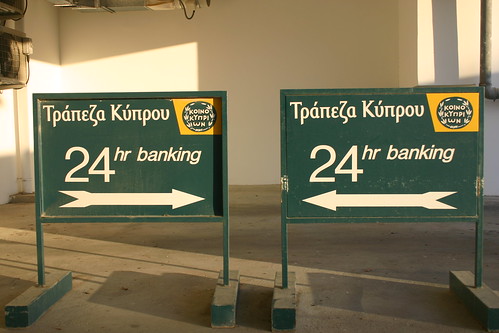
In Berlin, it's better to have a Belgian bank account than a German one

While banks in Germany rake in ATM fees from customers of other German banks, EU law forbids them from charging citizens of other EU countries.

It's a 'Brussels week' for me this week, I'm in town to shoot a few videos and moderate some conferences. As the Autumn draws on, I'm finding myself here more often than I'm in Berlin. But this is fine, since I have apartments in both cities. 

Strictly speaking, when I'm in Brussels I am "home". This is still my primary address - my Belgian phone is still my primary number, and I still use a Belgian bank account for all transactions. And actually, this last fact has made my life in Berlin easier.

Tuesday, 13 August 2013

Ins and outs

As the British seek new EU opt-outs, Danes will likely vote to end theirs.

Over the past several years, as UK prime minister David Cameron has taken his country further and further toward the EU exit door, he has been keen to stress that the UK is not alone in its desire for a more devolved EU. He points to the increasingly Eurosceptic Dutch, who have, like the UK, recently conducted a review of the EU's powers. He points to the Danes and Swedes, who are also voluntarily remaining outside the Eurozone.

So when news came this week that it now looks likely that Denmark will hold an ‘EU referendum' next year, it may have seemed like welcome news for the British Conservatives. Cameron has attracted a large amount of ill will on the continent by scheduling an in/out EU referendum for the UK in 2017. But why should Britain be singled out for scorn, when the Danes are holding their own EU referendum?

However the Danish case is a very different animal. The British referendum will be a vote on a theoretical new EU-UK relationship which the government will negotiate, giving the UK more opt-outs from EU law. The Danish referendum will be the opposite – a vote on whether to end the opt-outs Denmark negotiated for itself back in 1992.

Wednesday, 20 March 2013

A Cyprus whodunit

Brussels is in full blame-game mode today following last night’s rejection by the Cypriot parliament of the bailout package offered to the country by the EU. It’s a veritable whodunit mystery, with the answer depending on whether you’re inclined to believe the President of Cyprus, or the rest of Europe.

All sides agree on one thing – the decision taken by European finance ministers in the early hours of Saturday morning to require a one-time levy on all Cypriot bank accounts in exchange for the bail-out was colossally stupid, plunging the Eurozone into a new crisis and risking a bank run in the country. What cannot be agreed upon is whose idea it was.

Raiding people’s savings accounts is an unprecedented move. Such conditions were not imposed on any other country receiving bailout money, and indeed no such idea was ever even discussed. But Cyprus is a special case. As the likelihood of an EU bailout for the small Mediterranean island increased, worry began growing that the move would actually be a bail-out for wealthy Russian oligarchs who use the island for money-laundering or tax-evading.

Tuesday, 26 February 2013

Send in the clowns

There are plenty of people in Europe who hold stereotype-based views about Italy - that it is and has always been an ‘unserious’ country. Italian voters won’t have helped that perception over the weekend, when half of them voted for either a comedian or a clown to lead their country. “Do they think this is a joke?” one exasperated German asked me this morning.

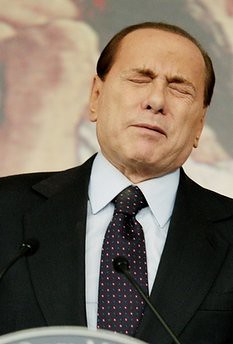
Elections have consequences, and people get the leaders they deserve. Those Italians who insist on re-electing the clownish SilvioBerlusconi despite the ruin and shame he’s brought to Italy - and those Italians who decided they would rather see political anarchy by voting for a comedian who will not even sit in the parliament – will get the future they deserve. The problem is that because of the Eurozone debt crisis, we are all going to get the future they deserve.

Those outside Italy have long been baffled at how such a sizable portion of the Italian population could still support Berlusconi after the corruption allegations, Bunga Bunga parties, dalliances with underage Moroccan prostitutes and – most consequentially – the disastrous handling of the Italian economy. But what is newly shocking is the other surprise winner of this election – an anti-establishment comedian. The fact that so many Italians would vote for what is essentially an anarchist party, led by a comedian who does not even intend to take a seat in the Italian parliament, has rattled the world today.

Friday, 22 February 2013

The Italian election that could sink Europe

Italy’s constant lurching between left and right since WWII had, in the past, become so frequent that few people bothered to pay too much attention to the vagaries of Italian politics. But all that has changed since the advent of the eurozone crisis. All eyes are on the Eurozone's third largest economy this weekend as Italians go to the polls in what could be the most consequential Italian election of the modern republic.

Much of the international media attention has focused on the possibility of a return to power for the country’s notorious former leader Silvio Berlusconi, who was ousted in 2011 by what essentially amounted to an EU putsch. The prospect of a return to power for the now clearly mentally unstable Berlusconi is terrifying to the rest of Europe and would likely result in absolute panic in the Eurozone. But such a scenario is unlikely, even with Berlusconi’s last-minute efforts to try to buy votes by promising tax rebates.

Wednesday, 12 September 2012

The peril and promise of a new treaty

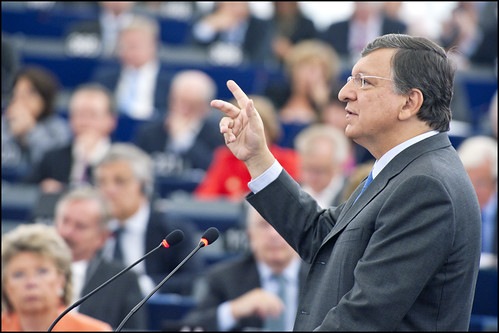
European Commission president Jose Manuel Barroso dared to use the ‘F word’ in his state of the union address here in Strasbourg today – federalism.

“Let’s not be afraid of the word, we will need to move towards a federation of nation states,” he told the European Parliament. “Today, I call for a federation of nation states. Not a superstate.” This federation, he continued, will ultimately require a new treaty, as German Chancellor Angela Merkel had suggested last week. EU leaders, still traumatized by the painful experience of ratifying the Lisbon Treaty in the last decade, have been desperate to avoid this.

“Before the next European Parliament elections in 2014, the Commission will present its outline for the shape of the future European Union. And we will put forward explicit ideas for treaty change in time for a debate.”

Barroso has been hesitant to use the word federal in the past when describing the future direction of the European Union, aware of the images of a power-grab it can conjure up in member states. But in his state of the union addresses, a yearly tradition itself created by the Lisbon Treaty, Barroso has been keen to make the European Parliament happy. He clearly thought that by finally using the F-word, he could do it.

Monday, 3 September 2012

A long-distance relationship

There are many clichés used to describe Iceland’s position in the middle of the Atlantic. Torn between Europe and North America – quite literally sitting on the fault line separating the two continents geologically – the country’s location is the most frequently used metaphor. This has been particularly true now that the country is in the process of EU accession.

While in Iceland over the past four days – a stopover on my way back to Brussels from a visit home to New York – the question of EU accession was very much on my mind. In fact I made it a point to ask every Icelander I met how they plan to vote in the coming referendum (what can I say, I’m tons of fun at a party). I planned to write some kind of blog entry on the way back reflecting people’s opinions and concerns, and here I am on the plane writing it.

It’s tempting to start trying to explain Iceland’s reluctance to embrace Europe with an anecdote about geography, since it is so far the European mainland. I could describe the intense sense of isolation I felt while out in the uninhabited lava fields away from Reykjavik. Or I could muse about the feeling of being torn in two directions which I felt while standing in the gorge separating the two continents at Pingvellier Park.

Wednesday, 25 July 2012

Romney's 'apology for the apology' tour

Mitt Romney has arrived in London today, the first stop on a three-country tour meant to shore up his foreign policy credentials. His tour opened with a remarkably tone-deaf gaffe by a campaign staffer, who told British newspaper The Telegraph that Barack Obama cannot understand the common “Anglo-Saxon heritage” of the US and the UK.

The advisor was likely using the term in the continental European context, which refers to the free-market economic heritage of English-speaking countries. He was likely trying to make some 'Obama as Socialist' characterisation. But this definition is unknown in the English-speaking countries themselves, where the term is a seldom-used ethnic description of English descent (ie, from the Germanic tribes who settled in Southwest England). So it ended up just coming off as shockingly racist. Stephen Colbert hilariously summed up the bemused reaction of Americans to the comment.

It’s a bad start to what is a very important foreign tour for Romney. Over the next few days he will be meeting with virtually every high level politician in the UK. On Friday he will attend the Olympics opening ceremony, surely excited about the prospects for his horse-dancer in the dressage competition.

The Republican presidential candidate’s choice of three countries for this visit is highly significant. After his visit to the UK he will fly to Israel, where he will make a series of high-profile appearances. He will then finish his tour in Poland. All three are countries which the Romney campaign has accused the Obama administration of at best ignoring, and at worst insulting.

Monday, 30 January 2012

What’s wrong with a transfer union?

The eurocrisis has introduced a plethora of strange words into our everyday vocabulary: ‘Contagion’, ‘technocrats’, ‘moral hazard’, ‘austerity’ and of course the derisive description, ‘transfer union’. This last term is used by those in Northern Europe who warn that bailing out the economies of Southern Europe will lead to a European Union where money steadily flows from rich states to poor states and the North loses out. Many argue that, in fact, this is what the EU has always been.

Such feelings are at the core of the German public’s resistance to the Greek bail-outs – emotions that have turned what is normally one of Europe’s most pro-EU countries into a relatively more eurosceptic place these days. “Why should we work hard just to see our money flow to lazy people in the south?” some Germans are asking.

Their resentment is fueled by charts like the interactive diagram below, found in the Guardian newspaper’s new ‘Europa’ section (a truly fantastic project with five other papers that I’m very excited about). It shows which countries are net ‘payers’ into the EU, and which are net ‘receivers’. The statistics are familiar and often brought up when people talk about the European Union – the biggest recipients of EU funds are in Southern and Eastern Europe while the biggest contributors are in Northern Europe.

Monday, 23 January 2012

Croatians vote to join EU

Amidst all the bad news, the EU can feel at least a bit reassured following the strong endorsement given by Croatians this weekend to their country joining the European Union. Though you'd be forgiven for getting the impression from the English-speaking media that the EU is now a toxic project that few want to be associated with, 67% of Croatians voted on Sunday to join the union.

An accession agreement was already signed by the country's government in December, and they are set to become the 28th member state at the end of this year. But the accession required a public referendum to go through. There were some rumblings of concern last year that the eurozone crisis could deliver a surprise no from the Croatian people. Brussels received a pleasant surprise last night when news came that the referendum had not only passed, it had passed by a large majority.

The vote comes a year after Estonia's decision to join the euro currency. Both decisions show that even in the midst of the eurozone crisis, the European project continues to move forward - not backward. Of course, both of these things were planned and in motion before the eurozone crisis hit. The real test may come next year when the people of Iceland vote on whether to move from their status as a pseudo-member-state in the EEA to a full member state of the EU. Opinion polls are already showing that referendum could have a hard time passing, particularly as the Icelandic economy recovers from their crisis as the eurozone slips further into its much larger crisis.

Wednesday, 14 December 2011

This isn’t about the UK any more

The markets have returned to panic mode today as their confidence in national governments to approve the new Eurozone financial consolidation treaty wavered. Ratification has hit some bumps in the road, with Finland’s prime minister expressing dissatisfaction with the transfer of authority over national budgets to the EU on Tuesday. In Ireland, the opposition parties seem keen to force a referendum on the issue even if the country’s legal services rule that one is not required.

The euro fell below $1.30 today, its lowest point in a year. Yields on Italian bonds widened to new highs. It’s a familiar pattern we’ve seen repeated several times now: markets rally upon news of a new European Council agreement, but then crash a few days later when they look at the details and realise it’s not as strong as they’d hoped. The UK's abandonment of Europe may have been the big story on Friday, but now the more important story sets in - the markets have not been satisfied.

But there seems to be some confusion in the British media though about what this all means vis-à-vis the UK’s decision to veto the attempt at treaty change on Friday. The Spectator has run a column from the Eurosceptic think tank Open Europe scolding the British media for describing the UK as isolated as a result of the 26 vs. 1 outcome last week. There isn’t really any such divide, Open Europe insists, because many other member states support the UK’s reticence. As evidence that all is not what it seems, they run through the list of objections to the new treaty being expressed in national capitals this week.

Friday, 9 December 2011

9 December 2011: The day Britain left Europe

David Cameron emerged as the villain of the hour in the early hours of this morning as news broke that after tense all-night discussions, the UK has vetoed treaty change to save the faltering euro. The meeting then went to plan B, forging ahead on a new treaty with just the 17 countries of the eurozone. But nine non-eurozone countries then said they would also sign the new treaty, leaving the UK as the lone one out. This may sound like a small detail, but in reality it is huge. As the world press is reporting this morning, this effectively means the UK has begun the process of leaving Europe. And even the UK’s usual allies in the American media were aghast.

“UK Threatens Eurozone” headlined ABC News this morning. “UK to Euro nations: We’re out, good luck” heralded CBS News this morning. The reason for Cameron’s veto is bound to make him even more unpopular globally. In order to give his assent to the treaty change, which would not have affected Britain but only the countries using the euro, he demanded that the UK be given an opt-out from proposed increased regulation on banks and financial traders. That financial transaction tax (or 'banker tax') proposed by the EU earlier this year had nothing to do with last night's negotiations.

France and Germany balked, and Cameron walked. As one journalist friend noted last night, "The UK has refused to help solve the crisis because it wants to help the banks who started the crisis." Because the other 26 members walked away and went ahead without Britain, it means the financial transaction tax is still on the table, and the situation on that issue is unchanged from what it was before the summit. Cameron walks away with nothing.

Putting the global economy at risk in order to protect London City traders may not be the most popular stance given the current economic crisis. And Sarkozy emerged from the meeting this morning eager to exploit this. “You cannot have an opt-out and then ask to participate in all the discussion about the euro that you did not want to have, and which you also criticised,” Sarkozy declared to the press after emerging from the meeting at 5:30 this morning. It took Cameron a full half-hour after Sarkozy spoke to comport himself and figure out what he was going to say in his own press conference.

Thursday, 8 December 2011

Cameron's choice tonight: will UK be inside or outside the room?

The degree to which the Left has become irrelevant in Europe was in evidence today as the European People’s Party (EPP), the EU grouping of Europe’s centre-right conservative parties, met in Marseille. The annual meeting of centre-right leaders, which coincidentally is this year a day before the final European Council, has toda become a first round in the treaty change talks. US Treasury Secretary Timothy Geithner has been there meeting with Europe's Conservative leaders, helping them to devise a strategy to save the Euro. Every leader who is important in this process was there today.

But it is not only the Left that is noticeable in their absence today in Marseille. Despite being a centre-right conservative leader, David Cameron is not there either. That’s because in 2009 Cameron took the decision to take his Tory party out of the EPP group and create a new, europsceptic grouping called ‘European Conservatives and Reformists’. That group is essentially just the British Conservatives, with a few hard right parties from Eastern Europe thrown in for good measure.

That decision, which was the fulfilment of a promise he made to the Eurosceptic wing of the Tory party in 2005 in order to be appointed party leader, may well be weighing heavily on the British leader’s mind today. He has already been locked out of the discussions amongst Eurozone leaders to devise a strategy to end the euro crisis. Now he is also locked out of the pre-summit meeting today in Marseille where so much of the strategy is being formulated. The later is a self-inflicted wound, and must be particularly hard to take considering it’s hard to see how creating a new EU group has benefitted the Tories in any way.

Tuesday, 15 November 2011

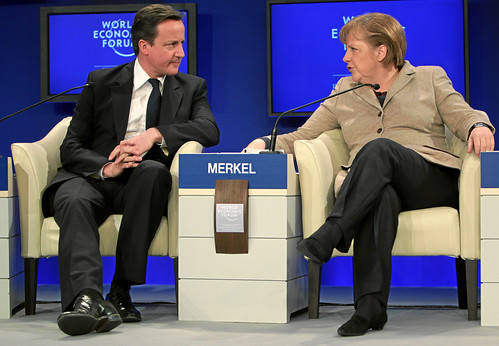
Angela and Dave fight it out over EU's future

It’s the fundamental question facing the EU today: should the union integrate, or disintegrate? In two duelling speeches yesterday the British prime minister and the German chancellor took polar opposite positions on the answer.

David Cameron’s speech, delivered just hours after Angela Merkel delivered a speech to her conservative CDU party conference calling for further European integration, appeared to be a direct response to the German chancellor. Describing himself as a Eurosceptic, Cameron said the EU had overreached in its ambitions and that the euro crisis is "an opportunity, in Britain's case, for powers to ebb back instead of flow away and for the European Union to focus on what really matters".

Merkel’s speech hours earlier had delivered the opposite message. Telling the audience that Europe faced its greatest challenge since the second world war, she said, “The task of our generation is to complete economic and monetary union and build political union in Europe step by step…that does not mean less Europe, it means more Europe.”

Considering the influence of the UK in Europe compared with the influence of Germany, it was a bit like a pygmy picking a fight with a giant. Cameron’s argument may find a sympathetic audience with the British press, but among national governments – even those in his ‘Northern bloc’ – the idea that the crisis is an opportunity to pull Europe apart is not very alluring. But whether or not the UK actually has the influence to sell Europe on the idea of downgrading the EU to merely a free trade zone, the fact is this may happen anyway. But few outside Britain would describe this as a desirable outcome.

Tuesday, 8 November 2011

Berlusconi is finished - for real this time

This blog has predicted the imminent resignation of Italian prime minister Silvio Berlusconi many times. In fact I counted, and in the past six years the blog claimed on five separate occasions that his sex and corruption scandals were about to topple him. After all it was hard to believe that a leader facing the kind of allegations he has faced could have held on to power. But this is Italy, and the normal rules don't apply.

But now it seems that the markets have accomplished what common decency couldn't - they have forced Silvio Berlusconi out of power. Tonight the Italian leader announced he will step down.

Rumours to this effect were swirling yesterday, causing European markets to rally and the euro's value to shoot up. But then Berlusoni issued a denial of the rumours on his Facebook page (where else?) and the markets tumbled. This was a clear sign: the markets had lost any shred of faith in Berlusconi to implement the reforms he promised European leaders last month. Berlusconi has survived many things, but when it came to the all-powerful markets that seem to be calling the shots these days, he was no match.

Thursday, 3 November 2011

Was it all for nought?

Greek Prime Minister George Papandreou is getting an earful today at the G20 summit in Cannes from world leaders furious at his shocking and sudden call for a referendum on the Greek bailout on Tuesday. The surprise announcement sent markets into a tailspin and seemed to, in an instant, eviscerate the deal painstakingly crafted last week by European leaders to save the euro. Now for the first time EU leaders are today openly talking about Greece leaving the Euro. Was last week's all-night negotiating session all for nothing?

Papandreou is facing the same level of fury at home, much of it coming from within his own party. His own finance minister broke ranks shortly after the announcement and reacted with incredulity to the idea of calling a referendum. Papandreou's Socialist government is now hanging by a thread as it looks like he will have to step down or face an imminent vote of no confidence.

Reports coming out of the G20 meeting this afternoon indicate that Papandreou may have been convinced to cancel his call for a referendum. But whether he cancels the referendum or his soon-to-come replacement does, it will only serve to enrage the Greek public further. Promising them a referendum and then snatching it away is undoubtedly worse than having never promised a referendum at all.

Thursday, 27 October 2011

Just Lips service?

So the Euro is saved, for now. At 4am European leaders finally emerged from their talks to tell the fatigued journalists that after hours of very difficult negotiations, they had come to an agreement that will give the markets what they are demanding.

Perhaps it was the late hour, or the fact that the Polish presidency had closed the press bar at 11pm, but the journalists covering the summit initially greeted the announcement with scepticism. Many questioned whether the "bazooka" just unveiled really had the firepower to shield Spain and Italy from collapse. After all, this was not the first time the press had been held captive until late into the night in the Justus Lipsius building - or 'Just Lips' as I like to call it - to be told at the break of dawn that the euro would be saved. So in the end, was this just lip service? Or was this the decisive action the markets needed to see?

The agreement has three prongs:
  • Private banks holding Greek debt will accept a loss of 50% on their Greek bonds
  • The eurozone's main bailout fund (the European financial stability facility or EFSF) will be leveraged to €1 trillion.
  • Italy will implement reforms to bring down the country's staggering debt, including a lowering of the retirement age.

Wednesday, 26 October 2011

Will Europe be saved tonight?

I'm here at the big EU summit in Brussels, the D-day event that is being billed as the last chance to save the Euro and prevent a collapse of the European economy. Even if the leaders emerge from those fortified doors having done everything the markets are asking, there will still be a long road ahead in this crisis. But this could be the moment they were finally able to turn the tide and appear in control.

Or it could be remembered as the moment where the entire European project collapsed. The tension in the press room is palpable. It's hard to say if it's coming from the stressed-out journalists or seeping in from the inner chambers where the European leaders are meeting. Either way, I would venture to say the Justus Lipsius building (or 'Just Lips' as I like to call it) is one of the most tense places on earth at the moment.

The markets need the leaders to come out of those doors and tell the press room two things: First, that they have amassed a trillion euro war chest to protect all of the Southern European economies, including Italy and Spain, from collapse. Second, that Italy has agreed to put in place a drastic austerity plan in line with what is being imposed on Greece.

Monday, 24 October 2011

UK sidelined as Cameron faces attack from Sarko and his own MPs

David Cameron's quest for influence at this week's Eurozone crisis meetings is meeting headwinds, to say the least. First French president Nicolas Sarkozy tells him to 'shut up' at yesterday's summit, and now he is facing a rebellion his back-bench Eurosceptic MPs.

Tonight the rebels will try to force a vote in the parliament to set a public referendum in the UK on its EU membership. Cameron opposes such a referendum and has instructed his party to vote against it, as have the leaders of his coalition partners the Liberal Democrats and the opposition Labour. But 70 Conservative MPs are expected to defy him and vote for a referendum.

Of course, the measure has no hope of passing. But commentators and the markets,will be focused on the message that the rebellion will send at this precarious and sensitive time. British foreign secretary William Hague, who is himself quite eurosceptic, told the BBC that the vote being forced by the back-benchers is "the wrong question at the wrong time" and has likened it to "a piece of graffiti". The vote will "create additional economic uncertainty in this country at a difficult economic time," he said.

Cameron has imposed a 'three-line whip' on his party to vote against the measure, which is the most serious whip a party can issue. Any MPs who disobey will be expected to resign from government jobs. Cameron has said the preceding Labour Party should have held a public referendum on the ratification of the Lisbon Treaty, and he has pledged to hold a referendum on any future treaty changes. But he says an 'in-out' referendum would be counter-productive. This is likely because he knows such a referendum could easily yield an 'out' result, plunging the UK into a diplomatic and economic crisis.