It's a process that's been long in the making, but this weekend's election in Spain seemed to be the final nail in the coffin for European Democratic Socialism - at least for the moment. With the fall of the Socialist government of Jose Luis Rodriguez Zapatero in Spain, following on the heels of the fall of Socialist prime minister George Papandreou in Greece two weeks ago, the EU is now left with only two centre-left governments - Denmark and Austria.
The already dwindling left was already not in a good position, with just five centre-left governments out of the 27 EU states at the beginning of the year. Four of those governments have since fallen, including the collapse of the Slovenian government in September (new elections, which the Left is certain to lose, will be held next month). Only the Austrian government has survived, and they were joined by the Danish social democrats who won a trend-defying election in September. Cyprus, which has a communist (but in truth more nationalist) government, does not sit with the centre-right grouping in Europe.
At the same time, five governments now have provisional or technocratic governments - effectively under the control of the markets and the dominant centre-right governments of Europe. The presidencies of the three institutions of EU governance - the commission, the parliament and the council - are all held by the centre-right. The situation is unprecedented. The irony is, at this time of crisis when Europe seems to be tearing itself apart, the governments of Europe have never been so ideologically united - at least in terms of the left-right divide.
Showing posts with label George Papandreou. Show all posts
Monday, 21 November 2011
Friday, 4 November 2011
Who is the villain in the eurocrisis movie?
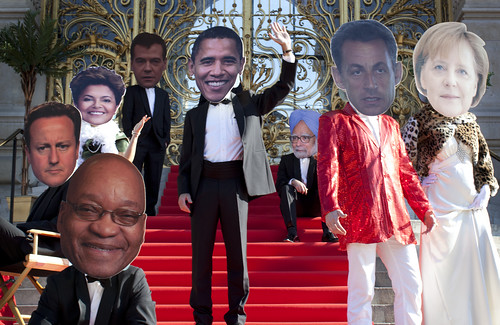
Cannes has seen its fair share of cinematic flops over the years. But this red carpet-laden city on France's south coast has never seen a political flop like the one it witnessed over the past two days. It had all the elements of an edge-of-your-seat political thriller: high stakes, sudden plot twists, personal rivalries and looming global disaster. But who is the villain in this particular script? Today there was plenty of finger-pointing to go around.
The leaders of the world's 20 richest countries intended to come to Cannes to come up with a solution to global economic crisis which is quickly spiraling out of control. But a shock announcement Tuesday from the Greek prime minister that he would hold a referendum on Greece's acceptance of the bailout package worked out last week changed all that. The resulting outcry threw the Greek government into disarray, putting it near collapse - which could have precipitated a global emergency. The leaders of the 20 richest countries in the world ended up working out nothing, spending the entire summit glued to their blackberries waiting for news from a tiny country in the Mediterranean.
The leaders left Cannes tonight with nothing to show for their meeting. No plan to save the eurozone, no funding, and no consensus. Indeed the G20 summit has ended with the world in a worse state than it was in when it started. Europe, and the world, could be just days away from economic collapse if the Greek government collapses tonight in a no-confidence vote scheduled for midnight.
The leaders of the world's 20 richest countries intended to come to Cannes to come up with a solution to global economic crisis which is quickly spiraling out of control. But a shock announcement Tuesday from the Greek prime minister that he would hold a referendum on Greece's acceptance of the bailout package worked out last week changed all that. The resulting outcry threw the Greek government into disarray, putting it near collapse - which could have precipitated a global emergency. The leaders of the 20 richest countries in the world ended up working out nothing, spending the entire summit glued to their blackberries waiting for news from a tiny country in the Mediterranean.
The leaders left Cannes tonight with nothing to show for their meeting. No plan to save the eurozone, no funding, and no consensus. Indeed the G20 summit has ended with the world in a worse state than it was in when it started. Europe, and the world, could be just days away from economic collapse if the Greek government collapses tonight in a no-confidence vote scheduled for midnight.
Location:
Cannes, France
Thursday, 3 November 2011
Was it all for nought?
Greek Prime Minister George Papandreou is getting an earful today at the G20 summit in Cannes from world leaders furious at his shocking and sudden call for a referendum on the Greek bailout on Tuesday. The surprise announcement sent markets into a tailspin and seemed to, in an instant, eviscerate the deal painstakingly crafted last week by European leaders to save the euro. Now for the first time EU leaders are today openly talking about Greece leaving the Euro. Was last week's all-night negotiating session all for nothing?
Papandreou is facing the same level of fury at home, much of it coming from within his own party. His own finance minister broke ranks shortly after the announcement and reacted with incredulity to the idea of calling a referendum. Papandreou's Socialist government is now hanging by a thread as it looks like he will have to step down or face an imminent vote of no confidence.
Reports coming out of the G20 meeting this afternoon indicate that Papandreou may have been convinced to cancel his call for a referendum. But whether he cancels the referendum or his soon-to-come replacement does, it will only serve to enrage the Greek public further. Promising them a referendum and then snatching it away is undoubtedly worse than having never promised a referendum at all.
Papandreou is facing the same level of fury at home, much of it coming from within his own party. His own finance minister broke ranks shortly after the announcement and reacted with incredulity to the idea of calling a referendum. Papandreou's Socialist government is now hanging by a thread as it looks like he will have to step down or face an imminent vote of no confidence.
Reports coming out of the G20 meeting this afternoon indicate that Papandreou may have been convinced to cancel his call for a referendum. But whether he cancels the referendum or his soon-to-come replacement does, it will only serve to enrage the Greek public further. Promising them a referendum and then snatching it away is undoubtedly worse than having never promised a referendum at all.
Subscribe to:
Comments (Atom)