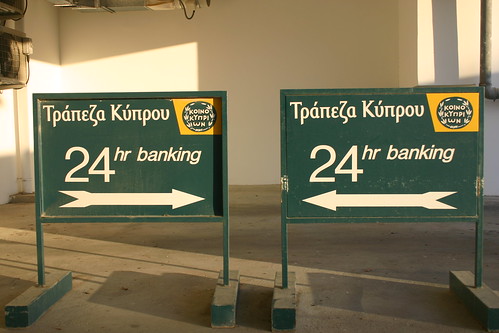
With EU-Turkey relations at an all-time low, the reunification of Cyprus seems like a distant prospect. This week I saw an island where the frozen conflict has become largely normalized. Unlike in Berlin, this wall doesn't look like its falling any time soon.
Sometimes, old wounds just won't heal. So it is with the island of Cyprus, where a 180 kilometer scar runs from shore to shore, and has been festering for four decades.
I visited the island for the first time this week, and those wounds were on display right from the start. As my plane flew across Greek Cyprus, over the capital Nicosia, I could see the giant Turkish flag painted on the mountains to the north, taunting the Greeks. It reminded me of the Alexanderplatz TV Tower in Berlin, built to be unavoidably visible everywhere in West Berlin during the Cold War.
The trip was, admittedly, somewhat of a box-checking exercise. Of the 32 European Union and EFTA countries, there are three left that I haven't visited - Cyprus, Slovenia and Romania. I'm heading to Slovenia next month for a conference, and have resolved to do a weekend in Bucharest before the year is done. Then - I win?
Showing posts with label Greece. Show all posts
Thursday, 15 March 2018
Monday, 6 July 2015
Berliners and Madriders see Greek referendum very differently
Berliners seem calm about yesterday's 'no' vote in Greece, but they also don't seem inclined to cut the Greeks any slack.
Ahead of yesterday's Greek referendum, I was in Madrid for the weekend with some friends from Brussels. I arrived back in Berlin last night. The contrast between the opinions I encountered in these two capitals could not be more stark.
During Saturday's Madrid gay pride parade, one of the highlights was a large Greek flag making its way down the parade route. The flag was greeted by huge cheers, just a day before the Greeks were set to go to the polls for a referendum which was being billed by EU leaders as an in-out vote on the country's euro membership.
The flag was, I believe, carried by the contingent of Podemos, Spain's far-left opposition party which is closely aligned with Syriza, the far-left governing party in Greece. But the cheers weren't for Podemos. They were in solidarity with the Greek people. This sentiment was largely reflected in the conversations I had with people there. They were sympathetic, and supportive of a debt write-off.
Wednesday, 20 March 2013
A Cyprus whodunit
All sides agree on one thing – the decision taken by European finance ministers in the
early hours of Saturday morning to require a
one-time levy on all Cypriot bank accounts in exchange for the bail-out was
colossally stupid, plunging the Eurozone into a new crisis and risking a bank
run in the country. What cannot be agreed upon is whose idea it was.
Raiding people’s savings accounts is an unprecedented move.
Such conditions were not imposed on any other country receiving bailout money,
and indeed no such idea was ever even discussed. But Cyprus is a special case. As the
likelihood of an EU bailout for the small Mediterranean island increased, worry
began growing that the move would actually be a bail-out for wealthy Russian
oligarchs who use the island for money-laundering or tax-evading.
Wednesday, 20 June 2012
In Cypriot hands
On 1 July Cyprus will take over the rotating 6-month presidency of the European Union from Denmark. It is almost the perfect storm of fragility – the union is set to be led by one of its weakest members at a time when its own weakness threatens to tear it apart.
The Greek Cypriot government, which is the one that will be taking over the presidency, rules over just 800,000 people - fewer than live in the EU’s ‘capital city’ Brussels. This of course excludes the 300,000 Turkish-speaking people in Northern Cyprus, a self-governing break-away territory that has been separate since the country’s civil war in 1974. But as the EU does not recognise the existence of Northern Cyprus, nominally the entire island is taking over the presidency.
Turkey, whose military still occupies Northern Cyprus, is the only country that recognises it as a country. The Greek Cypriot government considers itself to be the ruler of the whole island, as does the EU. But they are effectively two separate countries in an open state of war, but with a cease-fire.
Friday, 8 June 2012
All eyes on Angela
These have been anxious times here in Europe, but this month tensions have risen to a whole new level. The world may be just weeks away from financial collapse. There is an increasing consensus that there is only one person who can prevent the catastrophe – Angela Merkel.
Next Sunday Greeks will return to the polls in a do-over election that is likely to yield the same unacceptable result – a majority in parliament who refuse to abide by the austerity conditions attached to their financial bailout. This means they can no longer receive the bailout, which means they will have to leave the euro, which economists say is very likely to spark a domino effect for other countries like Spain and Italy dropping out. Panic would ensue.
But the world may not have the luxury to wait until the 14th. There are rumours circulating today that Spain is going to have to ask the EU for a bail-out tomorrow. This could set off a financial earthquake globally, as it would be the first large EU country to have to be bailed out (so far only Greece, Ireland and Portugal have received bail-outs).
There is a lot that is uncertain about the way the next three weeks will play out. But there is one thing is certain - only Germany can pull Europe back from the brink. It is the largest European financial power by far, and it is the only one with the heft - and the resources - to stun the debt markets into submission. So far it has resisted every entreaty to do so. But time is running out.
Next Sunday Greeks will return to the polls in a do-over election that is likely to yield the same unacceptable result – a majority in parliament who refuse to abide by the austerity conditions attached to their financial bailout. This means they can no longer receive the bailout, which means they will have to leave the euro, which economists say is very likely to spark a domino effect for other countries like Spain and Italy dropping out. Panic would ensue.
But the world may not have the luxury to wait until the 14th. There are rumours circulating today that Spain is going to have to ask the EU for a bail-out tomorrow. This could set off a financial earthquake globally, as it would be the first large EU country to have to be bailed out (so far only Greece, Ireland and Portugal have received bail-outs).
There is a lot that is uncertain about the way the next three weeks will play out. But there is one thing is certain - only Germany can pull Europe back from the brink. It is the largest European financial power by far, and it is the only one with the heft - and the resources - to stun the debt markets into submission. So far it has resisted every entreaty to do so. But time is running out.
Friday, 18 May 2012
Obama gets tough with Merkel, but is it too late?
Now that German Chancellor Angela Merkel has been hobbled by
the loss of her key ally in France,
it seems the Obama administration is wasting no time in pressuring her into a
course correction. The chorus of anti-austerity (and by extension anti-Merkel)
voices is growing louder by the minute.
At next week’s G8 summit at Camp David, Barack Obama is reportedly going to put pressure on Germany to drop its insistence on the Eurozone economies adopting a severe austerity regime. He will ask Merkel to instead pursue a policy of stimulus and growth. He will apparently do so in no uncertain terms – warning Merkel that if she does not change course quickly she risks plunging the world into another deep recession that would be even worse than the Lehman Bros collapse in 2008.
The Guardian reports that the Obama administration is expected to try to forge close ties with new French President Francois Hollande at the first meeting of the two leaders on Tuesday. They are keen to rapidly establish Hollande as an ally in exerting pressure on Merkel to change course.
Obama already has the support of UK Prime Minister David Cameron, who while unwavering in his demand for austerity at home, publicly chastised the German chancellor in a speech yesterday for her lack of flexibility. Saying that the eurozone either had to “make up…or break up”, he said urgent steps are needed quickly to prevent an economic implosion of epic proportions in the coming weeks. He will reportedly tell Merkel this weekend to use Germany's wealth to rescue Southern Europe before it is too late.
At next week’s G8 summit at Camp David, Barack Obama is reportedly going to put pressure on Germany to drop its insistence on the Eurozone economies adopting a severe austerity regime. He will ask Merkel to instead pursue a policy of stimulus and growth. He will apparently do so in no uncertain terms – warning Merkel that if she does not change course quickly she risks plunging the world into another deep recession that would be even worse than the Lehman Bros collapse in 2008.
The Guardian reports that the Obama administration is expected to try to forge close ties with new French President Francois Hollande at the first meeting of the two leaders on Tuesday. They are keen to rapidly establish Hollande as an ally in exerting pressure on Merkel to change course.
Obama already has the support of UK Prime Minister David Cameron, who while unwavering in his demand for austerity at home, publicly chastised the German chancellor in a speech yesterday for her lack of flexibility. Saying that the eurozone either had to “make up…or break up”, he said urgent steps are needed quickly to prevent an economic implosion of epic proportions in the coming weeks. He will reportedly tell Merkel this weekend to use Germany's wealth to rescue Southern Europe before it is too late.
Monday, 30 January 2012
What’s wrong with a transfer union?
The eurocrisis has introduced a plethora of strange words into our everyday vocabulary: ‘Contagion’, ‘technocrats’, ‘moral hazard’, ‘austerity’ and of course the derisive description, ‘transfer union’. This last term is used by those in Northern Europe who warn that bailing out the economies of Southern Europe will lead to a European Union where money steadily flows from rich states to poor states and the North loses out. Many argue that, in fact, this is what the EU has always been.
Such feelings are at the core of the German public’s resistance to the Greek bail-outs – emotions that have turned what is normally one of Europe’s most pro-EU countries into a relatively more eurosceptic place these days. “Why should we work hard just to see our money flow to lazy people in the south?” some Germans are asking.
Their resentment is fueled by charts like the interactive diagram below, found in the Guardian newspaper’s new ‘Europa’ section (a truly fantastic project with five other papers that I’m very excited about). It shows which countries are net ‘payers’ into the EU, and which are net ‘receivers’. The statistics are familiar and often brought up when people talk about the European Union – the biggest recipients of EU funds are in Southern and Eastern Europe while the biggest contributors are in Northern Europe.
Such feelings are at the core of the German public’s resistance to the Greek bail-outs – emotions that have turned what is normally one of Europe’s most pro-EU countries into a relatively more eurosceptic place these days. “Why should we work hard just to see our money flow to lazy people in the south?” some Germans are asking.
Their resentment is fueled by charts like the interactive diagram below, found in the Guardian newspaper’s new ‘Europa’ section (a truly fantastic project with five other papers that I’m very excited about). It shows which countries are net ‘payers’ into the EU, and which are net ‘receivers’. The statistics are familiar and often brought up when people talk about the European Union – the biggest recipients of EU funds are in Southern and Eastern Europe while the biggest contributors are in Northern Europe.
Monday, 21 November 2011
Europe's left has vanished from the map
It's a process that's been long in the making, but this weekend's election in Spain seemed to be the final nail in the coffin for European Democratic Socialism - at least for the moment. With the fall of the Socialist government of Jose Luis Rodriguez Zapatero in Spain, following on the heels of the fall of Socialist prime minister George Papandreou in Greece two weeks ago, the EU is now left with only two centre-left governments - Denmark and Austria.
The already dwindling left was already not in a good position, with just five centre-left governments out of the 27 EU states at the beginning of the year. Four of those governments have since fallen, including the collapse of the Slovenian government in September (new elections, which the Left is certain to lose, will be held next month). Only the Austrian government has survived, and they were joined by the Danish social democrats who won a trend-defying election in September. Cyprus, which has a communist (but in truth more nationalist) government, does not sit with the centre-right grouping in Europe.
At the same time, five governments now have provisional or technocratic governments - effectively under the control of the markets and the dominant centre-right governments of Europe. The presidencies of the three institutions of EU governance - the commission, the parliament and the council - are all held by the centre-right. The situation is unprecedented. The irony is, at this time of crisis when Europe seems to be tearing itself apart, the governments of Europe have never been so ideologically united - at least in terms of the left-right divide.
The already dwindling left was already not in a good position, with just five centre-left governments out of the 27 EU states at the beginning of the year. Four of those governments have since fallen, including the collapse of the Slovenian government in September (new elections, which the Left is certain to lose, will be held next month). Only the Austrian government has survived, and they were joined by the Danish social democrats who won a trend-defying election in September. Cyprus, which has a communist (but in truth more nationalist) government, does not sit with the centre-right grouping in Europe.
At the same time, five governments now have provisional or technocratic governments - effectively under the control of the markets and the dominant centre-right governments of Europe. The presidencies of the three institutions of EU governance - the commission, the parliament and the council - are all held by the centre-right. The situation is unprecedented. The irony is, at this time of crisis when Europe seems to be tearing itself apart, the governments of Europe have never been so ideologically united - at least in terms of the left-right divide.
Friday, 18 November 2011
The new Italy: this is what technocracy looks like
Former EU commissioner Mario Monti, appointed as Italian prime minister on Sunday after Silvio Berlusconi was forced by the markets and EU leaders to resign, had his ‘technocrat government’ approved by the Italian parliament today.
Neither Monti nor the members of his cabinet have been elected by the Italian people. They are not politicians but instead experts in their respective fields. The 'government of experts' has been brought in because, it was thought, both within and outside Italy, the Italian political system is so broken that only unelected non-politicians could be trusted to implement the reforms EU leaders say are necessary to prevent the country’s economic collapse.
American readers may be wondering how on earth a national leader in a democracy could come into power without having been elected. It has to do with a quirk in parliamentary democracy. Members of the upper houses of many of Europe’s parliaments (their equivalents of the US Senate) are appointed rather than elected. A prime minister can come from either house, so if the parliament wishes to appoint a leader who has not been elected they simply have the president appoint that person to the senate.
Neither Monti nor the members of his cabinet have been elected by the Italian people. They are not politicians but instead experts in their respective fields. The 'government of experts' has been brought in because, it was thought, both within and outside Italy, the Italian political system is so broken that only unelected non-politicians could be trusted to implement the reforms EU leaders say are necessary to prevent the country’s economic collapse.
American readers may be wondering how on earth a national leader in a democracy could come into power without having been elected. It has to do with a quirk in parliamentary democracy. Members of the upper houses of many of Europe’s parliaments (their equivalents of the US Senate) are appointed rather than elected. A prime minister can come from either house, so if the parliament wishes to appoint a leader who has not been elected they simply have the president appoint that person to the senate.
Friday, 11 November 2011
Are we done with democracy?
This was the question being asked on the BBC's Newsnight programme Wednesday night. Italian economist Vito Tanzi said during the interview that a government of unelected technocrats can do what elected politicians cannot - tell people the truth and push through unpopular but necessary reforms. "It can do a better job of informing people what needs to be done. I think that is the problem that the Italians were told for many years that there were no problems, that nothing needed to be done when the situation was progressively getting worse. If you have this kind of government, then sooner or later you get in trouble. The technical people would know better and would tell people what the consequences are of continuing with current policies"
He was of course speaking of his friend Mario Monti, the former EU Competition Commissioner who is set to be appointed new Italian prime minister.
In Greece, it was announced yesterday that another EU official, former European Central Bank vice president Lucas Papademos, will be appointed prime minister of Greece. Neither of these men has ever been elected to any office in their home countries. But both were appointed by their countries to their EU positions, and both earned praise for their performance in those positions. Greece and Italy are joining the two EU countries which already have provisional unelected governments - Slovakia (whose government collapsed after the parliament refused to back the Greece bail-out) and Belgium.
Tuesday, 8 November 2011
Berlusconi is finished - for real this time
This blog has predicted the imminent resignation of Italian prime minister Silvio Berlusconi many times. In fact I counted, and in the past six years the blog claimed on five separate occasions that his sex and corruption scandals were about to topple him. After all it was hard to believe that a leader facing the kind of allegations he has faced could have held on to power. But this is Italy, and the normal rules don't apply.
But now it seems that the markets have accomplished what common decency couldn't - they have forced Silvio Berlusconi out of power. Tonight the Italian leader announced he will step down.
Rumours to this effect were swirling yesterday, causing European markets to rally and the euro's value to shoot up. But then Berlusoni issued a denial of the rumours on his Facebook page (where else?) and the markets tumbled. This was a clear sign: the markets had lost any shred of faith in Berlusconi to implement the reforms he promised European leaders last month. Berlusconi has survived many things, but when it came to the all-powerful markets that seem to be calling the shots these days, he was no match.
But now it seems that the markets have accomplished what common decency couldn't - they have forced Silvio Berlusconi out of power. Tonight the Italian leader announced he will step down.
Rumours to this effect were swirling yesterday, causing European markets to rally and the euro's value to shoot up. But then Berlusoni issued a denial of the rumours on his Facebook page (where else?) and the markets tumbled. This was a clear sign: the markets had lost any shred of faith in Berlusconi to implement the reforms he promised European leaders last month. Berlusconi has survived many things, but when it came to the all-powerful markets that seem to be calling the shots these days, he was no match.
Friday, 4 November 2011
Who is the villain in the eurocrisis movie?
Cannes has seen its fair share of cinematic flops over the years. But this red carpet-laden city on France's south coast has never seen a political flop like the one it witnessed over the past two days. It had all the elements of an edge-of-your-seat political thriller: high stakes, sudden plot twists, personal rivalries and looming global disaster. But who is the villain in this particular script? Today there was plenty of finger-pointing to go around.
The leaders of the world's 20 richest countries intended to come to Cannes to come up with a solution to global economic crisis which is quickly spiraling out of control. But a shock announcement Tuesday from the Greek prime minister that he would hold a referendum on Greece's acceptance of the bailout package worked out last week changed all that. The resulting outcry threw the Greek government into disarray, putting it near collapse - which could have precipitated a global emergency. The leaders of the 20 richest countries in the world ended up working out nothing, spending the entire summit glued to their blackberries waiting for news from a tiny country in the Mediterranean.
The leaders left Cannes tonight with nothing to show for their meeting. No plan to save the eurozone, no funding, and no consensus. Indeed the G20 summit has ended with the world in a worse state than it was in when it started. Europe, and the world, could be just days away from economic collapse if the Greek government collapses tonight in a no-confidence vote scheduled for midnight.
The leaders of the world's 20 richest countries intended to come to Cannes to come up with a solution to global economic crisis which is quickly spiraling out of control. But a shock announcement Tuesday from the Greek prime minister that he would hold a referendum on Greece's acceptance of the bailout package worked out last week changed all that. The resulting outcry threw the Greek government into disarray, putting it near collapse - which could have precipitated a global emergency. The leaders of the 20 richest countries in the world ended up working out nothing, spending the entire summit glued to their blackberries waiting for news from a tiny country in the Mediterranean.
The leaders left Cannes tonight with nothing to show for their meeting. No plan to save the eurozone, no funding, and no consensus. Indeed the G20 summit has ended with the world in a worse state than it was in when it started. Europe, and the world, could be just days away from economic collapse if the Greek government collapses tonight in a no-confidence vote scheduled for midnight.
Location:
Cannes, France
Thursday, 3 November 2011
Was it all for nought?
Greek Prime Minister George Papandreou is getting an earful today at the G20 summit in Cannes from world leaders furious at his shocking and sudden call for a referendum on the Greek bailout on Tuesday. The surprise announcement sent markets into a tailspin and seemed to, in an instant, eviscerate the deal painstakingly crafted last week by European leaders to save the euro. Now for the first time EU leaders are today openly talking about Greece leaving the Euro. Was last week's all-night negotiating session all for nothing?
Papandreou is facing the same level of fury at home, much of it coming from within his own party. His own finance minister broke ranks shortly after the announcement and reacted with incredulity to the idea of calling a referendum. Papandreou's Socialist government is now hanging by a thread as it looks like he will have to step down or face an imminent vote of no confidence.
Reports coming out of the G20 meeting this afternoon indicate that Papandreou may have been convinced to cancel his call for a referendum. But whether he cancels the referendum or his soon-to-come replacement does, it will only serve to enrage the Greek public further. Promising them a referendum and then snatching it away is undoubtedly worse than having never promised a referendum at all.
Papandreou is facing the same level of fury at home, much of it coming from within his own party. His own finance minister broke ranks shortly after the announcement and reacted with incredulity to the idea of calling a referendum. Papandreou's Socialist government is now hanging by a thread as it looks like he will have to step down or face an imminent vote of no confidence.
Reports coming out of the G20 meeting this afternoon indicate that Papandreou may have been convinced to cancel his call for a referendum. But whether he cancels the referendum or his soon-to-come replacement does, it will only serve to enrage the Greek public further. Promising them a referendum and then snatching it away is undoubtedly worse than having never promised a referendum at all.
Thursday, 27 October 2011
Just Lips service?
So the Euro is saved, for now. At 4am European leaders finally emerged from their talks to tell the fatigued journalists that after hours of very difficult negotiations, they had come to an agreement that will give the markets what they are demanding.
Perhaps it was the late hour, or the fact that the Polish presidency had closed the press bar at 11pm, but the journalists covering the summit initially greeted the announcement with scepticism. Many questioned whether the "bazooka" just unveiled really had the firepower to shield Spain and Italy from collapse. After all, this was not the first time the press had been held captive until late into the night in the Justus Lipsius building - or 'Just Lips' as I like to call it - to be told at the break of dawn that the euro would be saved. So in the end, was this just lip service? Or was this the decisive action the markets needed to see?
The agreement has three prongs:
Perhaps it was the late hour, or the fact that the Polish presidency had closed the press bar at 11pm, but the journalists covering the summit initially greeted the announcement with scepticism. Many questioned whether the "bazooka" just unveiled really had the firepower to shield Spain and Italy from collapse. After all, this was not the first time the press had been held captive until late into the night in the Justus Lipsius building - or 'Just Lips' as I like to call it - to be told at the break of dawn that the euro would be saved. So in the end, was this just lip service? Or was this the decisive action the markets needed to see?
The agreement has three prongs:
- Private banks holding Greek debt will accept a loss of 50% on their Greek bonds
- The eurozone's main bailout fund (the European financial stability facility or EFSF) will be leveraged to €1 trillion.
- Italy will implement reforms to bring down the country's staggering debt, including a lowering of the retirement age.
Wednesday, 14 September 2011
US tells Europe to act quickly on euro crisis
Obama said he will put the issue at the top of the agenda for the G20 meeting in France in November. "[European leaders] are taking some steps to slow the crisis but not solve the crisis," the president told a group of journalists at the White House. "The bigger problem is what happens in Spain and Italy if the markets keep making a run at those very big countries?" Few would disagree with the president on these sentiments, but it might be hard to take from a country which almost deliberately drove itself to default because of its broken political system.
Friday, 9 September 2011
War of words between PIGS and FANGs
The European Commissioner from Spain delivered a surprising attack yesterday on the Northern European countries pushing Southern Europe to adopt painful austerity measures. The comments follow a controversial proposal from the Dutch prime minister earlier this week which called for EU member states struggling with debt to be put under the 'guardianship' of the European Commission, surrendering their ability to make their own financial decisions.
"There are member states, in particular some of the most powerful -- Germany, Netherlands, Finland, Austria -- who feel that they don't have this kind of problem," Almunia told a group of business executives in New York. "[They believe] they don't need to make an additional effort to compensate the lack of resources of the countries who have the most difficulties to reduce imbalances."
The rhetoric was then ratcheted up to an even more dramatic level today when the European Commissioner from Germany told the tabloid Bild that if indebted (read: Southern) EU countries refuse to comply with new rules on debts and deficits, their flags should be flown at half mast outside institutional buildings. Mourning the loss of fiscal prudence, perhaps?
Wednesday, 7 September 2011
Germany backs bailouts – for now
The markets are breathing a sigh of relief today after Germany's constitutional court ruled that it is legal and in line with the EU treaties for the country to be bailing out its struggling Eurozone neighbors. But the jubilation may be short-lived, because in its ruling the court sewed a minefield of potential future obstacles that will have to be dealt with in the coming months.
The ruling was in response to a lawsuit from Eurosceptic German citizens who said the bail-outs of Portugal, Ireland and Greece to stem the European debt crisis are unconstitutional because the German parliament should have control over taxpayer money, rather than the European Central Bank. The court rejected that argument, saying Germany's participation did not amount to an excessive burden on the country's budget, nor did it constitute a significant transfer of power away from Berlin.
Germany is by far the largest contributor to the bailout funds. If the judges had sided with the challengers in this ruling today it would cast Germany's ability to participate in those bailouts into question, which in turn would have thrown the markets into turmoil. Instead, the announcement this morning sent European stocks shooting up. Amongst the German public, who are growing weary of what many perceive as Germans being on the hook for the profligate spending of their Southern neighbors.
The ruling was in response to a lawsuit from Eurosceptic German citizens who said the bail-outs of Portugal, Ireland and Greece to stem the European debt crisis are unconstitutional because the German parliament should have control over taxpayer money, rather than the European Central Bank. The court rejected that argument, saying Germany's participation did not amount to an excessive burden on the country's budget, nor did it constitute a significant transfer of power away from Berlin.
Germany is by far the largest contributor to the bailout funds. If the judges had sided with the challengers in this ruling today it would cast Germany's ability to participate in those bailouts into question, which in turn would have thrown the markets into turmoil. Instead, the announcement this morning sent European stocks shooting up. Amongst the German public, who are growing weary of what many perceive as Germans being on the hook for the profligate spending of their Southern neighbors.
Monday, 8 August 2011
Europe's choice: anger voters, or drop the euro
The decision to have the European Central Bank buy up Italian and Spanish bonds is a huge step toward fiscal union in Europe, and it did not come easily. Last week it looked like Europe's leaders were intending to reject any such move when they announced Thursday that they would buy only Irish and Portuguese bonds. This was effectively pointless because both of these countries are already getting EU bail-outs, and the markets took it as a sign that the ECB would not buy the Italian and Spanish bonds. This caused a panic, the bond yields of those countries plummeted even faster than they were earlier in the week.
The heart of the problem is this: the markets are demanding that the EU rapidly establish stronger fiscal union so that individual states don't collapse under the debt crisis and bring the common currency down with them. Essentially, the European Central Bank needs to take on the debt of the struggling economies. But European leaders are resisting doing so because the public mood for further European integration is so low right now.
Friday, 22 July 2011
Eurozone agrees second bailout for Greece
Stocks are rising today as the markets digest the news that Europe has taken a step back from the brink of economic disaster. Eurozone leaders yesterday agreed on a second €109bn bailout for Greece, something economists said had to come in the next few days to avoid calamity. Once again, Europe's leaders have taken a small step to narrowly avert disaster. But without a big step to reform the Eurozone, is there any end to the debt crisis in sight?
Greece's private lenders will be forced to participate in the bailout and take an estimated 21% loss on their loans to the country, in what is being called a 'selective default'. But it is still unclear whether the ratings agencies will decide this qualifies as a default or not. The private lender participation was something German Chancellor Angela Merkel wanted, but French President Nicolas Sarkozy and the European Central Bank had been resisting.
Wednesday, 13 July 2011
Eurozone in panic: Is Italy next domino to fall?
The Eurozone is looking at several doomsday scenarios this week after Italy emerged as the latest EU state to face serious and sudden attack by international bond and security markets. After a very public spat between Prime Minister Silvio Berlusconi and his finance minister, and with the continued political uncertainty over Berlusconi's position, the markets have decided Italy may not be safe to lend to any longer.
With the paralysis in the country's government likely to prevent decisive action to confront the crisis, some are saying Italy is perhaps days away from becoming an economic failed state. And unfortunately it is not too big to fail, but it is too big for the EU to bail out.
Such extreme rhetoric may or may not be justified, depending on who you talk to. But the risk is extreme. The countries that have so far fallen victim to the debt crisis and required an EU bailout – Portugal, Ireland and Greece – are relatively tiny and their debt makes up less than 5% of overall eurozone public debt. If worse came to worse, France and Germany could afford to buy back all of their debt combined.
With the paralysis in the country's government likely to prevent decisive action to confront the crisis, some are saying Italy is perhaps days away from becoming an economic failed state. And unfortunately it is not too big to fail, but it is too big for the EU to bail out.
Such extreme rhetoric may or may not be justified, depending on who you talk to. But the risk is extreme. The countries that have so far fallen victim to the debt crisis and required an EU bailout – Portugal, Ireland and Greece – are relatively tiny and their debt makes up less than 5% of overall eurozone public debt. If worse came to worse, France and Germany could afford to buy back all of their debt combined.
Subscribe to:
Comments (Atom)