Showing posts with label Germany. Show all posts
Showing posts with label Germany. Show all posts
Tuesday, 13 March 2018
A Trumpian trade war, a new German government, and an Italian election mess

Wednesday, 31 January 2018
The latest on Brexit and German coalition formation
Monday, 27 November 2017
The coalitions podcast: chaos in Berlin, calm in Bonn

Sunday, 19 November 2017
Berlin: the uncapital

I've been in Bonn, Germany the past two weeks, covering the UN climate talks. It's my first time in the former West German capital, and it's been a very eye-opening experience.
One of my clients is Deutsche Welle, Germany's public international broadcaster (roughly the equivalent of the BBC World Service). I work for them in their Brussels and Berlin offices, but their headquarters are in Bonn. So these weeks were an opportunity to finally meet many of my colleagues in person for the first time.
When I tell people outside Germany that DW's headquarters is in Bonn, and Berlin has a much smaller satellite office, they're surprised. "Why wouldn't they be based in Berlin?" they ask. In fact, DW's situation is not unusual. Very few German media companies are based in Berlin. The TV stations and national papers are often based in Hamburg or Cologne, maintaining only small 'Berlin bureaus'.
Sunday, 24 September 2017
Angela's bad night - a German election special
Friday, 15 September 2017
One speed or two? Juncker challenges Macron's EU vision
Sunday, 10 September 2017
Should Germans stop speaking English in Berlin?
Friday, 1 September 2017
Fake Brexit: Is Britain heading for pseudo-independence from the EU?
Sunday, 27 August 2017
Who will be Merkel's dance partner?
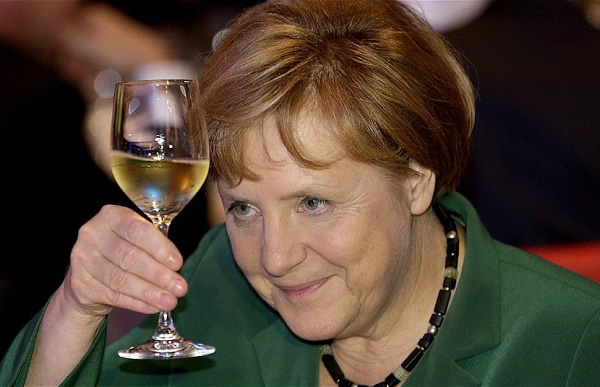
Compared to some of its neighbors, Germany isn’t known for having elections with edge-of-your-seat excitement. Particularly in the past decade, as Angela Merkel’s conservative CDU/CSU bloc has dominated politics, federal elections haven’t had much in the way of surprises.
But this year was supposed to be different. People expected a real contest between two credible candidates on September 24. That didn’t pan out.
Merkel has now been in power for twelve years, and she is running for a historic fourth term that could make her, along with Helmut Kohl, the longest-serving chancellor in modern German history. But many of her decisions have proved unpopular, particularly her controversial move to welcome Syrian refugees fleeing that country’s civil war in August 2015. It was thought that voters were ready for change.
Wednesday, 16 August 2017
Air Berlin's 'poor but sexy' collapse

On the outskirts of Berlin, hidden among closed motorways and unused train tracks, lies Germany's national embarrassment.
Berlin-Brandenburg Airport, originally scheduled to open as the German capital's first real properly sized airport in 2010, has been beset by delays and still sits unused today. As I discovered when I visited the site for a radio piece on Deutsche Welle two years ago, construction has actually finished and the airport is ready to go. But a fatal engineering flaw involving exhaust fans means it cannot open, and there is no solution in sight.
Friday, 28 July 2017
The German autostate

The allegations that have surfaced this month against German automakers seem to confirm the worst suspicions that many in Europe hold about the EU’s largest country: while they insist on rigid enforcement of rules for everyone else, Germans seem to think the rules don’t apply to them.
A report by Der Spiegel magazine last week alleged that Germany’s five biggest automakers - Volkswagen, BMW, Daimler, Porsche and Audi - have been colluding for two decades on pricing, suppliers and diesel technical standards, in order to give them leverage over foreign competitors. This week the European Union said it is investigating the issue, and has appointed a vice president to oversee the investigation.
Friday, 21 July 2017
On the way in, and on the way out?
Monday, 10 July 2017

Friday, 30 June 2017
Germany’s late but welcome turn on gay marriage

For several years, Germany has seemed like a strange anomaly in Western Europe on one of the key cultural issues of the modern era.
As country after country passed gay marriage in Europe and the Americas, Germany held out.
On the gay marriage map of Europe, a wave of dark blue came rushing in from the West. Starting with The Netherlands and Belgium in 2001, countries adopted full gay marriage.
The most surprising development came in 2015, when the Irish voted in a referendum to allow gay marriage - the first country to do so by public vote. Long known as a conservative country dominated by the Catholic church, it was a chance for the country to demonstrate just how much it has changed over the past three decades.
But meanwhile in central Europe, everything remained frozen.
Tuesday, 16 May 2017
After trauma of Lisbon, Macron faces uphill battle for EU treaty change
Emmanuel Macron made his first foreign visit as French president yesterday, coming here to Berlin for a meeting with Angela Merkel.
That Berlin was his first destination is no surprise. The Franco-German relationship is the most important for Paris, and also the most important relationship in the European Union as a whole. But there was an added importance to this first visit. During his campaign Macron made promises about a process of renewal and reform of the EU. None of that will be possible without the cooperation of Germany's chancellor.
We still do not know if Merkel, a conservative, will be that chancellor. Germany is having a general election in September and she may be unseated by her center-left challenger Martin Schulz, a former president of the European Parliament.
Thursday, 10 November 2016
Think you can escape America? Think again


Horrified by what I was seeing from Americans, I left the country a decade ago. But I came to learn that wherever I go, the American people determine my fate.
On 2 November 2004 I made a fateful choice. I was living in Chicago at the time, and was watching that year’s presidential election results at a friend’s apartment. We were all pretty sure that Democrat John Kerry was going to win. After all, sitting president George W Bush had been completely discredited by the Iraq War debacle, right?
It didn’t work out that way. Despite polls predicting a Kerry win, Bush emerged victorious. People at the apartment were perplexed, some were crying. I left by myself and walked to Lake Michigan. I stared out at the water and decided I did not see a future for myself in the United States. I vowed to move to Europe.
It didn’t work out that way. Despite polls predicting a Kerry win, Bush emerged victorious. People at the apartment were perplexed, some were crying. I left by myself and walked to Lake Michigan. I stared out at the water and decided I did not see a future for myself in the United States. I vowed to move to Europe.
Monday, 19 September 2016
This one map of Berlin shows all you need to know about Europe's refugee divide

Yesterday, German Chancellor Angela Merkel waited nervously in her unassuming Berlin residence while the voters in Germany's capital city determined her fate.
The vote taking place outside her door technically had nothing to do with her. It was a local election for the Berlin Parliament (landtag), not the national one (bundestag). Berlin and two other German cities (Hamburg and Bremen) are, for historical reasons, also federal states.
But the result would have a direct effect on Merkel's chancellorship because it came hot on the heels of her centre-right CDU party's humiliating defeat in her home state of Mecklenburg-Pomerania. The CDU came in third, behind the centre-left SPD and, alarmingly, the new nationalist party Alternative for Germany (AfD).
Monday, 5 September 2016
Merkel's far-right home state

Last month, I took a trip with some friends to the Northwest German island of Rügen in the Baltic Sea. It's a beautiful holiday island full of white chalk cliffs and rolling green hills. But when we were there, it was also full of sights of a more disconcerting variety - political ads for the far-right and racist messages splattered in graffiti.
As we left Berlin on the train and travelled north through Mecklenburg-Pomerania, signs for the far-right Alternative for Germany (AfD) and the extreme-right (neo-Nazi) National Democratic Party (NPD) became more and more frequent. They were all over the island, and were an especially frequent site in the island's departure city, Stralsund. On the posters for the main centrist German parties, Angela Merkel's center-right CDU and the center-left SPD (who are currently governing the country in a coalition), was written a chillingly familiar word in graffiti: volksverräter (traitor to the nation).
The only ads not splattered with grafitti were those for the AfD and NPD, some of which called Germany's new arrivals "rapefugees".
This is Chancellor Merkel's home turf - the constituency which she represents in the German parliament. And like parts of neighbouring Poland, it is not a friendly place for people of color.
Tuesday, 9 August 2016
My continuing adventures with the German language
 |
| Germany's schlager superstar Helene Fischer |
It's been a year since I started learning German and wrote my first blog entry about the language, and some have suggested that I do an update.
I'm reticent to do so because, to be perfectly honest, my German is really not at a level it should be for someone who started learning it a year ago. But my five-month long winter break in the Americas didn't really aid my process of German-learning. Though I intended to keep studying during my travels via an online course, once I got to Latin America I decided to do a short Spanish course while I was down there instead.
Needless to say, when I got back to Berlin in May and resumed my course, it was an overwhelming first day. I felt like I had forgotten everything from my elementary level class the year before and was starting from scratch. Particularly after having spent a few months learning a MUCH easier language (Spanish), I honestly felt like throwing in the towel. 'There are so many Americans here in Berlin that never bother learning German,' I thought. 'Why can't I be one of them?'
Monday, 1 August 2016
Erdogan’s Germans

Yesterday in Cologne, 30,000 German residents amassed in the city center to pledge allegiance to a foreign leader.
The demonstrators, Turkish immigrants or people of Turkish decent, were following a call to action from Turkish President Recep Tayyip Erdogan, asking people to show solidarity against the attempted military coup on 15 July. They brandished iconographied pictures of the Turkish strongman, waved Turkish flags and chanted their fidelity to Erdogan’s Islamist AKP party.
The Turkish president himself was supposed to address the crowd via a live video address, but this was banned by the police for fear that it would cause the crowd to become "overexcited".
Subscribe to:
Comments (Atom)