Showing posts with label English language. Show all posts
Showing posts with label English language. Show all posts
Sunday, 10 September 2017
Should Germans stop speaking English in Berlin?

Tuesday, 17 January 2017
May's Brexit vision depends on the goodwill of Australians

This morning in London, Theresa May will make what is probably the most important speech of her political career.
The British people "voted to leave the European Union and embrace the world" she will say, outlining a vision for the UK to completely cut itself off from the EU and instead focus on rebuilding a globally-focused maritime trading empire. The first focus will be on the countries which share a monarch with Britain - Australia, New Zealand and Canada.
I've been travelling through Australia for the past two weeks as part of a month-long visit, and I've been asking Australians how they feel about being part of Britain's glorious new trading vision. The reaction has largely been bemusement. But more on that later.
Tuesday, 9 August 2016
My continuing adventures with the German language
 |
| Germany's schlager superstar Helene Fischer |
It's been a year since I started learning German and wrote my first blog entry about the language, and some have suggested that I do an update.
I'm reticent to do so because, to be perfectly honest, my German is really not at a level it should be for someone who started learning it a year ago. But my five-month long winter break in the Americas didn't really aid my process of German-learning. Though I intended to keep studying during my travels via an online course, once I got to Latin America I decided to do a short Spanish course while I was down there instead.
Needless to say, when I got back to Berlin in May and resumed my course, it was an overwhelming first day. I felt like I had forgotten everything from my elementary level class the year before and was starting from scratch. Particularly after having spent a few months learning a MUCH easier language (Spanish), I honestly felt like throwing in the towel. 'There are so many Americans here in Berlin that never bother learning German,' I thought. 'Why can't I be one of them?'
Friday, 6 May 2016
English has taken over Eurovision

When the Eurovision Song Contest began in 1956, organisers had not thought to specify any policy for what language the acts could sing in. It was just assumed that each country would sing in their own language.
That changed in 1965, when Sweden showed up to the contest with an entry in English. France was not amused. They convinced the Geneva-based European Broadcasting Union, which runs the contest, to impose a rule requiring each country's entry to be in an official language of that country. Otherwise, they argued, English would erode the contest's cultural legitimacy.
Friday, 1 April 2016
Would Brexit banish English from continental Europe?

Much has been written about the future of the UK if it chooses to leave the European Union in June’s referendum. Less has been written about the effect of Brexit on the EU.
The loss of British influence in Europe would be felt in many ways, most likely resulting in a less neoliberal, free-market-oriented bloc. Recently I’ve written about the possibility of a more proactive EU environmental policy if the UK were to leave. But could a Brexit also affect linguistics?
Today The Local, an expat newspaper in France, published a tongue-in-cheek (note today's date) evaluation of what a Brexit would mean for the English language in Europe, given that it has long been in the crosshairs of the French government. They imagine a future where the Academie Francaise, France's notoriously strict language enforcer, would send patrols around the country looking for British expats who can't speak French. Given the (well-deserved) reputation of Anglophones for not sufficiently learning the langauges of the countries they move to, the April Fools article hits where it hurts.
But in fact there is truth behind this gag. Right now UK citizens have the right to live and work in France, and the government cannot require them to speak French in order to do so. Were the UK to leave the EU and not be allowed to join the European Economic Area, it would mean Brits would have to apply for a visa to live in France. And France could easily require language proficiency as a requirement for granting visas.
Friday, 6 November 2015
English in Berlin? Not as widespread as you might think

One of the biggest adjustments for me moving from Brussels to Berlin has been linguistic. For one thing, I moved from a city where I speak the language (French) to one where I don't (German).
But I'll admit it - even though I speak French I preferred to do most things in my native language when possible. In Brussels, this was most of the time. I only spoke French when I absolutely had to, either for work (a lot of French lawmakers don't speak English or are not allowed to), for dealing with Belgian administration, or socially if I was with a group of all Francophones (that didn't happen very often).
Wednesday, 24 March 2010
A Gallic Plot?
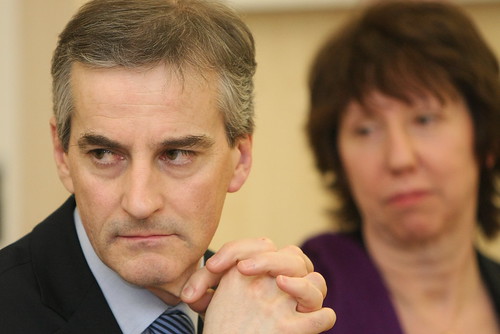 Yesterday there was an amusing story going around about how the French Europe minister has invited Catherine Ashton, the native Brit recently appointed as the EU’s first foreign minister, to learn “the language of diplomacy” at a school near Avignon.
 It was more of a tongue-in-cheek jest than an actual offer for assistance, but Ashton has taken him up on it and will be spending a month this summer in the south of France taking French lessons. But of course France’s offer wasn’t really about language. It reflects the increasing French dissatisfaction with Ashton as she creates the new EU diplomatic corps, which they fear is going to be dominated by the English.
Ashton speaks only rusty French, and she will only take questions at press conferences in English – a fact which has deeply irritated the French media. The fact that Ashton does not speak fluent French has been continually pointed out by those who think she is not qualified for the job. This is particularly true in France, where the phrase “the language of diplomacy” is not used with a smirk or as an old-timey throwback, but as their actual understanding of the world. Of course the reality is that French ceased to be the language of diplomacy 70 years ago, but don’t tell that to the French. Even within the EU, English has largely replaced French as the lingua franca since the accession of the Eastern European member states in 2004.
Friday, 15 January 2010
Who wants an EU Grammy?

Apparently this award show has been going since 2004, and previous winners include France’s Carla Bruni, Germany’s Tokio Hotel, Italy’s Tiziano Ferro and Benito Benasi, Sweden’s Basshunter and Britain’s The Ting Tings. This year’s awards took place last night in the Netherlands, hosted by the BBC’s Jools Holland.
Intrigued by the concept, I did a little basic esearch and found that the objective of the awards, sponsored by the Commission and the European Broadcasting Union, is to “highlight the success of 10 debuting European artists in selling albums and touring outside their home territory” to “stimulate the cross-border circulation of artists' works”.
Wednesday, 30 September 2009
"Das ist Deutschland Hier"
Oh SNAP! One expects this kind of thing from the French, but from the Germans??
Here is video of the new German foreign minister Guido Westerwelle admonishing a BBC reporter who asked him a question in English on Monday, snapping: "We're in Germany here."
The snippy retort has raised eyebrows in Germany and across Europe, most notably because Germany has long been one of the European countries with the least “language pride”, happy to operate in English as the ‘lingua franca’ of international diplomacy and business. Westerwelle’s comments are particularly surprising coming from a soon-to-be foreign minister, who presumably will need to use his command of English frequently when meeting with foreign dignitaries from around the world.
And incidentally, this BBC reporter was actually reporting for the World Service, which is an English language global news service that doesn't broadcast within the UK, but rather across the world to Africa, Asia, Europe and the Americas.
The French are notorious for this kind of defensive language pride. Could this be a sign that the Germans are starting to feel more confident about defending their own national identity? The BBC reporter’s question was about how German foreign policy would change with Westerwelle as foreign minister. Though he grumpily refused to directly answer the question, his rant may have revealed plenty about how Germany's foreign policy will change under his leadership. Was this a calculated signal to the international community, or a momentary bout of crankiness?
Germany is now the largest and most economically powerful country in Europe by far. Yet Germans are also renowned for their humble and realistic approach to their relative size and importance on the world stage. They have historically accepted the fact that German is not a world language and that English is the lingua franca (hence even though there are three co-equal working languages of the EU – English German and French – German is not often used in an official working capacity). This has set them apart from the French who many view as delusional about the importance of their language in the world. Germany, because of it’s WW2 legacy, has for the past half-century been very self-effacing and accommodating – particularly with English. As is often noted, 'it's not allowed to have German pride'.
Does Westerwelle’s rant signal the rebirth of a newly assertive Germany?
The snippy retort has raised eyebrows in Germany and across Europe, most notably because Germany has long been one of the European countries with the least “language pride”, happy to operate in English as the ‘lingua franca’ of international diplomacy and business. Westerwelle’s comments are particularly surprising coming from a soon-to-be foreign minister, who presumably will need to use his command of English frequently when meeting with foreign dignitaries from around the world.
And incidentally, this BBC reporter was actually reporting for the World Service, which is an English language global news service that doesn't broadcast within the UK, but rather across the world to Africa, Asia, Europe and the Americas.
The French are notorious for this kind of defensive language pride. Could this be a sign that the Germans are starting to feel more confident about defending their own national identity? The BBC reporter’s question was about how German foreign policy would change with Westerwelle as foreign minister. Though he grumpily refused to directly answer the question, his rant may have revealed plenty about how Germany's foreign policy will change under his leadership. Was this a calculated signal to the international community, or a momentary bout of crankiness?
Germany is now the largest and most economically powerful country in Europe by far. Yet Germans are also renowned for their humble and realistic approach to their relative size and importance on the world stage. They have historically accepted the fact that German is not a world language and that English is the lingua franca (hence even though there are three co-equal working languages of the EU – English German and French – German is not often used in an official working capacity). This has set them apart from the French who many view as delusional about the importance of their language in the world. Germany, because of it’s WW2 legacy, has for the past half-century been very self-effacing and accommodating – particularly with English. As is often noted, 'it's not allowed to have German pride'.
Does Westerwelle’s rant signal the rebirth of a newly assertive Germany?
Tuesday, 3 June 2008
Brazil devours its mother tongue
 By decree of a law passed last week, Portugal will no longer use Portuguese.
Well, not the same kind of Portuguese anyway. In a highly controversial vote that’s been debated for many years, the Portuguese Parliament has effectively changed the written language of Portugal to the type of Portuguese used in Brazil. This new standardization requires a change in spelling for hundreds of words and adds three new letters to the alphabet. All books will have to be republished in Brazilian Portuguese, and school curriculums will now be taught using the new language standardization.
The change was enormously controversial because it was seen as a matter of national pride by the former colonial power. But the seven other Portuguese-speaking countries in the world - Brazil, Angola, Mozambique, East Timor, Cape Verde, Guinea-Bissau, and Sao Tome and Principe – had already standardized to Brazilian years ago.
Wednesday, 5 September 2007
Helsinki
 One of the most striking things about Helsinki is the dominance of its skyline by two very different churches. Approaching the city from the sea, you see the blazing white Helsinki Lutheran Cathedral to the west, and the glowing red Uspenski Orthodox Cathedral to the east. Inside the two cathedrals, the differences couldn’t more striking. The Russian Orthodox cathedral is littered with golden Byzantine iconography, while the Lutheran church is a sparse, monotone mass of white walls.
 Given their geographic locations, its not hard to see the two as symbols of a country torn in two different directions, between the Lutheran Swedes to the west and the Orthodox Russians to the east. Finland spent 300 years under Swedish rule, followed by a century under Russian rule after Russia wrested the territory from the Kingdom of Sweden in 1809. It was only in 1917 following World War I that Finland declared its independence and became an independent country for the first time in its history.
Monday, 3 September 2007
Stockholm
 I'm here in Stockholm, just got back from my first day of interviews for the story I'm working on. Luckily all the appointments were relatively close to one another (it's a very centralized city, nice change of pace from London!) so it was relatively painless. Although they all started to get rather repetitive and by my last interview of the day I was definitly ready to be done.
So I'm back in my hotel room to write a quick blog before I meet my friend for dinner. My hotel is laughably horrible. I was trying to prove a point, or something, by booking the cheapest hotel I could find.
Tuesday, 6 February 2007
Top ten American/British differences


I thought around this time it might be interesting to make a list of all the differences I’ve observed between the US and the UK so far. So without further ado, here are the top ten differences I’ve seen so far:
1) Laundry
Everyone in this city has a washing machine in their flat, but pretty much nobody has a drier. Weird right? You take your clothes right out of the wash and hang them up on these drying racks and wait two days for them to dry. This is strange to me because, in New York, it’s considered a luxury to have washing machines in your building, let alone in your apartment! And if you do have a washing machine, you will always have a drier to go along with it. I’ve never seen a washing machine all on its own before I came here. But everyone has them, and they’re always in the kitchen.
2) Heat
And speaking of appliances, also in everyones’ kitchens are these big gas heat contraptions which turn on and off to eat the unit (they look very scary, there’s fire inside!). Everyone has gas heat here, which I’ve never had before. Many people have their thermostats on timers, so that they turn off overnight and during the day while they’re at work. That’s right, turn off, not even a lower temperature or anything. “Why heat an empty house?” they ask me. “But…then it’s all cold when you get home!” My addled American brain tried to wrap itself around the concept. I suppose turning it off during the day makes sense, but overnight? It’s freezing!
3) Public Drinking
It’s allowed, and quite common. It’s so strange to me to be sitting on the tube and see the person across from me sipping a beer. Not that I’m complaining! I’ve fully taken advantage of this wonderful custom.
4) Corner Shops
And speaking of corner shops, they leave much to be desired. They’re kind of the equivalent of “delis” in New York, except that there’s no actual deli so you can’t really call it that. While in New York there’s basically three on every block, here they’re not nearly as common and you can end up walking for 30 minutes trying to find one. For that reason, I can’t really pull my legendary beer trick here. Not only because it would take too long to go from the club to the deli, but also because the delis/corner shops cant’ sell beer after 11 because of...
5) Blue Laws
Probably most of you are familiar with the fact that London has these ridiculous licensing laws, what we would call “blue laws” in the Northeast. Basically there are three different licenses. One allows you to serve alcohol till 11, another till 2, and another till 4. All of the pubs close their doors at 11. Some bars (a “bar” here is basically a fancier “pub” where you can’t wear sneakers) continue to serve after that but don’t let anyone else in, and legally they have to pretend you’re just a “guest” in their “private establishment” so they can’t “charge” you. But they do. If you want to go anywhere after 11 it’s going to involve a long wait in line and a cover charge. So fun right?
6) Language
They use funny words here! A few notable examples that have tended to confuse me: “brilliant” is used here as an exclamation of approval, like “awesome” in the states (but if you say “awesome” here people laugh at you). I was quite confused when I handed someone at work a stapler and they said “brilliant!!” as if I had just discovered the cure for cancer or something. Trucks are “lories”. You don’t go to the bathroom, you “go to the toilet” (something that sounds a bit too specific to me!). Instead of saying “how are you?” you say “Are you alright?” which tends to unnerve me because in the states you would only say that to someone if they looked unwell or upset. And finally, British people have this tendency to add “isn’t it?” at the end of their sentences for no reason at all. As in, “It’s right cold outside isn’t it.” It’s not as a question, it’s a statement of fact.
7) Politeness
Everyone here is very very polite to each other, almost eerily polite (at least coming from New York!). There’s greater civility in daily life. But at the same time, people are much more blunt here than they are in the states. I like this combination of politeness and directness, it seems to me to be the ideal way to interact.
8) Customer Service
Customer service here is a constant gripe, and its high quality in the US is continually praised by Brits. After living here a month I can see why! It’s truly abysmal, at least from an American perspective. Most everything closes at 6pm, phone numbers for troubleshooting things are hard to find, and everything is done by appointment. All in all though it’s really not a big deal.
9) Voicemail
Europeans have some kind of distrust or dislike for voicemail which I cannot understand. Most people don’t even have it set up on their mobiles, and many people don’t have it set up on their work phones either, which really frustrates me at work. They all send texts rather than leave voicemails. In fact, people call me and if I don’t answer, rather than leave me a voicemail (which I do have set up) they hang up and then send a text message with whatever they wanted. Weird right? I think I’ve been left one voicemail the whole time I’ve been here, and that was from my grandma! I even got a text from my liason at the bank to tell me my account had been opened successfully. And at work, people answer my phone if it rings and I’m not here, and then leave me a note. Why?? I can’t understand it. It’s so much easier for me to get the voicemail because then they can leave exactly what they wanted. A written message only has their name and number. And, having someone else take a message for me is needlessly involving someone else in the process who shouldn’t be bothered.
10) Commercials
This cracks me up. International companies will take American commercials and run them here, but they’ll dub them over with a British accent. If it’s something that requires a good deal of on-screen actors, they’ll actually remake the exact same commercials except recasting with British actors. So right now Mac is running British versions of the “I’m a Mac” ads they’ve been running in the states. Now the ones in the states, starring John Hodgman and Justin Long, are hysterical. The British ones have one key difference: they’re stoooopid! They’re so not funny. Maybe it’s just because they’re using the same dialogue from the US versions, but these two actors are just not as funny. Here, watch one and judge for yourself.
Ok I could probably go on all day with this but I’ll leave it there.
Subscribe to:
Comments (Atom)