At a time when the public is voting for political leaders who say they are from 'outside the system', Portugal's surprise Eurovision win shows entertainment is not immune to this trend.
When Salvador Sobral took the microphone to accept his victory in the Eurovision Song Contest in Kiev on Saturday night, it went a little differently than people might have expected.
Such speeches are usually filled with breathless platitudes, with artists thanking the fans and talking about how great the song contest is. But Sobral is not your usual Eurovision winner. He used the occasion to rail against "disposable" pop music in general - taking a few cryptic swipes at the song contest he had just won. His was "a victory for music and for people who make music that actually means something."
Given the political events of the past year, it all gave me a sense of deja vu.
Showing posts with label Portugal. Show all posts
Monday, 15 May 2017
Friday, 30 December 2016
Could the US have a military coup?
The military is the only American institution left with public trust, and that trust is enormous. As a new era dawns, the previously unthinkable is on the table.
Each year, I come home to the United States for an extended break over the Christmas holiday. Ordinarily it’s a time to relax, recharge, and spend some quality time with family. But this year a dark cloud is hanging over my visit.
I’m from the New York area, so it’s no surprise that people here are still feeling a sense of shell shock about November’s election result. But this isn’t the same disappointment people felt during the George W era. This isn’t about politics. There is a palpable sense of anxiety and fear in the air. Nobody knows what’s coming next.
There is a sense that everything people thought they knew about their own country has suddenly evaporated. More than one person has described the feeling as being one of a “living nightmare” that they still expect to wake up from. Someone else told me that the sudden shock of having the world you thought you knew come tumbling to the ground gave him “the same feeling as on September 11th”.
Each year, I come home to the United States for an extended break over the Christmas holiday. Ordinarily it’s a time to relax, recharge, and spend some quality time with family. But this year a dark cloud is hanging over my visit.
I’m from the New York area, so it’s no surprise that people here are still feeling a sense of shell shock about November’s election result. But this isn’t the same disappointment people felt during the George W era. This isn’t about politics. There is a palpable sense of anxiety and fear in the air. Nobody knows what’s coming next.
There is a sense that everything people thought they knew about their own country has suddenly evaporated. More than one person has described the feeling as being one of a “living nightmare” that they still expect to wake up from. Someone else told me that the sudden shock of having the world you thought you knew come tumbling to the ground gave him “the same feeling as on September 11th”.
Wednesday, 22 February 2012
Carnivals around the world
Today is Ash Wednesday, a day when Roman Catholic areas can witness in equal number people with ashes on their forehead and those with bags under their eyes. It is the first day of lent – the 40-day fasting period leading up to Easter. But it is also the day after Mardi Gras and the carnival week, a period of revelry which can lead to some serious hangovers at the finish.
This year I went to the carnival celebrations in Cologne, Germany – the largest street festival in Europe (pictured above). I think I’m going for a record at this point – I’ve now been to carnivals in six cities on three continents (I’m not sure if that’s a brag or an embarrassing confession). The carnivals that I’ve seen in Rio de Janeiro, Salvador, New Orleans, Venice, Binche, Maastricht and Cologne have all been remarkably different – reflecting the diversity of the global Catholic community.
An American asked me yesterday if Europeans celebrate the “American holiday of Mardi Gras.” In fact it’s Americans who are celebrating the European tradition of carnival, with Mardi Gras just being a local New Orleans variant. Carnivals have been celebrated in Europe in the days before Lent begins for 1,000 years. The term comes from the Latin carne vale, which means “goodbye to meat”. Traditionally during Lent Catholics were supposed to refrain from drinking or eating rich foods such as meat, dairy, fats and sugar. They were also not to engage in any partying or celebrations, to mark the 40 days that Jesus spent in the wilderness. So in the days before Lent, all rich food and drink had to be disposed of.
This year I went to the carnival celebrations in Cologne, Germany – the largest street festival in Europe (pictured above). I think I’m going for a record at this point – I’ve now been to carnivals in six cities on three continents (I’m not sure if that’s a brag or an embarrassing confession). The carnivals that I’ve seen in Rio de Janeiro, Salvador, New Orleans, Venice, Binche, Maastricht and Cologne have all been remarkably different – reflecting the diversity of the global Catholic community.
An American asked me yesterday if Europeans celebrate the “American holiday of Mardi Gras.” In fact it’s Americans who are celebrating the European tradition of carnival, with Mardi Gras just being a local New Orleans variant. Carnivals have been celebrated in Europe in the days before Lent begins for 1,000 years. The term comes from the Latin carne vale, which means “goodbye to meat”. Traditionally during Lent Catholics were supposed to refrain from drinking or eating rich foods such as meat, dairy, fats and sugar. They were also not to engage in any partying or celebrations, to mark the 40 days that Jesus spent in the wilderness. So in the days before Lent, all rich food and drink had to be disposed of.
Wednesday, 13 July 2011
Eurozone in panic: Is Italy next domino to fall?
The Eurozone is looking at several doomsday scenarios this week after Italy emerged as the latest EU state to face serious and sudden attack by international bond and security markets. After a very public spat between Prime Minister Silvio Berlusconi and his finance minister, and with the continued political uncertainty over Berlusconi's position, the markets have decided Italy may not be safe to lend to any longer.
With the paralysis in the country's government likely to prevent decisive action to confront the crisis, some are saying Italy is perhaps days away from becoming an economic failed state. And unfortunately it is not too big to fail, but it is too big for the EU to bail out.
Such extreme rhetoric may or may not be justified, depending on who you talk to. But the risk is extreme. The countries that have so far fallen victim to the debt crisis and required an EU bailout – Portugal, Ireland and Greece – are relatively tiny and their debt makes up less than 5% of overall eurozone public debt. If worse came to worse, France and Germany could afford to buy back all of their debt combined.
With the paralysis in the country's government likely to prevent decisive action to confront the crisis, some are saying Italy is perhaps days away from becoming an economic failed state. And unfortunately it is not too big to fail, but it is too big for the EU to bail out.
Such extreme rhetoric may or may not be justified, depending on who you talk to. But the risk is extreme. The countries that have so far fallen victim to the debt crisis and required an EU bailout – Portugal, Ireland and Greece – are relatively tiny and their debt makes up less than 5% of overall eurozone public debt. If worse came to worse, France and Germany could afford to buy back all of their debt combined.
Monday, 20 June 2011
EU issues Greece an ultimatum - could it backfire?
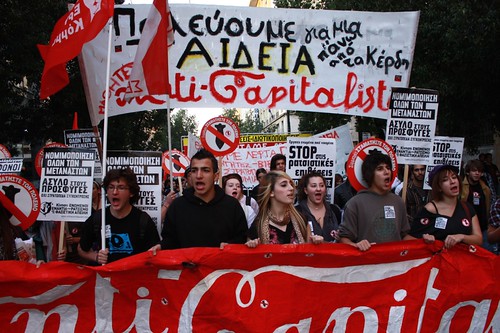
But given the enormous disaster that would likely befall the Eurozone if Greece leaves the currency union, is this a threat the EU can afford to make? There is a real risk that this latest move could backfire. Massive protests continue in Athens today as people stand in front of the parliament chanting "we won't pay". Inside the building, Socialist prime minister George Papandreou is holding a confidence vote to reaffirm his mandate before he attempts to push these austerity measures through the parliament.
Now facing defection from his own party's members and extreme pressure from public opinion, Papandreou's confidence vote will be a rollercoaster ride over the next few days. There is a chance that this latest move from the finance ministers will further enrage Greek public opinion, where there is already an impression that the EU, at the insistence of Germany, is dictating draconian measures in an anti-democratic way. A perceived insult like this could put public optinion in Greece over the edge and cause even more Socialists to withdraw from the parliament. If Papandreaou's government falls it could mean a default on Greece's debt and, most chillingly, a withdrawal from the Euro. These events could spiral out of control and cause a meltdown of the European economy, and maybe even the world economy. Given that reality, is this really a threat the finance ministers can afford to make?
Monday, 6 June 2011
Europe's left continues to disappear
Yet another centre-left European government was ousted yesterday as the Portuguese voted overwhelmingly for the country's conservatives. Prime Minister Jose Socrates' Socialists, who have been in power since 2005, received just 28% of the vote. The centre-right party, bizarrely named the 'Social Democrats' (a legacy of Portugal's desire to avoid conservative-sounding names reminiscent of the dictatorship) got 37% of the vote, just short of an overall majority. They will form a coalition with the further right People's Party who polled at 11%.
"Centre-right wins in _____" is becoming a familiar headline for European Monday mornings. Conservative governments are re-elected, while centre-left governments are voted out. The left hasn't won an election here since the Socialists took power in Greece in 2009. With the Portuguese Socialists gone, this leaves the EU with only five centre-left governments - Greece, Cyprus, Austria, Slovenia and Spain. Compare this to the 19 governments controlled by the centre-right - plus three controlled by the right-leaning free-market Liberals.
Given the disastrous local election results for Spain's Socialists two weeks ago one can assume they will fall from power in the country's general election next year, if not earlier. This will leave the left with essentially no presence in Europe. It is an unprecedented situation in modern European history - the first time since the advent of widespread Democracy that the European left has had no voice.
"Centre-right wins in _____" is becoming a familiar headline for European Monday mornings. Conservative governments are re-elected, while centre-left governments are voted out. The left hasn't won an election here since the Socialists took power in Greece in 2009. With the Portuguese Socialists gone, this leaves the EU with only five centre-left governments - Greece, Cyprus, Austria, Slovenia and Spain. Compare this to the 19 governments controlled by the centre-right - plus three controlled by the right-leaning free-market Liberals.
Given the disastrous local election results for Spain's Socialists two weeks ago one can assume they will fall from power in the country's general election next year, if not earlier. This will leave the left with essentially no presence in Europe. It is an unprecedented situation in modern European history - the first time since the advent of widespread Democracy that the European left has had no voice.
Wednesday, 18 May 2011
Merkel to Southern Europe: work more, play less
"People in countries like Greece, Spain and Portugal should not retire earlier than in Germany. We should all make the same efforts, this is important," German press agency DPA quotes Merkel as saying. "We cannot have a common currency where some get lots of vacation time and others very little. That won't work in the long term."The notoriously early retirement ages in Southern Europe have been a cause of serious griping in Germany since the country was forced to foot most of the bill to bail out Greece and Portugal over the past year. In Greece and Italy, a person can retire as early as 57. In Germany a person can't retire earlier than 65, and Merkel's government has voted to raise that to 67 over the next three years. Part of the conditions of Greece receiving its EU-IMF bailout was that it introduce reforms to raise the retirement age to 63.
Wednesday, 11 May 2011
Lost in translation?
Portugal's Eurovision performance last night at the first semi-final in Dusseldorf raised more than a few eyebrows. In the midst of what many see as a German-imposed austerity drive forced on Portugal after they had to take a €78 billion bailout from the EU and IMF, their Eurovision entry performed a song dressed as protestors and chanting slogans, right in the belly of the beast. It was a bit of an awkward moment, especially considering political messages are supposed to be banned from the Eurovision Song Contest.
According to the group, the song was apparently supposed to be a sort of celebration of Portugal despite all of its bad news. Entitled "A Luta é Alegria" (The Struggle is Joy), it calls on the Portuguese to not give in to feelings of despair or rage at the restrictions being imposed on them. The message, I imagine, was intended to be like the old expression 'keep calm and carry on' used by the British during World War II. "There’s no point in tightening the belt, there’s no point in complaining," they sang. "There’s no point in frowning and rage is pointless, it won’t help you. Many people wish to silence you. Many people want you to feel resentful. Many people want to sell you the air itself."
Thursday, 24 March 2011
Anti-austerity protests shut down EU Quarter
As one of the last remaining Socialist governments in Europe collapses today, the left is taking to the streets in Brussels in what seems like a last-ditch effort to stop the massive austerity cuts to government spending taking place across Europe.
This morning I had the arduous task of trying to make my way to work through the massive union demonstrations by the European Trade Union Confederation that have closed off the EU Quarter. While some parts of the protests seemed relatively peaceful and good-natured, I could already observe danger signs. The security forces are wearing body armour, riot gear and gas masks. Youths with bandanas around their faces were everywhere, particularly on the side streets. Many of the older demonstrators are already intoxicated. I saw eggs being pelted at the windows of buildings on Rue de la Loi. Firecrackers were exploding all over the place (my suitcase got hit by one in fact!). My friend tells me a window in her office was smashed by a rock. It's going to be a fun day…
Friday, 4 March 2011
While the right leads in Helsinki, the left is sidelined in Athens
Europe's two main political groupings – the center-right European People's Party (EPP) and the center-left Party of European Socialists (PES) – are today holding dueling summits in Helsinki and Athens, respectively. The simultaneous timing of the two-day events, a bit like the party conferences in the UK or US – is highly unusual. But they are coinciding because they are both meant to get each side singing from the same hymn sheet at next Friday's incredibly important European Council summit. And given Europe's current political reality, the choice of a Northern capital for the right's meeting and a Southern capital for the left's meeting seems entirely appropriate.
But despite the fact that these are nominally meetings of Europe's two main political groups, the reality is that the Helsinki summit will effectively be a meeting of those running Europe while Athens will be an ignored meeting of those sitting on the sidelines. Because the European left has been pushed to Europe's geographic fringes and marginalized by the debt crisis, the Athens meeting will be a meeting of politicians "in opposition". In Helsinki, German chancellor Angela Merkel will lead a meeting of representatives of the governments of 17 of the 27 EU member states. At the Socialist conference in Athens only five governments will be represented.
In addition to national leaders like Merkel, Berlusconi and Ireland's incoming prime minister Enda Kenny, European Commission President Jose Manuel Barroso and European Council President Herman Van Rompuy– both from the EPP – are also in Helsinki. The president of the European Parliament, EPP politician Jerzy Buzek, may come tomorrow. They will be discussing the Eurozone Competitiveness Pact drawn up by Merkel and Sarkozy as well as the debt relief fund. They will also discuss a united European response to the events in North Africa. In effect it will be a sort of mini European Council summit.
What will they talk about in Athens? Who knows. Who cares? Whatever is on the agenda, it will have little consequence for the direction of EU policy.
But despite the fact that these are nominally meetings of Europe's two main political groups, the reality is that the Helsinki summit will effectively be a meeting of those running Europe while Athens will be an ignored meeting of those sitting on the sidelines. Because the European left has been pushed to Europe's geographic fringes and marginalized by the debt crisis, the Athens meeting will be a meeting of politicians "in opposition". In Helsinki, German chancellor Angela Merkel will lead a meeting of representatives of the governments of 17 of the 27 EU member states. At the Socialist conference in Athens only five governments will be represented.
In addition to national leaders like Merkel, Berlusconi and Ireland's incoming prime minister Enda Kenny, European Commission President Jose Manuel Barroso and European Council President Herman Van Rompuy– both from the EPP – are also in Helsinki. The president of the European Parliament, EPP politician Jerzy Buzek, may come tomorrow. They will be discussing the Eurozone Competitiveness Pact drawn up by Merkel and Sarkozy as well as the debt relief fund. They will also discuss a united European response to the events in North Africa. In effect it will be a sort of mini European Council summit.
What will they talk about in Athens? Who knows. Who cares? Whatever is on the agenda, it will have little consequence for the direction of EU policy.
Friday, 19 February 2010
From Portugal to Brazil (and back again)
It was an amazing trip, and really interesting - especially in the way we bookended it with some time in Portugal. We got a really cheap flight to Brazil with TAP, Portugal's national airline, but it required a 24 hour stopover in Porto on the way there and another stopover in Lisbon on the way back. So it was a little colonial recreation, if you will. This theme for the trip was heightened by the fact that the first port of call was Salvador, the capital of Brazil during the colonial period. The city is billed as having the largest collection of colonial architecture in Latin America, and it didn't disappoint.
Thursday, 4 June 2009
My first vote in Europe
In the UK they still use paper balloting, so they hand you a sheet, you take it over to a little desk, mark off a big x, and slip it into a box. It seemed very old-timey to me, as where I’m from in Connecticut they haven’t used paper balloting since before I was born. Even the big pull-lever voting machines with the automatic curtains - which seemed so cool to me as a child when I would go into the booth with my parents - now seem antiquated in the US with the advent of electronic voting machines. Funny enough, the paper I was given this morning was about a metre long, making it appear as if I had a lot to vote on. But in reality there was only one X to be made, next to the party you were choosing. Each party though has to list the six candidates it would field if it wins, making the list quite long with all of the small parties. It’s done on a proportional allocation basis, with the winning parties getting to put forward a certain number of MEPs based on how much of the vote they got in each district. The UK and Holland are the only countries voting today, the rest of Europe will vote on Sunday and the British results won’t be revealed until then.
I won’t say who I voted for but I will say it was a tough decision. In Brussels they complain that one of the (many) problems with the European parliament is that people vote on purely national issues, which are mostly irrelevant to the issues being considered by the European Parliament. Even knowing this, I have to admit that national political considerations in Britain probably contributed about 50% to my decision. It’s just really hard to ignore the national politics when so often the most immediate and tangible result of these euroelections is the verdict they deliver on the national party in power.
Off with their Heads!
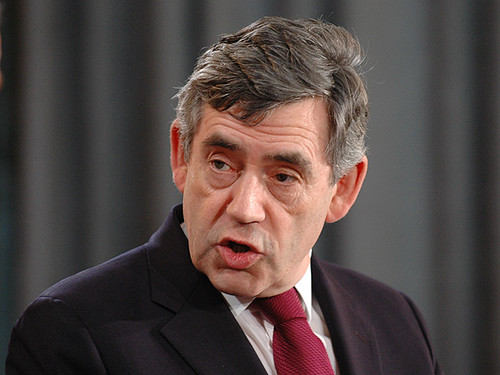
But nowhere is the euroelection being watched more closely as a barometer than in Britain, where it is being held concurrently with many local council elections across England. Gordon Brown’s government is in freefall this week. The ongoing expenses scandal has caused Brown’s already weak government to fall apart, and each hour that passes seems to get worse. The last two days have seen the resignations of several cabinet ministers, and it is thought that Chancellor Alistair Darling will be sacked within days. Brown will have to form a new cabinet next week, but if Labour MPs refuse to serve on his cabinet, he will have to step down as Labour leader. A new Labour leader would then be selected by the party, who would inevitably have to call a general election that Labour will almost certainly lose. It is thought that Labour MPs are waiting for the result of today’s vote to make their decision. If Labour does dismally (some are predicting they could even come in fourth or fifth behind the far-right British National Party) then they will force his resignation by refusing to serve on his new cabinet.
It is expected that the Tories will probably receive the largest share of today’s EP vote, thought the majority of people almost certainly don’t realize what they’re voting for with that decision. David Cameron is set to take the Tories out of the parliament’s main centre-right EPP grouping shared by Angela Merkel and Nicolas Sarkozy and form a new Eurosceptic fringe grouping by allying with far-right parties of Eastern Europe. This issue has received almost no coverage from the British media, so it is certain that most of today’s Tory voters aren’t aware that they’re voting for a coalition that will include the anti-gay, climate-denying Polish nationalist Law and Justice party. That said, perhaps even if they knew they wouldn’t be bothered by it.
Rock Stars and Royalty
Then of course there’s the amusing MEP entries of this year’s election. The European Parliament, often half-jokingly maligned as a refuge of freaks, cast-aways and has-beens, has attracted its fair share of celebrity candidates this year. Slovakia, which was mortified after the last EP election five years ago when it had the lowest turnout in all the EU at just 17%, has pulled out all of the stops to try to get people to the polls this year, fielding an African-born pop singer, a fitness trainer and a former ice hockey star. Who knows that their objectives for Europe are, but I suspect the main intent with fielding them was just to make sure Slovakia doesn’t come last in turnout again.
Another interesting one to watch will be Sweden’s Pirate Party, a group formed entirely in reaction to the recent prosecutions in that country of file-sharing site managers. The candidates actually dress as pirates and have used pirate speak when campaigning (and they’re expected to gain some seats on Sunday!). There’s also Elena Basescu - Romania's equivalent to Paris Hilton – who is expected to win a seat as she is the daughter of the Romanian president. Other quirky candidates include a former Czech astronaut; a Finnish racing champion and a Bulgarian Taekwondo idol.
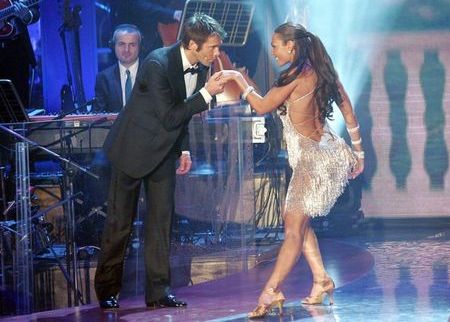
And of course my nerdy European history fascination can’t help but be interested in the fact that the reigning heirs of two of Europe’s formerly most powerful but today ousted (and banned) monarchies – the Habsburgs and the Savoys – are both in the running in Austria and Italy respectively. The candidacy of “Prince of Venice and Piedmont” Emanuele Filiberto in Italy is particularly interesting as he was banned from entering Italy his whole life (oweing to the expulsion of members of the former Italian monarchy when the Republic was declared in until Berlusconi lifted the restriction for him and his father in 2002. Shortly after that he celebrated his triumphal return to his family’s former kingdom by entering Italy’s version of Dancing with the Stars.
Asked why he would make a good MEP, he said, "I was in exile for 31 years and I know Europe well. I speak five languages. I know half of the current heads of state personally, and the other half I'm related to." It’s an argument any Royalist could agree with!
Check out this BBC site for real-time election results on Sunday and Monday. I'll be in Berlin this weekend, but will certainly be keeping tabs on it from there!
Tuesday, 3 June 2008
Brazil devours its mother tongue
By decree of a law passed last week, Portugal will no longer use Portuguese.Well, not the same kind of Portuguese anyway. In a highly controversial vote that’s been debated for many years, the Portuguese Parliament has effectively changed the written language of Portugal to the type of Portuguese used in Brazil. This new standardization requires a change in spelling for hundreds of words and adds three new letters to the alphabet. All books will have to be republished in Brazilian Portuguese, and school curriculums will now be taught using the new language standardization.
The change was enormously controversial because it was seen as a matter of national pride by the former colonial power. But the seven other Portuguese-speaking countries in the world - Brazil, Angola, Mozambique, East Timor, Cape Verde, Guinea-Bissau, and Sao Tome and Principe – had already standardized to Brazilian years ago.
Thursday, 8 May 2008
Rebirth in Lisbon
When in Lisbon, there are two key dates that stay on the mind: 1755 and 1974.During a visit I made to the city last weekend, these two pivotal turning points constantly came up. They were both times of regeneration, of a culture and a city redefining itself after a dramatic upheaval. And they both speak to the remarkable ability for societies to recover and rebuild.
In 1755 Lisbon suffered a massive earthquake followed by a tidal wave and fire that completely razed the city and killed 15,000 people. In 1974, a military coup was able to finally wrest power from a dictatorship that ruled Portugal with an iron fist for more than four decades.
Monday, 25 February 2008
China
I'm in Hong Kong this week on a business trip, my first trip to East Asia. So far it's been very interesting.I came in early for the weekend to see my friend from grad school Liz, who is living and working in Shenzen. The first thing I noticed about the area is the big difference between Hong Kong and the mainland. Of course for all of its history as a city until 1997 Hong Kong was under the control of the British, and it was just a little over ten years ago that it was handed over to the Chinese, but with special stipulations. Hong Kong became the Hong Kong Special Administrative Region under the "one country, two systems" policy, continuing to operate as a seperate country for most intents and purposes until 2047.
Subscribe to:
Comments (Atom)