
Showing posts with label Recep Tayyip Erdogan. Show all posts
Showing posts with label Recep Tayyip Erdogan. Show all posts
Friday, 21 July 2017
On the way in, and on the way out?

Friday, 30 December 2016
Could the US have a military coup?

Each year, I come home to the United States for an extended break over the Christmas holiday. Ordinarily it’s a time to relax, recharge, and spend some quality time with family. But this year a dark cloud is hanging over my visit.
I’m from the New York area, so it’s no surprise that people here are still feeling a sense of shell shock about November’s election result. But this isn’t the same disappointment people felt during the George W era. This isn’t about politics. There is a palpable sense of anxiety and fear in the air. Nobody knows what’s coming next.
There is a sense that everything people thought they knew about their own country has suddenly evaporated. More than one person has described the feeling as being one of a “living nightmare” that they still expect to wake up from. Someone else told me that the sudden shock of having the world you thought you knew come tumbling to the ground gave him “the same feeling as on September 11th”.
Monday, 1 August 2016
Erdogan’s Germans

Yesterday in Cologne, 30,000 German residents amassed in the city center to pledge allegiance to a foreign leader.
The demonstrators, Turkish immigrants or people of Turkish decent, were following a call to action from Turkish President Recep Tayyip Erdogan, asking people to show solidarity against the attempted military coup on 15 July. They brandished iconographied pictures of the Turkish strongman, waved Turkish flags and chanted their fidelity to Erdogan’s Islamist AKP party.
The Turkish president himself was supposed to address the crowd via a live video address, but this was banned by the police for fear that it would cause the crowd to become "overexcited".
Tuesday, 19 July 2016
It's time for the EU to drop the Turkish accession charade
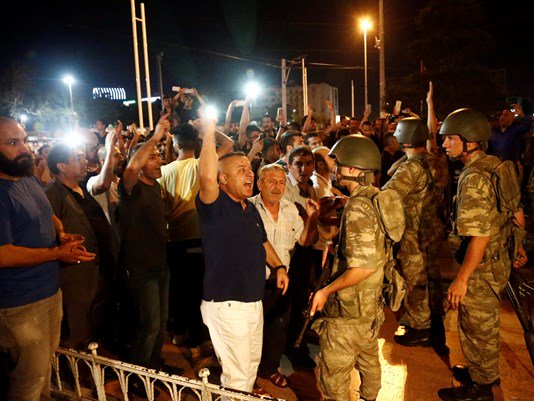
As the implications of the events of Friday night have sunk in, world leaders have started to suggest what they dared not say over the weekend.
Since Friday Turkish President Recep Tayyip Erdogan has rounded up and arrested more than 6,000 members of the military and judiciary, accusing them of being involved in the supposed coup. "It looks at least as if something has been prepared," Johannes Hahn, the European Commissioner from Austria, said today. "The lists [of people to arrest] are available, which indicates it was prepared and to be used at a certain stage."
"I'm very concerned. It is exactly what we feared," he added.
Hahn's words carry significance because he happens to be the commissioner for EU enlargement. He is directly responsible for Turkey's accession process to join the EU. But in realty, that process is as theatrical and illusory as Friday night's coup probably was (more on that below).
Monday, 13 September 2010
Referendum in Turkey - Careful what you wish for, Europe

The changes are mostly aimed at reducing the role of the military in the country, and were champtioned by Turkey's current Islamo-conservative prime minister Recep Tayyip Erdogan. The vote represents a huge victory for Erdogan over the country's uncompromisingly secular military. It indicates that his Islamnic party will likely win the upcoming elections next year. And, it satisfies a main demand of the EU for Turkey to be able to join the union. But considering that the legitimate concern over the wisdom of a Turkish accession is now a consensus everywhere in Western continental Europe, this could actually cause some real headaches for European policy makers. It is likely they will just move the goal posts further out for Turkey's accession, a tactic criticised by last year's report on EU policy toward Turkey.
Friday, 30 July 2010
Cameron promises the world to Turkey
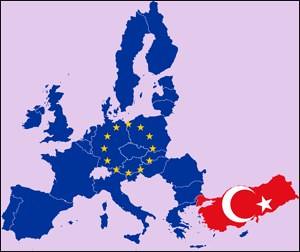 This week's speech by UK prime minister David Cameron in Ankara was notably aggressive – not toward his Turkish hosts, but toward Britain’s EU allies. Perhaps it shouldn’t come as too much of a surprise from a leader who promised to be combative with the EU when sticking up for Britain’s interests. But Cameron’s strong (and unrealistic) guarantees to Turkey and his condemnation of Germany and France will set UK foreign relations on a tricky tightrope walk. What exactly is Mr. Cameron playing at here?
In his speech, Cameron was unusually outspoken about his support for Turkey’s membership in the EU. Of course this is long-held British policy, and the previous Labour government was also supportive of the membership. But Cameron went above and beyond this by ratcheting up the rhetoric. Saying he wanted to “pave the road from Ankara to Brussels,” Cameron stated that “the EU would be poor without Turkey.” Pointing to Turkey’s membership in NATO, Cameron said “It’s just wrong to say Turkey can guard the camp but not be allowed to sit inside the tent.”
By contrast German foreign minister Guido Westerwelle, who was in Ankara with Mr. Cameron, was much more cautious. Westerwelle, the leader of Germany’s Liberal party, also supports Turkey’s membership in the EU. But his party is in a governing coalition with Angela Merkel’s Christian Democrats, who strongly oppose such an accession. He’s already been in trouble with Merkel for being too effusive in his public support for Turkish membership in the union, and this time around it was clear he had learned his lesson. Though he encouraged Turkey to carry on in its efforts to join, he gave a frank assertion that Turkey is “not ready” to join the EU. Even more importantly, he pointed out that the EU is not ready to absorb Turkey.
But guess which speech the Turkish media splashed across the front pages? The Turkish press was positively effervescent over Cameron’s lavish praise for Turkey, and his face was all over Turkish TV screens this week. A quick and easy diplomatic coup for the UK no doubt, which is keen to establish strong ties with Turkey’s new Islamist-leaning government.
Tuesday, 24 July 2007
Turkey's Islamic landslide
 I think you’d be hard pressed to find a political climate more reflective of a wider issue than what’s going on in Turkey right now. The conflict between the Islamic-rooted party and the secularist party resulted in the calling of an election on Sunday that saw the Islamic party receive a solid victory, more than anyone could have imagined last week. What will this mean for Turkey’s future, and its relations with Europe?
The situation is enormously complicated and requires a bit of explaining. Turkey was the center of the Ottoman Empire for centuries, which stretched at various times from Morocco in North Africa to Hungary in Europe. It literally had territory on three different continents and therefore acted as a bridge between many different cultures. By World War I the empire was antiquated and ailing, and following the sultan’s disastrous decision to join with the Germans and Austro-Hungarians in World War I, a group of “young Turks” in the army led by a man who came to be known as Ataturk (or “father of the Turks”) seized power and completely reformed Turkey, giving up its non-Turkish possessions and developing a fiercely secular, Western-oriented nation. Ataturk was an avowed enemy of religion and felt that the state must take safeguards to keep it firmly out of the government. For this reason, Turkey and the rest of the Middle East took very divergent paths in the remainder of the 20th century.
 For decades the country was ruled by Ataturk’s heirs, the secularist army. But in the last ten years Islam has been becoming steadily more popular in the country, as evidenced by the rising number of women in Ankara and Istanbul wearing headscarves. This is worrying to much of the country, who fear that Turkey could slide toward the kind of governments seen in the rest of the Middle East. Even a moderately Islamic government, comparable say to the degree that the US government is Christian, would be extremely worrying to many Turks.
So when the Islamic-rooted party Justice and Development was voted into power five years ago, the army stood up and prepared to take up their traditional role of defending the secularist Turkish state, through force if necessary. When the party nominated the current foreign minister, Abdullah Gul, to be president. Gul’s wife wears a headscarf, and this fact was so unacceptable to the army that they not only derailed the nomination but demanded that the government hold new elections. But this move backfired and now Justice and Development is even more powerful than before, although they have pledged to nominate a new compromise candidate for president, presumably one who’s never even seen a head scarf.
So it’s a simple story of a pro-Western army trying to keep an Islamic fundamentalist party out of power right? Not even close. It’s a lot more complicated than it seems at first glance. For instance, it could be argued that Justice and Development is Islamic in the same way that Angela Merkel’s Christian Democrats in Germany are Christian (i.e., a historic root in the religion but not strongly religious). What’s more, it can’t really be said that the party is anti-Western, because they’ve made a number of economic and social reforms in an effort to get Turkey admitted to the EU. They’ve actually presided over an economic boom time in Turkey, and the reality is this is probably the reason they received such an overwhelming result on Sunday. People weren’t voting for an Islamic party, they were voting for a party that had presided over successful times.
What’s more, the secularist army’s party, the Republican People’s Party, is “pro-Western” really just in its opposition to Islam and its promotion of Western lifestyles and values. The reality is this is an autocratic party that wants to stifle democracy, and this is one of the biggest obstacles to Turkey’s joining the EU. As long as the RPP remains so powerful, the country could never join the European Union.
It’s also not as clear-cut as religious people versus secular people, in many ways the religion issue is a mask for an urban-rural divide. As Mark Mardell pointed out this week, the conflict is as much about the educated, secular, urban elite of Istanbul and Ankara, who control the army and the beaurocracy, fearing the uneducated, religious mob of the rural interior. Writes Mardell:
This is a battle of different classes, as well as of religion and ideas. Anyone think of any other countries with an urban and coastal liberal elite that feels under threat from the religious politics of the rural hinterland? The big difference is that the Pentagon wouldn’t even dream of putting tanks on the White House lawn if George W held a prayer meeting.I thought this was an interesting analogy. It would be as if the urban elites of the East and West coast controlled the army and the rural red state voters controlled the government (of course the opposite is true, the rural red staters control both!). But if this were the case in the US, the conflict wouldn’t just be about religion versus secularism, although that would be a big part of it. That conflict would just be part of a larger class conflict, and this is the case in Turkey today.
I thought Mardell’s story about a conversation he had with some Turkish generals was even more interesting. Writes Mardell:
I had an early morning drive across the Bosphorous to talk to a couple of retired senior military men, three-star generals. They argued Turkey was not a democracy, despite the fact it goes to the polls on Sunday in what appear to be free and fair elections, with multiple political parties and a free-ish and vociferous press. Their arguments strike me as rather Leninist. The masses are uneducated and illiterate so can be deceived by unscrupulous politicians. Only when they are better educated will Turkey be a real democracy. It is the army’s job to intervene if there is any deviation on the path to this true democracy.Turkey is really a very interesting country, and I’m curious to see how this unfolds over the next several years. One is really unsure who to side with in this debate.
They make a similar argument about "ethnic issues"... which means the Kurds. Poverty and bad education is the problem. The solution may need a tough military component but it's really about developing the south-east of Turkey until people stop worrying about issues of identity.
Subscribe to:
Comments (Atom)