Showing posts with label referendum. Show all posts

Friday, 15 July 2016

Europe will referenda itself to death


From Budapest to Paris to Cleveland, the West‘s blind idolatry of direct democracy will be its own undoing. 

"The referendum is a device of dictators and demagogues," declared UK prime minister Clement Attlee in 1949. No surprise, then, that Europe’s next anti-EU referendum following Brexit has been called by Hungary’s Viktor Orban.

The Hungarian prime minister’s absolute control over the political, judicial and media institutions in his country have been likened by many to the power of a dictator, including by European Commission President Jean-Claude Juncker

Hungary has attracted particularly negative international attention because of its brutal treatment of Syrian refugees trying to cross through the country to Germany. It is the latter issue that has prompted the referendum, scheduled for 2 October. 

Sunday, 3 July 2016

Thousands marched, but what are the options for keeping UK in EU?

It is a time of huge uncertainty for Britain, but there are four scenarios which could see the country remain in the EU.

Yesterday saw an unprecedented, and uncharacteristic, outpouring of love for the European Union on the streets of London.
Tens of thousands of people marched on the British Parliament in a protest hastily organised on Facebook called 'March for Europe'. It was a show of European love not ordinarily seen in the British capital, where EU flags are normally verboten. And it wasn't a vague outpouring of sentiment either. The protesters had a specific demand for the parliament - do not pull the trigger on Brexit. That trigger is known as article 50 (more on that later).

The crowd was overwhelmingly young and educated. As The Guardian's Ed Vulliamy noted, "the hollow, bitter wit of the banners and placards was a fair indication of who took to the streets". “Un-Fuck My Future”, the placards pleaded. “No Brex Please, We’re British”. "Fromage, not Farage". Pictures of Whitney Houston singing “I Will Always Love EU” and Rick Astley singing "Never gonna give EU up, never gonna let EU down". 

“Hell no, we won’t go!” they chanted.

Tuesday, 28 June 2016

Can we stop the 'Democracy is beautiful' platitudes? This vote was a travesty

In the West we are brainwashed to always view more democracy as better. But the Brexit fiasco shows how inappropriate referenda are.

Being a Swiss person in England on Saturday, British journalists were keen to get tennis star Roger Federer's take on the Brexit chaos taking place around him. He gave a politician's answer. "It’s nice to have democracy here, that you have an opportunity to vote. It’s a beautiful thing."

Really Roger? You think what we've seen over the past days is "a beautiful thing?"

David Cameron expressed similar sentiments in his resignation speech after losing the vote. "The country has just taken part in a giant democratic exercise, perhaps the biggest in our history," he said. "We should be proud of the fact that in these islands we trust the people for these big decisions."

Monday, 27 June 2016

The UK Parliament can block Brexit, but it needs a mandate

There is zero prospect for a second referendum, but a general election may be called in the next few months that would be a de-facto second vote. The result could be an unravelling of the main political parties.

In the three days since Brexit, social media has been abuzz with the prospect of holding a second referendum. The argument goes that so many leave voters did not understand what they were voting for, it justifies holding a new poll. 

An official petition asking for a second referendum has collected more than four million signatures, which will force a parliamentary debate on the subject.

But the idea of a second referendum is fanciful. The process of the first referendum was so ugly, so destabilising, that few would want to put the UK through that again. 

Like Trump, Brexit won by accident

Brexiteer fumbling this weekend gives an impression of self-interested politicians who launched a campaign they didn't expect to actually win. Sound familiar?

This morning's appearances on the Sunday shows by the politicians who campaigned for Brexit was a full-on car crash. Perhaps the most extraordinary was Ian Duncan Smith's interview with Andrew Marr.

After trying to get any shred of information from IDS, Marr finally asked, exasperated, “What’s the plan?” “How do you mean?” IDS responded defensively. So Marr cited, for example, the leave campaign's promise to spend the "£350m per week that the UK sends to Brussels" (a completely inaccurate figure) to instead fund the NHS. 

“We never said that,” IDS replied. Marr was indignant. “Yes you did. So even if there was £350m per week, which there isn’t, how are you going to fulfil all of your other spending promises?”

“We never made any commitments. We just made a series of promises that were possibilities," IDS responded.

Sunday, 12 June 2016

After divorce, UK and EU unlikely to be 'friends with benefits'

The EEA was not built for a country the size of Britain. To think that the EU will allow it to easily join is folly.

This week the EU's most powerful finance minister, Germany's Wolfgang Schäuble, will say in an exclusive interview to be published by Der Spiegel that the UK should not be given special access to the EU common market, à la Norway, if it quits the bloc.

"In is in, out is out," he will say in the interview, which was seen and previewed by The Guardian.  “That won’t work, it would require the country to abide by the rules of a club from which it currently wants to withdraw. If the majority in Britain opts for Brexit, that would be a decision against the single market."

Sunday, 1 May 2016

Norway is the Puerto Rico of Europe

Puerto Rico has to obey laws made in Washington, but has no say in shaping them. Sound familiar?

Over the past two years, Puerto Ricans have been reeling from a government debt crisis that is throwing the island into near chaos. But for their fellow American citizens, it has gone largely unnoticed.

The incomparable John Oliver did a segment about the crisis last week, and like a lot of Americans I found myself watching it with a sense of embarrassment. I also hadn't heard anything about the crisis before.

Continental Americans have a disconnected relationship with the American territory to their south. Many do not know that it is part of the United States, and even those that do know often forget.

Friday, 4 March 2016

Good at the big things, bad at the small things

Eurosceptics are wrong when they say the UK has no influence in the EU, but they are right that Britain is outgunned and outmanoeuvred in Brussels lawmaking. What they don't tell you is that this is self-inflicted impotence.

When the new European Commission of Jean-Claude Juncker took office in 2014, they promised to counteract increasing euroscepticism by being "big on the big things and small on the small things". In other words, no more 'Brussels meddling' in small issues that should be left to national governments. 

Of course, they had a British audience and an upcoming Brexit referendum chiefly in mind. Years of media reports on bendy bananas and 'Anglo-French Friendship ponds' have led to an impression, generally accepted as gospel in the UK, that eurocrats like legislating for legislating's sake. The Commission's 'better regulation' drive is meant to counter this impression, whether or not it's an accurate one.

As I've written before, these UK media outrages over small regulations are not really about the laws themselves, but about who has the right to make them. The regulations being complained about in the British media, when they are actually a real thing (which is maybe 40% of the time), would attract no attention at all if they were made at Westminster. 

Friday, 26 February 2016

Brexit is the British Trump

After years of vilifying the EU, the English elite have created a Frankenstein's monster they cannot control.

It now looks increasingly likely that Donald Trump will be the Republican nominee for the US Presidency, and the world is looking on in bemused horror. What kind of hysteria has propelled this man toward becoming the American right's standard-bearer?

It has been widely observed over the past months that this is a monster of the Republican Party's own making. For years the party has driven turnout by peddling a narrative of fear, and stoking the worst instincts of its base. Truth became relative, and 'truthiness' was the name of the game. If it felt true, then go with it.

Tuesday, 19 November 2013

Quebec: no need for readmission

Given that it is the only significant independence movement in the developed world outside Europe, the cause of Quebec secession is often used as an example in discussions of separatism in the European context. And so it was perhaps not surprising that at an event at the European Parliament last week about independence movements within the EU, a Quebecer was on hand to share his experiences.

The European Free Alliance (EFA), a collection of seven separatist members of the European Parliament from Scotland, Wales, Corsica, Flanders, the Russian community in Latvia and the Basque Country, hosted the event on “the right to decide” last Wednesday (13 November). The group sits in a sometimes uncomfortable common group with the Greens, who notably had little by way of promotion of the event on the group’s website.

In addition to Quebec, the event looked at the independence referendum situations in Scotland, Catalonia, the Basque Country, Wales and Galicia.

Europe has long had a strange relationship with Quebecois separatism. The situation in Belgium is often compared to that of Canada. France has been a strong supporter of Quebecois separatism, while simultaneously suppressing separatist movement sin Corsica, Brittany and Savoy. But are there really lessons for Europe from Quebec’s experience?

Monday, 21 October 2013

How small is too small?

Yesterday the citizens of San Marino voted on becoming an EU member state. But is that even possible? 

As Brussels braces itself for the inevitable disappointment of a referendum on EU accession in Iceland, when or if that ever takes place, it will come as little comfort that another non-EU European country rejected EU membership yesterday.

The Republic of San Marino, the tiny microstate of 33,000 people situated within Northern Italy, held a referendum yesterday on whether to apply for EU membership. The proposition failed because not enough people turned out to vote. Though a narrow majority of people who voted approved the measure (50.3% versus 49.7%), a referendum needs 32% of eligible voters to vote yes in order for the measure to pass. The 'yes' vote amounted to just 20%.

Unlike an eventual Iceland referendum, the San Marino referendum was not a response any actual offer of EU membership.  The question of whether to start accession negotiations with Brussels was put to voters after a group of citizens collected the required number of signatures. No matter how the referendum turned out it was non-binding. It would be up to the San Marino government whether to actually request accession negotiations, and it would be up to EU member states whether to accept that request.

Saturday, 14 September 2013

Total recall

In the coming months, the UK is set to enact a right to recall elected politicians. But the American example shows this may not be the boon to democracy it appears.

Recently, the disgraceful tale of a Scottish politician refusing to resign in the face of 23 (yes, 23) separate domestic abuse convictions has revived talk in the UK of that old populist hobby-horse – the right to recall.

Bill Walker, a Scottish National Party member of the Scottish Parliament (pictured below), was convicted last month of a series of domestic abuse offenses against three different ex wives and a stepdaughter over three decades.

Though he was expelled from the SNP after the conviction, for weeks Walker refused to vacate his seat – and there was nothing the SNP or the Scottish Parliament could do to make him leave. As the British media examined the bizarre situation, those who advocate establishing a citizen's recall law in the UK came out in force to argue that this disgraceful state of affairs makes their case.

Tuesday, 13 August 2013

Ins and outs

As the British seek new EU opt-outs, Danes will likely vote to end theirs.

Over the past several years, as UK prime minister David Cameron has taken his country further and further toward the EU exit door, he has been keen to stress that the UK is not alone in its desire for a more devolved EU. He points to the increasingly Eurosceptic Dutch, who have, like the UK, recently conducted a review of the EU's powers. He points to the Danes and Swedes, who are also voluntarily remaining outside the Eurozone.

So when news came this week that it now looks likely that Denmark will hold an ‘EU referendum' next year, it may have seemed like welcome news for the British Conservatives. Cameron has attracted a large amount of ill will on the continent by scheduling an in/out EU referendum for the UK in 2017. But why should Britain be singled out for scorn, when the Danes are holding their own EU referendum?

However the Danish case is a very different animal. The British referendum will be a vote on a theoretical new EU-UK relationship which the government will negotiate, giving the UK more opt-outs from EU law. The Danish referendum will be the opposite – a vote on whether to end the opt-outs Denmark negotiated for itself back in 1992.

Thursday, 23 May 2013

UKIP voters demand referendum...on Eurovision

As the EU referendum debate has heated up in Britain over the past several months, the UK-based polling agency YouGov has conducted periodic surveys asking the voting public whether they want an in-out referendum, and how they would vote in it.

In this week's survey, they threw an additional query into the mix – asking the same question but replacing the ‘European Union' with the ‘Eurovision Song Contest'. The result is rather revealing.
The survey shows that if a referendum on Eurovision were held, the UK's voters would vote to leave the song contest, with only 29% voting to remain in it. Among UK Independence Party (UKIP) voters, only 13% would vote to remain in the contest.

32% of the survey's respondants said they want the government to hold an in-out referendum on Eurovision (44% said they were opposed, while 24% said they weren't sure). The majority of UKIP voters with an opinion said they want the UK to hold such a referendum.

Wednesday, 23 January 2013

Brexit begins

By all accounts, the speech delivered by UK Prime Minister David Cameron this morning outlining his vision for a British disengagement with the EU was short on substance, contradictory and hackneyed. He mixed metaphors, made embarrassing errors reflecting a lack of EU knowledge and managed to enrage his EU partners even without having made specific demands.

But despite its rhetorical flaws, Cameron’s speech will be one for the history books. With three words - "in/out referendum" – Cameron has plunged the UK into four years of economic uncertainty. The prime minister will have the dreaded ‘Brexit vote’, but only in 2017, after the next election. With this he hopes to placate the fiercely eurosceptic wing of his party while at the same time kicking the can down the road. But the long time frame, business leaders and non-EU governments have warned, could be hugely damaging to the British economy. Investors will likely be hesitant to invest in the UK when their future in the European market is uncertain.

Friday, 11 January 2013

Obama warns Cameron over his dangerous EU game

The British eurosceptic right, normally known for their fawning obsession with America, have been in a strange state of cognitive dissonance this week after the Obama Administration delivered this frank warning to British Conservatives on Wednesday: if the UK leaves the EU, it could doom itself to international irrelevance.

Philip Gordon, the US assistant secretary of state for European affairs, said in a speech in London that the UK leaving the EU would be a mistake, implying that Britain’s relationship with the US (and, presumably, most other major global players) would be damaged as a result.
"We have a growing relationship with the European Union as an institution which has a growing voice in the world – and we want to see a strong British voice in that European Union. That is in the American interest," he said. "When Europeans put their resources together and have a collective decision-making function they end up playing a major role in the world…And for the UK to be a part of that stronger, more important voice in the world is something I know a lot of British people welcome."
It isn’t just an academic debate. At the end of this month, British prime minister David Cameron will deliver a speech in The Hague on Britain’s future relationship with the EU. It is expected that he will announce a public referendum on EU membership that will take place in 2018 – well after the next general election and most likely after Cameron is out of office. Cameron has found it increasingly difficult to assuage the demands of a significant contingent of his increasingly anti-European party for a referendum on Britain leaving the EU.

Wednesday, 12 September 2012

The peril and promise of a new treaty

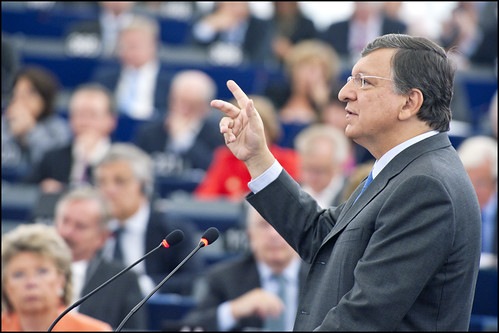
European Commission president Jose Manuel Barroso dared to use the ‘F word’ in his state of the union address here in Strasbourg today – federalism.

“Let’s not be afraid of the word, we will need to move towards a federation of nation states,” he told the European Parliament. “Today, I call for a federation of nation states. Not a superstate.” This federation, he continued, will ultimately require a new treaty, as German Chancellor Angela Merkel had suggested last week. EU leaders, still traumatized by the painful experience of ratifying the Lisbon Treaty in the last decade, have been desperate to avoid this.

“Before the next European Parliament elections in 2014, the Commission will present its outline for the shape of the future European Union. And we will put forward explicit ideas for treaty change in time for a debate.”

Barroso has been hesitant to use the word federal in the past when describing the future direction of the European Union, aware of the images of a power-grab it can conjure up in member states. But in his state of the union addresses, a yearly tradition itself created by the Lisbon Treaty, Barroso has been keen to make the European Parliament happy. He clearly thought that by finally using the F-word, he could do it.

Monday, 23 January 2012

Croatians vote to join EU

Amidst all the bad news, the EU can feel at least a bit reassured following the strong endorsement given by Croatians this weekend to their country joining the European Union. Though you'd be forgiven for getting the impression from the English-speaking media that the EU is now a toxic project that few want to be associated with, 67% of Croatians voted on Sunday to join the union.

An accession agreement was already signed by the country's government in December, and they are set to become the 28th member state at the end of this year. But the accession required a public referendum to go through. There were some rumblings of concern last year that the eurozone crisis could deliver a surprise no from the Croatian people. Brussels received a pleasant surprise last night when news came that the referendum had not only passed, it had passed by a large majority.

The vote comes a year after Estonia's decision to join the euro currency. Both decisions show that even in the midst of the eurozone crisis, the European project continues to move forward - not backward. Of course, both of these things were planned and in motion before the eurozone crisis hit. The real test may come next year when the people of Iceland vote on whether to move from their status as a pseudo-member-state in the EEA to a full member state of the EU. Opinion polls are already showing that referendum could have a hard time passing, particularly as the Icelandic economy recovers from their crisis as the eurozone slips further into its much larger crisis.

Monday, 24 October 2011

UK sidelined as Cameron faces attack from Sarko and his own MPs

David Cameron's quest for influence at this week's Eurozone crisis meetings is meeting headwinds, to say the least. First French president Nicolas Sarkozy tells him to 'shut up' at yesterday's summit, and now he is facing a rebellion his back-bench Eurosceptic MPs.

Tonight the rebels will try to force a vote in the parliament to set a public referendum in the UK on its EU membership. Cameron opposes such a referendum and has instructed his party to vote against it, as have the leaders of his coalition partners the Liberal Democrats and the opposition Labour. But 70 Conservative MPs are expected to defy him and vote for a referendum.

Of course, the measure has no hope of passing. But commentators and the markets,will be focused on the message that the rebellion will send at this precarious and sensitive time. British foreign secretary William Hague, who is himself quite eurosceptic, told the BBC that the vote being forced by the back-benchers is "the wrong question at the wrong time" and has likened it to "a piece of graffiti". The vote will "create additional economic uncertainty in this country at a difficult economic time," he said.

Cameron has imposed a 'three-line whip' on his party to vote against the measure, which is the most serious whip a party can issue. Any MPs who disobey will be expected to resign from government jobs. Cameron has said the preceding Labour Party should have held a public referendum on the ratification of the Lisbon Treaty, and he has pledged to hold a referendum on any future treaty changes. But he says an 'in-out' referendum would be counter-productive. This is likely because he knows such a referendum could easily yield an 'out' result, plunging the UK into a diplomatic and economic crisis.

Tuesday, 6 September 2011

EU still terrified of treaty change

During today's midday briefing a European Commission spokesperson emphatically insisted that any tightening of economic integration in the Eurozone will not require treaty change. Reporters in the room didn't seem to be buying it. It's not hard to see why, after the president of the European Central Bank said yesterday that such a change would require such a treaty change.

It's an uncomfortable situation for the EU, which only recently was able to pass the long-stalled Lisbon Treaty after a painful and embarrassing six year saga. There is now a consensus that the only way to save the euro from the contagion of the debt crisis is to establish a tighter economic union between the countries that use the currency, essentially establishing a single finance ministry instead of having separate economic policies for the different states.

But there is fear that doing so will require yet another treaty change, and Brussels is worried that another round of treaty change approval by member states would be a disaster. There is still uncertainty over whether such changes would meet the threshold for UK Prime Minister David Cameron's 'cast-iron guarantee' to hold a public referendum on every treaty change. Because of the widespread antipathy toward the EU in Britain, it is guaranteed that any referendum on an EU question would fail – even if it is on a question that doesn't directly concern Britain, such as the eurozone (the UK does not use the euro and would therefore keep its own finance ministry).