Showing posts with label Norway. Show all posts

Friday, 22 September 2017

Pseudo-independence

Facing increasing panic over a looming exit deadline in March 2019, Theresa May has called for a ‘transition period’ in which the UK loses its EU voting power but still has to follow its rules. It could easily turn permanent.

Desperate to salvage Brexit talks which have gone off the rails, British Prime Minister Theresa May gave a much-anticipated speech in Florence today. She surely hopes it will stem the panic over the country’s lack of preparedness for the ‘cliffs edge’. That is March 29, 2019, when the country must leave the EU.

There is now little prospect that an agreement on Britain’s post-Brexit relationship with the EU can be agreed by that date. And so the prime minister had little choice but to do something to calm the jitters of British businesses and markets. 

Tuesday, 22 August 2017

My prediction: Britain will join the EEA

Like in Norway and Switzerland, British elites will have to accept an arrangement they know is bad in order to indulge the illusions of a slight majority of voters. 

The political class was stunned. After a nationwide in/out referendum on EU membership, expected to yield an 'in' result because the entirety of the political and business establishment supported it, people awoke to the news that people had voted out, by 52%. A yearning for national sovereignty had won the day.

This wasn't 24 June 2016. It was 29 November 1994, the day after Norway's referendum on whether to join the European Union. 52% voted for Norway to be outside the EU, while 47% voted to be in it - an almost exact mirror of the UK result 22 years later. The result was a political shock that sent reverberations through the government and business establishment. 

What happened in Norway in the ensuing years was a lesson in how politicians must sometimes pull their citizens along begrudgingly, or even unwittingly. Because even though EU membership had been rejected, Norway effectively ended up becoming an EU pseudo-member - under terms much worse than if it had become a member state. The same fate awaited Iceland and Switzerland. 

Saturday, 2 July 2016

Why England in the EEA would be a victory for France

France has always resented British influence in the EU. Excluding the UK from EU law-making could reshape the union in the French model.

In 1963, when the United Kingdom first applied to join the European Community, the answer from Paris was a resolute 'non'. 

French President Charles de Gaulle vetoed the application in '63 and again in '67. He said that "a number of aspects of Britain's economy, from working practices to agriculture...made Britain incompatible with Europe". He added that the UK had a “deep-seated hostility” to any pan-European project.

It wasn't until De Gaulle relinquished the French presidency that Paris finally relented and allowed the UK to join the club in 1972.

So what were the "aspects of Britain's economy" that De Gaulle was so worried about? It was free market liberal economics. De Gaulle, and his successors, distrusted the "Anglo-Saxon" (The French term for Anglo-American) model of capitalism and had a very different vision for Europe.

Sunday, 12 June 2016

After divorce, UK and EU unlikely to be 'friends with benefits'

The EEA was not built for a country the size of Britain. To think that the EU will allow it to easily join is folly.

This week the EU's most powerful finance minister, Germany's Wolfgang Schäuble, will say in an exclusive interview to be published by Der Spiegel that the UK should not be given special access to the EU common market, à la Norway, if it quits the bloc.

"In is in, out is out," he will say in the interview, which was seen and previewed by The Guardian.  “That won’t work, it would require the country to abide by the rules of a club from which it currently wants to withdraw. If the majority in Britain opts for Brexit, that would be a decision against the single market."

Sunday, 1 May 2016

Norway is the Puerto Rico of Europe

Puerto Rico has to obey laws made in Washington, but has no say in shaping them. Sound familiar?

Over the past two years, Puerto Ricans have been reeling from a government debt crisis that is throwing the island into near chaos. But for their fellow American citizens, it has gone largely unnoticed.

The incomparable John Oliver did a segment about the crisis last week, and like a lot of Americans I found myself watching it with a sense of embarrassment. I also hadn't heard anything about the crisis before.

Continental Americans have a disconnected relationship with the American territory to their south. Many do not know that it is part of the United States, and even those that do know often forget.

Monday, 3 September 2012

A long-distance relationship

There are many clichés used to describe Iceland’s position in the middle of the Atlantic. Torn between Europe and North America – quite literally sitting on the fault line separating the two continents geologically – the country’s location is the most frequently used metaphor. This has been particularly true now that the country is in the process of EU accession.

While in Iceland over the past four days – a stopover on my way back to Brussels from a visit home to New York – the question of EU accession was very much on my mind. In fact I made it a point to ask every Icelander I met how they plan to vote in the coming referendum (what can I say, I’m tons of fun at a party). I planned to write some kind of blog entry on the way back reflecting people’s opinions and concerns, and here I am on the plane writing it.

It’s tempting to start trying to explain Iceland’s reluctance to embrace Europe with an anecdote about geography, since it is so far the European mainland. I could describe the intense sense of isolation I felt while out in the uninhabited lava fields away from Reykjavik. Or I could muse about the feeling of being torn in two directions which I felt while standing in the gorge separating the two continents at Pingvellier Park.

Friday, 16 September 2011

Denmark's election: is the Left clawing its way back?

The centre-left Social Democratic Party scored a victory in yesterday's closely-watched general election in Denmark, ending the 10-year reign of a conservative coalition that had been moving steadily further and further to the right.

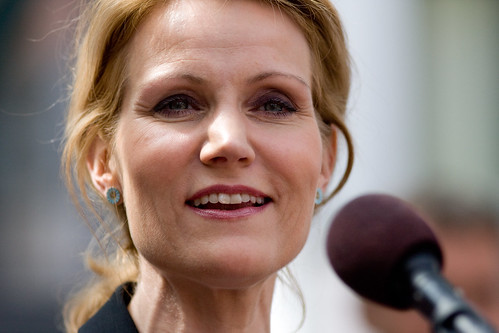
The campaign of the centre-left coalition, called the 'Red Bloc', was centred around a promise to raise taxes on the country's investment banks and wealthiest citizens, reversing a trend of decreasing corporate taxes led by the previous government. The victory for this message is a stinging rebuke to the current austerity crusade dominating the governments of Europe. The Social Democrats, led by Helle Thorning-Schmidt (pictured above), promised to actually expand Denmark's welfare system, which is already one of Europe's largest. They have also promised to use the proceeds from increasing taxes on investment banks and the wealthy to improve roads, schools and hospitals.

So is this a sign that Europe's hobbled left may be on it's way back? Are voters across Europe growing tired with the messages of the right and ready to turn to a new direction? Or are the circumstances of this change in direction limited to Denmark?

Sunday, 24 July 2011

Europe's Timothy McVeigh

Europe is in shock this weekend after Friday's horrifying act of terrorism in Norway that killed 76 people. Because of the stated aims of the perpetrator, it is already prompting questions over whether Europe has been looking the other way as the far right has grown in numbers and power.

When the news first broke on Friday that a car bomb had gone off outside the prime minister's office in Norway, many people assumed it was an act of Islamic terrorism. But soon after, news broke that the bombing had been followed by a shooting spree at a political youth retreat for the country's ruling Labour party. Then it was clear that this was unlikely to be an act of Islamic terrorism, since it seemed to fit the modus operandi of either a deranged lone gunman or an act of far-right domestic terrorism. In the end, it turned out to be the latter.

The man accused of orchestrating the attack, Anders Behring Breivik, reportedly carried out the attack on the ruling Labour party because he felt that their tolerant attitude toward Islam was destroying the country. It was an anti-government, far-right, fundamentalist Christian act of terrorism - similar to the Oklahoma City bombing in the US in 1995 committed by far-right extremist Timothy McVeigh.

Wednesday, 9 February 2011

Switzerland buries its head in the sand

Switzerland's foreign minister was in Brussels yesterday for some awkward discussions with EU leaders, and despite the beaming smiles following her meetings it was clear that by this point Brussels and Bern are operating on two different wavelengths.

The visit was arranged following a serious souring in relations between Switzerland and the EU after a resolution from EU foreign ministers in December warned that the relationship between the two had become incoherent and unwieldy. While Switzerland is not a member of the EU, it is a sort of "pseudo-member" and is allowed to participate in the EU single market thanks to a series of bilateral agreements. These 120 agreements were negotiated in two rounds in 1999 and 2004. In exchange for allowing Switzerland the benefits of access to the common market, the EU expects certain things in return - such as the right for any EU citizen to live and work in Switzerland (and vice versa). But in return, the EU position is that if Switzerland violates any of these accords, all 120 of them will be torn up.

So far this arrangement has suited the Swiss just fine - probably because most Swiss citizens are unaware of the extent of the accords and think their country remains completely independent and separate from the EU. But Brussels has grown frustrated with the unwieldy and complicated arrangement, and now they are saying Switzerland needs to move over to a more defined relationship as exists in the other pseudo-EU countries - Norway, Iceland and Liechtenstein.

Thursday, 20 January 2011

Is David Cameron forming an Anti-European Union?

Nicolas Sarkozy's plans for a "Mediterranean Union" may be floundering, but at the other end of Europe British Prime Minister David Cameron is just getting started with plans to form a 'Northern European Union.'

The leaders of Britain, Sweden, Denmark, Norway, Finland, Iceland, Latvia, Lithuania and Estonia are all meeting in London today to discuss the potential for a grouping which Cameron is calling an "alliance of common interests". He wants to boost trade between the UK and the Nordic and Baltic countries, but also to increase the flow of ideas. These include ideas on technology and economic and social policy, areas in which Northern Europe has similarities and expertise that are not necessarily shared by many countries in other parts of Europe.

Cameron insinuated as much yesterday when he said a northern grouping could become an "avant garde" for economic growth in Europe. And of course, Northern European countries have deep historical ties as most were ruled by Denmark at one time or another. And before the EU came along the Nordics had their own attempted intergovernmental union, the Nordic Council.

Sunday, 30 May 2010

Germany reclaims Eurovision for the big 4

Another year, another Eurovision. Last night was actually my 4th since I moved to Europe. I think I'm going to start counting my years here based on the number of Eurovisions I've watched.

This year's entries performed in Oslo were ok, but not as good as the very solid entries of last year's competition in Moscow. Still, I thought the winning entry from Germany was very good and deserved to win. It's a catchy tune and it sounds very modern. It's very much in the Brit pop mold, and the German singer even adopts a sort of faux-British accent for it. But it was cool that Germany won, it's the first time they've won as a united Germany. West Germany last won the competition in 1982 with Ein Bisschen Frieden.

Saturday, 25 July 2009

Naked Fiddlers in the Swedish Mountains

The final press conference of the EU environment and energy ministers meeting in Åre, Sweden has just concluded, and I'm now on the bus that will bring me across the border to Norway. This was my first time covering an EU ministerial, and overall it was a really interesting experience. I made lots of contacts and got a few decent stories, but perhaps the most valuable aspect of the trip was observing the interaction between the Brussels press corps and EU officials.

I was rather surprised by the high level of security at the meeting. After all, these are only energy and environment ministers, and we're out in the middle of nowhere in Åre, a ski resort deep in the center of the country, seven hours by train from Stockholm. There were security guards everywhere, and even the accredited journalists were very restricted in where we could and couldn't go. Are environment ministers really prime targets for destabilising elements? I mean, I don't even know who most of them are, and I cover this area!

Tuesday, 19 May 2009

The West is Back

One of the big flaws of this blog is that I have a tendancy to forget to write updates after I write about an upcoming event, so I thought I’d just give a quick update on the Eurovision results. Yes it is a little silly that this is my third entry about Eurovision in a week, but indulge me for a moment! I admit I’m unjustifiably fascinated by it.

As expected Norway came away the winner, but what was perhaps not expected was the huge margin by which they won (the largest in Eurovision history). In a distant second came fellow Scandinavian country Iceland with a lovely slow song called “Is it True,” and in third place was, inexplicably, Azerbaijan (huh??).

Western Europe can be pleased that it’s once again in the running, but lest people start to object that it seems to be only the Nordics that still have a shot from the West, take a look at the next few rankings. The UK came in an impressive 5th place, a far cry from the low scores it had the last few years. With Andrew Lloyd Webber penning this year's entry, it shows that a little effort can pay off. And France came in 8th, pretty good considering its entry was one of the only songs not in English and was decidedly Gallic and un-Eurovisiony in nature (Patricia Kaas definitely brought a touch of class to the proceedings!)


Some of the contest’s lowest scorers did much to show that the new voting system has ended the Eastern Europe dominance. Much to my dismay, Ukraine came in a dismal 12th (I favoured it because I met Svetlana in London awhile back but if I’m honest it wasn’t of the highest musical calibre – but what a show!). The Czech Republic was the only country to score the dreaded nul points, proving that even their Slavic heritage and Eastern geography couldn’t save them from the discerning eye of the new judging panels. Latvia, which had decidedly the worst entry in the whole competition, somehow managed to get 7 points.

So it would appear the new voting system worked. Norway should certainly put on a good show next year. Hell, maybe I’ll even see if I can get tickets. I’ve still never been to Norway. As for how the show was for the UK without broadcasting legend Terry Wogan, I couldn’t tell you. I was watching the show at a party and couldn’t hear any of Graham Norton’s narration, anyone catch it?

As regards the fears of violence on the Moscow streets over a gay rights protest, it appears nothing got out of hand, though the police were predictably heavy-handed. It appears they also made arrests of the Orthodox and skinhead counter-demonstraters as well though.