Today's vote in Wallonia against an EU-Canada free trade deal makes it painfully clear - Europeans will not approve any arrangement that lets Britain have its cake and eat it too.
Over the past weeks, people in the UK have been engaged in a tortured debate - should we have a "hard Brexit" or a "soft Brexit"?
A hard Brexit, viewed by most people (even the Brexiteers) as the worst outcome, would mean that the UK cuts economic ties with Europe, and continues to trade with the EU only on WTO terms. In other words, the UK is left with the same relationship with the EU enjoyed by Morocco.
A 'soft Brexit' would mean the UK retains market access while formally leaving the EU. This would occur either by the UK joining the EEA (à la Norway and Iceland) or negotiating bilateral treaties (à la Switzerland). Either of the latter two options would involve compromise. Crucially, the EU has made clear that the UK can't have either of these "soft Brexit" scenarios without maintaining freedom of movement (the ability for EU citizens to live and work in any EU country).
Showing posts with label Boris Johnson. Show all posts
Friday, 14 October 2016
Thursday, 28 July 2016
Despite a gruesome week, Germans keep calm and carry on
Reports in American media of German 'panic' are greatly exaggerated. Most still believe Merkel's refugee policy is the right thing to do.
Over the past week, as Germany was struck by a string of four violent attacks in a row, German Chancellor Angela Merkel stayed on holiday.
It might seem strange for people in other countries. It stands in stark contrast to the political reaction in neighboring France, where French President Francois Hollande rushed to the scene of recent attacks there and made dramatic pronouncements and new policy promises.
It has matched the general tone of the measured response here in Germany, both from the media and from politicians. There has been no hysteria.
Of course, this is largely because the scale and scope of the French and German attacks were very different. The German terrorist attacks were failures, killing no one but the perpetrator. While the attacks in Belgium and France were co-ordinated large-sale attacks by ISIS cells, the events in Germany have been small attempts by lone wolves. While the other attacks have had clear links with ISIS, the Germany links are tenuous or non-existent.
Over the past week, as Germany was struck by a string of four violent attacks in a row, German Chancellor Angela Merkel stayed on holiday.
It might seem strange for people in other countries. It stands in stark contrast to the political reaction in neighboring France, where French President Francois Hollande rushed to the scene of recent attacks there and made dramatic pronouncements and new policy promises.
It has matched the general tone of the measured response here in Germany, both from the media and from politicians. There has been no hysteria.
Of course, this is largely because the scale and scope of the French and German attacks were very different. The German terrorist attacks were failures, killing no one but the perpetrator. While the attacks in Belgium and France were co-ordinated large-sale attacks by ISIS cells, the events in Germany have been small attempts by lone wolves. While the other attacks have had clear links with ISIS, the Germany links are tenuous or non-existent.
Friday, 15 July 2016
Europe will referenda itself to death
From Budapest to Paris to Cleveland, the West‘s blind idolatry of direct democracy will be its own undoing.
"The referendum is a device of dictators and demagogues," declared UK prime minister Clement Attlee in 1949. No surprise, then, that Europe’s next anti-EU referendum following Brexit has been called by Hungary’s Viktor Orban.
The Hungarian prime minister’s absolute control over the political, judicial and media institutions in his country have been likened by many to the power of a dictator, including by European Commission President Jean-Claude Juncker.
Hungary has attracted particularly negative international attention because of its brutal treatment of Syrian refugees trying to cross through the country to Germany. It is the latter issue that has prompted the referendum, scheduled for 2 October.
Saturday, 2 July 2016
Why England in the EEA would be a victory for France
France has always resented British influence in the EU. Excluding the UK from EU law-making could reshape the union in the French model.
In 1963, when the United Kingdom first applied to join the European Community, the answer from Paris was a resolute 'non'.
French President Charles de Gaulle vetoed the application in '63 and again in '67. He said that "a number of aspects of Britain's economy, from working practices to agriculture...made Britain incompatible with Europe". He added that the UK had a “deep-seated hostility” to any pan-European project.
It wasn't until De Gaulle relinquished the French presidency that Paris finally relented and allowed the UK to join the club in 1972.
So what were the "aspects of Britain's economy" that De Gaulle was so worried about? It was free market liberal economics. De Gaulle, and his successors, distrusted the "Anglo-Saxon" (The French term for Anglo-American) model of capitalism and had a very different vision for Europe.
In 1963, when the United Kingdom first applied to join the European Community, the answer from Paris was a resolute 'non'.
French President Charles de Gaulle vetoed the application in '63 and again in '67. He said that "a number of aspects of Britain's economy, from working practices to agriculture...made Britain incompatible with Europe". He added that the UK had a “deep-seated hostility” to any pan-European project.
It wasn't until De Gaulle relinquished the French presidency that Paris finally relented and allowed the UK to join the club in 1972.
So what were the "aspects of Britain's economy" that De Gaulle was so worried about? It was free market liberal economics. De Gaulle, and his successors, distrusted the "Anglo-Saxon" (The French term for Anglo-American) model of capitalism and had a very different vision for Europe.
Tuesday, 28 June 2016
Can we stop the 'Democracy is beautiful' platitudes? This vote was a travesty
In the West we are brainwashed to always view more democracy as better. But the Brexit fiasco shows how inappropriate referenda are.
Being a Swiss person in England on Saturday, British journalists were keen to get tennis star Roger Federer's take on the Brexit chaos taking place around him. He gave a politician's answer. "It’s nice to have democracy here, that you have an opportunity to vote. It’s a beautiful thing."
Really Roger? You think what we've seen over the past days is "a beautiful thing?"
David Cameron expressed similar sentiments in his resignation speech after losing the vote. "The country has just taken part in a giant democratic exercise, perhaps the biggest in our history," he said. "We should be proud of the fact that in these islands we trust the people for these big decisions."
Being a Swiss person in England on Saturday, British journalists were keen to get tennis star Roger Federer's take on the Brexit chaos taking place around him. He gave a politician's answer. "It’s nice to have democracy here, that you have an opportunity to vote. It’s a beautiful thing."
Really Roger? You think what we've seen over the past days is "a beautiful thing?"
David Cameron expressed similar sentiments in his resignation speech after losing the vote. "The country has just taken part in a giant democratic exercise, perhaps the biggest in our history," he said. "We should be proud of the fact that in these islands we trust the people for these big decisions."
Monday, 27 June 2016
The UK Parliament can block Brexit, but it needs a mandate
There is zero prospect for a second referendum, but a general election may be called in the next few months that would be a de-facto second vote. The result could be an unravelling of the main political parties.
In the three days since Brexit, social media has been abuzz with the prospect of holding a second referendum. The argument goes that so many leave voters did not understand what they were voting for, it justifies holding a new poll.
An official petition asking for a second referendum has collected more than four million signatures, which will force a parliamentary debate on the subject.
But the idea of a second referendum is fanciful. The process of the first referendum was so ugly, so destabilising, that few would want to put the UK through that again.
Like Trump, Brexit won by accident
Brexiteer fumbling this weekend gives an impression of self-interested politicians who launched a campaign they didn't expect to actually win. Sound familiar?This morning's appearances on the Sunday shows by the politicians who campaigned for Brexit was a full-on car crash. Perhaps the most extraordinary was Ian Duncan Smith's interview with Andrew Marr.
After trying to get any shred of information from IDS, Marr finally asked, exasperated, “What’s the plan?” “How do you mean?” IDS responded defensively. So Marr cited, for example, the leave campaign's promise to spend the "£350m per week that the UK sends to Brussels" (a completely inaccurate figure) to instead fund the NHS.
“We never said that,” IDS replied. Marr was indignant. “Yes you did. So even if there was £350m per week, which there isn’t, how are you going to fulfil all of your other spending promises?”
“We never made any commitments. We just made a series of promises that were possibilities," IDS responded.
Monday, 20 June 2016
Yes, the gig for the UK journo in Brussels is to stretch the truth
A tell-all Facebook post by a former journalist at The Times has gone viral this weekend, exposing a truth that most in the EU press corps already know.
On Friday Martin Fletcher, a former foreign correspondent for Britain's The Times newspaper, posted some explosive allegations on Facebook.
"For 25 years our press has fed the British public a diet of distorted, mendacious and relentlessly hostile stories about the EU," he wrote. "And the journalist who set the tone was Boris Johnson."
Fletcher describes how, in 1999, he arrived in Brussels as The Times' Brussels correspondent, shortly after Boris Johnson's stint covering the EU capital for The Telegraph. Johnson later went on to become the Mayor of London and the main politician backing a British secession from the European Union. If there is a vote for Brexit on Thursday, Johnson is likely to be the next UK prime minister.
On Friday Martin Fletcher, a former foreign correspondent for Britain's The Times newspaper, posted some explosive allegations on Facebook.
"For 25 years our press has fed the British public a diet of distorted, mendacious and relentlessly hostile stories about the EU," he wrote. "And the journalist who set the tone was Boris Johnson."
Fletcher describes how, in 1999, he arrived in Brussels as The Times' Brussels correspondent, shortly after Boris Johnson's stint covering the EU capital for The Telegraph. Johnson later went on to become the Mayor of London and the main politician backing a British secession from the European Union. If there is a vote for Brexit on Thursday, Johnson is likely to be the next UK prime minister.
Friday, 11 March 2016
Is the EU archaic, or dynamic?
Boris Johnson's description of the EU as an "anachronism" is rich coming from a monarchy with no written constitution.
Wild-maned London mayor Boris Johnson delivered a much-anticipated speech today explaining why he has become the most prominent proponent of the UK leaving the European Union. I suffered through it so you don't have to.
It is striking how similar BoJo's speeches sound to those delivered by Donald Trump across the pond. Demonstrating a willful disregard for the facts (more on that later), BoJo paints a picture of a glorious future - making Britain great again. Things are terrible now because the UK is in the EU, and as soon as it leaves things will be great again. But his explanations as to why they will be better are at best vague, at worst fanciful. When asked today what the risks were of a brexit, BoJo claimed he "honestly can't think of any".
The overall message is that the UK needs to "burst out of the shackles of Brussels" because the EU is "an anachronism", and the UK on its own would by much more dynamic and modern. "This thing's 50 years old," he scoffed, as if that harkened back to the Middle Ages.
It's not the first time I've heard this characterisation in the Brexit debate. UK Education Secretary Michael Gove, another prominent Brexit proponent, said the same in in his statement backing Brexit. "The EU is an institution rooted in the past and is proving incapable of reforming to meet the big technological, demographic and economic challenges of our time," he wrote. "It was developed in the 1950s and 1960s and like other institutions which seemed modern then, from tower blocks to telexes, it is now hopelessly out of date...it is an analogue union in a digital age."
Wild-maned London mayor Boris Johnson delivered a much-anticipated speech today explaining why he has become the most prominent proponent of the UK leaving the European Union. I suffered through it so you don't have to.
It is striking how similar BoJo's speeches sound to those delivered by Donald Trump across the pond. Demonstrating a willful disregard for the facts (more on that later), BoJo paints a picture of a glorious future - making Britain great again. Things are terrible now because the UK is in the EU, and as soon as it leaves things will be great again. But his explanations as to why they will be better are at best vague, at worst fanciful. When asked today what the risks were of a brexit, BoJo claimed he "honestly can't think of any".
The overall message is that the UK needs to "burst out of the shackles of Brussels" because the EU is "an anachronism", and the UK on its own would by much more dynamic and modern. "This thing's 50 years old," he scoffed, as if that harkened back to the Middle Ages.
It's not the first time I've heard this characterisation in the Brexit debate. UK Education Secretary Michael Gove, another prominent Brexit proponent, said the same in in his statement backing Brexit. "The EU is an institution rooted in the past and is proving incapable of reforming to meet the big technological, demographic and economic challenges of our time," he wrote. "It was developed in the 1950s and 1960s and like other institutions which seemed modern then, from tower blocks to telexes, it is now hopelessly out of date...it is an analogue union in a digital age."
Friday, 4 March 2016
Good at the big things, bad at the small things
Eurosceptics are wrong when they say the UK has no influence in the EU, but they are right that Britain is outgunned and outmanoeuvred in Brussels lawmaking. What they don't tell you is that this is self-inflicted impotence.
When the new European Commission of Jean-Claude Juncker took office in 2014, they promised to counteract increasing euroscepticism by being "big on the big things and small on the small things". In other words, no more 'Brussels meddling' in small issues that should be left to national governments.
Of course, they had a British audience and an upcoming Brexit referendum chiefly in mind. Years of media reports on bendy bananas and 'Anglo-French Friendship ponds' have led to an impression, generally accepted as gospel in the UK, that eurocrats like legislating for legislating's sake. The Commission's 'better regulation' drive is meant to counter this impression, whether or not it's an accurate one.
As I've written before, these UK media outrages over small regulations are not really about the laws themselves, but about who has the right to make them. The regulations being complained about in the British media, when they are actually a real thing (which is maybe 40% of the time), would attract no attention at all if they were made at Westminster.
When the new European Commission of Jean-Claude Juncker took office in 2014, they promised to counteract increasing euroscepticism by being "big on the big things and small on the small things". In other words, no more 'Brussels meddling' in small issues that should be left to national governments.
Of course, they had a British audience and an upcoming Brexit referendum chiefly in mind. Years of media reports on bendy bananas and 'Anglo-French Friendship ponds' have led to an impression, generally accepted as gospel in the UK, that eurocrats like legislating for legislating's sake. The Commission's 'better regulation' drive is meant to counter this impression, whether or not it's an accurate one.
As I've written before, these UK media outrages over small regulations are not really about the laws themselves, but about who has the right to make them. The regulations being complained about in the British media, when they are actually a real thing (which is maybe 40% of the time), would attract no attention at all if they were made at Westminster.
Wednesday, 8 August 2012
Bank battle: New York vs London
Yesterday's news that US regulators are investigating yet another British bank for illegal activity has provoked a roar of indignation and incredulity from the City of London. Today a member of the British parliament accused the US government of launching the string of investigations in order to weaken the British banking sector.
“I think it's a concerted effort that's been organised at the top of the US government,” fumed Labour MP John Mann to British media. “I think this is Washington trying to win a commercial battle to have trading from London shifted to New York.”
This week the New York State regulator charged the British bank Standard Chartered of money laundering $250 billion in funds aimed for Iran. The US has a trade embargo against Iran, and under US law all companies publicly traded in the US, including Standard Chartered, must comply. The money laundering went on for nearly a decade, the regulator alleges.
The announcement comes just weeks after the US Congress held highly confrontational hearings of British-based HSBC executives over allegations that HSBC was laundering money for Mexican drug cartels. Earlier this summer London-based Barclays bank was discovered to have been manipulating libor rates – the rates at which banks lend to each other.
“I think it's a concerted effort that's been organised at the top of the US government,” fumed Labour MP John Mann to British media. “I think this is Washington trying to win a commercial battle to have trading from London shifted to New York.”
This week the New York State regulator charged the British bank Standard Chartered of money laundering $250 billion in funds aimed for Iran. The US has a trade embargo against Iran, and under US law all companies publicly traded in the US, including Standard Chartered, must comply. The money laundering went on for nearly a decade, the regulator alleges.
The announcement comes just weeks after the US Congress held highly confrontational hearings of British-based HSBC executives over allegations that HSBC was laundering money for Mexican drug cartels. Earlier this summer London-based Barclays bank was discovered to have been manipulating libor rates – the rates at which banks lend to each other.
Wednesday, 1 August 2012
Romney’s offend-a-thon comes to an end
If the aim of Mitt Romney’s ‘world tour’ over the past week was to demonstrate his ability to tactfully represent the United States on the world stage, it’s safe to say the trip had the opposite effect. Professing to be on a quest to ‘restore relations with America’s most important strategic allies’, Romney managed to cause grave offense in all three of the countries he visited.
It started badly and quickly went from bad to worse. Even before he touched down in London last Wednesday, his campaign had raised eyebrows when an advisor said that Barack Obama was unable to understand the “common Anglo-Saxon heritage” of the US and the UK. Given that in English this term only refers to the Germanic tribes of Southwest England (unlike the "free-market capitalism" meaning it has in France), it came off as shockingly racist – i.e., a black man cannot understand the common Germanic heritage of the English and their descendants.
Romney then managed to enrage the British public by casting doubt on their readiness to host the Olympic Games, telling a US journalist in London that the UK’s preparedness was “not encouraging.” This sent the British media into a frenzy of anti-Romney headlines, such as “Mitt the Twit” (The Sun, owned by Rupert Murdoch) and “Who invited Party-Pooper Romney?” (The ultra-conservative Daily Mail). He even managed to enrage Conservative British Prime Minister David Cameron, who quipped at a press conference, "Of course it's easier if you hold an Olympic Games in the middle of nowhere." (Romney ran the 2002 Winter Olympics in Salt Lake City, Utah). Even London mayor Boris Johnson, himself a gaffe-magnet, used Mitt Romney’s name when speaking to crowds asif describing some kind of panto villain, quickly followed with boos from assembled Olympics-lovers.
It started badly and quickly went from bad to worse. Even before he touched down in London last Wednesday, his campaign had raised eyebrows when an advisor said that Barack Obama was unable to understand the “common Anglo-Saxon heritage” of the US and the UK. Given that in English this term only refers to the Germanic tribes of Southwest England (unlike the "free-market capitalism" meaning it has in France), it came off as shockingly racist – i.e., a black man cannot understand the common Germanic heritage of the English and their descendants.
Romney then managed to enrage the British public by casting doubt on their readiness to host the Olympic Games, telling a US journalist in London that the UK’s preparedness was “not encouraging.” This sent the British media into a frenzy of anti-Romney headlines, such as “Mitt the Twit” (The Sun, owned by Rupert Murdoch) and “Who invited Party-Pooper Romney?” (The ultra-conservative Daily Mail). He even managed to enrage Conservative British Prime Minister David Cameron, who quipped at a press conference, "Of course it's easier if you hold an Olympic Games in the middle of nowhere." (Romney ran the 2002 Winter Olympics in Salt Lake City, Utah). Even London mayor Boris Johnson, himself a gaffe-magnet, used Mitt Romney’s name when speaking to crowds asif describing some kind of panto villain, quickly followed with boos from assembled Olympics-lovers.
Monday, 11 June 2012
Super size drink ban – the view from Europe
As an American living in Europe
I am obviously confronted with frequent differences from my homeland. One of
the most typical is the very profound difference in the way that Europeans and
Americans view the state and its role in people’s daily lives.
I’ve been encountering this difference this week in the very different reactions to the news that New York mayor Mike Bloomberg wants to ban supersize soft drinks from being sold in restaurants and movie theaters. I have a number of friends here, mostly in the UK, who regularly watch the Daily Show. And they were perplexed by Jon Stewart’s rant last week against the proposal.
“I don’t understand, isn’t he on the left?” one Irish friend asked me. Given the obesity epidemic in the United States, he was confused as to why anyone would oppose the measure. This is generally the reaction I've heard from European friends. Of course this goes hand in hand with Europeans’ general impression that food sizes in the US are obscenely large.
I’ve been encountering this difference this week in the very different reactions to the news that New York mayor Mike Bloomberg wants to ban supersize soft drinks from being sold in restaurants and movie theaters. I have a number of friends here, mostly in the UK, who regularly watch the Daily Show. And they were perplexed by Jon Stewart’s rant last week against the proposal.
“I don’t understand, isn’t he on the left?” one Irish friend asked me. Given the obesity epidemic in the United States, he was confused as to why anyone would oppose the measure. This is generally the reaction I've heard from European friends. Of course this goes hand in hand with Europeans’ general impression that food sizes in the US are obscenely large.
Friday, 3 February 2012
UK gets ready for ‘American’ mayors
In three months, on 3 May, citizens of some of England’s largest cities will hold a referendum on whether or not they want their cities to be run by mayors. Though it may not seem like a revolution-in-the-making, it would represent a big change. American-style ‘mayors’ are an new concept in the UK.
London was the first British city to adopt the concept, creating an elected mayor position for the first time in 2000, a position now held by Boris Johnson. Before a devolution referendum was approved by Londoners in 1998 the city was ruled by 32 local boroughs with drastically less power than the current mayor enjoys. The referendum essentially created ‘London’ as an entity that had never existed before – a ‘Greater London Authority’ with its own government controlling the entire London area.
The ‘City of London’, the historic city where the financial centre now is, has had, and still has, a ceremonial ‘Lord Mayor” – a position which has existed since 1189. But actual elected mayors with powers have been unknown, largely because the UK is such a unitary state. It's one of the reasons some posit the British are so hostile to federalism at the European level. Given they have one of the lowest levels of local government in the western world, the concept of federal entitites sharing power rather than having it "dictated" to them from Brussels might be hard for them to understand.
As opposed to a federal state like the US, most decisions in the UK are taken centrally by the British Parliament – even painfully local things like new building authorisations or roads. But atr the turn of the century the government of Tony Blair made a huge decision - devolving powers to four regions through a process called devolution. Scotland and Wales were ‘devolved’ and given their own parliaments to make local decisions in 1999 (Northern Ireland has had a devolved government off and on since 1921, but a new one was established in 1999). London – which could be considered a ‘region’ in its own respect considering it has a larger population than Scotland and Wales put together – was also given devolved powers at the same time.
London was the first British city to adopt the concept, creating an elected mayor position for the first time in 2000, a position now held by Boris Johnson. Before a devolution referendum was approved by Londoners in 1998 the city was ruled by 32 local boroughs with drastically less power than the current mayor enjoys. The referendum essentially created ‘London’ as an entity that had never existed before – a ‘Greater London Authority’ with its own government controlling the entire London area.
The ‘City of London’, the historic city where the financial centre now is, has had, and still has, a ceremonial ‘Lord Mayor” – a position which has existed since 1189. But actual elected mayors with powers have been unknown, largely because the UK is such a unitary state. It's one of the reasons some posit the British are so hostile to federalism at the European level. Given they have one of the lowest levels of local government in the western world, the concept of federal entitites sharing power rather than having it "dictated" to them from Brussels might be hard for them to understand.
As opposed to a federal state like the US, most decisions in the UK are taken centrally by the British Parliament – even painfully local things like new building authorisations or roads. But atr the turn of the century the government of Tony Blair made a huge decision - devolving powers to four regions through a process called devolution. Scotland and Wales were ‘devolved’ and given their own parliaments to make local decisions in 1999 (Northern Ireland has had a devolved government off and on since 1921, but a new one was established in 1999). London – which could be considered a ‘region’ in its own respect considering it has a larger population than Scotland and Wales put together – was also given devolved powers at the same time.
Thursday, 22 September 2011
Bike sharing coming to New York?
I’m in New York City today, I’ve come home again for a baptism that was rescheduled due to last month’s hurricane. It’s just a short trip for the weekend, so I’ve only brought a carry-on bag. Because I’m traveling light, I was able to take a bike to the train station this morning, which is always nicer than taking the tram.
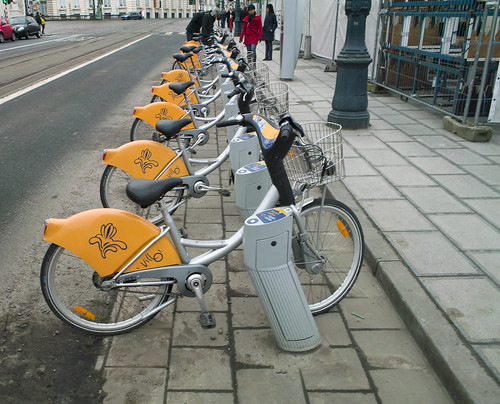
I use the Brussels bike-share scheme every day actually, it’s quite nice to have in a city with not very comprehensive public transportation. It’s quite simple really. For €30 a year I can check out a bike from any the stations scattered around Brussels and return it to a different station at my destination. It’s free as long as I return it to another station within a half hour. If I want to take it out for longer, it’s €1 for every 30 minutes. It’s particularly nice because my apartment is downhill from my office, so I take the metro to work and check out a bike to coast home.
Today I’ve learned that New York is considering implementing a similar scheme. But will it work in New York as well as it’s worked in European cities?
I use the Brussels bike-share scheme every day actually, it’s quite nice to have in a city with not very comprehensive public transportation. It’s quite simple really. For €30 a year I can check out a bike from any the stations scattered around Brussels and return it to a different station at my destination. It’s free as long as I return it to another station within a half hour. If I want to take it out for longer, it’s €1 for every 30 minutes. It’s particularly nice because my apartment is downhill from my office, so I take the metro to work and check out a bike to coast home.
Today I’ve learned that New York is considering implementing a similar scheme. But will it work in New York as well as it’s worked in European cities?
Tuesday, 16 August 2011
British police don't want American supercop
David Cameron's announcement last week that he is appointing former New York City police chief Bill Bratton to guide the UK through its response to the riots has been met with a barrage of criticism from the country's police chiefs. The war of words over the appointment of the controversial 'supercop', who implemented New York's "zero tolerance" approach to policing in the 1990's, has exposed a deep rift between Westminster and Scotland Yard, and the atmosphere is only getting more heated.
Bratton gained fame as New York Mayor Rudy Giuliani's right-hand man in implementing the "broken windows theory" of policing in the city. The theory states that petty crime leads to serious crime, so the 1990's led to a serious crackdown on minor offenses. It turned New York from one of the most crime-ridden cities in the Western world to the safest large city in the United States. But on the flip side, many say it has turned New York into a virtual police state, where officers can arrest you for anything.
The original plan was reportedly to appoint Bratton as London's police commissioner, but this was shot down because he is not a British citizen. So instead he has been appointed as a government adviser. But even this has angered Britain's police chiefs, who say Bratton's 'zero tolerance' approach to policing in America is not appropriate for the UK.
Bratton gained fame as New York Mayor Rudy Giuliani's right-hand man in implementing the "broken windows theory" of policing in the city. The theory states that petty crime leads to serious crime, so the 1990's led to a serious crackdown on minor offenses. It turned New York from one of the most crime-ridden cities in the Western world to the safest large city in the United States. But on the flip side, many say it has turned New York into a virtual police state, where officers can arrest you for anything.
The original plan was reportedly to appoint Bratton as London's police commissioner, but this was shot down because he is not a British citizen. So instead he has been appointed as a government adviser. But even this has angered Britain's police chiefs, who say Bratton's 'zero tolerance' approach to policing in America is not appropriate for the UK.
Monday, 20 June 2011
EU issues Greece an ultimatum - could it backfire?
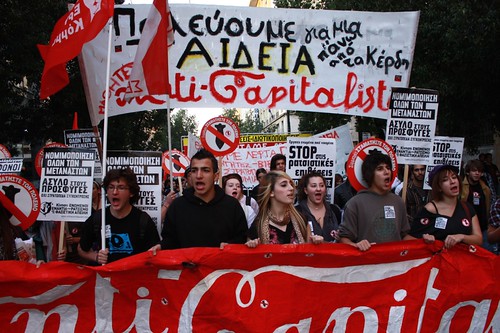
But given the enormous disaster that would likely befall the Eurozone if Greece leaves the currency union, is this a threat the EU can afford to make? There is a real risk that this latest move could backfire. Massive protests continue in Athens today as people stand in front of the parliament chanting "we won't pay". Inside the building, Socialist prime minister George Papandreou is holding a confidence vote to reaffirm his mandate before he attempts to push these austerity measures through the parliament.
Now facing defection from his own party's members and extreme pressure from public opinion, Papandreou's confidence vote will be a rollercoaster ride over the next few days. There is a chance that this latest move from the finance ministers will further enrage Greek public opinion, where there is already an impression that the EU, at the insistence of Germany, is dictating draconian measures in an anti-democratic way. A perceived insult like this could put public optinion in Greece over the edge and cause even more Socialists to withdraw from the parliament. If Papandreaou's government falls it could mean a default on Greece's debt and, most chillingly, a withdrawal from the Euro. These events could spiral out of control and cause a meltdown of the European economy, and maybe even the world economy. Given that reality, is this really a threat the finance ministers can afford to make?
Thursday, 14 January 2010
London plans ‘USA Day'?? I'm out of here!
In the past year of doing this job covering the EU I’ve been living in London (where the company is based) and just going into Brussels when required. But someone in our Brussels office is leaving, so I need to be over there full-time now. I’m looking forward to it actually. Covering the EU from London has been a bit like trying to cover the US Congress from New York. You can do it (people do) but you can’t do it very well. Sure, you can hop on a Eurostar or Amtrak train to attend the key hearings, press conferences and events. But if you’re not immersed in the EU or DC bubble, you’re just not fully connected
Monday, 7 July 2008
The Ray Lewis fiasco
Last week’s whirlwind of accusations, denials and subsequent resignation have been a source of embarrassment for the new mayor, and may be a sign of things to come for the office, which was meant to be a showcase for what a Conservative government could do nationally in the UK.
It all started on Thursday, when Channel 4 first informed the mayor by phone that they were preparing a piece on Lewis after several Anglican Bishops informed the station that in the 1990’s, Lewis had been disrobed as an Anglican priest because of sexual and financial misconduct. They said Lewis had borrowed money from several parishioners – an act in itself rather inappropriate – and then left the country without paying it back.
Monday, 2 June 2008
Last round on the underground
Having lived in the UK for awhile now, I've become pretty accustomed to scenes of mass public drunkenness. But nothing compares to the insanity of Saturday night's tube drinking party, when an estimated 50,000 people descended on London's circle line underground stations and trains to hold a booze fest the night before the new London mayor's public transport drinking ban was to go into effect.The chaos and destruction that followed shouldn't have been surprising to anyone familiar with British drinking culture. But the complete ineptitude with which the new mayor handled the drinking ban roll-out may be just a preview of the new London.
Subscribe to:
Comments (Atom)


_2_new.jpg)