Showing posts with label crime. Show all posts

Tuesday, 10 April 2012

Brussels, the broken city

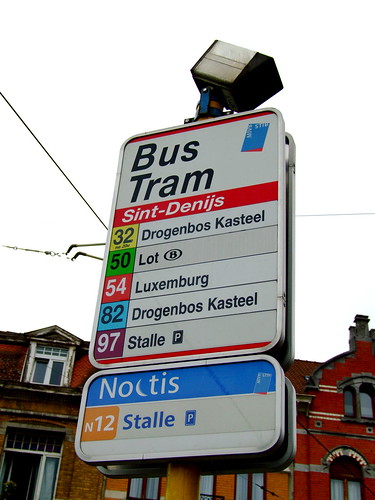
Public transport has been shut down in Brussels for four days now, a state of affairs we learned this morning will likely continue until Thursday. The entire situation has seemed to put people here in a more pronounced state of cynicism and disgust than normal, given both the circumstances of the incident which sparked the strike and the behaviour of the transit workers.

Early on Saturday morning, a city bus was involved in a traffic accident with a drunk driver. When a supervisor from Brussels’ public transport agency STIB came to investigate the accident and accused the car driver of being drunk, he became offended and called some friends to defend him. Those friends attacked the STIB supervisorand killed him.

In response, the STIB immediately shut down the network. This was done well before the facts of the incident were clear and before the employee had died (he didn’t die until later in the day at the hospital). Initial reports on the STIB’s web site said the trains weren’t running because of a “lightning strike”. Later it was a stabbing, until eventually it just said a “serious incident with dramatic consequences”.

The STIB employees said they wouldn’t go back to work until they had a meeting with the Belgian government about improving their safety on Monday night (this being Easter weekend, Monday was a public holiday). But last night, without providing much explanation, the STIB workers union said whatever had been offered them was not enough, and they would continue to stay home.

Wednesday, 30 November 2011

Brussels – enter at your own risk

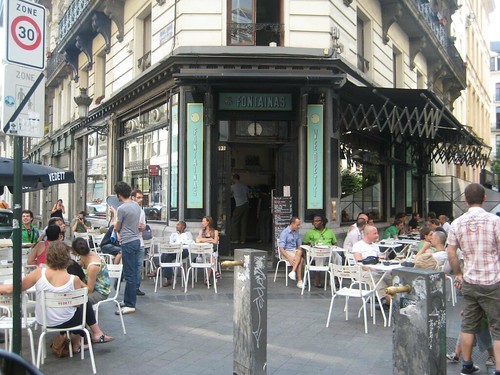
Fontainas, a cafe in central Brussels that could best be described as the headquarters of the city’s gay community, is shut down this week. Its doors have been closed since an incident Sunday night that sent a man to the hospital with severe stab wounds.

News of the attack, which has been spreading like wildfire through social media all week, seems to have left the city’s gay community shocked yet unsurprised at the same time. The storyline has become a familiar one in Brussels. Three drunk men entered the café, began hurling homophobic abuse at the people inside, and before long a violent altercation ensued. The details of what took place are still unclear, but the incident was serious enough to shut the doors of this Brussels landmark since Sunday. And although homophobic attacks are unfortunately common in Brussels city centre - an area of the city that is known for its crime and grime - this incident has still caused huge shock because the establishment is so well-known. Even the soon-to-be Belgian prime minister, who is openly gay, can often be seen there.

A movement has been growing to try to pressure the city authorities to do more to keep the city centre safe since a gay-bashing attack in June that many saw as the straw that broke the camel's back. A man was beaten by a group of young men near the Bourse (stock exchange), just next to Grand Place, because he was gay and behaving in an effeminate manner.

Tuesday, 4 October 2011

The Knox verdict: another humiliation for Italy

These are embarrassing times to be Italian. The country is in a financial mess, on the precipice of becoming the latest victim of the debt crisis. The prime minister is now regarded even by most Italians to be a national embarrassment, yet he still clings to power. The waste crisis in Naples has spiralled out of control, and Italy's handling of migrants from North Africa during the Arab Spring has drawn condemnation from human rights groups and European leaders alike. Even their prime minister has heaped scorn upon Italy, calling it a "shitty country". The last thing Italians needed was another embarrassment.

As I write this, Amanda Knox is boarding a plane in Rome, heading back to her home in the US after four years in an Italian jail for a crime the judiciary now says she did not commit. Yesterday's verdict of innocence, the conclusion of the most closely-watched Italian court case in decades, brought jeers and condemnation not just from the crowd of Italians outside but also from the Italian media. Many in Italy see the verdict as the judiciary bending to American pressure. But other Italians agree with the sentiment felt abroad - particularly in the US – that the Italian judiciary and police system are so flawed there was no way Ms Knox could be convicted without significant doubt about her guilt.

Tuesday, 16 August 2011

British police don't want American supercop

David Cameron's announcement last week that he is appointing former New York City police chief Bill Bratton to guide the UK through its response to the riots has been met with a barrage of criticism from the country's police chiefs. The war of words over the appointment of the controversial 'supercop', who implemented New York's "zero tolerance" approach to policing in the 1990's, has exposed a deep rift between Westminster and Scotland Yard, and the atmosphere is only getting more heated.

Bratton gained fame as New York Mayor Rudy Giuliani's right-hand man in implementing the "broken windows theory" of policing in the city. The theory states that petty crime leads to serious crime, so the 1990's led to a serious crackdown on minor offenses. It turned New York from one of the most crime-ridden cities in the Western world to the safest large city in the United States. But on the flip side, many say it has turned New York into a virtual police state, where officers can arrest you for anything.

The original plan was reportedly to appoint Bratton as London's police commissioner, but this was shot down because he is not a British citizen. So instead he has been appointed as a government adviser. But even this has angered Britain's police chiefs, who say Bratton's 'zero tolerance' approach to policing in America is not appropriate for the UK.

Wednesday, 24 September 2008

Guns in Finland

Yesterday's school shooting in Finland are interesting to look at from an American perspective, considering that the United States has an extensive recent history with school shootings and gun control is such a controversial issue in the US. Finland provides an interesting illustration, when compared to its European neighbors, of the possible links between the availability of guns and the frequency of gun crime.

In the US, gun control advocates often point to Europe as an example of an area where it is much harder to get a gun, and conversely there is much less gun crime. This is generally true, in the UK for instance even the police don't carry guns - and I saw first hand how rare and serious crimes involving guns are when I saw the police response to my getting mugged in January.

But there is one major exception to the restrive gun laws in Europe, and that is Finland. In Finland it is actually quite easy to get a gun, and owning one is very popular. There are 1.6 million firearms in private hands in Finland, and the minimum age for owning one is only 15. Only the US and Yemen have higher civilian gun ownership.

Now after yesterday's shooting, which closely followed another horrific school shooting in Finland in the past year, the country's prime minister has called for gun laws to be tightened. Matti Vanhanen said today that Finland should consider banning private handguns.

"In terms of handguns that can easily be carried about, we have to think about whether they should be available for private people," Vanhanen said. "In my opinion, they belong on shooting ranges."

Eleven students died in yesterday's shooting, and nine died in a similiar shooting in the town of Tuusula. Both of the gunmen had valid licenses for owning a gun, and both were young men who had posted videos on youtube with their weapons before the shooting. After last year's attack the Finnish government said it would consider changing the gun ownership laws, but no change was ever made.

School shootings haven't been very common in Europe, but they have occured. Outside of Finland there have been only two major ones. There was one in Scotland in 1996 that preceded the Columbine shootings, and another one in Germany in 2002. Though Finland has had several school shootings, gun crime in the country is relatively rare (although crime in general in Finland is rare). According to goverment figures, 14 percent of homicides in Finland involve a firearm.

Like the United States, Finland has a long and deep connection with hunting and personal gun ownership. But unlike the United States, there is no way of interpreting Finland's constitution as guaranteeing the right to gun ownership, and there is no powerful gun lobby. It could be that having these two shootings so close to one another could be the catalyst.

Wednesday, 6 February 2008

My first 'gun in the face'

Well, I guess it was only a matter of time considering the fact that London has a much higher crime rate than New York, but I got mugged yesterday evening in South London. Suffice it to say last night was one of the more surreal evenings I’ve had in my life.

Already I knew it was going to be an interesting night because I was finally going to go visit my friend who lives in a boat in the Thames. No, he’s not a pirate, but he sold his flat and bought a sailing boat, and lives in it in a quay next to Canary Wharf. The easiest way to get there from where I live is to take a boat, there’s a public transport boat that runs up and down the Thames called the Thames Clipper. It was almost completely empty, but had amazing views going down the river. I’m thinking when my family comes to visit this weekend I’ll take them on that rather than a boat cruise, it’s faster and cheaper.

When we arrived at the Greenland Pier Dock a few people got off, but it was mostly deserted. It’s a mix of boats docked and really nice flats, generally a pleasant-looking, expensive area. It reminded me of Roosevelt Island actually. My friend was running late to meet me so I went for a walk to explore. I came across this floating bar in a ship called the Wibbly Wobbly. Then my friend showed up. It was 7:30pm.