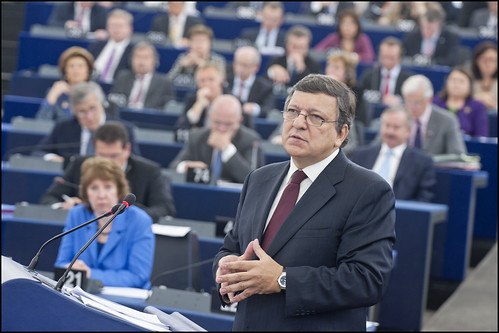
France has always resented British influence in the EU. Excluding the UK from EU law-making could reshape the union in the French model.
In 1963, when the United Kingdom first applied to join the European Community, the answer from Paris was a resolute 'non'.
French President Charles de Gaulle vetoed the application in '63 and again in '67. He said that "a number of aspects of Britain's economy, from working practices to agriculture...made Britain incompatible with Europe". He added that the UK had a “deep-seated hostility” to any pan-European project.
It wasn't until De Gaulle relinquished the French presidency that Paris finally relented and allowed the UK to join the club in 1972.
So what were the "aspects of Britain's economy" that De Gaulle was so worried about? It was free market liberal economics. De Gaulle, and his successors, distrusted the "Anglo-Saxon" (The French term for Anglo-American) model of capitalism and had a very different vision for Europe.
Showing posts with label United Kingdom. Show all posts
Saturday, 2 July 2016
Sunday, 26 June 2016
Ireland faces its doomsday scenario
Both sides of Ireland are in a panic because Brexit could make the peace process unravel. But perhaps the North has come far enough to allow a non-violent reunification of the island.
"Of all the things that could happen to an Irish government short of the outbreak of war, this is pretty much up there with the worst of them," wrote The Irish Times, the republic's main newspaper, as the world woke up to the "Brexit nightmare" on Friday morning.
"Ever since David Cameron announced that he would hold a referendum back in 2012, Irish officials have regarded the prospect of a British exit from the EU as the worst thing that could happen [to Ireland]," the paper wrote. "[Irish PM] Kenny now faces leading Ireland through a period of difficulty and uncertainty unprecedented in the last 50 years, more complex and unpredictable than the recent financial crisis, more destabilising the Northern Troubles."
The UK is Ireland's biggest trading partner. One billion euros worth of goods flow freely across the Irish Sea each week, tariff-free because both countries are in the European Union. If the UK leaves the EU while the Republic of Ireland stays in, customs duties will have to be imposed on that trade. That is, unless the UK joins the EEA, but I've written before on why that is unlikely.
"Ever since David Cameron announced that he would hold a referendum back in 2012, Irish officials have regarded the prospect of a British exit from the EU as the worst thing that could happen [to Ireland]," the paper wrote. "[Irish PM] Kenny now faces leading Ireland through a period of difficulty and uncertainty unprecedented in the last 50 years, more complex and unpredictable than the recent financial crisis, more destabilising the Northern Troubles."
The UK is Ireland's biggest trading partner. One billion euros worth of goods flow freely across the Irish Sea each week, tariff-free because both countries are in the European Union. If the UK leaves the EU while the Republic of Ireland stays in, customs duties will have to be imposed on that trade. That is, unless the UK joins the EEA, but I've written before on why that is unlikely.
Sunday, 12 June 2016
After divorce, UK and EU unlikely to be 'friends with benefits'
The EEA was not built for a country the size of Britain. To think that the EU will allow it to easily join is folly.
This week the EU's most powerful finance minister, Germany's Wolfgang Schäuble, will say in an exclusive interview to be published by Der Spiegel that the UK should not be given special access to the EU common market, à la Norway, if it quits the bloc.
"In is in, out is out," he will say in the interview, which was seen and previewed by The Guardian. “That won’t work, it would require the country to abide by the rules of a club from which it currently wants to withdraw. If the majority in Britain opts for Brexit, that would be a decision against the single market."
This week the EU's most powerful finance minister, Germany's Wolfgang Schäuble, will say in an exclusive interview to be published by Der Spiegel that the UK should not be given special access to the EU common market, à la Norway, if it quits the bloc.
"In is in, out is out," he will say in the interview, which was seen and previewed by The Guardian. “That won’t work, it would require the country to abide by the rules of a club from which it currently wants to withdraw. If the majority in Britain opts for Brexit, that would be a decision against the single market."
Tuesday, 24 May 2016
Why is the BBC afraid to call UKIP a nationalist party?
Populism is other people, according to the British media.
Austria's presidential election on Sunday, in which the country came within a hair's breadth of electing its first far-right head of state since World War II, has generated a new round of media coverage on the rise of extremist parties across Europe.
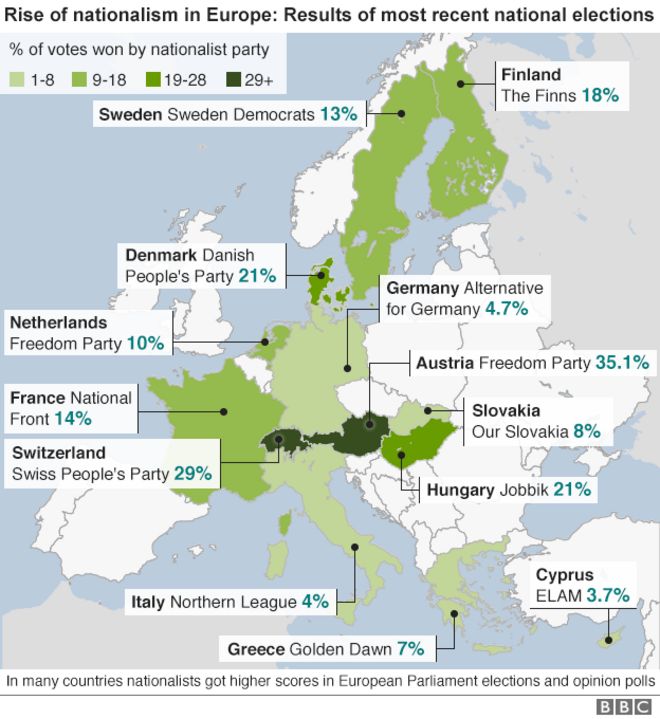
Today the BBC published an analysis of the 'Widespread revolt against the political centre', tracing the rise of these parties. It is accompanied by a map showing the percentage of votes won by "nationalist parties" in the most recent elections.
Notice anything strange about this map? According to the BBC, the UK is either not part of Europe, or has no nationalist party.
Austria's presidential election on Sunday, in which the country came within a hair's breadth of electing its first far-right head of state since World War II, has generated a new round of media coverage on the rise of extremist parties across Europe.
Today the BBC published an analysis of the 'Widespread revolt against the political centre', tracing the rise of these parties. It is accompanied by a map showing the percentage of votes won by "nationalist parties" in the most recent elections.
Notice anything strange about this map? According to the BBC, the UK is either not part of Europe, or has no nationalist party.
Saturday, 23 April 2016
Obama bursts Britain’s post-imperial hubris
The crux of the Brexiters' argument is an anglosphere alliance. Yesterday the US president told them it’s not going to happen.That sound you heard yesterday across the United Kingdom was the collective wince of a nation finally made to accept an uncomfortable truth – he’s just not that into you.
Americans are largely unaware of what’s happening with the Brexit debate, but whether they know it or not they are central to the case for the UK seceding from the European Union. They are also largely unaware that they are in a “special relationship” with the UK, a term which, as I’ve written before, is obsessed over in the UK but unknown in the US.
For years US politicians have indulged the British in their fantasies of a two-way relationship between equal partners. But in light of the severe risk a Brexit presents, Barack Obama had no choice but to fly to the UK and finally break the bad news to the Brits.
Friday, 11 March 2016
Is the EU archaic, or dynamic?
Boris Johnson's description of the EU as an "anachronism" is rich coming from a monarchy with no written constitution.
Wild-maned London mayor Boris Johnson delivered a much-anticipated speech today explaining why he has become the most prominent proponent of the UK leaving the European Union. I suffered through it so you don't have to.
It is striking how similar BoJo's speeches sound to those delivered by Donald Trump across the pond. Demonstrating a willful disregard for the facts (more on that later), BoJo paints a picture of a glorious future - making Britain great again. Things are terrible now because the UK is in the EU, and as soon as it leaves things will be great again. But his explanations as to why they will be better are at best vague, at worst fanciful. When asked today what the risks were of a brexit, BoJo claimed he "honestly can't think of any".
The overall message is that the UK needs to "burst out of the shackles of Brussels" because the EU is "an anachronism", and the UK on its own would by much more dynamic and modern. "This thing's 50 years old," he scoffed, as if that harkened back to the Middle Ages.
It's not the first time I've heard this characterisation in the Brexit debate. UK Education Secretary Michael Gove, another prominent Brexit proponent, said the same in in his statement backing Brexit. "The EU is an institution rooted in the past and is proving incapable of reforming to meet the big technological, demographic and economic challenges of our time," he wrote. "It was developed in the 1950s and 1960s and like other institutions which seemed modern then, from tower blocks to telexes, it is now hopelessly out of date...it is an analogue union in a digital age."
Wild-maned London mayor Boris Johnson delivered a much-anticipated speech today explaining why he has become the most prominent proponent of the UK leaving the European Union. I suffered through it so you don't have to.
It is striking how similar BoJo's speeches sound to those delivered by Donald Trump across the pond. Demonstrating a willful disregard for the facts (more on that later), BoJo paints a picture of a glorious future - making Britain great again. Things are terrible now because the UK is in the EU, and as soon as it leaves things will be great again. But his explanations as to why they will be better are at best vague, at worst fanciful. When asked today what the risks were of a brexit, BoJo claimed he "honestly can't think of any".
The overall message is that the UK needs to "burst out of the shackles of Brussels" because the EU is "an anachronism", and the UK on its own would by much more dynamic and modern. "This thing's 50 years old," he scoffed, as if that harkened back to the Middle Ages.
It's not the first time I've heard this characterisation in the Brexit debate. UK Education Secretary Michael Gove, another prominent Brexit proponent, said the same in in his statement backing Brexit. "The EU is an institution rooted in the past and is proving incapable of reforming to meet the big technological, demographic and economic challenges of our time," he wrote. "It was developed in the 1950s and 1960s and like other institutions which seemed modern then, from tower blocks to telexes, it is now hopelessly out of date...it is an analogue union in a digital age."
Friday, 26 February 2016
Brexit is the British Trump
After years of vilifying the EU, the English elite have created a Frankenstein's monster they cannot control.
It now looks increasingly likely that Donald Trump will be the Republican nominee for the US Presidency, and the world is looking on in bemused horror. What kind of hysteria has propelled this man toward becoming the American right's standard-bearer?
It has been widely observed over the past months that this is a monster of the Republican Party's own making. For years the party has driven turnout by peddling a narrative of fear, and stoking the worst instincts of its base. Truth became relative, and 'truthiness' was the name of the game. If it felt true, then go with it.
It now looks increasingly likely that Donald Trump will be the Republican nominee for the US Presidency, and the world is looking on in bemused horror. What kind of hysteria has propelled this man toward becoming the American right's standard-bearer?
It has been widely observed over the past months that this is a monster of the Republican Party's own making. For years the party has driven turnout by peddling a narrative of fear, and stoking the worst instincts of its base. Truth became relative, and 'truthiness' was the name of the game. If it felt true, then go with it.
Thursday, 24 October 2013
Immigrant-on-immigrant xenophobia
Italians were shocked yesterday to learn that a Northern Italian teenager who had recently gone to the UK to study and find work had been beaten to death over the weekend. Joele Leotta, 19, was brutally attacked by a group of young men who accused him of “stealing English jobs”, the Italian papers reported.The Italian papers were quick to make a connection to increasing anti-European and anti-immigrant rhetoric from the Conservative government in the UK. Some intitial reports in Italy mentioned the new campaign by the government to send vans into certain neighbourhoods telling illegal immigrants to “go home” in big letters.
The initial press coverage prompted Hannes Swoboda, the leader of the Socialist (S&D) group in the European Parliament, to issue a press release saying the murder was the result of the xenophobic climate created by the government. "The xenophobic, aggressive climate inflamed by populists such as UKIP and by the rhetoric of the Conservatives in government is now leading to murder in the streets of Britain,” said Swoboda in a statement. “Campaigns such as vans with slogans telling immigrants to 'go home' and continuous negative rhetoric against foreigners – including EU citizens – are creating an ugly mood in Britain, which has long prided itself on being an open-minded and tolerant nation.”
Friday, 11 January 2013
Obama warns Cameron over his dangerous EU game
Philip Gordon, the US assistant secretary of state for
European affairs, said in a speech in London that the UK leaving the EU would
be a mistake, implying that Britain’s relationship with the US (and,
presumably, most other major global players) would be damaged as a result.
It isn’t just an academic debate. At the end of this month, British prime minister David Cameron will deliver a speech in The Hague on Britain’s future relationship with the EU. It is expected that he will announce a public referendum on EU membership that will take place in 2018 – well after the next general election and most likely after Cameron is out of office. Cameron has found it increasingly difficult to assuage the demands of a significant contingent of his increasingly anti-European party for a referendum on Britain leaving the EU."We have a growing relationship with the European Union as an institution which has a growing voice in the world – and we want to see a strong British voice in that European Union. That is in the American interest," he said. "When Europeans put their resources together and have a collective decision-making function they end up playing a major role in the world…And for the UK to be a part of that stronger, more important voice in the world is something I know a lot of British people welcome."
Monday, 24 September 2012
Britain snubs Europe, goes to the dance with Canada
During a visit to Canada
today Hague announced that the UK
is going to close some British embassies across the world and merge them with Canadian
embassies. The two countries will establish joint diplomatic missions, sharing
embassy offices and consular services.
The move, an attempt to save money in these cost-cutting
times, might seem logical enough at first glance. But the more you delve into
it the more you realize it is diplomatically and logistically bizarre. While
the UK and Canada may have
similar foreign policy (something irrelevant to the consular services they are
merging), they are completely separate countries which share no unified visa
system. The only thing they share is a queen.
Wednesday, 1 August 2012
Romney’s offend-a-thon comes to an end
If the aim of Mitt Romney’s ‘world tour’ over the past week was to demonstrate his ability to tactfully represent the United States on the world stage, it’s safe to say the trip had the opposite effect. Professing to be on a quest to ‘restore relations with America’s most important strategic allies’, Romney managed to cause grave offense in all three of the countries he visited.
It started badly and quickly went from bad to worse. Even before he touched down in London last Wednesday, his campaign had raised eyebrows when an advisor said that Barack Obama was unable to understand the “common Anglo-Saxon heritage” of the US and the UK. Given that in English this term only refers to the Germanic tribes of Southwest England (unlike the "free-market capitalism" meaning it has in France), it came off as shockingly racist – i.e., a black man cannot understand the common Germanic heritage of the English and their descendants.
Romney then managed to enrage the British public by casting doubt on their readiness to host the Olympic Games, telling a US journalist in London that the UK’s preparedness was “not encouraging.” This sent the British media into a frenzy of anti-Romney headlines, such as “Mitt the Twit” (The Sun, owned by Rupert Murdoch) and “Who invited Party-Pooper Romney?” (The ultra-conservative Daily Mail). He even managed to enrage Conservative British Prime Minister David Cameron, who quipped at a press conference, "Of course it's easier if you hold an Olympic Games in the middle of nowhere." (Romney ran the 2002 Winter Olympics in Salt Lake City, Utah). Even London mayor Boris Johnson, himself a gaffe-magnet, used Mitt Romney’s name when speaking to crowds asif describing some kind of panto villain, quickly followed with boos from assembled Olympics-lovers.
It started badly and quickly went from bad to worse. Even before he touched down in London last Wednesday, his campaign had raised eyebrows when an advisor said that Barack Obama was unable to understand the “common Anglo-Saxon heritage” of the US and the UK. Given that in English this term only refers to the Germanic tribes of Southwest England (unlike the "free-market capitalism" meaning it has in France), it came off as shockingly racist – i.e., a black man cannot understand the common Germanic heritage of the English and their descendants.
Romney then managed to enrage the British public by casting doubt on their readiness to host the Olympic Games, telling a US journalist in London that the UK’s preparedness was “not encouraging.” This sent the British media into a frenzy of anti-Romney headlines, such as “Mitt the Twit” (The Sun, owned by Rupert Murdoch) and “Who invited Party-Pooper Romney?” (The ultra-conservative Daily Mail). He even managed to enrage Conservative British Prime Minister David Cameron, who quipped at a press conference, "Of course it's easier if you hold an Olympic Games in the middle of nowhere." (Romney ran the 2002 Winter Olympics in Salt Lake City, Utah). Even London mayor Boris Johnson, himself a gaffe-magnet, used Mitt Romney’s name when speaking to crowds asif describing some kind of panto villain, quickly followed with boos from assembled Olympics-lovers.
Wednesday, 25 July 2012
Romney's 'apology for the apology' tour
Mitt Romney has arrived in London today, the first stop on a three-country tour meant to shore up his foreign policy credentials. His tour opened with a remarkably tone-deaf gaffe by a campaign staffer, who told British newspaper The Telegraph that Barack Obama cannot understand the common “Anglo-Saxon heritage” of the US and the UK.
The advisor was likely using the term in the continental European context, which refers to the free-market economic heritage of English-speaking countries. He was likely trying to make some 'Obama as Socialist' characterisation. But this definition is unknown in the English-speaking countries themselves, where the term is a seldom-used ethnic description of English descent (ie, from the Germanic tribes who settled in Southwest England). So it ended up just coming off as shockingly racist. Stephen Colbert hilariously summed up the bemused reaction of Americans to the comment.
It’s a bad start to what is a very important foreign tour for Romney. Over the next few days he will be meeting with virtually every high level politician in the UK. On Friday he will attend the Olympics opening ceremony, surely excited about the prospects for his horse-dancer in the dressage competition.
The Republican presidential candidate’s choice of three countries for this visit is highly significant. After his visit to the UK he will fly to Israel, where he will make a series of high-profile appearances. He will then finish his tour in Poland. All three are countries which the Romney campaign has accused the Obama administration of at best ignoring, and at worst insulting.
The advisor was likely using the term in the continental European context, which refers to the free-market economic heritage of English-speaking countries. He was likely trying to make some 'Obama as Socialist' characterisation. But this definition is unknown in the English-speaking countries themselves, where the term is a seldom-used ethnic description of English descent (ie, from the Germanic tribes who settled in Southwest England). So it ended up just coming off as shockingly racist. Stephen Colbert hilariously summed up the bemused reaction of Americans to the comment.
It’s a bad start to what is a very important foreign tour for Romney. Over the next few days he will be meeting with virtually every high level politician in the UK. On Friday he will attend the Olympics opening ceremony, surely excited about the prospects for his horse-dancer in the dressage competition.
The Republican presidential candidate’s choice of three countries for this visit is highly significant. After his visit to the UK he will fly to Israel, where he will make a series of high-profile appearances. He will then finish his tour in Poland. All three are countries which the Romney campaign has accused the Obama administration of at best ignoring, and at worst insulting.
Friday, 10 February 2012
UK court ends prayer in town councils - but on technicality
A UK court issued an interesting ruling today – finding that it is not lawful for town councils to say prayers before meetings. What makes it an interesting case is that the UK, unlike the US, does not have a legal separation between church and state.
In fact England has an official state religion – the Church of England. So having local government say Anglican prayers before a government meeting might not seem so unusual. But an atheist counsellor in a town called Bideford in Southwest England decided to challenge his council’s practice of saying a prayer before meetings. The legal challenge, brought by the National Secular Society, said that prayers have no place in "a secular environment concerned with civic business".
Because the UK has no formal constitution, and no domestic legal guarantee of religious freedom, the NSS cited the European Convention on Human Rights - which protects an individual's right to “freedom of conscience” and protects against discrimination. The ECHR (transposed into British law through the 1998 Human Rights Act) is often cited in British cases involving human rights because there is no British constitution to appeal to. This lack of a legal code for human rights often means that Britain is more subject to the non-binding verdicts of the European Court of Human Rights (which guarantees the convention) than other countries.
In fact England has an official state religion – the Church of England. So having local government say Anglican prayers before a government meeting might not seem so unusual. But an atheist counsellor in a town called Bideford in Southwest England decided to challenge his council’s practice of saying a prayer before meetings. The legal challenge, brought by the National Secular Society, said that prayers have no place in "a secular environment concerned with civic business".
Because the UK has no formal constitution, and no domestic legal guarantee of religious freedom, the NSS cited the European Convention on Human Rights - which protects an individual's right to “freedom of conscience” and protects against discrimination. The ECHR (transposed into British law through the 1998 Human Rights Act) is often cited in British cases involving human rights because there is no British constitution to appeal to. This lack of a legal code for human rights often means that Britain is more subject to the non-binding verdicts of the European Court of Human Rights (which guarantees the convention) than other countries.
Wednesday, 11 January 2012
Would the EU allow a Scottish secession-accession?
Following the whirlwind events of this week, Scotland now appears to be closer to secession than it has ever been in the 300-year history of Great Britain. This week the first minister of the devolved Scottish Parliament set a date for the first referendum on Scottish independence in history. And according to polling, if the referendum were held today, Scots could very well vote to separate from the United Kingdom.
The discussion of secession has been hanging in the air for some time, ever since the secessionist Scottish National Party won a majority in the Scottish Parliament in 2007. But now with an independence referendum date set, discussion has turned for the first time toward the real practicalities of what a split would entail and the difficult questions it would present. Who does the oil in the UK's territorial North Sea waters belong to - Britain or Scotland? Who would be on the hook for the massive bailouts of Scotland's two banking giants in 2008? Would Scotland use the British pound, the euro, or a new Scottish pound?
Scottish First Minister Alex Salmond took the decision in response to a call from UK Prime Minster David Cameron to call a referendum, which the SNP had promised in their election, now. London knows that with the current economic crisis, Scots would be unlikely to be very brave at the polls. But Salmond balked, saying he would not take orders from London and setting a referendum date in 2014.
EU complications
Though there have been a lot questions asked in the British media today about what secession would mean, as far as I can tell not a lot of thought has gone into the EU implications of all this. Everyone has been asking whether or not Scotland would choose to use the euro. But there's a leap being made there. In order to use the euro, Scotland would have to be part of the EU. That is not up to them, it is up to the 27 member states. And there are plenty of member states with good reason to block Scotland's entry.
The discussion of secession has been hanging in the air for some time, ever since the secessionist Scottish National Party won a majority in the Scottish Parliament in 2007. But now with an independence referendum date set, discussion has turned for the first time toward the real practicalities of what a split would entail and the difficult questions it would present. Who does the oil in the UK's territorial North Sea waters belong to - Britain or Scotland? Who would be on the hook for the massive bailouts of Scotland's two banking giants in 2008? Would Scotland use the British pound, the euro, or a new Scottish pound?
Scottish First Minister Alex Salmond took the decision in response to a call from UK Prime Minster David Cameron to call a referendum, which the SNP had promised in their election, now. London knows that with the current economic crisis, Scots would be unlikely to be very brave at the polls. But Salmond balked, saying he would not take orders from London and setting a referendum date in 2014.
EU complications
Though there have been a lot questions asked in the British media today about what secession would mean, as far as I can tell not a lot of thought has gone into the EU implications of all this. Everyone has been asking whether or not Scotland would choose to use the euro. But there's a leap being made there. In order to use the euro, Scotland would have to be part of the EU. That is not up to them, it is up to the 27 member states. And there are plenty of member states with good reason to block Scotland's entry.
Wednesday, 14 December 2011
This isn’t about the UK any more
The markets have returned to panic mode today as their confidence in national governments to approve the new Eurozone financial consolidation treaty wavered. Ratification has hit some bumps in the road, with Finland’s prime minister expressing dissatisfaction with the transfer of authority over national budgets to the EU on Tuesday. In Ireland, the opposition parties seem keen to force a referendum on the issue even if the country’s legal services rule that one is not required.
The euro fell below $1.30 today, its lowest point in a year. Yields on Italian bonds widened to new highs. It’s a familiar pattern we’ve seen repeated several times now: markets rally upon news of a new European Council agreement, but then crash a few days later when they look at the details and realise it’s not as strong as they’d hoped. The UK's abandonment of Europe may have been the big story on Friday, but now the more important story sets in - the markets have not been satisfied.
But there seems to be some confusion in the British media though about what this all means vis-à-vis the UK’s decision to veto the attempt at treaty change on Friday. The Spectator has run a column from the Eurosceptic think tank Open Europe scolding the British media for describing the UK as isolated as a result of the 26 vs. 1 outcome last week. There isn’t really any such divide, Open Europe insists, because many other member states support the UK’s reticence. As evidence that all is not what it seems, they run through the list of objections to the new treaty being expressed in national capitals this week.
The euro fell below $1.30 today, its lowest point in a year. Yields on Italian bonds widened to new highs. It’s a familiar pattern we’ve seen repeated several times now: markets rally upon news of a new European Council agreement, but then crash a few days later when they look at the details and realise it’s not as strong as they’d hoped. The UK's abandonment of Europe may have been the big story on Friday, but now the more important story sets in - the markets have not been satisfied.
But there seems to be some confusion in the British media though about what this all means vis-à-vis the UK’s decision to veto the attempt at treaty change on Friday. The Spectator has run a column from the Eurosceptic think tank Open Europe scolding the British media for describing the UK as isolated as a result of the 26 vs. 1 outcome last week. There isn’t really any such divide, Open Europe insists, because many other member states support the UK’s reticence. As evidence that all is not what it seems, they run through the list of objections to the new treaty being expressed in national capitals this week.
Monday, 24 October 2011
UK sidelined as Cameron faces attack from Sarko and his own MPs
David Cameron's quest for influence at this week's Eurozone crisis meetings is meeting headwinds, to say the least. First French president Nicolas Sarkozy tells him to 'shut up' at yesterday's summit, and now he is facing a rebellion his back-bench Eurosceptic MPs.
Tonight the rebels will try to force a vote in the parliament to set a public referendum in the UK on its EU membership. Cameron opposes such a referendum and has instructed his party to vote against it, as have the leaders of his coalition partners the Liberal Democrats and the opposition Labour. But 70 Conservative MPs are expected to defy him and vote for a referendum.
Of course, the measure has no hope of passing. But commentators and the markets,will be focused on the message that the rebellion will send at this precarious and sensitive time. British foreign secretary William Hague, who is himself quite eurosceptic, told the BBC that the vote being forced by the back-benchers is "the wrong question at the wrong time" and has likened it to "a piece of graffiti". The vote will "create additional economic uncertainty in this country at a difficult economic time," he said.
Cameron has imposed a 'three-line whip' on his party to vote against the measure, which is the most serious whip a party can issue. Any MPs who disobey will be expected to resign from government jobs. Cameron has said the preceding Labour Party should have held a public referendum on the ratification of the Lisbon Treaty, and he has pledged to hold a referendum on any future treaty changes. But he says an 'in-out' referendum would be counter-productive. This is likely because he knows such a referendum could easily yield an 'out' result, plunging the UK into a diplomatic and economic crisis.
Tonight the rebels will try to force a vote in the parliament to set a public referendum in the UK on its EU membership. Cameron opposes such a referendum and has instructed his party to vote against it, as have the leaders of his coalition partners the Liberal Democrats and the opposition Labour. But 70 Conservative MPs are expected to defy him and vote for a referendum.
Of course, the measure has no hope of passing. But commentators and the markets,will be focused on the message that the rebellion will send at this precarious and sensitive time. British foreign secretary William Hague, who is himself quite eurosceptic, told the BBC that the vote being forced by the back-benchers is "the wrong question at the wrong time" and has likened it to "a piece of graffiti". The vote will "create additional economic uncertainty in this country at a difficult economic time," he said.
Cameron has imposed a 'three-line whip' on his party to vote against the measure, which is the most serious whip a party can issue. Any MPs who disobey will be expected to resign from government jobs. Cameron has said the preceding Labour Party should have held a public referendum on the ratification of the Lisbon Treaty, and he has pledged to hold a referendum on any future treaty changes. But he says an 'in-out' referendum would be counter-productive. This is likely because he knows such a referendum could easily yield an 'out' result, plunging the UK into a diplomatic and economic crisis.
Friday, 7 October 2011
Two different animals
Conservative Prime Minister David Cameron stood before the yearly gathering of Conservative Party members – similar to the 'national conventions' in the US – and said he wholeheartedly supports gay marriage and will work to enact it in the UK next year (to replace the current civil unions). This was met with thundering applause in the hall. Try to imagine the reaction if a presidential candidate said this to the Republican National Convention!
In the second example, a huge row has developed after the Conservative Home Secretary Theresa May used an incorrect fact in her speech to the conference. Explaining why she wants to dismantle the Human Rights Act, which is the British transposition of the European Convention on Human Rights, she listed as an example a case where the act's requirements meant that there was an "illegal immigrant who cannot be deported because – and I am not making this up – he had a pet cat."
As it turns out, she was making this up. As the decision shows, the actual verdict against deportation had nothing to do with a pet cat, the decision was instead due to a mistake made by the Home Office's prosecution. A pet cat, which had been mentioned in the appellant's brief along with his partner as reasons why he has a home life in the UK, was merely mentioned by the judge in his verdict as an attempt at humour. It was later revealed that May had taken the cat story from a speech made by UK Independence Party leader Nigel Farage.
Tuesday, 4 October 2011
The Knox verdict: another humiliation for Italy
As I write this, Amanda Knox is boarding a plane in Rome, heading back to her home in the US after four years in an Italian jail for a crime the judiciary now says she did not commit. Yesterday's verdict of innocence, the conclusion of the most closely-watched Italian court case in decades, brought jeers and condemnation not just from the crowd of Italians outside but also from the Italian media. Many in Italy see the verdict as the judiciary bending to American pressure. But other Italians agree with the sentiment felt abroad - particularly in the US – that the Italian judiciary and police system are so flawed there was no way Ms Knox could be convicted without significant doubt about her guilt.
Wednesday, 28 September 2011
EU banker tax? UK says no
With these words European Commission President Jose Manuel Barroso put forward what is bound to be an enormously controversial piece of EU legislation, a transaction tax on bankers and investors who invest in stocks, bonds and derivatives. Speaking to the European Parliament in Strasbourg today for his annual 'state of the union' address, Barroso said the tax would bring in €55 billion per year, starting from 2014.
The language used by the president was clearly populist in nature, emphasising a sense of fairness and responding to a public feeling that the bankers who caused the economic crisis of 2008 have never been called to account and have not been asked to contribute to the recovery from the pain they caused. Stock markets and investment firms have made remarkable recoveries over the past few years, and executive pay has steadily risen. But at the same time the economy as a whole has suffered enormously and continues to suffer.
Wednesday, 21 September 2011
DADT repeal: US joins the Western world
Yesterday America's infamous Don't Ask, Don't Tell ban on gays in the military was officially repealed. It was a hard-fought battle for the Democratic Party, and the Obama administration was keen to publicize the fulfillment of one of the president's key campaign promises. It wasn't easy, and the past three years have been met with opposition and setbacks.
The level of jubilation from Democrats was incredible, but understandable considering how long they have fought to end this ban. But looking at the situation in a global context, the excitement over a rather small policy change might seem strange. After all, until Tuesday the United States was the only country in the developed world that still had a ban on gays serving in the military.
Barring gays from military service is illegal under European law, and no such ban exists in any EU state - even in ultra-Catholic Poland or Italy. In fact the only country in all of Europe to have a ban on gays in the military is Serbia. In Latin America, the only countries to have bans on gays in the military are Cuba and Venezuela. As can be seen in the map above, the divide between gay bans (in red) and no gay bans (in blue and gray) mirrors the divide between the developed and developing world. Gay service bans are common in Africa and the Middle East.
The level of jubilation from Democrats was incredible, but understandable considering how long they have fought to end this ban. But looking at the situation in a global context, the excitement over a rather small policy change might seem strange. After all, until Tuesday the United States was the only country in the developed world that still had a ban on gays serving in the military.
Barring gays from military service is illegal under European law, and no such ban exists in any EU state - even in ultra-Catholic Poland or Italy. In fact the only country in all of Europe to have a ban on gays in the military is Serbia. In Latin America, the only countries to have bans on gays in the military are Cuba and Venezuela. As can be seen in the map above, the divide between gay bans (in red) and no gay bans (in blue and gray) mirrors the divide between the developed and developing world. Gay service bans are common in Africa and the Middle East.
Subscribe to:
Comments (Atom)

.jpg)