Populism is other people, according to the British media.
Austria's presidential election on Sunday, in which the country came within a hair's breadth of electing its first far-right head of state since World War II, has generated a new round of media coverage on the rise of extremist parties across Europe.
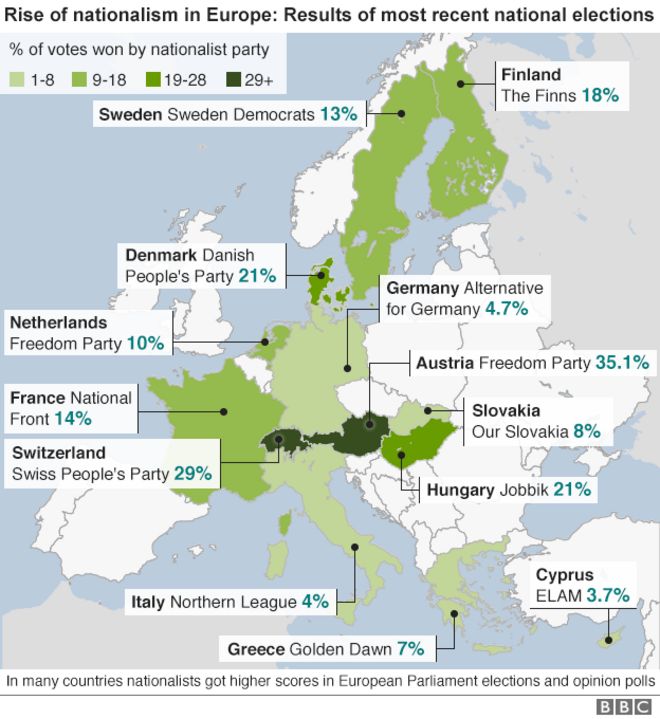
Today the BBC published an analysis of the 'Widespread revolt against the political centre', tracing the rise of these parties. It is accompanied by a map showing the percentage of votes won by "nationalist parties" in the most recent elections.
Notice anything strange about this map? According to the BBC, the UK is either not part of Europe, or has no nationalist party.
Showing posts with label UKIP. Show all posts
Tuesday, 24 May 2016
Saturday, 14 September 2013
Total recall
Recently, the disgraceful tale of a Scottish politician refusing to resign in the face of 23 (yes, 23) separate domestic abuse convictions has revived talk in the UK of that old populist hobby-horse – the right to recall.
Bill Walker, a Scottish National Party member of the Scottish Parliament (pictured below), was convicted last month of a series of domestic abuse offenses against three different ex wives and a stepdaughter over three decades.
Though he was expelled from the SNP after the conviction, for weeks Walker refused to vacate his seat – and there was nothing the SNP or the Scottish Parliament could do to make him leave. As the British media examined the bizarre situation, those who advocate establishing a citizen's recall law in the UK came out in force to argue that this disgraceful state of affairs makes their case.
Thursday, 12 September 2013
The pan-sceptic ticket
Nigel Farage's state of the union response suggests UKIP will make climate change denial a centrepiece of their European election campaign.
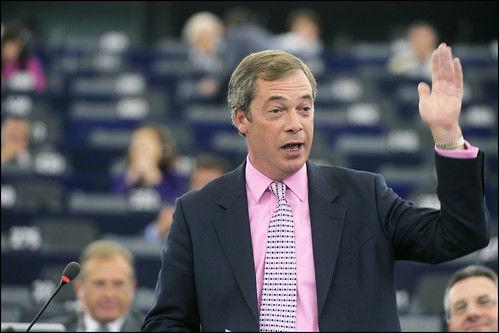
I was a bit taken aback on Wednesday when, during his response to President Barroso's State of the European Union speech in Strasbourg, UKIP leader Nigel Farage devoted almost the entirety of his speech not to warnings about the creeping European super-state, but to an impassioned denial of climate change.
The subject is nothing new for UKIP. The official party line is that there is no proof that climate change is man-made, and this is often brought up by UKIP MEPs. The party has been particularly vocal about renewable energy, blasting “ugly” wind turbines blotting the English countryside and biofuel subsidies it says are responsible for fuel poverty in the UK. This was made clear by UKIP MEPs during Monday's debate on biofuel legislation, which strangely put UKIP on the same side as the Greens.
But it was surprising to see Farage devote so much time to the issue during a big-picture debate on the EU that had nothing to do with climate change. The EU had fallen victim to a “green obsession”, he said. The resulting legislation had driven manufacturing away from the UK and forced people into fuel poverty.
I was a bit taken aback on Wednesday when, during his response to President Barroso's State of the European Union speech in Strasbourg, UKIP leader Nigel Farage devoted almost the entirety of his speech not to warnings about the creeping European super-state, but to an impassioned denial of climate change.
The subject is nothing new for UKIP. The official party line is that there is no proof that climate change is man-made, and this is often brought up by UKIP MEPs. The party has been particularly vocal about renewable energy, blasting “ugly” wind turbines blotting the English countryside and biofuel subsidies it says are responsible for fuel poverty in the UK. This was made clear by UKIP MEPs during Monday's debate on biofuel legislation, which strangely put UKIP on the same side as the Greens.
But it was surprising to see Farage devote so much time to the issue during a big-picture debate on the EU that had nothing to do with climate change. The EU had fallen victim to a “green obsession”, he said. The resulting legislation had driven manufacturing away from the UK and forced people into fuel poverty.
Thursday, 23 May 2013
UKIP voters demand referendum...on Eurovision
As the EU referendum debate has heated up in Britain over the past
several months, the UK-based polling agency YouGov has conducted
periodic surveys asking the voting public whether they want an in-out
referendum, and how they would vote in it.
In this week's survey, they threw an additional query into the mix – asking the same question but replacing the ‘European Union' with the ‘Eurovision Song Contest'. The result is rather revealing.
The survey shows that if a referendum on Eurovision were held, the UK's voters would vote to leave the song contest, with only 29% voting to remain in it. Among UK Independence Party (UKIP) voters, only 13% would vote to remain in the contest.
32% of the survey's respondants said they want the government to hold an in-out referendum on Eurovision (44% said they were opposed, while 24% said they weren't sure). The majority of UKIP voters with an opinion said they want the UK to hold such a referendum.
In this week's survey, they threw an additional query into the mix – asking the same question but replacing the ‘European Union' with the ‘Eurovision Song Contest'. The result is rather revealing.
The survey shows that if a referendum on Eurovision were held, the UK's voters would vote to leave the song contest, with only 29% voting to remain in it. Among UK Independence Party (UKIP) voters, only 13% would vote to remain in the contest.
32% of the survey's respondants said they want the government to hold an in-out referendum on Eurovision (44% said they were opposed, while 24% said they weren't sure). The majority of UKIP voters with an opinion said they want the UK to hold such a referendum.
Friday, 7 October 2011
Two different animals
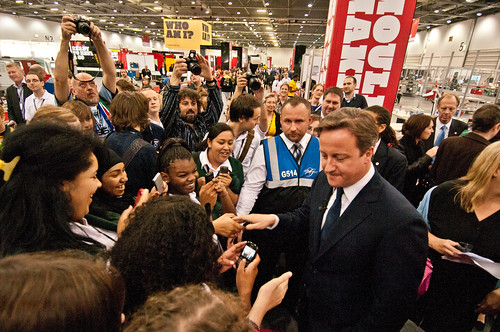
Conservative Prime Minister David Cameron stood before the yearly gathering of Conservative Party members – similar to the 'national conventions' in the US – and said he wholeheartedly supports gay marriage and will work to enact it in the UK next year (to replace the current civil unions). This was met with thundering applause in the hall. Try to imagine the reaction if a presidential candidate said this to the Republican National Convention!
In the second example, a huge row has developed after the Conservative Home Secretary Theresa May used an incorrect fact in her speech to the conference. Explaining why she wants to dismantle the Human Rights Act, which is the British transposition of the European Convention on Human Rights, she listed as an example a case where the act's requirements meant that there was an "illegal immigrant who cannot be deported because – and I am not making this up – he had a pet cat."
As it turns out, she was making this up. As the decision shows, the actual verdict against deportation had nothing to do with a pet cat, the decision was instead due to a mistake made by the Home Office's prosecution. A pet cat, which had been mentioned in the appellant's brief along with his partner as reasons why he has a home life in the UK, was merely mentioned by the judge in his verdict as an attempt at humour. It was later revealed that May had taken the cat story from a speech made by UK Independence Party leader Nigel Farage.
Wednesday, 28 September 2011
EU banker tax? UK says no
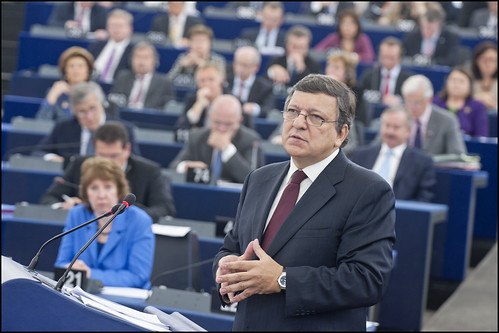
With these words European Commission President Jose Manuel Barroso put forward what is bound to be an enormously controversial piece of EU legislation, a transaction tax on bankers and investors who invest in stocks, bonds and derivatives. Speaking to the European Parliament in Strasbourg today for his annual 'state of the union' address, Barroso said the tax would bring in €55 billion per year, starting from 2014.
The language used by the president was clearly populist in nature, emphasising a sense of fairness and responding to a public feeling that the bankers who caused the economic crisis of 2008 have never been called to account and have not been asked to contribute to the recovery from the pain they caused. Stock markets and investment firms have made remarkable recoveries over the past few years, and executive pay has steadily risen. But at the same time the economy as a whole has suffered enormously and continues to suffer.
Thursday, 25 February 2010
Nigel Farage, europhile hero?
Farage delivered yesterday a blisteringly insulting attack on the new "EU President", telling him he has the "charisma of a damp rag" and the "appearance of a low-grade bank clerk". Now, such personal attacks may be commonplace in Westminster, but that is not how the European Parliament operates (or any other parliament I know of! Except maybe Australia...). MEPs today have been furious about the outburst. The parliamen's president is considering disciplinary action against him, and has summoned him for a meeting on Tuesday to discuss the incident.
Wednesday, 10 June 2009
Euroelection: BNP Overshadows the Real Story
Anti-EU parties did enormously well in Britain’s European Parliament vote. The UK Independence Party, which believes that Britain should secede from the EU, got 16.5% of the vote, beating Labour and coming in second with 13 seats. With the far-right British National Party – which also wants to exit the EU – gaining two seats, Britain will be sending 15 MEPs to represent them in the European Parliament who don’t believe the institution should exist at all. And of course “sending” is perhaps a misleading term here, since all 15 of these MEPs are unlikely to ever show up in Brussels to cast a vote, preferring to remain in Britain in protest.
Yesterday I was at a sustainability conference in London’s Docklands, and was listening to an opening speech given by Tory MEP Caroline Jackson, who represents Britain’s Southwest region. She said she was dismayed that British voters had chosen to waste 15 of their seats in parliament. Those 15 seats which will remain conspicuously empty for the next five years, as the British people have elected them in based on an issue that has absolutely nothing to do with the European Parliament, which decides neither which countries are in the EU nor the makeup and structure of the union.
Jackson went on to point out that with the departure of the Tories from the main centre-right group European People’s Party (EPP), the reality was that the UK has now effectively relinquished 30 out of its 72 seats.
“It’s a sad moment for me, as a Conservative, to find that the Conservatives have put themselves in this bottom group, leading effectively nowhere,” she said. She isn’t alone in this observation. Many Tory MEPs have pointed out that this decision will put the Conservatives on the fringes of Europe, with no influence in the parliament and shut out of decision-making. If they had stayed in the EPP, the Conservatives would have been one of the largest parties in the EP’s largest block. It would have been a powerful position in an increasingly powerful body within the EU, which now controls the majority of British policy in the areas of environment, agriculture and trade.
As it stands, the second-largest country in the EU will have just 42 real usable seats in the European parliament (minus 30 wasted seats), compared to Germany’s 99 effective seats and France’s 68 (minus their 4 wasted seats from fringe parties). While the rest of mainstream Europe is fully engaged in the EU as it works to solve problems that cannot be solved nationally - such as climate change, terrorism and the financial crisis – Britain will have taken its toys and gone home. They’ll remain part of the EU, governed by its laws, but refusing to actively take part in shaping its policy. The Tories are now going to lose most of their ranking seats on the parliament's committees. Representatives of British industry and NGOs will now have few MEP to go to to influence EU policy in Britain's favour. Essentially, the UK has cut off its nose to spite its face. Many in Brussels are scratching their heads at what could motivate what they see as an idiotic, irresponsible decision.
Far-Right Ascendance in Britain
The British Media hasn’t taken much notice of the diminished influence the UK now has in the parliament. They’ve instead focused on the fact that the British National Party, the far-right group that doesn’t allow non-whites as members and espouses the ideas of Adolph Hitler, won two MEP seats. The victories, which were won in the North of England, have caused alarm and revulsion across the UK. When notorious BNP leader Nick Griffin tried to hold an impromptu victory press conference outside the houses of Parliament yesterday he was confronted by a group of anti-fascist protestors who pelted him with eggs. The anti-fascist group says they will trail the far-right leader wherever he goes to remind the public of his extreme racist views, but the reality is such protests will probably bring him more attention than having the seat will.
Of course Britain won’t be the first EU country sending far-right MEPs to Brussels. Jean-Marie Le Pen’s Front National has long been sending elected members to the body, and there are far-right MEPs from Eastern Europe that have called for the mass deportation of Roma (gypsies). But this is the first time that Britain, the mother of all Democracies, has sent a fascist representative to Europe. In fact, this is the first high office that the BNP has been elected to (so far they’ve only managed to get seats on local town councils), and without a doubt it gives them some legitimacy (if not any actual power since they’re unlikely to ever make a trip to Brussels to cast a vote, lest they mix with the foreigns).
Such a win for the BNP does great damage to the nation’s psyche because it challenges many of the narratives the British people have for themselves. Most British people forget that there was significant fascist movement here during the 1930’s that in the end was unable to wrest power. The sad reality is that this win means the BNP is now a bit player in British Politics that isn’t going away, but they are unlikely to become a significance force with anywhere near the reach of Oswald Mosley’s fascists of the ‘30s.
The British people’s attitude about the irrelevance of the European Parliament has enabled two fascists to sneak into their representation in Brussels. In the long-run, the more important consequence of that will be the European disengagement and isolationism that one day Britain may look back on and regret if it finds itself alone and irrelevant in the 21st century. “And all we were talking about was the bloody BNP,” they may remark with a larf.
Subscribe to:
Comments (Atom)