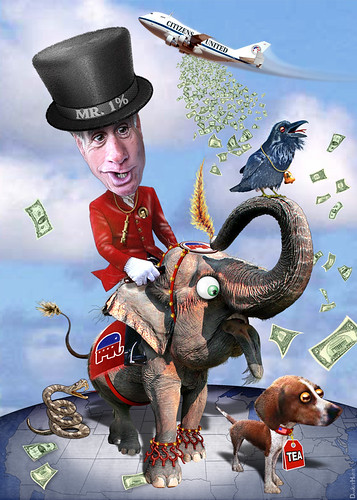
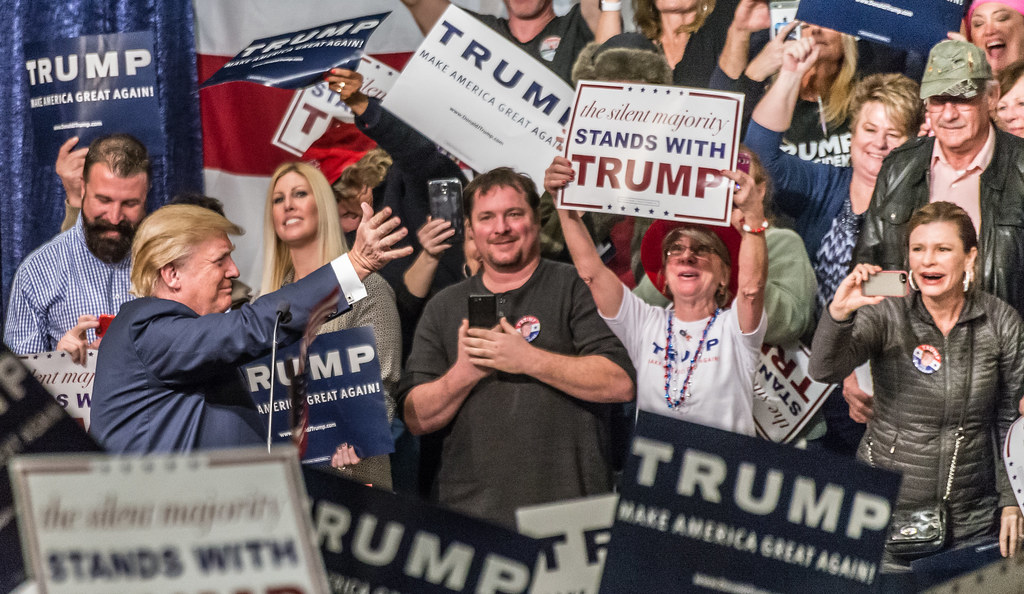
The Tory-led ECR group will attend Donald Trump's nominating convention, but Merkel's center-right EPP will not. It reflects the path British Conservatives have chosen to take.
Years before his faustian bargain to offer an EU referendum to maintain his Conservative Party leadership, David Cameron tossed the eurosceptics another bone to become party leader.
In his 2005 campaign to become Conservative leader, he promised to take the Tories out of the main-centre-right bloc in Europe, the European Peoples Party (EPP), and form a new eurosceptic bloc. For years, the eurosceptic wing of the Conservative Party had complained that the EPP, which contains the main center-right parties of Europe including those of Germany, France, Italy and Spain, was too 'federalist' in its approach to the European Union.
Showing posts with label Conservative Party. Show all posts
Tuesday, 5 July 2016
Friday, 11 April 2014
The greenest government ever?
British Conservatives have among the worst voting records in the European Parliament on climate issues, according to a new analysis.
In May 2010, David Cameron, the UK's prime minister, made a bold claim. As he finalised talks on forming a governing coalition with the Liberal Democrats, he told an audience of civil servants that his would be “the greenest government ever”.
It is a claim that Cameron may have come to regret. Over the past four years, the quote has been repeatedly thrown back at him by environmentalists upset over a variety of issues – whether cuts to renewable energy subsidies or fracking for shale gas. Yet Cameron has maintained that his government is doing more to combat climate change than any previous UK government, and that the UK is playing a more constructive role in the climate fight than other European countries.
But green campaigners say this claim is hard to justify when you look at the voting record of Conservative members of the European Parliament. An analysis by campaign group CAN Europe published this week, scoring MEPs based on how they voted on ten key pieces of climate legislation over the 2009-14 term, ranks the British Conservatives among the worst parties in the Parliament for climate action.
In May 2010, David Cameron, the UK's prime minister, made a bold claim. As he finalised talks on forming a governing coalition with the Liberal Democrats, he told an audience of civil servants that his would be “the greenest government ever”.
It is a claim that Cameron may have come to regret. Over the past four years, the quote has been repeatedly thrown back at him by environmentalists upset over a variety of issues – whether cuts to renewable energy subsidies or fracking for shale gas. Yet Cameron has maintained that his government is doing more to combat climate change than any previous UK government, and that the UK is playing a more constructive role in the climate fight than other European countries.
But green campaigners say this claim is hard to justify when you look at the voting record of Conservative members of the European Parliament. An analysis by campaign group CAN Europe published this week, scoring MEPs based on how they voted on ten key pieces of climate legislation over the 2009-14 term, ranks the British Conservatives among the worst parties in the Parliament for climate action.
Saturday, 14 September 2013
Total recall
Recently, the disgraceful tale of a Scottish politician refusing to resign in the face of 23 (yes, 23) separate domestic abuse convictions has revived talk in the UK of that old populist hobby-horse – the right to recall.
Bill Walker, a Scottish National Party member of the Scottish Parliament (pictured below), was convicted last month of a series of domestic abuse offenses against three different ex wives and a stepdaughter over three decades.
Though he was expelled from the SNP after the conviction, for weeks Walker refused to vacate his seat – and there was nothing the SNP or the Scottish Parliament could do to make him leave. As the British media examined the bizarre situation, those who advocate establishing a citizen's recall law in the UK came out in force to argue that this disgraceful state of affairs makes their case.
Thursday, 12 September 2013
The pan-sceptic ticket
Nigel Farage's state of the union response suggests UKIP will make climate change denial a centrepiece of their European election campaign.
I was a bit taken aback on Wednesday when, during his response to President Barroso's State of the European Union speech in Strasbourg, UKIP leader Nigel Farage devoted almost the entirety of his speech not to warnings about the creeping European super-state, but to an impassioned denial of climate change.
The subject is nothing new for UKIP. The official party line is that there is no proof that climate change is man-made, and this is often brought up by UKIP MEPs. The party has been particularly vocal about renewable energy, blasting “ugly” wind turbines blotting the English countryside and biofuel subsidies it says are responsible for fuel poverty in the UK. This was made clear by UKIP MEPs during Monday's debate on biofuel legislation, which strangely put UKIP on the same side as the Greens.
But it was surprising to see Farage devote so much time to the issue during a big-picture debate on the EU that had nothing to do with climate change. The EU had fallen victim to a “green obsession”, he said. The resulting legislation had driven manufacturing away from the UK and forced people into fuel poverty.
I was a bit taken aback on Wednesday when, during his response to President Barroso's State of the European Union speech in Strasbourg, UKIP leader Nigel Farage devoted almost the entirety of his speech not to warnings about the creeping European super-state, but to an impassioned denial of climate change.
The subject is nothing new for UKIP. The official party line is that there is no proof that climate change is man-made, and this is often brought up by UKIP MEPs. The party has been particularly vocal about renewable energy, blasting “ugly” wind turbines blotting the English countryside and biofuel subsidies it says are responsible for fuel poverty in the UK. This was made clear by UKIP MEPs during Monday's debate on biofuel legislation, which strangely put UKIP on the same side as the Greens.
But it was surprising to see Farage devote so much time to the issue during a big-picture debate on the EU that had nothing to do with climate change. The EU had fallen victim to a “green obsession”, he said. The resulting legislation had driven manufacturing away from the UK and forced people into fuel poverty.
Wednesday, 10 April 2013
Thatcher's rose-tinted American legacy
The American media’s reverential depiction of Margaret
Thatcher this week says much about how the US and UK differ when looking at history.
As I’ve watched the international media coverage of the
death of Margaret Thatcher over the past few days, I’ve almost felt like we're talking about different women.
In America,
the wall-to-wall coverage – quite unusual for a foreign leader – has been downright worshipful. This tone has been matched by politicians on both sides of
the aisle. "The world has lost one of the great champions of freedom and
liberty, and America
has lost a true friend,” declared Barack Obama on Monday. “She helped restore
the confidence and pride that has always been the hallmark of Britain at its
best."
Here in continental Western Europe,
where Thatcher was far less popular, the coverage couldn’t be more different. One
French politician remarked that Thatcher will see the miners she put out of
work in hell, while German MP Michael Roth declared "her radical market
policies and her Europe-sceptical politics will certainly not be missed.”
In the UK
the coverage has been more nuanced. As people say, she was a bit like Marmite –
you either loved her or you hated her. The political persuasions of British
papers has determined which side they’ve chosen to emphasise. But no media
outlet has ignored the fact that she split opinions. Even Conservative Prime
Minister David Cameron’s statement to the Parliament on Monday acknowledged this.
Thursday, 8 November 2012
A relief for Europe - but will gridlock persist?
Europe isn’t the only place feeling relieved because of a dislike for Romney. Outside Israel, there probably wasn’t one country on the globe that was excited about the prospect of a Romney presidency.
The Republican candidate's dangerous rhetoric seemed almost guaranteed to launch a war with Iran which no US allies would have been keen to sign up to. He had described Russia as America’s “greatest geopolitical foe” and had spoken of China as if it was the evil empire, promising to “get tough” with them in a way Obama hadn’t (although he never provided details about what that would mean). Latin America recoiled at his extreme anti-immigration rhetoric, and Africa was less than excited about his promises to cut US overseas aid.
In Brussels, there is a sense that long-stalled bilateral issues that were waiting until the resolution of the election can finally be taken off the back burner. There is (perhaps naïve) hope that a second-term Obama can show up to the UN climate summit in Doha next month with a reverse-course on the US intransigence in taking action to combat global warming. Negotiations on a US-EU free trade deal can now begin. Most importantly – fears that Europe was about to see a return to the trans-Atlantic tensions that marked the George W. Bush era have now been allayed.
Monday, 24 September 2012
Britain snubs Europe, goes to the dance with Canada
During a visit to Canada
today Hague announced that the UK
is going to close some British embassies across the world and merge them with Canadian
embassies. The two countries will establish joint diplomatic missions, sharing
embassy offices and consular services.
The move, an attempt to save money in these cost-cutting
times, might seem logical enough at first glance. But the more you delve into
it the more you realize it is diplomatically and logistically bizarre. While
the UK and Canada may have
similar foreign policy (something irrelevant to the consular services they are
merging), they are completely separate countries which share no unified visa
system. The only thing they share is a queen.
Wednesday, 12 September 2012
The peril and promise of a new treaty
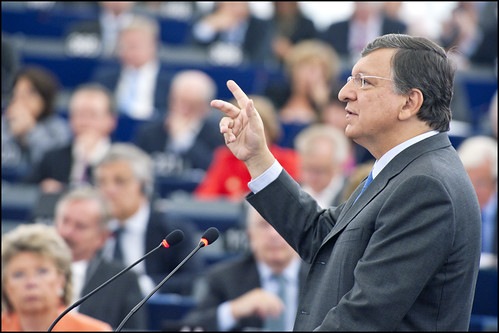
European Commission president Jose Manuel Barroso dared to use the ‘F word’ in his state of the union address here in Strasbourg today – federalism.
“Let’s not be afraid of the word, we will need to move towards a federation of nation states,” he told the European Parliament. “Today, I call for a federation of nation states. Not a superstate.” This federation, he continued, will ultimately require a new treaty, as German Chancellor Angela Merkel had suggested last week. EU leaders, still traumatized by the painful experience of ratifying the Lisbon Treaty in the last decade, have been desperate to avoid this.
“Before the next European Parliament elections in 2014, the Commission will present its outline for the shape of the future European Union. And we will put forward explicit ideas for treaty change in time for a debate.”
Barroso has been hesitant to use the word federal in the past when describing the future direction of the European Union, aware of the images of a power-grab it can conjure up in member states. But in his state of the union addresses, a yearly tradition itself created by the Lisbon Treaty, Barroso has been keen to make the European Parliament happy. He clearly thought that by finally using the F-word, he could do it.
“Let’s not be afraid of the word, we will need to move towards a federation of nation states,” he told the European Parliament. “Today, I call for a federation of nation states. Not a superstate.” This federation, he continued, will ultimately require a new treaty, as German Chancellor Angela Merkel had suggested last week. EU leaders, still traumatized by the painful experience of ratifying the Lisbon Treaty in the last decade, have been desperate to avoid this.
“Before the next European Parliament elections in 2014, the Commission will present its outline for the shape of the future European Union. And we will put forward explicit ideas for treaty change in time for a debate.”
Barroso has been hesitant to use the word federal in the past when describing the future direction of the European Union, aware of the images of a power-grab it can conjure up in member states. But in his state of the union addresses, a yearly tradition itself created by the Lisbon Treaty, Barroso has been keen to make the European Parliament happy. He clearly thought that by finally using the F-word, he could do it.
Location:
Strasbourg, France
Thursday, 8 December 2011
Cameron's choice tonight: will UK be inside or outside the room?
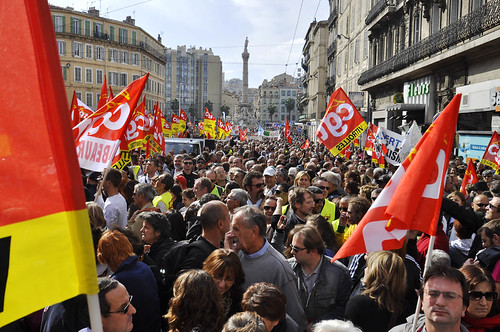
The degree to which the Left has become irrelevant in Europe was in evidence today as the European People’s Party (EPP), the EU grouping of Europe’s centre-right conservative parties, met in Marseille. The annual meeting of centre-right leaders, which coincidentally is this year a day before the final European Council, has toda become a first round in the treaty change talks. US Treasury Secretary Timothy Geithner has been there meeting with Europe's Conservative leaders, helping them to devise a strategy to save the Euro. Every leader who is important in this process was there today.
But it is not only the Left that is noticeable in their absence today in Marseille. Despite being a centre-right conservative leader, David Cameron is not there either. That’s because in 2009 Cameron took the decision to take his Tory party out of the EPP group and create a new, europsceptic grouping called ‘European Conservatives and Reformists’. That group is essentially just the British Conservatives, with a few hard right parties from Eastern Europe thrown in for good measure.
That decision, which was the fulfilment of a promise he made to the Eurosceptic wing of the Tory party in 2005 in order to be appointed party leader, may well be weighing heavily on the British leader’s mind today. He has already been locked out of the discussions amongst Eurozone leaders to devise a strategy to end the euro crisis. Now he is also locked out of the pre-summit meeting today in Marseille where so much of the strategy is being formulated. The later is a self-inflicted wound, and must be particularly hard to take considering it’s hard to see how creating a new EU group has benefitted the Tories in any way.
But it is not only the Left that is noticeable in their absence today in Marseille. Despite being a centre-right conservative leader, David Cameron is not there either. That’s because in 2009 Cameron took the decision to take his Tory party out of the EPP group and create a new, europsceptic grouping called ‘European Conservatives and Reformists’. That group is essentially just the British Conservatives, with a few hard right parties from Eastern Europe thrown in for good measure.
That decision, which was the fulfilment of a promise he made to the Eurosceptic wing of the Tory party in 2005 in order to be appointed party leader, may well be weighing heavily on the British leader’s mind today. He has already been locked out of the discussions amongst Eurozone leaders to devise a strategy to end the euro crisis. Now he is also locked out of the pre-summit meeting today in Marseille where so much of the strategy is being formulated. The later is a self-inflicted wound, and must be particularly hard to take considering it’s hard to see how creating a new EU group has benefitted the Tories in any way.
Friday, 7 October 2011
Two different animals
Conservative Prime Minister David Cameron stood before the yearly gathering of Conservative Party members – similar to the 'national conventions' in the US – and said he wholeheartedly supports gay marriage and will work to enact it in the UK next year (to replace the current civil unions). This was met with thundering applause in the hall. Try to imagine the reaction if a presidential candidate said this to the Republican National Convention!
In the second example, a huge row has developed after the Conservative Home Secretary Theresa May used an incorrect fact in her speech to the conference. Explaining why she wants to dismantle the Human Rights Act, which is the British transposition of the European Convention on Human Rights, she listed as an example a case where the act's requirements meant that there was an "illegal immigrant who cannot be deported because – and I am not making this up – he had a pet cat."
As it turns out, she was making this up. As the decision shows, the actual verdict against deportation had nothing to do with a pet cat, the decision was instead due to a mistake made by the Home Office's prosecution. A pet cat, which had been mentioned in the appellant's brief along with his partner as reasons why he has a home life in the UK, was merely mentioned by the judge in his verdict as an attempt at humour. It was later revealed that May had taken the cat story from a speech made by UK Independence Party leader Nigel Farage.
Tuesday, 20 September 2011
Lib Dems declare 'rhetoric war' on Conservative allies
According to opinions polls the party has lost more than half of its supporters since its decision to join with the Conservatives to form a coalition government last year. A subsequent u-turn on tuition fees and the loss of the alternative votereferendum – the prize they had been awarded for allying with the Conservatives – has sent the party to what some think could be their lowest popularity ever. This despite the fact that they are now in government for the first time.
The language being used at this week's conference shows the party is going to try a drastic change of tact in order to stop the haemorrhaging of support. Though they have been restrained in showing major disagreement with their coalition partners over the past year, after this week the honeymoon is clearly over - rhetorically at least.
Monday, 5 September 2011
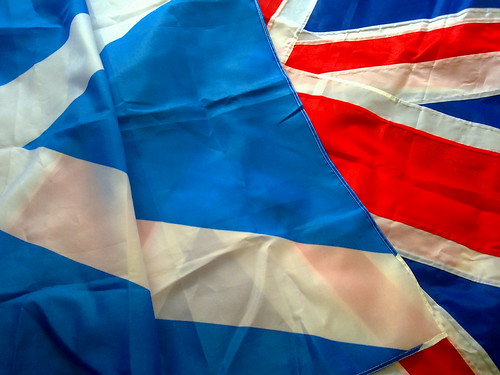
Conservative Party may disband in Scotland
In an attempt to shed its image as an 'English party', members of the Conservative Party in Scotland are considering splintering off from the Tories and forming a new Scottish centre-right party. The move, which would not be the result of any policy disagreement with the Tory leadership but rather for identification issues, reflects just how strong regionalism has become in Europe in recent years.
The change is being proposed by Murdo Frasier, a candidate in the current race for a new leader of the Conservatives in Scotland. The Tories have been pretty much banished from power by Scottish voters for over a decade now, ever since a massive defeat in 1997. They currently hold only 15 of the 129 seats in the Scottish Parliament and only one of Scotland's 59 seats in the British Parliament. Since 2007 the largest party in the Scottish Parliament has been the Scottish National Party, which wants to seceed from the UK.
Frasier has centred his leadership campaign around a promise to break this trend by dissolving the party, which he says has become a "toxic brand" in Scotland because people see it as representing the interests of Westminster over Edinburgh. The new party would likely not even have the words "conservative" or "tory" in its name.
The change is being proposed by Murdo Frasier, a candidate in the current race for a new leader of the Conservatives in Scotland. The Tories have been pretty much banished from power by Scottish voters for over a decade now, ever since a massive defeat in 1997. They currently hold only 15 of the 129 seats in the Scottish Parliament and only one of Scotland's 59 seats in the British Parliament. Since 2007 the largest party in the Scottish Parliament has been the Scottish National Party, which wants to seceed from the UK.
Frasier has centred his leadership campaign around a promise to break this trend by dissolving the party, which he says has become a "toxic brand" in Scotland because people see it as representing the interests of Westminster over Edinburgh. The new party would likely not even have the words "conservative" or "tory" in its name.
Friday, 12 August 2011
David Cameron's 'Katrina moment'
Members of the British parliament were called back from their vacations for an emergency session yesterday to deal with the country's riots earlier this week. The past two nights have been quiet - a combination of bad weather and a surge in police forces seems to have done the trick. But now the political storm begins, with the public demanding to know how the situation could have gotten so out of control.
The focus of much of the public's ire has been prime minister David Cameron. He was seen to be back-footed during the crisis, spending the first few days of the rioting insisting he would not cut short his vacation in Italy, and only returning to the country after the riots got very serious Monday night. The media has been referring to it as his "Katrina moment", referencing the back-footed response of US president George W. Bush to Hurricane Katrina in 2005. The incident is being seen as a defining moment of his premiership, and he has been much maligned for it. The above gag photo of his speech on Tuesday from photoshoplooter illustrates the public's perception of his response.
Cameron has been working overtime to dispel that image over the past few days. In yesterday's emergency session he aggressively denounced the riots, saying the behavior of this bad element of society could not be excused by social factors or circumstances. And though his party often criticised the opposition Labour party for introducing "knee-jerk legislation" after crises during their time in government, he floated no fewer than six new policies. These include a ban on face masks in public, increased curfew powers, allowing courts to ban children from gathering in certain places and, most controversially, he said he is considering allowing temporary bans on social media during times of social unrest.
The focus of much of the public's ire has been prime minister David Cameron. He was seen to be back-footed during the crisis, spending the first few days of the rioting insisting he would not cut short his vacation in Italy, and only returning to the country after the riots got very serious Monday night. The media has been referring to it as his "Katrina moment", referencing the back-footed response of US president George W. Bush to Hurricane Katrina in 2005. The incident is being seen as a defining moment of his premiership, and he has been much maligned for it. The above gag photo of his speech on Tuesday from photoshoplooter illustrates the public's perception of his response.
Cameron has been working overtime to dispel that image over the past few days. In yesterday's emergency session he aggressively denounced the riots, saying the behavior of this bad element of society could not be excused by social factors or circumstances. And though his party often criticised the opposition Labour party for introducing "knee-jerk legislation" after crises during their time in government, he floated no fewer than six new policies. These include a ban on face masks in public, increased curfew powers, allowing courts to ban children from gathering in certain places and, most controversially, he said he is considering allowing temporary bans on social media during times of social unrest.
Friday, 29 July 2011
Where does the Norway shooting leave Europe’s conservatives?
Last week’s far right terrorist attack in Norway has prompted a lot of questions in European capitals, and many of the hardest questions are being asked inside the party headquarters of Europe’s center-right. Many of Europe's conservative parties have spent the last few years courting the far right vote, by co-opting some of their messages on immigration and cultural identity issues. In several countries including Denmark, Italy and the Netherlands the mainstream conservative parties have even allied themselves with the far right and invited them into governing coalitions. After the Norway attack, are those days over?
To answer this question, one must understand the current political balance in Europe, and why it has come about. Conservative parties now dominate the national governments of Europe as well as the EU institutions, relegating the left to just a few Southern countries. The Guardian put out a great interactive map today where you can trace Europe’s left-right balance over the past 50 years. Contrast the map just ten years ago in 2001 on the left with today’s situation in 2011 on the right (left-of-center in red and right-of-center, including Liberal parties, in blue). Considering that Spain and Greece now have their policies dictated to them by their conservative Northern European creditors, the left has effectively disappeared from Europe.
So why has Europe veered rightward at a time of economic crisis? There are probably many contributing factors – but the biggest cause is the complete disarray of the European left. From Scandinavia to Germany to France to Italy, European Social Democrats are in complete chaos, torn by infighting, a lack of enthusiasm and confusion over ideology. Europeans have voted conservative not because of some great ideological shift toward economic liberalism and laissez-faire capitalism. They have done so because the parties of the left have not offered any credible alternative for governance.
To answer this question, one must understand the current political balance in Europe, and why it has come about. Conservative parties now dominate the national governments of Europe as well as the EU institutions, relegating the left to just a few Southern countries. The Guardian put out a great interactive map today where you can trace Europe’s left-right balance over the past 50 years. Contrast the map just ten years ago in 2001 on the left with today’s situation in 2011 on the right (left-of-center in red and right-of-center, including Liberal parties, in blue). Considering that Spain and Greece now have their policies dictated to them by their conservative Northern European creditors, the left has effectively disappeared from Europe.
So why has Europe veered rightward at a time of economic crisis? There are probably many contributing factors – but the biggest cause is the complete disarray of the European left. From Scandinavia to Germany to France to Italy, European Social Democrats are in complete chaos, torn by infighting, a lack of enthusiasm and confusion over ideology. Europeans have voted conservative not because of some great ideological shift toward economic liberalism and laissez-faire capitalism. They have done so because the parties of the left have not offered any credible alternative for governance.
Monday, 25 July 2011
Political games are exacerbating both Atlantic debt crises
These are not exactly inspiring times for leadership in the Western world. On both sides of the Atlantic, a potential catastrophic default is looming largely as a result of short-sighted political manoeuvring. This is leading some to question whether the 20th century democratic institutions we have built our societies around are adequate to handle the challenges of this century.
In the United States, Republicans are holding hostage an authorisation to raise the amount of money the US is authorised to borrow – normally a routine housekeeping operation done by every congress – until the Obama administration agrees to massive cuts in government spending. The Democrats have offered to give them those cuts, but only if they are accompanied by an increase in taxes on the wealthiest Americans and the closure of corporate tax loop holes. The Republican leadership, terrified of the reaction of their base voters to any tax increase (even if it will have no effect on 98% of Americans) have refused the offer.
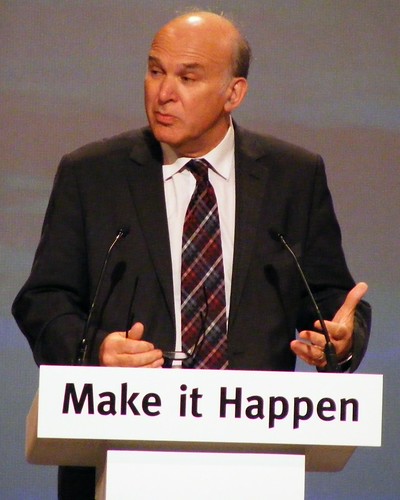
If the United States does not raise the debt ceiling by 2 August, it will go into default. This would almost surely have a disastrous effect on the worldwide economy. This weekend UK Business Secretary Vince Cable said that the "rightwing nutters" who are holding the debt ceiling authorisation hostage for their short-term political gain are a bigger threat to the world economy than the problems in the eurozone.
But conservatives in America aren't the only ones playing with fire in order to reap short-term political gain. The same kind of thinking seems to be guiding Cable's coalition boss. Over the past week UK Prime Minister David Cameron and his ministers have been saying that the UK intends to exploit the current eurozone crisis in order to "maximise what we want in terms of our engagement in Europe."
In the United States, Republicans are holding hostage an authorisation to raise the amount of money the US is authorised to borrow – normally a routine housekeeping operation done by every congress – until the Obama administration agrees to massive cuts in government spending. The Democrats have offered to give them those cuts, but only if they are accompanied by an increase in taxes on the wealthiest Americans and the closure of corporate tax loop holes. The Republican leadership, terrified of the reaction of their base voters to any tax increase (even if it will have no effect on 98% of Americans) have refused the offer.
If the United States does not raise the debt ceiling by 2 August, it will go into default. This would almost surely have a disastrous effect on the worldwide economy. This weekend UK Business Secretary Vince Cable said that the "rightwing nutters" who are holding the debt ceiling authorisation hostage for their short-term political gain are a bigger threat to the world economy than the problems in the eurozone.
But conservatives in America aren't the only ones playing with fire in order to reap short-term political gain. The same kind of thinking seems to be guiding Cable's coalition boss. Over the past week UK Prime Minister David Cameron and his ministers have been saying that the UK intends to exploit the current eurozone crisis in order to "maximise what we want in terms of our engagement in Europe."
Thursday, 14 April 2011
When tax policy and climate change collide
Generally, there are few areas in which the fiercely eurosceptic English public thinks EU regulation serves a useful purpose. One of those areas has traditionally been climate change. Even the Conservatives, the most anti-EU of the three main British parties, have highlighted the constructive role EU legislation can play in Europe's efforts to fight climate change. The EU is good as a free trade block and as a way of pooling efforts on climate change, they say, but it should stay out of areas best dealt with by member states such as taxation, finance, immigration, health and safety, transport and human rights.
The problem is it isn't that simple. Efforts to combat climate change in a coordinated pan-European way must by definition spread into many sectors, including all of those mentioned above. This conundrum was evident yesterday when the European Commission presented its plans to revise the EU energy taxation directive in a way that would change fuel taxes to make them more in line with climate change goals.
Saying the existing EU rules dating from 2003 are "outdated and inconsistent", the commission has proposed setting a minimum rate at which member states can charge fuel tax based on the carbon dioxide emitted and the energy produced rather than on the volume of the fuel. This would end the situation where renewable fuels are taxed the same as fossil fuels and some of the least energy-efficient fuels are taxed less than more energy-efficient ones. Fuel taxes have actually decreased by 10 cents per litre since 1999.
The problem is it isn't that simple. Efforts to combat climate change in a coordinated pan-European way must by definition spread into many sectors, including all of those mentioned above. This conundrum was evident yesterday when the European Commission presented its plans to revise the EU energy taxation directive in a way that would change fuel taxes to make them more in line with climate change goals.
Saying the existing EU rules dating from 2003 are "outdated and inconsistent", the commission has proposed setting a minimum rate at which member states can charge fuel tax based on the carbon dioxide emitted and the energy produced rather than on the volume of the fuel. This would end the situation where renewable fuels are taxed the same as fossil fuels and some of the least energy-efficient fuels are taxed less than more energy-efficient ones. Fuel taxes have actually decreased by 10 cents per litre since 1999.
Wednesday, 12 January 2011
UK throws a spanner into EU integration
British prime minister David Cameron survived a potential party revolt last night after successfully guiding his "European Union Bill" through a key vote in parliament. The bill, which honours a campaign promise to require every EU Treaty change be put to a public referendum in Britain, has been derided by the Conservative Party's hardcore Eurosceptic wing as being a soft touch.
The hardcore Eurosceptics are furious that the bill would make an exception for "minor" treaty changes, such as the upcoming establishment of a permanent financial rescue mechanism to aid faltering Eurozone states. The Tory leadership has insisted any designation of a treaty change as "minor" would be open to challenge by citizens, but the Eurosceptics counter that the final decision would be made by a judge and therefor the bill is not really "putting power back in the hands of the people" as Cameron claims. The rebel MPs say that what Cameron promised during the campaign was to submit every change, no matter how small, to public vote. They are alleging that the bill has been watered-down to appease the pro-European Liberal Democrats, who the Conservatives are now in coalition with.
But in a showdown vote last night the Eurosceptic rebels were only able to convince 39 coalition MPs to vote against the bill. The opposition Labour Party also voted against it, though they weren't exactly profiles in euro-defending courage in doing it - saying only that it was a 'distraction' from more pressing issues. The bill sailed through this stage of the process and looks set for passage.
Today the British media are heralding a victory for Cameron over the hardcore Eurosceptics who were unable to intimidate the prime minister into enacting a harsher bill. So hooray hoorah, on to the next subject. Brussels must be elated to have been spared this harsh retribution, right?
The hardcore Eurosceptics are furious that the bill would make an exception for "minor" treaty changes, such as the upcoming establishment of a permanent financial rescue mechanism to aid faltering Eurozone states. The Tory leadership has insisted any designation of a treaty change as "minor" would be open to challenge by citizens, but the Eurosceptics counter that the final decision would be made by a judge and therefor the bill is not really "putting power back in the hands of the people" as Cameron claims. The rebel MPs say that what Cameron promised during the campaign was to submit every change, no matter how small, to public vote. They are alleging that the bill has been watered-down to appease the pro-European Liberal Democrats, who the Conservatives are now in coalition with.
But in a showdown vote last night the Eurosceptic rebels were only able to convince 39 coalition MPs to vote against the bill. The opposition Labour Party also voted against it, though they weren't exactly profiles in euro-defending courage in doing it - saying only that it was a 'distraction' from more pressing issues. The bill sailed through this stage of the process and looks set for passage.
Today the British media are heralding a victory for Cameron over the hardcore Eurosceptics who were unable to intimidate the prime minister into enacting a harsher bill. So hooray hoorah, on to the next subject. Brussels must be elated to have been spared this harsh retribution, right?
Thursday, 9 December 2010
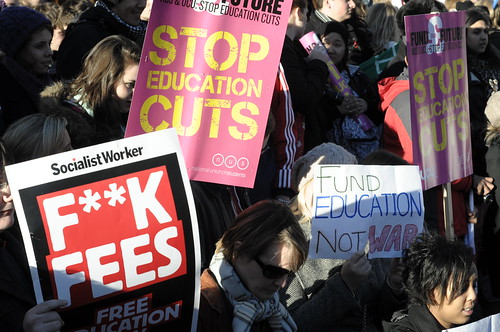
Violent protests in London as government increases tuition
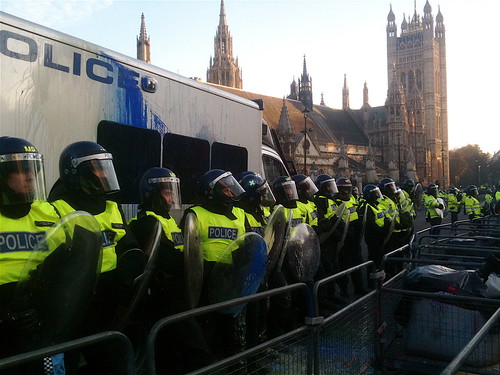
London was rocked today by the most violent anti-austerity protests yet seen, with Parliament Square becoming the scene of incredible sights of mayhem. The near-rioting took place just outside the Houses of Parliament where, inside, British politicians were casting the big vote on increasing English tuition rates by 300%. Horses charged into the crowd, fires raged and several police officers were seriously injured. Protesters broke into the treasury building and ransacked it. Christmas shoppers on Oxford Street were attacked. Even Prince Charles and Camilla were attacked as they tried to drive to the theatre, with protesters surrounding their car and smashing the windows.
The turmoil outside was mirrored by turmoil inside. The Liberal Democrats, who are in the governing coalition with the Conservative Party, saw a rebellion over the issue. Half of the Liberals defected, as did several Conservatives, shrinking the coalition's 84-seat majority to a majority of just 21 on this vote. The opposition Labour Party brutally criticised the plan, which will for the first time put British students in tens of thousands of pounds of debt after finishing a four-year degree - a situation that will be unique in all of Europe.
Thursday, 11 November 2010
UK tuition increases spark student riot
Fury over the conservative government’s decision to raise university tuition fees as part of its massive spending cuts program boiled over into the streets of London today, culminating in violent clashes at the Conservative Party headquarters at 30 Millbank. What started as a peaceful student protest quickly spun out of control, as demonstrators smashed the windows of the headquarters, poured into the lobby, and scaled the roof. They lit fires, smashed cars and refused to move from the street outside the building. It was unprecedented for a student protest in modern British history, and was the first major violent demonstration against Prime Minister David Cameron’s austerity package.
The protests center around a proposal by Cameron’s government to allow universities to charge students between £6,000 ($9,600) and £9,000 ($14,400) in tuition per year. Currently, tuition fees are capped at £3,290($5,264). These fees may seem low by Americans standards, where university education can cost around $40,000 a year. But they are part of a general shift in the UK that has been a long time in coming. For over a decade, the English education system has been drifting away from the state-funded European model and toward the mass-education American model. In just 15 years, students in the UK will have gone from paying £0 for a four year university education in 1997 to £60,000 in 2012. It’s no wonder students are angry.
Wednesday, 20 October 2010
UK cuts 1/5 of government spending - is it possible in the US?
As rolling strikes and violent protests against austerity measures continue to cause chaos in France today, across the channel the new conservative government of David Cameron introduced their much-anticipated package of budget cuts, the biggest slash to the UK budget since World War II. Naturally, the stoic British public is not reacting in the same 'take to the streets' manner of the French in their reaction to Sarkozy's attempts at budget cuts. Instead, there seems to be a sense of profound sadness and anxiety in the UK today.
Put quite simply, the cuts are massive. £83 billion ($130 billion) in cuts were announced this afternoon, an average of 20% out of every government department. 490,000 government employees will lose their jobs. Government offices in London will be cut by a third. Rent will be increased for people in public housing, police services will be cut, local town councils will get less money, and prisons will have less space. The retirement age will be raised to 66 (compared to 62 in the US). Both the sales and income tax will rise, with most of the increases coming out of the salaries of top earners. University teaching budgets will be cut by 75%, meaning the cost of tuition will rise considerably. And the British military isn't immune either, it will see an 8% cut in its budget. Even the queen will have to make do with less. Cameron is giving her a 14% pay cut.
Subscribe to:
Comments (Atom)