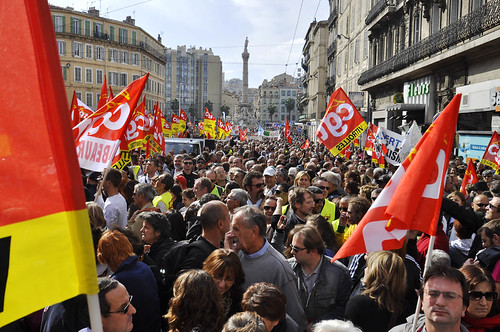
As rolling strikes and violent protests against austerity measures continue to cause chaos in France today, across the channel the new conservative government of David Cameron introduced their much-anticipated package of budget cuts, the biggest slash to the UK budget since World War II. Naturally, the stoic British public is not reacting in the same 'take to the streets' manner of the French in their reaction to Sarkozy's attempts at budget cuts. Instead, there seems to be a sense of profound sadness and anxiety in the UK today.
Put quite simply, the cuts are massive. £83 billion ($130 billion) in cuts were announced this afternoon, an average of 20% out of every government department. 490,000 government employees will lose their jobs. Government offices in London will be cut by a third. Rent will be increased for people in public housing, police services will be cut, local town councils will get less money, and prisons will have less space. The retirement age will be raised to 66 (compared to 62 in the US). Both the sales and income tax will rise, with most of the increases coming out of the salaries of top earners. University teaching budgets will be cut by 75%, meaning the cost of tuition will rise considerably. And the British military isn't immune either, it will see an 8% cut in its budget. Even the queen will have to make do with less. Cameron is giving her a 14% pay cut.
Showing posts with label British economy. Show all posts
Wednesday, 20 October 2010
Monday, 28 June 2010
When Dave met Barack
There’s been much speculation in the UK since the election victory of the Conservative Party’s David Cameron about how the new prime minister will get on with US president Barack Obama. The relationship between the men and women who have led the two partners in the so-called “special relationship” has been closely scrutinised for years.
There was the famously close relationship between Ronald Reagan and Maragaret Thatcher – two leaders whose ideologies had barely a hair’s length between them. Then there was the notoriously bizarre close friendship between Tony Blair and George W. Bush following September 11th - two men on opposite ends of the political spectrum united by their shared Christian evangelism and anti-terrorism crusade. That buddy-buddy relationship didn’t work out so well for Mr. Blair’s political career or for the UK as a whole.
Gordon Brown’s relationship with Barack Obama wasn’t exactly close (their first meeting was notoriously bungled) but the two men were singing from the same hymnsheet: during the economic downturn the best remedy was an injection of public spending and strong state action. Together they were able to convince the rest of the G20 nations that this was the best course of action, resulting in the consensus and unity of purpose displayed at the 2009 G20 summit in London.
There was the famously close relationship between Ronald Reagan and Maragaret Thatcher – two leaders whose ideologies had barely a hair’s length between them. Then there was the notoriously bizarre close friendship between Tony Blair and George W. Bush following September 11th - two men on opposite ends of the political spectrum united by their shared Christian evangelism and anti-terrorism crusade. That buddy-buddy relationship didn’t work out so well for Mr. Blair’s political career or for the UK as a whole.
Gordon Brown’s relationship with Barack Obama wasn’t exactly close (their first meeting was notoriously bungled) but the two men were singing from the same hymnsheet: during the economic downturn the best remedy was an injection of public spending and strong state action. Together they were able to convince the rest of the G20 nations that this was the best course of action, resulting in the consensus and unity of purpose displayed at the 2009 G20 summit in London.
Sunday, 14 December 2008
Merkel the Obstructionist?
If there's one thing the global economic turmoil has taught us, it's how suddenly everything can change. Angela Merkel definitly doesn't need to be told this twice. Just a few months ago she was Europe's champion; a practical, no-nonsense leader whose pragmatism and spirit of compromise had earned her great respect throughout Europe. But since the onset of the financial crisis she has largely been in the background, failing to come up with new ideas or solutions.
In the past week, this transformation has continued even more dramatically. Suddenly she's become Europe's 'Mrs. No,' the adversary to Gordon Brown's new self-styled 'hero of the world' role. Tensions have been simmering between Germany's chancellor and the British prime minister since last week when Brown didn't invite Merkel to a summit he held in London with French President Nicolas Sarkozy and European Commission (EU) president Jose Manuel Barroso. After that the German foreign minister publicly criticised Gordon Brown's plan to rescue the global economic crisis through government bailouts and shore-ups.
Also last week, Merkel appeared to do a flip-flop on Germany's climate change target commitments, as Germany argued in Posnan that it should have its target lowered, causing many environmental campaigners complaining that Europe seemed to be abandoning its commitment to tackling climate change.
In the end, Merkel ended up relenting for the most part and signed the agreements both for a Europe-wide bailout plan and an EU consensus on climate change. In the end she probably had to relent because although she has suddenly found herself in the role of 'Mrs. No,' she has no alternative plan to propose either for the economy or climate change. Merkal has always been short on ideas but long on action (the exact opposite of her French counterpart Sarkozy), so it's not surprising that she doesn't seem to be excelling in times that require quick and bold acttion. But even still, it's clear she has strong and profound objections to the idea of taking on more debt to solve the economic crisis. It will be interesting to see if the pattern of the last week will be repeated in the coming months. For the time being, it is clear that the relationship between Brown and Merkel has soured. And with her relationship with Sarkozy already notoriously rocky, Merkel could find herself isolated politically.
In the past week, this transformation has continued even more dramatically. Suddenly she's become Europe's 'Mrs. No,' the adversary to Gordon Brown's new self-styled 'hero of the world' role. Tensions have been simmering between Germany's chancellor and the British prime minister since last week when Brown didn't invite Merkel to a summit he held in London with French President Nicolas Sarkozy and European Commission (EU) president Jose Manuel Barroso. After that the German foreign minister publicly criticised Gordon Brown's plan to rescue the global economic crisis through government bailouts and shore-ups.
Also last week, Merkel appeared to do a flip-flop on Germany's climate change target commitments, as Germany argued in Posnan that it should have its target lowered, causing many environmental campaigners complaining that Europe seemed to be abandoning its commitment to tackling climate change.
In the end, Merkel ended up relenting for the most part and signed the agreements both for a Europe-wide bailout plan and an EU consensus on climate change. In the end she probably had to relent because although she has suddenly found herself in the role of 'Mrs. No,' she has no alternative plan to propose either for the economy or climate change. Merkal has always been short on ideas but long on action (the exact opposite of her French counterpart Sarkozy), so it's not surprising that she doesn't seem to be excelling in times that require quick and bold acttion. But even still, it's clear she has strong and profound objections to the idea of taking on more debt to solve the economic crisis. It will be interesting to see if the pattern of the last week will be repeated in the coming months. For the time being, it is clear that the relationship between Brown and Merkel has soured. And with her relationship with Sarkozy already notoriously rocky, Merkel could find herself isolated politically.
Saturday, 15 November 2008
The Imminent Collapse of the Pound?
Gordon Brown is in Washington this weekend, along with the other leaders of the G20 countries, attempting to come up with a solution to the global economic crisis. The ambitions for the group are huge, with suggestions of a global stimulus package and perhaps the creation of a global financial regulatory body. And it is the first time that the leaders of the G8 countries have met to discuss the current crisis with the growing economies like India, China and Brazil, which analysts say will be crucial in jolting the world out of the financial mess its in. But despite the big plans, everyone knows that at this weekend's meeting little is likely to be committed because of one very important absence from the conference: Barack Obama. With the Bush Administration leaving office in two months, countries see little point in making firm commitments now when everything could change come January.Just now the summit has released a declaration of intent, with key points saying that each country has committed to financial stimulus, with each using government money to prop up the economy. It's also come out with pretty damning language about what got us into this mess, laying the blame on the door of the US and the lack of macroeconomic regulation.
But with little concrete policy news coming out of the meeting, the media in the UK has focused today largely on some side comments made by prime minister Brown on the sidelines. The comments were a response to something said by the Tory shadow chancellor George Osbourne in the Times newspaper today. Osbourne told the Times that Brown's stimulus plans could cause a "proper sterling collapse, a run on the pound." From Washington Brown lashed out at the comments as "irresponsible," suggesting that talk like that could become a self-fulfilling prophecy.
As someone who lives in continental Europe but whose savings and salary are in pounds, this is obviously not good for me. In fact the timing of my little jaunt over to the continent apparently couldn't have been worse. Considering I'll be moving to Zurich at the end of this month (the pound-franc exchange is also not good), it's really hitting home how volatile working across borders can be, especially in times of economic turmoil such as these.
It is clear that Osbourne and many other Tories are hoping that a currency collapse could damage Labour in the same way that the Tories were hurt by the sterling crisis in 1992. But as someone who's livelihood depends on that not happening, I share Brown's annoyance at Osbourne's seeming attempt to use the economic crisis to score political points.
Monday, 6 October 2008
Merkel Goes it Alone?
The British media is reeling today from the surprise announcement from Angela Merkel yesterday that Germany would institute a full private bank savings guarantee, a decision which seemed to directly contradict what Merkel committed to on Saturday at the emergency summit in Paris. Though the leaders seemed to jointly criticize Ireland's decision last week to unilaterally guarantee all the money in its private banks without consulting the EU, Merkel has gone ahead and done exactly that for Germany the next day. It would now appear the question of whether there will be a cohesive EU-level response to the economic crisis is back on the table, and Saturday's meeting has been rendered irrelevent.
There is still great confusion over whether Merkel was just making a vague political commitment or an actual change i policy, but the news has thrown European governments for a loop. The fear in the UK is that if other EU countries are allowed to guarantee the full savings in private bank accounts (whereas the UK only guarantees 50,000 pounds - raised from 35,000 last week), it will mark an unfair competitive advantage for them and UK consumers will rush to move their money into foreign banks. Germany's decision has embolden other EU countries to do the same thing. Denmark shortly followed suit, and Greece has also stepped in to guarantee ts banks. Today Iceland is considering the same thing, and the Spanish government just announced that if there is no joint EU action, it will also act unilaterally to guarantee Spanish banks.
Given that Germany is Europe's largest economy, the decision by Merkel means that it is inevitable that all European countries will have to guarnatee the entire amount of its citizens' savings in private banks. Given that reality, many in the UK today were concluding that the only solution is a pan-European bailout fund. Liberal Democrat leader Nick Clegg told the Independent today that he supports a pan-European system of deposit guarantees. But how will British and German taxpayers feel about the idea of using their money to bail out Italian or Greek banks? They probably wouldn't be too enthused. But considering the fact that it is the Northern European banks that are collapsing at the moment, perhaps now is not the time for geographic snobbery.
Incidentally, there is increasing chatter that the current crisis could be exactly the bad medicine Europe needs to get its act together and put realy momentum behind the unification project, convincing EU citizens of the real, practical need for a stronger EU that can deal with such emergencies. In today's Brussels Blog, the Financial Times quotes one EU diplomat as saying today that the current emergency could have the same effect as the 1992 crisis in the European exchange mechanism has in, in the long run, consolidating support behind a single European currency. Similarly, the FT points out, it took the 9/11 terrorist attacks to prompt EU leaders into agreeing, at a summit just three months later, on the principle of a European arrest warrant.
The collapse of a big cross-border European financial institution could be just around the corner, and if this were to occur, no serious economist would be able to argue that rescuing the company is the responsibility of only the country in which that company happens to have its headquarters. But so far European national governments have been very resistant to the idea of creating a pan-European regulatory system.
European finance ministers are meeting tonight, and from the turmoil today it's clear that the market is hungry for some signal of a cohesive coordinated EU response. But with each country appearing to be unilaterally going forward and doing its own thing, it seems unlikely any such strong signal will emerge.
There is still great confusion over whether Merkel was just making a vague political commitment or an actual change i policy, but the news has thrown European governments for a loop. The fear in the UK is that if other EU countries are allowed to guarantee the full savings in private bank accounts (whereas the UK only guarantees 50,000 pounds - raised from 35,000 last week), it will mark an unfair competitive advantage for them and UK consumers will rush to move their money into foreign banks. Germany's decision has embolden other EU countries to do the same thing. Denmark shortly followed suit, and Greece has also stepped in to guarantee ts banks. Today Iceland is considering the same thing, and the Spanish government just announced that if there is no joint EU action, it will also act unilaterally to guarantee Spanish banks.
Given that Germany is Europe's largest economy, the decision by Merkel means that it is inevitable that all European countries will have to guarnatee the entire amount of its citizens' savings in private banks. Given that reality, many in the UK today were concluding that the only solution is a pan-European bailout fund. Liberal Democrat leader Nick Clegg told the Independent today that he supports a pan-European system of deposit guarantees. But how will British and German taxpayers feel about the idea of using their money to bail out Italian or Greek banks? They probably wouldn't be too enthused. But considering the fact that it is the Northern European banks that are collapsing at the moment, perhaps now is not the time for geographic snobbery.
Incidentally, there is increasing chatter that the current crisis could be exactly the bad medicine Europe needs to get its act together and put realy momentum behind the unification project, convincing EU citizens of the real, practical need for a stronger EU that can deal with such emergencies. In today's Brussels Blog, the Financial Times quotes one EU diplomat as saying today that the current emergency could have the same effect as the 1992 crisis in the European exchange mechanism has in, in the long run, consolidating support behind a single European currency. Similarly, the FT points out, it took the 9/11 terrorist attacks to prompt EU leaders into agreeing, at a summit just three months later, on the principle of a European arrest warrant.
The collapse of a big cross-border European financial institution could be just around the corner, and if this were to occur, no serious economist would be able to argue that rescuing the company is the responsibility of only the country in which that company happens to have its headquarters. But so far European national governments have been very resistant to the idea of creating a pan-European regulatory system.
European finance ministers are meeting tonight, and from the turmoil today it's clear that the market is hungry for some signal of a cohesive coordinated EU response. But with each country appearing to be unilaterally going forward and doing its own thing, it seems unlikely any such strong signal will emerge.
Monday, 29 September 2008
Bank Bailouts Come to Europe
Though just recently the European Central Bank said smugly that Europe would never see the kind of bailouts currently going on in the US, as many as predicted it now seems clear Europe will not be immune from the crisis. Yesterday brought the news that Belgian-Dutch group Fortis is being nationalized by the Benelux nations and British mortgage lender Bradford & Bingley is being nationalized by the UK government.
Though the UK was the first country to see a big bank bailout with the nationalization of Northern Rock, since the US institutions such as Lehman Brothers and AIG started started dropping like flies, Europe's banks had held firm. But no longer. Fortis is the first major continal European bank to falter.
Now analysts are saying the next phase of bank bailouts are likely to be seen in Europe. Joseph Kraft, head of Japan capital markets at Dresdner Kleinwort, told Reuters today,"It's definitely moving towards Europe. It's the beginning of the end and a necessary step, so we should see more institutions nationalised, absorbed or going into default."
At the same time it appears the US congress has been able to work out a deal with which they can approve the $700 billion bailout plan for the struggling banks.
Though the UK was the first country to see a big bank bailout with the nationalization of Northern Rock, since the US institutions such as Lehman Brothers and AIG started started dropping like flies, Europe's banks had held firm. But no longer. Fortis is the first major continal European bank to falter.
Now analysts are saying the next phase of bank bailouts are likely to be seen in Europe. Joseph Kraft, head of Japan capital markets at Dresdner Kleinwort, told Reuters today,"It's definitely moving towards Europe. It's the beginning of the end and a necessary step, so we should see more institutions nationalised, absorbed or going into default."
At the same time it appears the US congress has been able to work out a deal with which they can approve the $700 billion bailout plan for the struggling banks.
Tuesday, 22 January 2008
Will the US recession spread to Europe?
As Wall Street opens after the Martin Luther King weekend, the world is waiting with baited breath to see what happens after the opening bell. The US traders had the day off yesterday, but rather than relaxing they probably spent it in horror as they watched markets across the globe plunge amid fears of a US recession. Markets in Europe suffered their biggest one-day losses since the September 11th attacks. When trading opened this morning in the East the Asian markets took an absolute nose dive. In response the US Federal Reserve made an emergency rate cut early this morning US time, an eye-popping three-quarters of a percent. It helped the European markets bounce back slightly but it was too late for the close of the Asian markets.So far it doesn’t seem to have done the trick for this morning’s Wall Street trading, probably the most closely watched in years. The Dow fell immediately after the bell, dropping 441.72 points at one point. The Nasdaq and S & P 500 were down more than 3 percent just in the first half hour.
All of this of course is in response to a panic over the fact that the US is either about to enter a recession or it is already in one, sparked by the subprime loan crisis. But aside from the markets, how vulnerable is the rest of the world to this coming economic crisis in the US? The subject has been the topic of much speculation in Europe over the past week.
Monday, 14 January 2008
After Lisbon signing debacle, Brown shifts tone on Europe
In a move that can be expected to generate cheers of praise and some sighs of relief in Brussels, Gordon Brown today gave a strongly worded defense of Britain’s place in Europe, signaling a shift in tone from an administration which has so far seemed to be avoiding any discussion about the EU.
In a speech on the global economy delivered to business leaders this morning, Brown promised a policy of “full engagement” with the European Union and said that if Britain were to “retreat to the sidelines” of Europe, as some members of the Conservative Party are demanding, it would jeopardize Britain’s trade, jobs and the very foundation of the British economy itself.
It is the first time Brown has strongly condemned domestic criticisms of Britain’s membership in the union, criticism which is very popular in the British press and among right-leaning politicians. Brown has never been perceived to be particularly Euro-friendly. As chancellor in 2005, Brown derided the federalist ambitions of the original constitution, saying that EU leaders must accept that people are more attached to "national values" than an "outdated" federalist ideal.
In a speech on the global economy delivered to business leaders this morning, Brown promised a policy of “full engagement” with the European Union and said that if Britain were to “retreat to the sidelines” of Europe, as some members of the Conservative Party are demanding, it would jeopardize Britain’s trade, jobs and the very foundation of the British economy itself.
It is the first time Brown has strongly condemned domestic criticisms of Britain’s membership in the union, criticism which is very popular in the British press and among right-leaning politicians. Brown has never been perceived to be particularly Euro-friendly. As chancellor in 2005, Brown derided the federalist ambitions of the original constitution, saying that EU leaders must accept that people are more attached to "national values" than an "outdated" federalist ideal.
Subscribe to:
Comments (Atom)