Following the
rioting in Iceland this week resulting from the country's economic collapse, the cruel joke making the rounds in Europe right now is that Ireland, its Atlantic island neighbor, is just one letter and six months away from being Iceland itself.
Once hailed as the "Celtic Tiger" for its economic power performance after joining the EU, Ireland today finds itself in
bad economic straights. Yesterday the government announced that it would nationalize Anglo Irish Bank, the country's third largest lender. The government is also considering reducing the pay of public sector workers as it scrambles to find money anywhere, a decision which could lead to massive and possibly violent demonstrations in Dublin. In six months, Ireland could be in the same situation as Iceland.
Of course there is one key difference between the two: Ireland is on the Euro, Iceland is not. Many economists are saying that the fact that Ireland is in the euro zone is the only thing that has enabled the country's economy to stay afloat during these trying times. Though the economy is in big trouble, investors still consider the country safe because it is part of the euro zone, and its credit rating has not been downgraded.
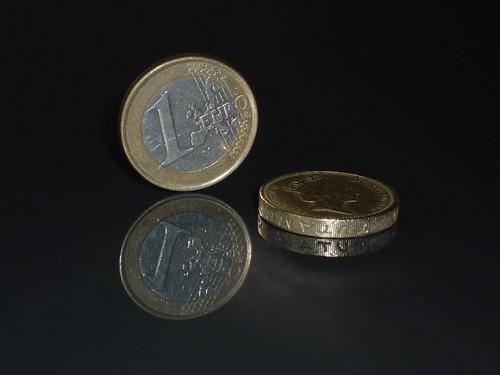
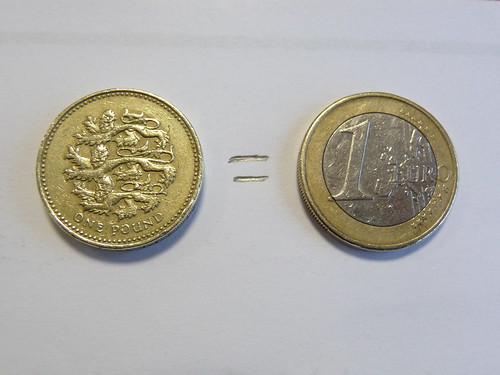
This fact has seemed to make a few Euroskeptics across the Irish sea more than a little defensive. The British pound has virtually collapsed over the past six months, dropping today to its lowest level against the dollar in 23 years. It's fallen from $2.00 to one pound in July to $1.34 to one pound today. And the pound has lost 20 percent of its value against the euro in the same time, with the two currencies now almost equal in value. Today the UK also officially entered a recession, with commentators noting that the fact that 3/4 of the UK's economy is dependent on the services industry (the most harshly affected industry in the current global crisis) means that the country will likely be the hardest hit of any during the global downturn. And without the stability of being part of a larger currency block, it is thought the UK may have to go crawling to the International Monetary Fund begging for money, because it won't be able to finance the massive level of debt it is taking on with its currency so devalued.
 This might explain the peculiarly hostile questioning the Irish finance minister received on the UK program Newsnight last night about whether it had been "too early" for the country to join the euro zone. The presenter insisted that the country's "hands are tied" by the Eurozone since it will be unable to set its own interest rates in response to the crisis (interest rates for the euro zone are set centrally by the European Central Bank in Frankfurt). The minister, Brian Lenihan, seemed hardly able to disguise his bemusement at the absurd question, pointing out that before Ireland joined the Euro its currency was pegged to the pound, and since the country has never freely floated its currency it has never been able control its own currency measures anyway. That shut the presenter up. But Lenihan must have taken a bit of satisfaction in then being able to tell the lecturing presenter that the Euro, "is the currency of our trade with many of our European partners. With the United Kingdom of course, we are at some disadvantage now because we're far stronger than sterling." Oh snap! "Small countries which have their own currencies tend to be speculated against," he continued. "We don't want to put our country in that position, so we linked to a stronger currency." Lenihan had cause for the comparison. Although the Irish economy is hurting, in the long run it may be in better shape than the UK ecnomy.
A New UK Euro Debate?
The prospect of the UK joining the Euro has long been dead in the water, but the current situation might revive the idea, particularly now that the pro-Europe Tory politician Ken Clarke has been brought back to the front benches. Rather than defending the British pound, however, British Euroskeptics seem to have fired an opening salvo by attacking the decisions of other countries to join. An opinion piece by Ruth Lea in today's Telegraph calls the euro zone "dysfunctional" and says the 'one size fits all' interest rate policy has been a disaster for smaller economies like Spain, Italy and Greece. She even blames the recent downgrading of Spain's credit rating on the Euro, seeming to suggest the Southern European economies will imminently drop out of the zone in order to devalue their own currencies out of the crisis.
But in reality, the Fitch ratings agency has kept Spain's credit rating as triple A because it's on the Euro. As the Wall Street Journal Europe pointed out today, Fitch affirmed Madrid's triple-A rating partly because "Spain's membership of the euro area supports its rating, as it eliminates the risk of a currency crisis." The Journal also points out that being part of the euro zone has kept these Southern European economies' budget deficits lower than 3 percent of GDP (or at least made them try to do so), making many euro zone countries now in a better position to absorb their rising deficits. Futher, the idea that these countries would suddenly leave the zone doesn't make sense. Aside from the enormous cost involved in converting the bills and the national debts back to the old currency, such a move would lead to massive wage inflation. And the concerns about national defaults would still exist to the same degree, only now the counties wouldn't have the security of being in thre euro zone to protect their credit rating. Perhaps it is just euroskeptic wishful thinking to think the euro zone is about to fall apart.
Celtic Tiger Laid Low
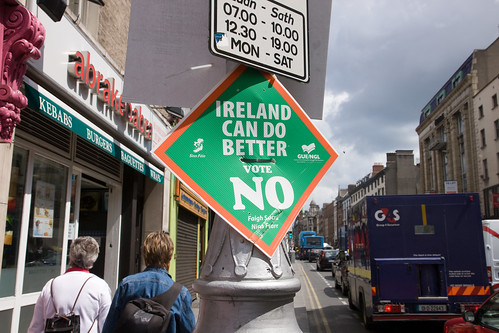
 Many have been speculating on what effect the new economic reality in Ireland will have on the re-vote to be held in the country on the ratification of the EU Reform Treaty. Last night Lenihan seemed pretty confident that the crisis has made the Irish realize how much they have benefited from membership in the EU and adoption of the Euro. One of the explanations analysts had given for the no vote last year was that, although Ireland had historically been very pro-Europe, its economic success over the past decade had given the Irish the confidence to spurn the EU, thinking they could go it alone if they needed to. The recent months have certainly been humbling for the tiny country, and perhaps they will be thinking differently this time around when they enter the voting booths. That's the hope in Brussels at least.
 Tensions between the UK and the EU over finance rules seem to be coming to a head this week. No sooner had news broke today that British prime minister Gordon Brown is blocking EU efforts to increase financial regulation of hedge funds and private equity, than word was leaked that tomorrow the UK is going to get a very stern tongue-lashing about the size of its debt. Just two more examples of how when it comes to money, the English Channel is wider than the Atlantic.