Showing posts with label European economy. Show all posts

Wednesday, 20 July 2011

North Atlantic crisis: US, Europe edge toward economic disaster

Normally at this time of year, politicians on both sides of the Atlantic would be preparing for their August break. But there will be no relaxing getaways this year, in what is turning into probably the most anxiety-packed summer of my lifetime.

Both Europe and the US may be just days away from serious financial troubles. And if situations on either continent spin out of control, a worldwide economic panic could be ahead.

On both sides, there are obvious and straightforward solutions that could avert disaster. But in the US, the recent electoral success of a Tea Party movement that wants to see the US default on its debts has rendered the political process incapable of taking action. In Europe, the recent surge toward nationalism and a lack of political courage has rendered the EU incapable of confronting the debt crisis head on. It is a massive failure of the political systems of the Western world.

Thursday, 2 September 2010

A Mediterranean revolt against the EU-wide patent

A few years ago I worked as a reporter covering intellectual property investment - essentially venture capital firms investing in new inventions and forming start-up companies around them. It was an interesting gig, but when I moved to London to start the job I knew nothing, and I mean nothing, about intellectual property. So it was a steep learning curve. I remember one of the things I was very surprised by when I started learning about how to protect intellectual property in Europe was the fact that, despite the existence of a European Patent Office in Munich, there is no such thing as a Europe-wide patent.

It struck me as rather strange. Of all the things the European Union could do well, it would seem that organising Europe-wide intellectual property protection would be high on the list. After all, it's a common market for products, shouldn't it be a common market for ideas?

But the reality is that though Brussels has tried time and time again, there still is no European patent - only individual patents for each member state. So if a company wants to patent its technology, product or idea throughout the European common market, it must undertake the arduous task of applying for a patent in each of the 27 member states. Each state has a different system, which involves a lot of work. And of course each state charges a high fee, resulting in a high financial cost for companies and researchers.
Saturday, 31 January 2009

Life In the Dark

If you've never tried eating in the dark, I highly recommend it. Last night I went to a blind restaurant here in Zurich called Blindekuh. It's an establishment where all the waiters are blind, and all the patrons eat completely in the dark, without being able to see a thing. Considering I had just been made redundant/laid off from my only steady freelancing gig an hour before we went to eat, it was hard not to see the experience as a metaphor for the state of the world right now.

I wasn't quite sure what to expect from the blind dining experience. I went with my father and some of his friends, apparently they had to make reservations for it four months ago. It's pretty wild. When you go to the table you are guided in by your waiter into a large dining room that is completely pitch black. You go through the entire meal and then are led out without ever having seen the room you were in. It's interesting how being in the dark heightens all your other senses. You suddenly become aware of the tone of people's voices, the feel of the objects around you and the taste of the food. Eating is a bit of an adventure. You have to move your hands very slowly around the table to make sure you don't knock anything over. You have no idea what it is you're putting in your mouth, so you just have to guess from the texture. Sometimes I would bring the fork to my mouth to find there was nothing on it! I speculated that it would be hilarious if there was a night-vision camera trained on us and at the end of the evening we could all watch ourselves hanging our heads over our plates, dragging our food into our wide open mouths and eating like infants. Actually, maybe that wouldn't be so pleasant to watch!

Of course I was a little distracted throughout the evening because just before we left I got a call from the web company I do my regular writing shift for saying they're having money problems and could no longer have a Europe correspondent. It's not a huge big deal as it's just one of my sources of income, but it was the only one that came with a regular daily schedule and a regular paycheck. But times are tough and I can understand why they can't afford to have foreign contractors any more. I was going to stop doing it in the next few months anyway, assuming I can find a full-time job soon. But it was a rather startling reminder of the state the world is in right now.

By my count 15 of my friends in the US and UK have been laid off in the past month (judging from Facebook status updates). They're not alone. US unemployment rose 159,000 to a record 4.78 million Americans this week. The Eurozone unemployment rate has risen to 8 percent. The predictions and analysis coming from the World Economic Forum in Davos this week have been truly frightening. And nobody seems to be quite certain of what's coming next, all they seem to agree on is that it's going to be bad.

Sitting there helpless in the dark last night, at first I felt quite anxious. But soon I realized I wasn't alone, we were all in this together. Me, my table, and all the other diners were also trying to navigate their way through this new uncertain world. But by working together, advising each other on where the obstacles in the dark lie, we made it through. By the end of the meal it almost felt normal to be eating in the dark. As we all feel blindly around the table in 2009, perhaps it will be good to keep in mind that we're all in the same boat.

It's going to be an interesting year in the dark.

Friday, 30 January 2009

'Black Thursday'

The one-day strike in France has come to an end, and despite some predictions, it didn't shut down the country. Yet for anyone who wanted to dismiss this simply as the French being French, there were signs today that this wasn't your average French protest.

The nation-wide industrial action severely disrupted air, rail and commuter service across the country. Air France stopped its flights, and hospitals had to operate at reduced capacity. Even journalists didn't show up for work today.

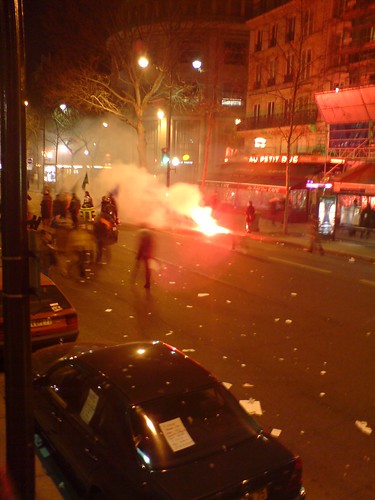
Industrial action is hardly unusual in France, but one thing was significantly different about today's strike: the protest wasn't against a specific issue, but rather at the government's handling of the entire global economic crisis. The French public is furious at the perceived unfairness of government bailouts going to the bankers and investors who caused the crisis in the first place. The protests turned violent this evening, with riots and fires erupting throughout the city and clashes with riot police.

Sarkozy recently said that a country like France will be hard to govern during this global economic crisis. He seemed today to be quite rattled by the strike. And with the dismal views coming out of Davos this week, things clearly are only going to get worse. As these protests keep occurring with increasing frequency in Europe, it's looking more and more likely that 2009 will be a year of discontent on the streets of Europe's capitals.

Friday, 23 January 2009

One Letter and Six Months

Following the rioting in Iceland this week resulting from the country's economic collapse, the cruel joke making the rounds in Europe right now is that Ireland, its Atlantic island neighbor, is just one letter and six months away from being Iceland itself.

Once hailed as the "Celtic Tiger" for its economic power performance after joining the EU, Ireland today finds itself in bad economic straights. Yesterday the government announced that it would nationalize Anglo Irish Bank, the country's third largest lender. The government is also considering reducing the pay of public sector workers as it scrambles to find money anywhere, a decision which could lead to massive and possibly violent demonstrations in Dublin. In six months, Ireland could be in the same situation as Iceland.

Of course there is one key difference between the two: Ireland is on the Euro, Iceland is not. Many economists are saying that the fact that Ireland is in the euro zone is the only thing that has enabled the country's economy to stay afloat during these trying times. Though the economy is in big trouble, investors still consider the country safe because it is part of the euro zone, and its credit rating has not been downgraded.

This fact has seemed to make a few Euroskeptics across the Irish sea more than a little defensive. The British pound has virtually collapsed over the past six months, dropping today to its lowest level against the dollar in 23 years. It's fallen from $2.00 to one pound in July to $1.34 to one pound today. And the pound has lost 20 percent of its value against the euro in the same time, with the two currencies now almost equal in value. Today the UK also officially entered a recession, with commentators noting that the fact that 3/4 of the UK's economy is dependent on the services industry (the most harshly affected industry in the current global crisis) means that the country will likely be the hardest hit of any during the global downturn. And without the stability of being part of a larger currency block, it is thought the UK may have to go crawling to the International Monetary Fund begging for money, because it won't be able to finance the massive level of debt it is taking on with its currency so devalued.

This might explain the peculiarly hostile questioning the Irish finance minister received on the UK program Newsnight last night about whether it had been "too early" for the country to join the euro zone. The presenter insisted that the country's "hands are tied" by the Eurozone since it will be unable to set its own interest rates in response to the crisis (interest rates for the euro zone are set centrally by the European Central Bank in Frankfurt). The minister, Brian Lenihan, seemed hardly able to disguise his bemusement at the absurd question, pointing out that before Ireland joined the Euro its currency was pegged to the pound, and since the country has never freely floated its currency it has never been able control its own currency measures anyway. That shut the presenter up. But Lenihan must have taken a bit of satisfaction in then being able to tell the lecturing presenter that the Euro, "is the currency of our trade with many of our European partners. With the United Kingdom of course, we are at some disadvantage now because we're far stronger than sterling." Oh snap! "Small countries which have their own currencies tend to be speculated against," he continued. "We don't want to put our country in that position, so we linked to a stronger currency." Lenihan had cause for the comparison. Although the Irish economy is hurting, in the long run it may be in better shape than the UK ecnomy.

A New UK Euro Debate?

The prospect of the UK joining the Euro has long been dead in the water, but the current situation might revive the idea, particularly now that the pro-Europe Tory politician Ken Clarke has been brought back to the front benches. Rather than defending the British pound, however, British Euroskeptics seem to have fired an opening salvo by attacking the decisions of other countries to join. An opinion piece by Ruth Lea in today's Telegraph calls the euro zone "dysfunctional" and says the 'one size fits all' interest rate policy has been a disaster for smaller economies like Spain, Italy and Greece. She even blames the recent downgrading of Spain's credit rating on the Euro, seeming to suggest the Southern European economies will imminently drop out of the zone in order to devalue their own currencies out of the crisis.

But in reality, the Fitch ratings agency has kept Spain's credit rating as triple A because it's on the Euro. As the Wall Street Journal Europe pointed out today, Fitch affirmed Madrid's triple-A rating partly because "Spain's membership of the euro area supports its rating, as it eliminates the risk of a currency crisis." The Journal also points out that being part of the euro zone has kept these Southern European economies' budget deficits lower than 3 percent of GDP (or at least made them try to do so), making many euro zone countries now in a better position to absorb their rising deficits. Futher, the idea that these countries would suddenly leave the zone doesn't make sense. Aside from the enormous cost involved in converting the bills and the national debts back to the old currency, such a move would lead to massive wage inflation. And the concerns about national defaults would still exist to the same degree, only now the counties wouldn't have the security of being in thre euro zone to protect their credit rating. Perhaps it is just euroskeptic wishful thinking to think the euro zone is about to fall apart.

Celtic Tiger Laid Low

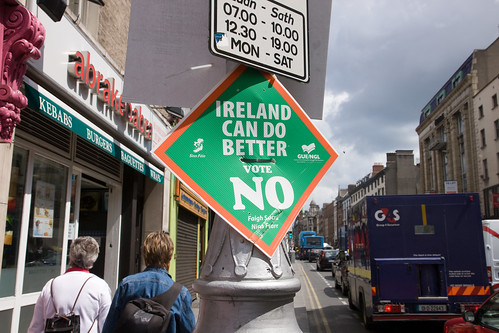
Many have been speculating on what effect the new economic reality in Ireland will have on the re-vote to be held in the country on the ratification of the EU Reform Treaty. Last night Lenihan seemed pretty confident that the crisis has made the Irish realize how much they have benefited from membership in the EU and adoption of the Euro. One of the explanations analysts had given for the no vote last year was that, although Ireland had historically been very pro-Europe, its economic success over the past decade had given the Irish the confidence to spurn the EU, thinking they could go it alone if they needed to. The recent months have certainly been humbling for the tiny country, and perhaps they will be thinking differently this time around when they enter the voting booths. That's the hope in Brussels at least.

Wednesday, 21 January 2009

Rioting in Iceland

When there's rioting in Iceland, you know we're in trouble. The small Scandinavian country in the middle of the Atlantic isn't usually associated with domestic strife, but rather high quality of life and abundant natural resources. But yesterday thousands of people took to the streets to protest the government's handling of the economy, which has plunged in recent months as a result of the larger global turmoil. Gross national product is down two-thirds, there has been a 45 percent rise in unemployment and the country is defaulting on loan repayments. In October the country's financial system collapsed and its currency plunged under the weight of billions of dollars in foreign debt taken on by its banks.


These weren't just mild demonstrations. Riot police had to fight with a large number of violent protesters outside the country's parliament. Pepper spray was fired at the protesters and 30 arrests were made.

Coming on the heels of the riots in Greece last month, many in Europe are becoming increasingly worried that the economic turmoil could lead to violent clashes between disaffected people and their governments across the continent. Eastern Europe is seen as particularly vulnerable to such violence, with some even predicting a "spring of discontent" in the region to be around the corner.

Eastern Europe has been hit hard by the financial crisis, especially Bulgaria, Romania and the Baltic states - all recent EU entrants. As the Guardian recently reported, incidents have been steadily increasing. Last week police in Vilnius, Lithuania had to tear-gas a crowd of demonstrators protesting tax rises and benefit cuts designed to save the state from bankruptcy. Sofia, Bulgaria has also seen recent widespread violence in which 150 people were arrested. Riga, Latvia has seen street battles as well.

These Eastern European economies are increasingly experiencing unexpected turmoil after years of posting double-digit growth. Their anger will likely be compounded by the fact that they were expecting that growth to continue, particularly after they joined the EU. The post-cold war governments are still new and relatively weak, and could be unprepared to deal with widespread unrest. And the increasing hostility isn't just being directed at the governments. Attacks on minorities are also becoming increasingly common, particularly against Roma (gypsy) communities. Recently 700 members of the far-right Workers' Party in the Czech Republic fought with police when they were prevented from marching on a Roma area.

Of course Iceland is just about as far as you can get from Eastern Europe without leaving the continent. If the global economic turmoil can cause rioting in a country with one of the highest quality of life ratings in the world, could rioting be far behind in the major Western economies? And even if it isn't, how will the major economies of Western Europe respond to growing political unrest to their east, in countries with which they are now united? Clearly the EU has an obligation to help Eastern Europe through the financial turmoil, but if the situation becomes fundamentally dangerous, can the EU do anything to stem the violence without a proper policing military force?

The "spring of discontent" will be an anxious time for Europe.

Sunday, 14 December 2008

Merkel the Obstructionist?

If there's one thing the global economic turmoil has taught us, it's how suddenly everything can change. Angela Merkel definitly doesn't need to be told this twice. Just a few months ago she was Europe's champion; a practical, no-nonsense leader whose pragmatism and spirit of compromise had earned her great respect throughout Europe. But since the onset of the financial crisis she has largely been in the background, failing to come up with new ideas or solutions.

In the past week, this transformation has continued even more dramatically. Suddenly she's become Europe's 'Mrs. No,' the adversary to Gordon Brown's new self-styled 'hero of the world' role. Tensions have been simmering between Germany's chancellor and the British prime minister since last week when Brown didn't invite Merkel to a summit he held in London with French President Nicolas Sarkozy and European Commission (EU) president Jose Manuel Barroso. After that the German foreign minister publicly criticised Gordon Brown's plan to rescue the global economic crisis through government bailouts and shore-ups.

Also last week, Merkel appeared to do a flip-flop on Germany's climate change target commitments, as Germany argued in Posnan that it should have its target lowered, causing many environmental campaigners complaining that Europe seemed to be abandoning its commitment to tackling climate change.

In the end, Merkel ended up relenting for the most part and signed the agreements both for a Europe-wide bailout plan and an EU consensus on climate change. In the end she probably had to relent because although she has suddenly found herself in the role of 'Mrs. No,' she has no alternative plan to propose either for the economy or climate change. Merkal has always been short on ideas but long on action (the exact opposite of her French counterpart Sarkozy), so it's not surprising that she doesn't seem to be excelling in times that require quick and bold acttion. But even still, it's clear she has strong and profound objections to the idea of taking on more debt to solve the economic crisis. It will be interesting to see if the pattern of the last week will be repeated in the coming months. For the time being, it is clear that the relationship between Brown and Merkel has soured. And with her relationship with Sarkozy already notoriously rocky, Merkel could find herself isolated politically.

Tuesday, 9 December 2008

Europe Nervous as Greek Riots Continue

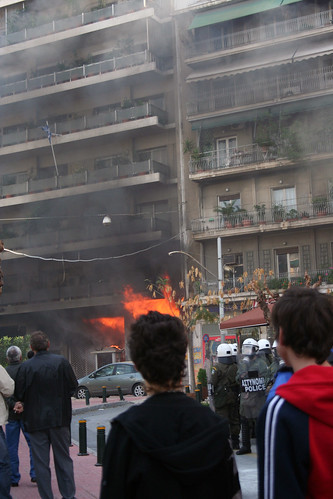
The deep fault lines within Greek society have exploded this week, with huge riots erupting across the country. The causes for the violence are myriad, but considering that part of the cause is the global economic stress, anyone in Europe watching the images on TV right now must be feeling at least a pang of dread. With so much uncertainly looming, there are plenty of people who fear scenes like this could be coming with more frequency across the continent.

The riots were immediately sparked by the fatal shooting of a 15-year-old protestor by police over the weekend, but the severity and length of the violence indicates that this is about much more than the shooting. Even though the country is prone to rioting from a strong left-wing student movement, this is the worst civil disorder to hit the country for decades according to reports. Schools across the country have been shut down, and transport has also come to a standstill. Most of the damage has been against property: luxury hotels, banks, any strong symbol of capitalism. The targets indicate that it is the economic reforms of prime minister Kostas Karamanlis that are driving people to the streets.

Students have a long and respected history of protest in Greece: it was they who brought the right-wing military junta down in the 1970's, and after that students were given special privileges to protest by the new government (similar to what happened in Spain in the 1970's). Police are not allowed to enter university campuses to arrest students, and during these riots students have used the campuses to regroup in between flare-ups of violence.

The government is saying that the police officer who shot the boy is going to be charged with manslaughter. Police say the boy was shot as he and some other young protesters were pelting a police car with stones. They say he was shot as he tried to throw a fuel-filled bomb at the police.

Greece is reeling right now from the effects of the global economic downturn; it has been hit harder than other European countries. The economic hardship has resulted in new flare-ups between the right and left in this country, both very powerful and both seething with hatred for the other side. As Europe watches the violence unfold, there must be fears in other countries with strong leftist movements that if the economic troubles get worse, these tensions between the right and left could flare up in their own countries as well.

Saturday, 15 November 2008

The Imminent Collapse of the Pound?

Gordon Brown is in Washington this weekend, along with the other leaders of the G20 countries, attempting to come up with a solution to the global economic crisis. The ambitions for the group are huge, with suggestions of a global stimulus package and perhaps the creation of a global financial regulatory body. And it is the first time that the leaders of the G8 countries have met to discuss the current crisis with the growing economies like India, China and Brazil, which analysts say will be crucial in jolting the world out of the financial mess its in. But despite the big plans, everyone knows that at this weekend's meeting little is likely to be committed because of one very important absence from the conference: Barack Obama. With the Bush Administration leaving office in two months, countries see little point in making firm commitments now when everything could change come January.

Just now the summit has released a declaration of intent, with key points saying that each country has committed to financial stimulus, with each using government money to prop up the economy. It's also come out with pretty damning language about what got us into this mess, laying the blame on the door of the US and the lack of macroeconomic regulation.

But with little concrete policy news coming out of the meeting, the media in the UK has focused today largely on some side comments made by prime minister Brown on the sidelines. The comments were a response to something said by the Tory shadow chancellor George Osbourne in the Times newspaper today. Osbourne told the Times that Brown's stimulus plans could cause a "proper sterling collapse, a run on the pound." From Washington Brown lashed out at the comments as "irresponsible," suggesting that talk like that could become a self-fulfilling prophecy.

Osbourne's rant was the first time a senior UK politician has suggested that the country may be just weeks away from a currency collapse similar to what happened in the early 1990's. The pound has lost more than a quarter of its value in four months, dropping from over $2.00 in July to less than $1.50 today. It has also plunged against the Euro, declining by 20 percent just in the last month, particularly in the last week. A Euro is now worth a shocking £1.16. If the currency continues falling at this rate it could be worth less than a euro by the end of the year. With an economy that has become almost completely reliant on financial services, currency speculators seem to have concluded that the UK is going to be disproportionately affected by the economic crisis.

As someone who lives in continental Europe but whose savings and salary are in pounds, this is obviously not good for me. In fact the timing of my little jaunt over to the continent apparently couldn't have been worse. Considering I'll be moving to Zurich at the end of this month (the pound-franc exchange is also not good), it's really hitting home how volatile working across borders can be, especially in times of economic turmoil such as these.

It is clear that Osbourne and many other Tories are hoping that a currency collapse could damage Labour in the same way that the Tories were hurt by the sterling crisis in 1992. But as someone who's livelihood depends on that not happening, I share Brown's annoyance at Osbourne's seeming attempt to use the economic crisis to score political points.

Tuesday, 21 October 2008

Europe's Moment

The blog's been noticeably quiet the past week, apologies for that. I had two language exams for my French certification last week, and then this weekend I had a friend from London visiting. My life's been a lot busier than I thought it would be during this sojourn, non-stop French tests all week and then visitors from London on the weekends. It's fun though!

To answer the question I posed in my post last Monday, in the end the US did go ahead and follow Europe's lead on the bank buyout plan. It really has been an astounding thing to watch. Though it initially looked like the EU was stumbling in trying to devise a unified response to the crisis, over the past week that trend has been reversed and the EU has actually taken on a leadership role in the world's response to the crisis, with the United States following!

Perhaps one of the most surprising elements of the past week was to see UK prime minister Gordon Brown rise to the occasion and become the man of the hour. As BBC Europe correspondent Mark Mardell noted last week, Brown has suddenly become the leader of Europe, having devised the bank bailout plan which continental Europe shortly copied and then the United States followed. Though he initially failed to lead Europe with his first summit, French president Sarkozy's gung-ho 'throw everything at the wall and see what sticks' approach has actually served him well during this crisis. He was full of ideas when addressing the European parliament last week, saying the EU must lead in "overhauling capitalism." In fact it is Angela Markel - Germany's chancellor who is respected throughout Europe for her calm, steady and thoughtful leadership - who has really stumbled during this crisis, seeming almost erratic and lost. I couldn't help but smile when I saw Paul Krugman's piece in the New York Times last week praising Brown's leadership (on the same day that he won the Nobel prize, so it got lots of press). The UK had basically given up on Brown until last week. Now he's quickly rising in the polls, closing David Cameron's lead over him to single digits. As the saying goes, "cometh the hour, cometh the man." But how long will the praise last?

The new clout that the EU has during this crisis was in evidence at the Camp David meeting over the weekend. During this crisis the EU has some new clout and it is being wielded loudly by Sarkozy. The EU is, after all, now the world's largest trading block. And for the first time, the EU is being listened to seriously by an American president (albeit a lame duck one). Just to see the sight of a French president standing at Camp David and calling for regulatary overhaul of the world's financial system while the US president stands next to him was an amazing sight. And on his other side was European Commission president Jose Manuel Barroso, whose advice at the end of the summit that the world needs new rules and regulations and that these should be based on the European model, "not gung-ho liberalism." The fact that this is being taken seriously by the US shows how much things have changed in the past few weeks. Is this Europe's moment to take the reigns and devise a new global financial system based on European values? It seems suddenly, and unexpectedly, within reach.

Monday, 13 October 2008

Europe to Semi-Nationalize Banks - Will US Follow?

Perhaps it's appropriate that it is on Columbus Day that the Old World appears to be getting into gear. All I can say is wow. What a day in Europe.

In what can only be described as a veritable financial earthquake, the UK nationized its main banks, the Eurozone unveiled a massive bank bailout plan, and even Poland said it will have a plan in place to inject funds into banks. Across Europe, banks are going to be partly nationalized. And the US could shortly follow suit. Who would have thought they'd see the day?

After much angst over the past week over the EU's inability to come up with a coordinated plan, this morning an emergency summit of the 15 countries in the eurozone (the countries that use the euro), the governments afreed to offer guarantees for the troubled banks, commiting the national goverments to use public money to make sure no European bank is allowed to fail. The market responded well to the news. European trading closed up by the end of the day, and the euro jumped 1.1 percent against the dollar.

British Prime Minister Gordon Brown even stopped by to join the leaders in a show of good fath, even though the UK isn't on the euro. But even before he went, Brown had outlined specifics this morning on the plan for the UK to use public funds to bail out the ailing banks, as announced last week. This morning it was revealed that the UK would undertake a partial nationalization of the British banking system, with the government taking a majority share in Royal Bank of Scotland and Halifax Bank. Continental Europe will soon follow suit. This afternoon each government, from France to Germany to Portugal to the Netherlands, all announced the massive amounts of money they will each make available to buy stakes in their banks. It's a truly stunning development.

And just now Polish government officials said that that country is also coming up with a plan to partially nationalize its banks through funding. This may be an indication that tomorrow, when all 27 EU countries meet in Brussels, the non-Eurozone EU countries will sign on to the plan.

So is this the unified European plan that the markets wanted? Sarkozy was presenting it that way this morning, saying, "This is indeed a common action that we are taking." But the agreement is only a framework, with each government taking steps at a national level according to its own interpretation of what should be done. So far, for today at least, this seems to have been enough coordination to calm the markets, both in the US and Europe. But will it last?

Apparently the US Fed will meet tomorow and iron out the final arrangements for bank funding, and it is thought they may come up with a plan similiar to that announced today in Europe, where the US government would take controlling stakes in American banks. It is expected that if the 27 EU countries do reach a consensus tomorrow on the bank partial nationalization plan, they will also tomorrow recomend that the US follow suit. If the US follows the recomendation, it will be truly amazing. To think that this week the US could follow Europe's lead toward economic nationalization shows just how rapidly things are changing before out eyes. But right now it's anybody's guess what the US will announce tomorrow.

The long and short of all this? I am now a banking customer of the UK government. Amazing.

Wednesday, 8 October 2008

Britain follows with UK Bailout Plan

Those in the US who thought the $700 billion bailout package passed by the congress last Friday was extremely unusual might be reassured by seeing another bailout unveiled across the pond - a £500 billion ($870 billion) plan for the UK. But importantly, the British bailout plan is entirely different from its counterpart in the US. Here's why.

For starters, the £500 billion figure being used by the British media this morning is a bit misleading. Though all $700 billion of the US package will be coming directly from taxpayers, only £50 billion ($87 billion) of the UK plan is coming from taxpayers money. That part of the plan will be used by the government to partially buy out failing UK banks. This is where the plan differs significantly from the one in the US. The $500bn US taxpayer-funded bailout package will be used to buy the bad debt from the ailing financial institutions to clear up their balance sheets. The
£50bn UK taxpayer-funded bailout package will be used by the government to buy partial ownership in failing UK high street banks, the banks most people use to store their savings.

Additionally, because of the differences between the US presidential system and the UK parliamentary system, there is no doubt as to whether this bailout plan will become reality. It's definitely happening.

So where is the £500 billion figure coming from? Some news outlets have decided to include the other part of the plan, half of which is theoretical money being made available and the other half of which is just a larger injection than normal by the Bank of England into the money markets, in the headline. £200 billion will be coming from the Bank of England under its existing Special Liquidity Scheme. The Bank of England always injects money into banks under this scheme, although now it will be putting in much more money much faster. Additionally, the Government is making £250 billion "available" for banks to guarantee medium-term debt in a bid to encourage banks to start lending to each other again, although so far the banks have said they won't use it.

Brown said that the £50 billion investment by the taxpayers will yield a return on the investment, as is being claimed in the US. Like in the US, Brown seemed to be throwing the financial philosophy of the ruling government (in this case New Labour) out the window in order to urge the new plan. "This is not a time for conventional thinking or outdated dogma but for the fresh and innovative intervention that gets to the heart of the problem," he said this morning. This language perhaps struck more than a few people as unusual this morning, as that "outdated dogma" was developed and followed by Brown himself when he was chancellor under Tony Blair. Such quick philosophical rethinking echoes the language that has been being used in the US about the Anglo-Saxon model of free-market capitalism.

The two men said the government had been working on this plan for weeks, but has chosen to unveil it now because of the market meltdown which took place yesterday, in which the high street banks plummeted on the UK stock markets. My bank, for instance, lost 40 percent of its value in the course of yesterday, making me feel quite nervous about my savings. This morning's announcement seems to have had a small rallying effect on the UK markets - for now.

European Plan?

So now that the UK has become the first EU country to come up with its own bailout package unilaterally, does this mean any talk of a pan-European bailout fund is dead in the water? Not necessarily, said Brown. The prime minister also announced that the UK has put forward ideas this morning for a pan-European funding plan. Yet he still ruled out extending the UK's savings account guarantee to cover all deposits, even as other European nations are scrambling to do so.

The fact that Brown didn't have much else to say about a pan-European response probably means that coordinated action is unlikely, which may mean that his announcement does little to calm the European markets in the long run. The market turmoil over the past two days was largely in response to the fact that the EU seems to have disintegrated in response to the economic crisis, with each member nation taking drastic unilateral steps which seem to conflict with one another. As Swedish finance minister Anders Borg told reporters in Luxembourg yesterday, "One country's solution is another country's problem.'' Though Brown's announcement this morning may temporarily calm the British markets, it may send the continental European markets into even more turmoil, and by tomorrow the beneficial effect of the announcement for UK trading could be overtaken by continues fears about the lack of a coordinated Europe-wide response.

Monday, 6 October 2008

Merkel Goes it Alone?

The British media is reeling today from the surprise announcement from Angela Merkel yesterday that Germany would institute a full private bank savings guarantee, a decision which seemed to directly contradict what Merkel committed to on Saturday at the emergency summit in Paris. Though the leaders seemed to jointly criticize Ireland's decision last week to unilaterally guarantee all the money in its private banks without consulting the EU, Merkel has gone ahead and done exactly that for Germany the next day. It would now appear the question of whether there will be a cohesive EU-level response to the economic crisis is back on the table, and Saturday's meeting has been rendered irrelevent.

There is still great confusion over whether Merkel was just making a vague political commitment or an actual change i policy, but the news has thrown European governments for a loop. The fear in the UK is that if other EU countries are allowed to guarantee the full savings in private bank accounts (whereas the UK only guarantees 50,000 pounds - raised from 35,000 last week), it will mark an unfair competitive advantage for them and UK consumers will rush to move their money into foreign banks. Germany's decision has embolden other EU countries to do the same thing. Denmark shortly followed suit, and Greece has also stepped in to guarantee ts banks. Today Iceland is considering the same thing, and the Spanish government just announced that if there is no joint EU action, it will also act unilaterally to guarantee Spanish banks.

Given that Germany is Europe's largest economy, the decision by Merkel means that it is inevitable that all European countries will have to guarnatee the entire amount of its citizens' savings in private banks. Given that reality, many in the UK today were concluding that the only solution is a pan-European bailout fund. Liberal Democrat leader Nick Clegg told the Independent today that he supports a pan-European system of deposit guarantees. But how will British and German taxpayers feel about the idea of using their money to bail out Italian or Greek banks? They probably wouldn't be too enthused. But considering the fact that it is the Northern European banks that are collapsing at the moment, perhaps now is not the time for geographic snobbery.

Incidentally, there is increasing chatter that the current crisis could be exactly the bad medicine Europe needs to get its act together and put realy momentum behind the unification project, convincing EU citizens of the real, practical need for a stronger EU that can deal with such emergencies. In today's Brussels Blog, the Financial Times quotes one EU diplomat as saying today that the current emergency could have the same effect as the 1992 crisis in the European exchange mechanism has in, in the long run, consolidating support behind a single European currency. Similarly, the FT points out, it took the 9/11 terrorist attacks to prompt EU leaders into agreeing, at a summit just three months later, on the principle of a European arrest warrant.

The collapse of a big cross-border European financial institution could be just around the corner, and if this were to occur, no serious economist would be able to argue that rescuing the company is the responsibility of only the country in which that company happens to have its headquarters. But so far European national governments have been very resistant to the idea of creating a pan-European regulatory system.

European finance ministers are meeting tonight, and from the turmoil today it's clear that the market is hungry for some signal of a cohesive coordinated EU response. But with each country appearing to be unilaterally going forward and doing its own thing, it seems unlikely any such strong signal will emerge.

Saturday, 4 October 2008

Verdict Is In: Europe will Respond Nationally

It looks like the question I posed in yesterday's post has been answered. In a press conference just now over at the Elysee Palace, the leaders of the European countries in the G8 laid out a very general plan for dealing with the crisis in Europe, after meeting all day to figure out what to do. And the verdict in, Europe will go forward with reforms on a national level, and there will be little in the way of a EU-wide policy. Sarkozy had reportedly been seeking an EU bailout fund similiar to the one just passed in the US, but apparently Angela Merkel was very opposed to any such plan. So European Commission President Jose Manuel Barroso announced that the EU will temporarily relax its competition rules to allow individual countries to undetake sweeping changes such as Ireland's decision last week to guarantee deposits in Irish banks.

So in the end, it appears the leaders decided the EU was just not ready to deal with a crisis of this magnitude. They said that the response by individual EU nations would be "coordinated," but they were short on details of what that might mean. At the same time, they were very specific about what they will be calling for when they meet with the wider G8.

Friday, 3 October 2008

Europe's Economic Solution: National or Federal?

As the US Congress debates today over the new version of the bailout bill, Europe is also scrambling to come up with solutions to the crisis which, although not of their making, has come to their shores. Despite overconfident assurances even recently that Europe would be immune to the American economic plague, it is clear now that the old world will be affected and there is consensus - unlike in the US - that drastic government action will be needed. But who should take the action? Right now the big debate raging is this: should there be a coordinated EU-level effort to deal with the crisis, or should each country deal with it in their own way tailored to their own situation?

It is not a simple question, and goes well beyond traditional euroskeptic/eurofederalist divisions. With the way the EU is currently set up (and while it still runs on the pre-Lisbon Treaty system), it would likely not be able to act quickly enough for any kind of big pan-European action like the US's bailout bill. But on the other hand, if each county just does it's own thing it could result in chaos and conflicting actions, particularly for the countries within the Eurozone that use the same curency and are regulated by the European Central Bank.

The pitfalls with the 'every man for yourself' plan were already seen earlier this week when Ireland went ahead unilaterally in implementing a savings guarantee program for its banks (similiar to the FDIC in the US) without notifying Brussels. The EU was not too pleased about that, but Irish politicians said that consulting Brussels would have taken too long and the government needed to act quickly. However right after they did it other European countries, most notably the UK, filed objections, saying it gave Irish banks an unfair advantage over other ones. Many Irish banks operate in the UK and it is thought consumers might rush to move their money into UK-based Irish banks because their savings guarantee is higher.

On the other hand, other European governments have banded together to take action.
Fortis received its bailout from a coalition of Belgium, the Netherlands and Luxembourg, and France, Belgium and Luxembourg together bailed out Dexia. And there's been plenty of other activity, reflected in this chart from McLatchy-Tribune above.

The sense of urgency aroud this issue has grown incredibly strong as new data suggests that a recession could be near in Europe's major economies. French President Nicolas Sarkozyis holding a summit tomorrow here in Paris with the other European members of the Group of Eight (UK, Germany and Italy) to reach some consensus on the reforms that are needed. The idea is that they should present a united Europan front when they meet with the larger Group of Eight shortly. But some other EU countries are not too happy about being left out of this meeting, most notably Spain which now has a larger economy than Italy but is not in the G8.

Already the EU has laid out the regualtory changes it is going to make to improve supervision over European banks that operate internationally, but this won't do anything to bail out banks and other financial companies that may fail in the coming weeks. One of these future changes, for instance, will be a requirement that people who sell loan packages must hold at least 5 percent of the investment.

However this works out, one thing is clear. This is new territory for the EU. Of course, globally this situation is quite new and is on a scale that hasn't been seen since the 1930's. But in Europe in particular, there are new institutions and new relationships that haven't been tested like this before. Will the EU be able to deal with the crisis effectively? Or will the magnitude of the problem be too much for the fledgling international body to handle, and will the solutions have to fall primarily on the national governments?

Wednesday, 1 October 2008

Europe speculates on end of US 'Empire'

Watching the live coverage of the US house floor Monday night in Paris was a truly surreal experience. On my cable system I get both French and British news station, and every station from both countries was carrying live minute-by-minute coverage of the vote on the bailout package, waiting in suspense and watching the vote tally. When the bill didn't pass, there was absolute panic over here. The news anchors were absolutely shocked, as were the commentators.

It really underlined how much the European economy still depends on the American economy. As Angela Merkel pointed out yesterday, this crisis is a problem created by the United States, and the United States is the only one who can solve it. So Europe is now in the position of having to sit back and wait for the United States to take some action as it reels from a painful crisis that is not of its own making. As the saying goes, when America sneezes, the world catches a cold. But what happens when America refuses to take any medicine?

Monday, 29 September 2008

Bank Bailouts Come to Europe

Though just recently the European Central Bank said smugly that Europe would never see the kind of bailouts currently going on in the US, as many as predicted it now seems clear Europe will not be immune from the crisis. Yesterday brought the news that Belgian-Dutch group Fortis is being nationalized by the Benelux nations and British mortgage lender Bradford & Bingley is being nationalized by the UK government.

Though the UK was the first country to see a big bank bailout with the nationalization of Northern Rock, since the US institutions such as Lehman Brothers and AIG started started dropping like flies, Europe's banks had held firm. But no longer. Fortis is the first major continal European bank to falter.

Now analysts are saying the next phase of bank bailouts are likely to be seen in Europe. Joseph Kraft, head of Japan capital markets at Dresdner Kleinwort, told Reuters today,"It's definitely moving towards Europe. It's the beginning of the end and a necessary step, so we should see more institutions nationalised, absorbed or going into default."

At the same time it appears the US congress has been able to work out a deal with which they can approve the $700 billion bailout plan for the struggling banks.

Friday, 26 September 2008

Global Economic Crisis: France to the Rescue?

Over the past week I have been wondering if the current global economic meltdown, caused in part by the lack of US regulation over the financial services industry over the past decade, would have an impact on the way Europe's political winds are currently blowing. Judging from French president Nicolas Sarkozy's speech in Toulon yesterday, it would appear that for its part at least, the French right does not intend to scale back its ambitious plans for liberalizing reforms in France. But at the same time, Sarkozy intends to use the example of the crisis to sell to the Anglo-Saxon world a more Gallic system of economic regulation. The jist of his speech, it would seem, is that he wants to bring France's economy more toward liberalization and to bring the UK/North American economy more toward regulation, and perhaps the two can meet in the middle.

The past few years in Europe have seen a fundamental shift toward the right, as Europeans grow anxious about generous social welfare programs that now seem unable to sustain themselves over the long term. First, Angela Merkel's Christian Democrat party wrested power from the socialists in Germany through a coalition goverment. Then Nicolas Sarkozy handily beat the socialist candidate Segolene Royal in the French presidential election last year. Italy's brief period with a leftist prime minister came to an abrupt end earlier this year with the return of Silvio Berlusconi. And in the UK, Conservative leader David Cameron seems likely to lead the Tories to a victory over Labour whenever the next election is called. The only big outlyer is Spain, where socialist prime minister Jose Luis Rodriguez Zapatero ousted the conservative government a few years ago and is still standing strong.

Both Merkel and Sarkozy have made reforming the country's social models a priority - undertaking a liberalization program for the economy. Sarkozy's has been the most aggressive. So with the near collapse of the credit market in the US exposing flaws in the free-market capitalsm that has prevailed in the Anglo-Saxon world over the past decade, I've wondered whether the ascendancy of the European right might be finished.

But Sarkozy seems to be quickly repositioning himself in the face of the crisis. The man the French left has dubbed "Sarko l'Americain" lambasted the US-inspired lack of regulation in the last few years yesterday, saying that the extreem free-market deregulation undertaken by the Bush adminsitration, "was a folly whose price is being paid today."

In his speech yesterday he warned Europe that it cannot escape shock waves from the US financial crisis and that to protect its future, it must take the initiative in rewriting worldwide banking rules to end the "folly" of an under-regulated system he said is now "finished."He said that at the EU's next meeting he would, as the current holder of the European presidency, propose swift action for the EU to tighten controls over European banks. And he said that the world's major parties should gather at a special summit before the end of the year and develop an entire new monetary and financial framework to replace the U.S.-dominated Bretton Woods system set up in 1944.

So, I wouldn't count the European center-right out yet. After all, their opposition, European socialism, is largely adrift ideologically these days. If the European center-right can position itself as the political movement that can look out for Europe's interests during this crisis and strongarm the US into increasing regulation, it could end up even stronger from this crisis than it started. I have yet to see any reassuring plan of action from Europe's socialists.