Today I paid a visit to the 'Occupy the London Stock Exchange' protestors who have camped out outside St. Paul's Cathedral in central London. It was a fascinating visit, I sat in on a 'general assembly' and also observed a conversation between an occupier and a banker that was being filmed for a British TV station. But what is perhaps the most interesting to me about the Occupy movement in London is the strange standoff it's not found itself in with the Church of England.
The 'occupy movement' has spread from its initial manifestation in August at Wall Street in New York to cities around the globe. On 15 October activists in London decided to stage their own version in the city's financial quarter ("the city"), the second most important financial centre in the world after Wall Street. They initially tried to occupy Paternoster Square, which is where the London Stock Exchange sits. But because the UK courts had already granted an injunction against public access to that particular square, police blocked their access to it.
So the 3,000 protestors moved to the nearby small open space next to St. Paul's Cathedral, the massive domed city landmark in the city built by Christopher Wren in 1697. The police surrounded the protestors in order to protect the cathedral. But the canon of St. Paul's told the police to leave. He said the church had decided to allow the protestors to protest peacefully on their land.
London was ablaze last night as an unprecedented wave of violence and looting spread throughout the city, spreading to other cities in England. It was the third day of rioting in London, initially sparked by the police shooting of a young black man in Tottenham last week. But last night saw the situation explode and quickly spread after the government and the police appeared to lose control of the situation.
The rioters carrying out the violence were mostly children, teenagers in hooded sweatshirts covering their faces, bashing in store windows and setting cars on fire. I've written before about how Britain is terrified of its own children. Last night was a shocking manifestation of that problem. A 2008 poll showed that more than half of British adults are afraid of British children, believing they behave like animals and pose an increasing danger to themselves and others.
The images from last night are truly shocking, particularly the fires. It was the largest number of simultaneous fires London has seen since the blitz. There were reportedly children as young as seven taking part in the violence. What precipitated the violence was the fatal police shooting of a young black man last week in Tottenham. The police say he had a gun and was shooting at them, but his family says he was unarmed. The facts surrounding the case are still unclear.
Both Europe and the United States have been put in an awkward position this month by the unfolding political revolt in Egypt. On one hand, they want to be consistent in encouraging democratic values and they don't want to be seen to be propping up dictatorships. On the other hand, they are terrified of the instability that could be set off by a political meltdown in the Middle East's most populous country. This is not helped by the fact that the Muslim Brotherhood is the second most powerful political force in Egypt after the regime of president-for-life Hosni Mubarak.
As the saying goes, better the devil you know than the devil you don't. Thus, the statements coming out of Brussels and Washington this week have been tepid and non-committal, stressing the need for stability over any ideological talk of overthrowing tyrants. The west is no great fan of Mubarak, but his semi-dictatorial rule has kept Egypt's strong Islamist movement in check and kept the country at peace with Israel. If he goes, there's no telling who might replace him.
The EU has come under particular criticism, as political violence has unfolded around the Mediterranean, for its slow reaction to events in its own backyard. This has been a particular embarrassment for the EU because its new diplomatic arm, the EEAS, was supposed to make Europe more decisive and reactive to foreign policy issues. And yet as one riot after the other has unfolded across the Mediterranean over the past weeks, the EU has been very restrained in its reaction.
Today more than 34,000 Belgians marched in a demonstration across Brussels demanding that the country's bickering politicians reach a compromise in the ongoing talks to form a government. Belgium has been without a government for 224 days now, the longest government-less period for any European country since the end of the Second World War. As the political crisis continues with no end in sight, there are increasing worries that this could finally be the end of the line for this country, which may be on the verge of splitting into separate Dutch-speaking and French-speaking halves.
I was out at the "Shame Belgium" march today and I was impressed by the very large turnout. It was particularly notable because the demonstration was not organised by unions or political parties, as is usually the case, but rather by a group of five young people via Facebook. The demonstration had no political or regional allegiance - organisers even said it didn't even have an official unionist or separatist stance. In fact the organisers even discouraged people from bringing Belgian flags, though clearly everyone chose to ignore that advice. The stated purpose of the rally was simply to demand that the politicians urgently get on with their negotiations to prevent the country descending into crisis.
The explosion of violence this week in Tunisia, the smallest and most affluent country of North Africa, is just the latest unrest to affect the shores of the Mediterranean Sea. From East to West and North to South, the region seems to be on the brink of becoming a hot zone for political crisis.
Rolling riots have broken out against Tunisia's authoritarian president, and the government has cracked down on the protests in such a violent way that the country appears to be headed for political collapse. Across the sea, the government of Lebanon collapsed on Wednesday, and the situation threatens to descend into violence as the various factions vie for control.
Not too far away in Greece, the country is still reeling from massive protests against the government's austerity cuts that have been forced by the debt crisis that has plunged the country into political and financial chaos. And at the western end of the sea, Spain continues to face protests over its own austerity cuts in response to its debt crisis, and the country hangs by a thread as it desperately tries to avoid financial collapse.
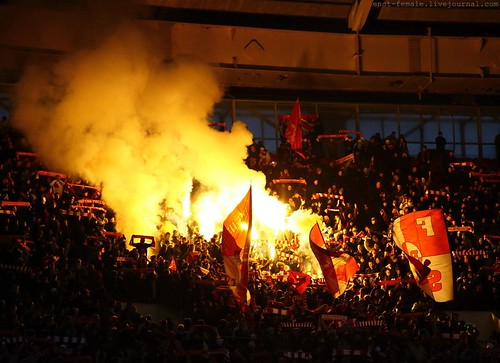
Central Moscow erupted in rioting this weekend as nationalist football hooligans attacked police officers and state buildings. The riots are the result of an explosive mix of ethnic tensions, ultranationalism and football that has cast doubt over the decision by FIFA a week ago to select Moscow as the host of the 2018 World Cup. Today the tensions continue. Hundreds of anti-riot police have amassed around Red Square and the Kremlin.
In Russia, as in much of Europe, football hooliganism often goes hand-in-hand with white supremacy and neo-nazi movements. The spark that lit the fuse for this particular riot came several weeks ago, when an ethnic Russian football fan was killed during a fight with a group of men from the predominantly Muslim North Caucasus region of the Russian Federation. He was a fan of the Spartak Moscow football team and a member of one of its most aggressive fan groups - or "firms" as the Russian hooligan groups like to call themselves. The Caucasian man arrested for the murder was subsequently released, prompting outrage from the Spartak Moscow fans who say the police are favoring the ethnic minorities.
The other day I was at a conference here in Brussels and one of the speakers, who was German, made a joke about America's tea party movement. Making the case that European consumers would not like paying extra taxes in order to pay for recycling, he joked, 'but in the United States I understand they have the tea party to take care of this kind of thing'. The audience laughed, and I laughed as well, because I assumed it was said tongue in cheek. But then when I thought about it I realised, wait, maybe he's serious...
I wouldn't blame Europeans for thinking the American tea party movement is motivated solely by their opposition to taxes, after all this is how its portrayed in the European media - particularly by the British press. And they in turn are taking their cues from the American mainstream media, who have also been portraying it as a movement of libertarian fiscal conservatives concerned about deficit spending and taxes. But even as this narrative continues, there is clear and unavoidable evidence that this is not what the movement is mainly about at all. In fact the movement has no real focus, serving mostly as a confused jumble of rage. Its participants – who show up to street demonstrations and rallies wearing funny hats and revolutionary war costumes - appear to have various grievances, and some seem to have no specific grievances in particular. But one thing is clear – the leaders of the tea party movement, and the candidates they have elected to represent the Republican Party in November's midterm election, are the same old social conservative culture warriors that have been around for years. Only this time, they're wearing funny hats.
You could call it a rude awakening. Over the past few weeks Europeans have reacted with shock and incredulity as they’ve watched the “debate” over US healthcare reform unfold across the pond. How could it be, they’ve asked me in tones of sheer exasperation, that even in the face of a healthcare crisis Americans could be so credulous as to believe the outlandish lies being spread about Obama’s healthcare reform effort. Death panels? Enemy lists? Nazi euthanasia? How, they’ve asked, could anyone be so stupid?
I haven’t had a good answer to give them, except that this is the cold hard reality of the place American politics has found itself in today. As I’ve written about before, many Europeans were lulled into a premature sense of relief when Barack Obama was elected in November. But while the head may have changed, the body remains the same – this is the same American public that elected George W. Bush twice. The combination of powerful vested interests in Washington, a strong right-wing media that dominates civic discourse, and a population that is, let’s face it, rather uninformed, mean that Barack Obama has his work cut out for him if he wants to effect real change. Getting elected was just the first step.
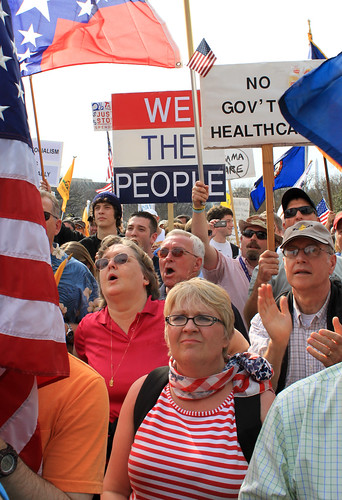
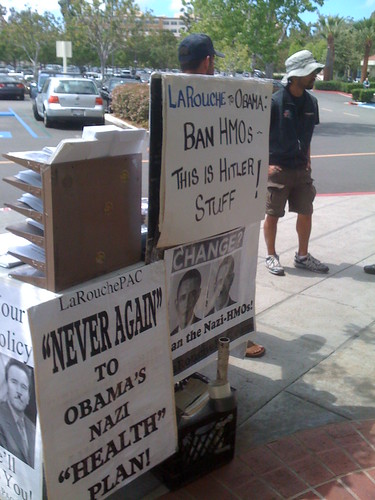
The mobs that have turned up to congressional town halls to shout down any discussion of healthcare reform, waving placards of Obama with a Hitler moustache and screaming about his “Nazi policies”, aren’t actually concerned about healthcare. This is about something much bigger, a general right-wing paranoia and militarism that tends to arise every time a progressive Democratic president is elected. It happened in the 1960’s culminating in a wave of political assassinations, it happened in the 1990’s culminating in the terrorist bombing in Oklahoma city by right-wing fanatic Timothy McVeigh, and it’s happening again now. Progressive Democratic presidents scare the bejesus out of the right-wing fringe inspiring hysteria and violence (although why this didn’t happen with Carter I don’t know, any ideas?).
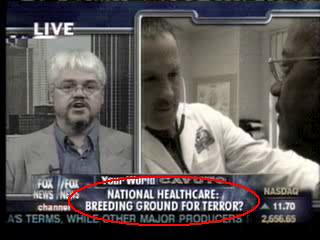
What’s different this time around is that powerful Washington forces have decided to tap into this right-wing rage and use it to their own political advantage. Fox News has seen an opportunity to define themselves in the Obama era by stoking the flames of hysteria and paranoia, increasing their viewership handily over the past several months. The healthcare and energy lobbies have been able to tap into this paranoid rage by convincing people that attempts to reform their industries are actually part of a grand fascist scheme to enforce a dictatorship.
The most absurd example of this came yesterday when protesters congregated in Texas to rail against Obama’s “Nazi” climate change bill, which would finally sign the US up to international agreements to fight climate change. At first glance it might seem bizarre that ordinary citizens are turning up to yell and scream about a piece of legislation that doesn’t have much to do with them but rather affects the oil and gas industries, right? Well if you look at the bottom of their placards many read that they are concerned “Energy Citizens”, and if you look into the origin of this group you can see it’s actually sponsored by the oil and gas industry, whose trade organisation was recently revealed in a leaked memo to be suggesting that oil company employees be mobilized for these “grass roots protests” in order to “put a human face” on the resistance to the bill.
The same has been true of the healthcare protest and the “tea-bagging” protests, both organised by powerful Washington lobby groups working with the aid of Fox news, which gets people revved up telling them the healthcare reform bill will kill their grandma.
Is this in the bill? No. Is it rational to say Obama is a racist Nazi because he’s trying to reform the nation’s healthcare system? No. But these myths persist, with the majority of Americans now saying they’re concerned about Obama’s healthcare reform effort. It now looks like the administration is going to take the public option off the table or break up the legislation, which would effectively mean the myth-spreading tactics have worked. Meaningful healthcare reform could be dead.
Don’t Get too Smug, Europe
But before Europeans shake their heads and roll their eyes at the seemingly hopeless ignorance of the American public, might I remind them that they are not immune to these impulses either. In trying to explain to Europeans the raw emotion surrounding this debate, I’ve been struggling to think of an issue here that brings out the same level of irrationality. It wasn’t long before my mind settled on the EU. When it comes to ridiculous irrational myths, European knowledge of the EU - particularly in the UK - could give these American healthcare protesters a run for their money.
Take the debate over the Lisbon reform treaty. The accusations levelled against it in the UK and Irish media have been absurd almost to the point of self-parody. According to the British media the treaty is a “massive power grab” that will turn the EU into a “totalitarian super-state”. Sound familiar? In reality, the treaty simply makes tweaks to the EU’s governing structure, changes that have been made necessary by the recent EU enlargement. The main purpose of the treaty is to make the EU more efficient and cost-effective, not to give it more power. Its goal, much like the healthcare reform bill, is to help people – not to hurt them. But that doesn't stop the totalitariansism comparisons. Just take a look at this over-the-top video from YouTube.
Euromyths are rampant in the UK. Some examples of completely baseless euromyths spread by the British media: English fish and chips shops would be forced to use Latin names for the fish (The Sun, 5 September 2001), double-decker buses would be banned (The Times, 9 April 1998), British rhubarb must be straight and barmaids would have to cover up their cleavage. (Update April 2010: Here's a recent patently absurd - and easily disprovable - example from the Daily Mail about the EU supposedly changing the name of the British Channel to the "Anglo-French Pond". That story was picked up by numerous other media outlets including the BBC's 'Have I got News for You'.) All of these are widely believed in Britain yet are completely untrue. Many euromyths can be traced directly to deliberate attempts by lobbysists to influence policy in Brussels. And they’re frequently presented in the same kind of screaming-headline, hysterical tone that is now being employed in the US healthcare debate.
And of course, a recurring complaint about both the Healthcare reform bill and the Lisbon reform treaty is that they're too long and complicated for ordinary people to understand. And because they're so long, they must be trying to pull something over on everyone. Because naturally, incredibly complex pieces of legislation should be easily understandable by your local trash collector.
In the UK, the right-leaning media makes completely baseless and false accusations about the EU and about the Lisbon Treaty, saying it will do things that are not at all in the document such as ban abortion across the EU, mandate an EU army, establish an EU constitution or subjugate member state courts. The public comes to accept these myths as fact. Then when it comes time for a vote, as occurred with the Irish referendum on the Lisbon Treaty last June, the public bases their vote on the misinformation they’ve received about the EU and the treaty. Democracy at its finest.
Can you imagine if healthcare reform were being put to a referendum in the US? It would never have any hope of passing. In fact the only way that this legislation may actually come to pass now is if the US congress does the right thing and bypasses the will of the people, making the responsible informed decision that a vast swathe of the American public cannot make themselves because they are so misinformed. This is how representative democracy is supposed to work – citizens elect representatives and entrust them with the responsibility of becoming versed in issues that ordinary citizens are not equipped to make decisions on themselves. This is why it is irresponsible to put a complex legal document like the Lisbon Treaty or healthcare reform to a public referendum. It is the worst perversion of Democracy – mob rule.
People tend to be pretty gullible, and powerful interests will always be able to manipulate them. Now that the internet has brought us what sociologists have termed the "post-fact society", this misinformation is very easy to spread - be it in America or Europe.
No Appetite for Revolution
Now to be fair, the level of hyperbole used in mainstream media around the Lisbon Treaty hasn’t reached the alarming heights of the US healthcare debate. And the Lisbon Treaty hasn’t inspired gun-totting mobs to show up at politician’s doorsteps last time I checked. Comparisons to Nazis are rarely used in continental Europe, as the memory of what the Nazis really were is still too raw to throw around the comparisons as lightly as Americans and, to a lesser extent, Brits do. But the difficulties encountered in both efforts for reform show how difficult it can be to change societal systems at the dawn of the new millennium, as we prepare to enter the 7th decade of peacetime in the Western world.
The fact is all of these big social programs, on either side of the Atlantic, were instituted in the years following World War II at a time when the public was still traumatised enough to have the appetite for real massive change. People are living in an era of unprecedented peace in the Western world, and even if there are major problems with system X, it’s working just fine for now thank you very much. Whether it be the EU project or healthcare reform, people in 2009 are just not mentally prepared for big change. Having lived their entire lives in peace, they just don’t have the appetite for risk. And powerful interests have grown up around the existing institutions that will resist change in order to safeguard their own interests.
Yet in both situations, the seeming comfort of the status quo is an illusion. Neither current situation is tenable in the long-term. In the US, while one out of every five Americans under 65 is uninsured, the majority do have insurance and, since they don’t know any better because they’ve never seen a European healthcare system, they think their coverage is the best in the world (Americans usually by default assume their anything is the best in the world). But the system of employer-funded healthcare is untenable. The US now spends around 15% of its GDP on healthcare, second only to East Timor among United Nations member states. Left unchanged, that number could rise to something like 30% in just a few decades. The current system is literally strangling small business. But all most Americans with insurance see is that they go to the doctor, he treats them, they get better. There is no crisis, they assume.
The same can be said of Europeans and their thoughts about the place in the world of their individual member state. The fact is that in a post Cold War world, with the rising power of India and China and the fact that the US no longer has a strategic long-term interest in safeguarding European defence, no individual European member state can hope to be a significant player on the world stage in the 21st century on its own. Yet your average British person hasn’t come to grips with this fact. As far as they can see, they appear to have a big influence on the world culturally (they often mistake American cultural imperialism and the widespread use of English as somehow attributable to themselves), they are nuclear armed, they have a seat on the UN security council and they are in the G8. But the fact is in 50 years they are unlikely to have any of these things (except perhaps an ageing fleet of dangerous and dilapidated Trident submarines) if they were to go it on their own. It’s a situation where the prospect of the UK separating from the EU could easily appear to be fine to the average British person, but where people with a real knowledge of world events and future projections know that is not a viable option.
In the meantime the media, big business and right-leaning politicians are all too willing to exploit the average person’s ignorance and lack of foresight in order to serve their own interests, convincing them that reform efforts that are meant to help the average person are actually an effort to impose a dictatorial superstate. It’s the situation we find ourselves in at the dawn of the 21st century on either side of the Atlantic.
We are, it would seem, a risk-averse species by nature. And a gullible one to boot.
I'm heading back to London tomorrow, just in time for the kick-off of the G20 Summit. The meeting of world leaders is already being called the most important G20 ever held, and it isn't just world leaders that are anticipating the big event.
This weekend G20 protests raged across Europe. At least 35,000 people marched in London calling for drastic government action on jobs, welfare and climate change. Of course, protests and the G20 have gone hand in hand since the group's inception, but this year is different. The old protesting stalwarts, who have always opposed the global capitalist system, are now finding a more receptive audience standing at the side of the road watching them march. One large banner at today's protest in London read, "Capitalism isn't working - another world is possible." Four years ago such a banner at the G20 would have seemed silly and irrelevant. For a middle class that has watched the economy collapse around them, the argument may sound quite convincing these days.
Today's march to Hyde Park in London was largely peaceful - just one person was arrested all day, for being drunk and disorderly. But there is a risk that as the week goes on the protests - in London and elsewhere - could turn violent. People are anxious, and there is a palpable sense that this G20 summit may be a turning point in the way this crisis unfolds. Last week George Soros predicted that this G20 summit could be the last opportunity to avoid a world-wide depression.
Large protests have already taken place in Rome, Berlin, Frankfurt, Vienna, Paris, Madrid and Barcelona, and many more are scheduled for later this week across Europe.
Street protests are obviously not an unusual occurrence in France. The country is known for its love of demonstrations, and anybody who's lived in Paris for even a bit knows how frequently a strike or a march can throw you off your daily commute. But recent demonstrations in France have been something different entirely, and they're making the government increasingly nervous.
First there was January's one-day strike protesting the economic crisis, and now today another nation-wide strike has gone ahead, with unions claiming that three million people have taken part. 200 towns across the country have seen demonstrations, in which all eight of the country's big unions are demanding more protections for workers in the recession. And as unemployment has risen to two million, they are demanding more is spent in any rescue package on more unemployment benefits.
Benoit Hamon, a leftist rising star in the Socialist party, has been at the forefront of the protests, saying French President Sarkozy has been aggravating the crisis my making the "wrong economic and social choices."
The huge numbers these two strikes have attracted are causing the French government increasing worry. Sarkozy's popularity is perilously low, and the number of French people supporting the strikers is increasing. 74 percent of the French said today they support this week's protests. according to BVA. That's up from 69 percent in January. There is increasing talk of violent revolts this spring. And as evidenced by Hamon's increasingly prominent role, the hard left is gaining power and influence. Olivier Besancenot, a postman and the leader of the New Anti-Capitalist Party, has also been gaining popularity. A recent poll put him as the candidate who could pose the most viable threat to President Sarkozy.
And this is all happening in France, which analysts will be the least affected by the crisis among major European countries. All of this is making leaders across Europe increasingly concerned about a "spring of discontent."
The Latvian government has become the second European administration to fall as a result of the global economic crisis, following the collapse of Iceland's government last month. Latvia's prime minister resigned today and the government folded as a result of the country's economic crisis, one of the worst in Europe.
Latvia is not in good shape, to say the least. With the country in severe recession, the economy is expected to contract by up to 12 percent in 2009, and unemployment is set to rise by 50 percent. GDP in the final quarter of 2008 fell by 10.5 percent compared to the previous year, and economists are predicting a further drop of 10 percent for this year.
The resignation follows last month's massive protests in Riga, the country's capital, which saw 40 people injured and 100 people arrested.
Latvia's situation is not isolated. The story throughout Eastern Europe is much the same. After years of boom following the east's entry into the EU, economies across the East have come to a crashing halt. Across Europe the countries that have experienced a boom in the past decade are now suffering the worst. The UK, for instance, is suffering severely while in France the effects have been less dramatic because the economy there had been performing poorly for some time before the crisis hit.
The plummeting fortunes of Eastern Europe have sparked fears that a "spring of discontent" is around the corner, a period that will see increasing violence in the young countries of the East and the collapse of several governments. Bulgaria, Romania and the Baltic states have all been hit particularly hard by the crisis. Sofia, Bulgaria has seen recent violence in which 150 people were arrested. I'll be travelling to Sofia next week to work on a story about vote buying and participate in a panel discussion organized by CafeBabel about the parliament elections. While I'm there, I'm also going to see what I can find out about the economic situation and whether the government is concerned about more dramatic protests in the near future. It will be an interesting time to be in the new EU state.
When there's rioting in Iceland, you know we're in trouble. The small Scandinavian country in the middle of the Atlantic isn't usually associated with domestic strife, but rather high quality of life and abundant natural resources. But yesterday thousands of people took to the streets to protest the government's handling of the economy, which has plunged in recent months as a result of the larger global turmoil. Gross national product is down two-thirds, there has been a 45 percent rise in unemployment and the country is defaulting on loan repayments. In October the country's financial system collapsed and its currency plunged under the weight of billions of dollars in foreign debt taken on by its banks.
These weren't just mild demonstrations. Riot police had to fight with a large number of violent protesters outside the country's parliament. Pepper spray was fired at the protesters and 30 arrests were made.
Coming on the heels of the riots in Greece last month, many in Europe are becoming increasingly worried that the economic turmoil could lead to violent clashes between disaffected people and their governments across the continent. Eastern Europe is seen as particularly vulnerable to such violence, with some even predicting a "spring of discontent" in the region to be around the corner.
Eastern Europe has been hit hard by the financial crisis, especially Bulgaria, Romania and the Baltic states - all recent EU entrants. As the Guardian recently reported, incidents have been steadily increasing. Last week police in Vilnius, Lithuania had to tear-gas a crowd of demonstrators protesting tax rises and benefit cuts designed to save the state from bankruptcy. Sofia, Bulgaria has also seen recent widespread violence in which 150 people were arrested. Riga, Latvia has seen street battles as well.
These Eastern European economies are increasingly experiencing unexpected turmoil after years of posting double-digit growth. Their anger will likely be compounded by the fact that they were expecting that growth to continue, particularly after they joined the EU. The post-cold war governments are still new and relatively weak, and could be unprepared to deal with widespread unrest. And the increasing hostility isn't just being directed at the governments. Attacks on minorities are also becoming increasingly common, particularly against Roma (gypsy) communities. Recently 700 members of the far-right Workers' Party in the Czech Republic fought with police when they were prevented from marching on a Roma area.
Of course Iceland is just about as far as you can get from Eastern Europe without leaving the continent. If the global economic turmoil can cause rioting in a country with one of the highest quality of life ratings in the world, could rioting be far behind in the major Western economies? And even if it isn't, how will the major economies of Western Europe respond to growing political unrest to their east, in countries with which they are now united? Clearly the EU has an obligation to help Eastern Europe through the financial turmoil, but if the situation becomes fundamentally dangerous, can the EU do anything to stem the violence without a proper policing military force?
The "spring of discontent" will be an anxious time for Europe.
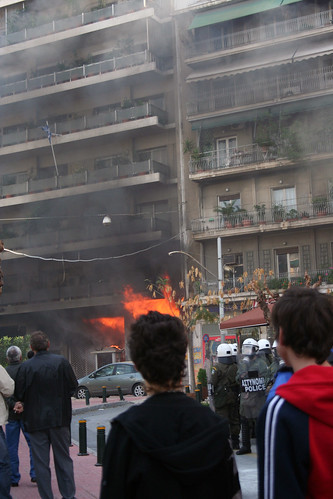
The deep fault lines within Greek society have exploded this week, with huge riots erupting across the country. The causes for the violence are myriad, but considering that part of the cause is the global economic stress, anyone in Europe watching the images on TV right now must be feeling at least a pang of dread. With so much uncertainly looming, there are plenty of people who fear scenes like this could be coming with more frequency across the continent.
The riots were immediately sparked by the fatal shooting of a 15-year-old protestor by police over the weekend, but the severity and length of the violence indicates that this is about much more than the shooting. Even though the country is prone to rioting from a strong left-wing student movement, this is the worst civil disorder to hit the country for decades according to reports. Schools across the country have been shut down, and transport has also come to a standstill. Most of the damage has been against property: luxury hotels, banks, any strong symbol of capitalism. The targets indicate that it is the economic reforms of prime minister Kostas Karamanlis that are driving people to the streets.
Students have a long and respected history of protest in Greece: it was they who brought the right-wing military junta down in the 1970's, and after that students were given special privileges to protest by the new government (similar to what happened in Spain in the 1970's). Police are not allowed to enter university campuses to arrest students, and during these riots students have used the campuses to regroup in between flare-ups of violence.
The government is saying that the police officer who shot the boy is going to be charged with manslaughter. Police say the boy was shot as he and some other young protesters were pelting a police car with stones. They say he was shot as he tried to throw a fuel-filled bomb at the police.
Greece is reeling right now from the effects of the global economic downturn; it has been hit harder than other European countries. The economic hardship has resulted in new flare-ups between the right and left in this country, both very powerful and both seething with hatred for the other side. As Europe watches the violence unfold, there must be fears in other countries with strong leftist movements that if the economic troubles get worse, these tensions between the right and left could flare up in their own countries as well.
May 1 is a traditional workers' day holiday across most of Europe, with most of the countries on the continent having the day off (the UK and Ireland save the day off for the following Monday). It coincides with a traditional pagan holiday welcoming spring, and such festivities are a big part of the celebrations. But it is also a traditional day for labour protests, although the intensity of those has tapered off over the years.
Berlin, for example, used to see massive street protests. But over the past five years they've dwindled to almost nothing. In fact May Day in Europe is quickly coming to resemble the watered-down version that is celebrated in September in the United States, Labour Day. The American version was put at that time as a compromise with unions because the government thought the traditional May 1 was too radical). Like in the United States, where few people could tell you what Labor Day celebrates, May 1 in the Europe has now also begun to lose its meaning in Europe.