Showing posts with label London. Show all posts

Wednesday, 8 August 2012

Bank battle: New York vs London

Yesterday's news that US regulators are investigating yet another British bank for illegal activity has provoked a roar of indignation and incredulity from the City of London. Today a member of the British parliament accused the US government of launching the string of investigations in order to weaken the British banking sector.

“I think it's a concerted effort that's been organised at the top of the US government,” fumed Labour MP John Mann to British media. “I think this is Washington trying to win a commercial battle to have trading from London shifted to New York.”

This week the New York State regulator charged the British bank Standard Chartered of money laundering $250 billion in funds aimed for Iran. The US has a trade embargo against Iran, and under US law all companies publicly traded in the US, including Standard Chartered, must comply. The money laundering went on for nearly a decade, the regulator alleges.

The announcement comes just weeks after the US Congress held highly confrontational hearings of British-based HSBC executives over allegations that HSBC was laundering money for Mexican drug cartels. Earlier this summer London-based Barclays bank was discovered to have been manipulating libor rates – the rates at which banks lend to each other.

Monday, 11 June 2012

Super size drink ban – the view from Europe


As an American living in Europe I am obviously confronted with frequent differences from my homeland. One of the most typical is the very profound difference in the way that Europeans and Americans view the state and its role in people’s daily lives.

I’ve been encountering this difference this week in the very different reactions to the news that New York mayor Mike Bloomberg wants to ban supersize soft drinks from being sold in restaurants and movie theaters. I have a number of friends here, mostly in the UK, who regularly watch the Daily Show. And they were perplexed by Jon Stewart’s rant last week against the proposal.

“I don’t understand, isn’t he on the left?” one Irish friend asked me. Given the obesity epidemic in the United States, he was confused as to why anyone would oppose the measure. This is generally the reaction I've heard from European friends. Of course this goes hand in hand with Europeans’ general impression that food sizes in the US are obscenely large.

Friday, 3 February 2012

UK gets ready for ‘American’ mayors

In three months, on 3 May, citizens of some of England’s largest cities will hold a referendum on whether or not they want their cities to be run by mayors. Though it may not seem like a revolution-in-the-making, it would represent a big change. American-style ‘mayors’ are an new concept in the UK.

London was the first British city to adopt the concept, creating an elected mayor position for the first time in 2000, a position now held by Boris Johnson. Before a devolution referendum was approved by Londoners in 1998 the city was ruled by 32 local boroughs with drastically less power than the current mayor enjoys. The referendum essentially created ‘London’ as an entity that had never existed before – a ‘Greater London Authority’ with its own government controlling the entire London area.

The ‘City of London’, the historic city where the financial centre now is, has had, and still has, a ceremonial ‘Lord Mayor” – a position which has existed since 1189. But actual elected mayors with powers have been unknown, largely because the UK is such a unitary state. It's one of the reasons some posit the British are so hostile to federalism at the European level. Given they have one of the lowest levels of local government in the western world, the concept of federal entitites sharing power rather than having it "dictated" to them from Brussels might be hard for them to understand.

As opposed to a federal state like the US, most decisions in the UK are taken centrally by the British Parliament – even painfully local things like new building authorisations or roads. But atr the turn of the century the government of Tony Blair made a huge decision - devolving powers to four regions through a process called devolution. Scotland and Wales were ‘devolved’ and given their own parliaments to make local decisions in 1999 (Northern Ireland has had a devolved government off and on since 1921, but a new one was established in 1999). London – which could be considered a ‘region’ in its own respect considering it has a larger population than Scotland and Wales put together – was also given devolved powers at the same time.

Wednesday, 2 November 2011

'Occupy London' pits bishop against bishop in Church of England

Today I paid a visit to the 'Occupy the London Stock Exchange' protestors who have camped out outside St. Paul's Cathedral in central London. It was a fascinating visit, I sat in on a 'general assembly' and also observed a conversation between an occupier and a banker that was being filmed for a British TV station. But what is perhaps the most interesting to me about the Occupy movement in London is the strange standoff it's not found itself in with the Church of England.

The 'occupy movement' has spread from its initial manifestation in August at Wall Street in New York to cities around the globe. On 15 October activists in London decided to stage their own version in the city's financial quarter ("the city"), the second most important financial centre in the world after Wall Street. They initially tried to occupy Paternoster Square, which is where the London Stock Exchange sits. But because the UK courts had already granted an injunction against public access to that particular square, police blocked their access to it.

So the 3,000 protestors moved to the nearby small open space next to St. Paul's Cathedral, the massive domed city landmark in the city built by Christopher Wren in 1697. The police surrounded the protestors in order to protect the cathedral. But the canon of St. Paul's told the police to leave. He said the church had decided to allow the protestors to protest peacefully on their land.

Thursday, 22 September 2011

Bike sharing coming to New York?

I’m in New York City today, I’ve come home again for a baptism that was rescheduled due to last month’s hurricane.  It’s just a short trip for the weekend, so I’ve only brought a carry-on bag. Because I’m traveling light, I was able to take a bike to the train station this morning, which is always nicer than taking the tram.

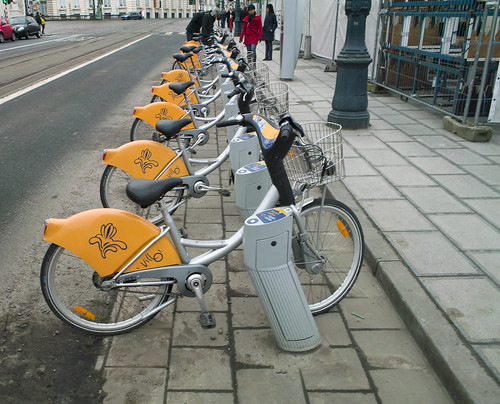
I use the Brussels bike-share scheme every day actually, it’s quite nice to have in a city with not very comprehensive public transportation. It’s quite simple really. For €30 a year I can check out a bike from any the stations scattered around Brussels and return it to a different station at my destination. It’s free as long as I return it to another station within a half hour. If I want to take it out for longer, it’s €1 for every 30 minutes. It’s particularly nice because my apartment is downhill from my office, so I take the metro to work and check out a bike to coast home.

Today I’ve learned that New York is considering implementing a similar scheme. But will it work in New York as well as it’s worked in European cities?

Tuesday, 9 August 2011

Britain's teenage riot

London was ablaze last night as an unprecedented wave of violence and looting spread throughout the city, spreading to other cities in England. It was the third day of rioting in London, initially sparked by the police shooting of a young black man in Tottenham last week. But last night saw the situation explode and quickly spread after the government and the police appeared to lose control of the situation.

The rioters carrying out the violence were mostly children, teenagers in hooded sweatshirts covering their faces, bashing in store windows and setting cars on fire. I've written before about how Britain is terrified of its own children. Last night was a shocking manifestation of that problem. A 2008 poll showed that more than half of British adults are afraid of British children, believing they behave like animals and pose an increasing danger to themselves and others.

The images from last night are truly shocking, particularly the fires. It was the largest number of simultaneous fires London has seen since the blitz. There were reportedly children as young as seven taking part in the violence. What precipitated the violence was the fatal police shooting of a young black man last week in Tottenham. The police say he had a gun and was shooting at them, but his family says he was unarmed. The facts surrounding the case are still unclear.

Thursday, 9 December 2010

Violent protests in London as government increases tuition

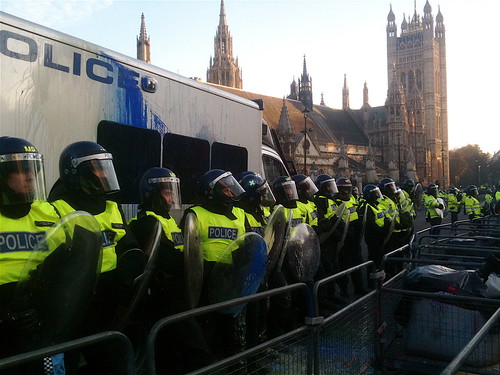
London was rocked today by the most violent anti-austerity protests yet seen, with Parliament Square becoming the scene of incredible sights of mayhem. The near-rioting took place just outside the Houses of Parliament where, inside, British politicians were casting the big vote on increasing English tuition rates by 300%. Horses charged into the crowd, fires raged and several police officers were seriously injured. Protesters broke into the treasury building and ransacked it. Christmas shoppers on Oxford Street were attacked. Even Prince Charles and Camilla were attacked as they tried to drive to the theatre, with protesters surrounding their car and smashing the windows.

The turmoil outside was mirrored by turmoil inside. The Liberal Democrats, who are in the governing coalition with the Conservative Party, saw a rebellion over the issue. Half of the Liberals defected, as did several Conservatives, shrinking the coalition's 84-seat majority to a majority of just 21 on this vote. The opposition Labour Party brutally criticised the plan, which will for the first time put British students in tens of thousands of pounds of debt after finishing a four-year degree - a situation that will be unique in all of Europe.

Friday, 17 September 2010

As expected, pope visit courts controversy in Britain

This week Pope Benedict XVI is making the first state visit by a pontiff to the United Kingdom. Considering the UK was historically the most anti-Catholic country in Europe (they have a holiday devoted to burning effigies of a Catholic traitor for goodness sake!), no one should be too surprised that this visit is causing some controversy.

In fact from the television coverage, it looks like the pope’s visit could be attracting more protesters than worshipers. The protesters appear to have two objections to the pope's visit. One: because it’s a state visit, the taxpayers are paying for it. Two: they are angry about the child abuse scandal and the Catholic heirarchy’s efforts to cover it up. Those are the ostensible reasons at least. But I suspect that if the Dalai Lama or an imam visited Britain on a state visit it wouldn’t be met with such a protest. Perhaps old historical animosity toward the ‘papists’ has a bit to do with this huge backlash to the visit. A great many public figures and politicians have objected to the visit as well, and the controversy has been raging ever since the visit was first announced. It even became a subject during the prime minister debates during this year's election. Surveys have shown that 2/3 of the British public dissaprove of the visit.

Tuesday, 25 May 2010

Madrid

I had an amazing time in Madrid this past weekend – my first visit to that city. After several weeks in cold, rainy Brussels it was a welcome respite. It also made me realize just how much I’m starting to miss being in a big city.

Madrid reminded me a lot of New York. With its grid street pattern of cement blocks, tall buildings, extensive and efficient metro and intense late-night nightlife, it was a bit like being back in the big apple. London is like New York in a lot of ways, but in those key areas I’ve listed above it is definitely not. So Madrid is probably the second most “like New York” city I’ve seen in Europe. The nightlife there is not only a lot of fun, but it’s also very relaxed and not as rigidly structured as the nightlife in London, where people go out very early and the rest of the evening has all sorts of rules about when things close. Comparing it to nightlife in Paris, it does have similar late-night hours, but I would definitely never describe Paris nightlife as being “relaxed”.

Thursday, 14 January 2010

London plans ‘USA Day'?? I'm out of here!

Well it’s been up in the air for awhile now but today it became official: my company is moving me to Brussels. I will be heading over there 1 March.

In the past year of doing this job covering the EU I’ve been living in London (where the company is based) and just going into Brussels when required. But someone in our Brussels office is leaving, so I need to be over there full-time now. I’m looking forward to it actually. Covering the EU from London has been a bit like trying to cover the US Congress from New York. You can do it (people do) but you can’t do it very well. Sure, you can hop on a Eurostar or Amtrak train to attend the key hearings, press conferences and events. But if you’re not immersed in the EU or DC bubble, you’re just not fully connected

Monday, 15 June 2009

Prince-on-Prince Contact

In a shock turn of events, it was revealed on Friday that Prince Charles has been successful in his bid to stop the Qataris from constructing modernist apartment blocks on the site of the old Chelsea Barracks, which is across the street from my flat. As you can imagine my flatmate, who has been intimately involved with the negotiations between our building’s residents and the Qataris, is none too pleased that the concessions he’s worked for two years to get have now gone up in smoke.

So what did it take for Qatari Diar (a real estate firm owned by the Qatari royal family) to abandon their planned development, designed by one of the worlds most prominent architects for a site that they purchased in the most expensive land transaction in British history? From the looks of it, it was a little princely camaraderie. The decision follows communication between Prince Charles and the Emir of Qatar in which the Prince of Wales asked him to stop the modernist development and instead start over with a more classic, traditional design.

So is this really the result of some royal influence, or is the royal contact angle just an over dramatisation by the British press? Right now it’s a bit unclear. As I wrote about in my previous post on this topic, the letter my flatmate received from the prince last month seemed to indicate that he probably didn’t want to see his royal name too associated with this mess - an effort that, judging from the headlines on Friday, clearly failed. One can easily see why he wanted to avoid it though. The heir apparent has been the target of considerable anger following this news, particularly from architects who say he should stop his “meddling”.

However the fact is that Charles was not really the driving force behind the opposition to this plan. The resistance was led by a proactive and energetic residents association (one that my building wasn’t a part of). It was that group, the Chelsea Barracks Action Group, that commissioned the ‘alternative’ Chelsea Barracks blueprint by traditional architect Quinlan Terry that much of the media has presented as being the brainchild of the prince (the one on the right in the above photo, compared to the planned design on the left). The prince, in fact, was really just peripherally involved in this whole dispute, from the looks of it. This was really a victory for CBAG chairwoman Georgie Thorburn, who has pursued this issue with almost messianic zeal over the past year.

But as peripheral as his involvement may have been, was Prince Charles the factor that tipped this in CBAG’s favour in the end? We’ll probably never know, as the intimate chats between royalty aren’t usually public knowledge, especially in Arabia! But what is for certain now is that the Chelsea Barracks site is back to the drawing board, and will continue to lie as a giant pit in the middle of posh Chelsea, with its two abandoned high-rise barrack dorms sticking up like rotting teeth. Not so great for the neighborhood’s aesthetic, but hey, at least I’m not going to be woken up by construction equipment in the morning any time soon!

Incidentally I’m in Amsterdam this week for work, on a press tour of some environmental projects throughout Holland. I’ll try to write a little bit about some of the things I’ve seen later in the week.

Wednesday, 13 May 2009

Prince Charles and the "Monstrous Carbuncle"

Earlier this week I was surprised to open the door and find a royal messenger holding a letter from Prince Charles. Of course I assumed it was my invitation to be knighted as “Best American Blogger in Britain,” but alas it was for my flatmate, who is head of the resident’s association in my building. That position probably doesn’t do much to account for why he gets letters from Prince Charles, but allow me to explain.

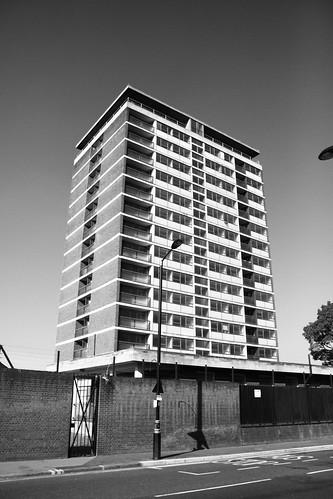
I live across from the Chelsea Barracks, a moderately-sized British army barracks that was sold and vacated last year. It now stands empty, with only two garish dormitory towers and a military chapel left as a reminder of its former use. The towers haven’t been torn down yet because of an ongoing conflict between the buyers - the Qatari royal family - and the neighborhood residents. Qatari Diar bought the property from the Ministry of Defence for £959 million, making it Britain’s most expensive residential development site in history at £70.3m per acre.

The Qataris have hired famed architect Richard Rogers to develop a modernist residential community that would be 50% affordable housing. The proposed projects would include tall buildings that would block the sunlight of neighboring buildings like mine (apparently the courtyard would be put permanently in shadow).

Earlier this year it was reported that Prince Charles wrote to Qatar Emir Sheikh Hamad bin Khalifa Al-Thani asking for Rogers’ design to be scrapped in favour of a more traditional scheme devised by classicist Quinlan Terry. Prominent London architects were outraged and called on the Prince to but out. But given that the site is right next to the Royal Chelsea Hospital and Sloane Square, many in this posh traditionally conservative area have been horrified by the though of a modern development towering over the venerable Chelsea.

The prince was then invited to speak at the to speak to the Royal Institute of British Architects last night, exactly 25 years after a highly controversial speech he made there 25 years ago blasting modern architecture and shooting down an idea to build an extension to the National Gallery at Trafalgar Square that resembled Paris’s Pompidou Centre. He famously likened the idea to seeing a “monstrous carbuncle on the face of a much-loved and elegant friend". That plan was scrapped quickly after those comments, and London modernist architects have never forgiven him for it. That’s why many were surprised that the Prince, who is often described as being inappropriately activist for a British royal, was invited back this year, and several architects boycotted the speech. You can judge for yourself in hindsight how a Pompidou Centre would have looked in Trafalgar Square.

This is where my flatmate entered the scuffle. Suspecting the Prince would make for a welcome ally in the residents' quest to stop the skyscraper development, so he sent him a letter. Surprisingly the prince wrote back quite fast, and the response came on Monday, one day before he was slated to speak to the institute. Though many thought he might take the opportunity of his speech to lambast the Chelsea Barracks development plan, we could tell from his letter on Monday that he had no such intention. The letter said that the prince's letter to the Qatar royal family was leaked to the press and was not meant to be public, and essentially that the prince was going to stay out of the controversy. Sure enough, last night saw a contrite, milder prince who even apologized for his remarks 25 years ago.

So, it looks like no prince ally for the Chelsea residents, at least not for now. And it remains to be seen whether the prince's contrition will heal his rift with the architects. But the war between classicists and modernists is far from over The modernists insist the classicists are trying to build fairy tale villages, and the classicists say modern architecture is cold and quickly outdated. Personally, I like them both.

As for the prince, he spent most of his speech actually railing about how new buildings should be eco-friendly. When it comes to pet issues, it's clear this "activist prince" moved on from architecture to climate change long ago.

Wednesday, 15 April 2009

Back in London

I thought I would write a quick update on where I am and what the heck I'm doing. I just got a full-time job reporting on EU environmental issues for a news service. I'll be working from the company's headquarters in London at first, and then in the Autumn I'll be moving back to Brussels to continue doing it from there. I'm looking forward to it!

So for now I'm back in London, getting back to the swing of things in the UK. I'm actually very excited to get back to full-time working. The freelancing was cool, but I think in the end I realized I really prefer a full-time regular job.

Thursday, 9 April 2009

Obama's Europe Verdict

Barack Obama is back home after his busy week abroad, and the time for reflection on what his trip to Europe says about his presidency is well underway. In London, Strasbourg, Prague and Istanbul Obama wowed the crowds and charmed the leaders, but what do his words say about how the relationship between Europe and the US is going to be defined during his presidency?

There's no doubt that a dramatic change in US foreign policy was officially unveiled during this trip. On the most symbolic level, the change in tone was striking. Obama seemed to be concentrating on putting distance between his policies and those of his predecessor. He admitted the mistakes America has made, while at the same time arguing that America is still the greatest hope for the world.

His speech in Prague, at the EU-US summit, was the main vehicle to deliver this message. "We must be honest with ourselves," he told the crowd. "In recent years, we've allowed our alliance to drift. I know that there have been honest disagreements over policy. But we also know that there's something more that has crept into our relationship. In America, there's a failure to appreciate Europe's leading role in the world. Instead of celebrating your dynamic union and seeking to partner with you to meet common challenges, there have been times where America's showed arrogance and been dismissive, even derisive. But in Europe, there is an anti-Americanism that is at once casual but can also be insidious. Instead of recognizing the good that America so often does in the world, there have been times where Europeans choose to blame America for much of what's bad."

"On both sides of the Atlantic, these attitudes have become all too common. They are not wise; they do not represent the truth. They threaten to widen the divide across the Atlantic and leave us both more isolated."


It is precisely because Obama remains so popular in Europe that he was able to deliver the critical second part of this message. Just imagine George W. Bush in Prague lecturing Europeans on their anti-Americanism. But Obama also warned Europe not to think it can sit back and relax now that Obama has been elected, expecting him to solve all their problems. "America is changing," he said, "but it cannot be America alone that changes."

This later expression of consternation was perhaps essential, as throughout all of these summits European leaders seemed to melt like jelly in Obama's presence, and there is a real risk that Europeans will think that Obama's election means that everything can return to the way it was before. As much as Obama insisted that he respects Europe as an equal partner and he will listen to it, the personal dynamic between the leaders seemed to suggest a very different sort of relationship. It was almost embarrassing to watch Gordon Brown smiling ear to ear during his press conference with Obama in London ahead of the G20, as he basked in the byproduct of the US president's celebrity. And Berlusconi was so overcome with Obamania during the group photo with the queen that he couldn't stop himself from screaming out the US president's name, which earned him a royal rebuke from her majesty.

But after all of Obama's talk about respect for the EU as an equal partner, his speech in Turkey seemed to undermine that. He affirmed the United State's continued support for Turkey's membership in the EU, a very controversial issue within the union. For many this statement not only betrayed a bit of American arrogance in meddling in the internal affairs of the EU, but also seemed to place Obama firmly in the 'EU as a merely a free trade zone' camp. Many have argued, most notably Nicolas Sarkozy, that the issue of Turkey joining the union is really fundamentally about what type of EU Europe wants. They argue that a strong, federal EU could never work after taking on Turkey as a member, and that the Anglo-Saxon desire to see Turkey as a member is reflective of the British/American desire to see the EU be only a free trade zone. Whether or not one agrees with this analysis, it was perhaps unwise of Obama to wade into the thorny issue immediately after affirming is respect and admiration for the EU. Sarkozy has been willing to look the other way in response to the comments, but privately he must be pretty displeased.

All in all it was an impressive visit, plagued by some hypocrisy and inconsistencies of message but as a whole wildly successful in the main thing it set out to accomplish: unveiling a new US foreign policy that will be a dramatic departure from the previous eight years.

Wednesday, 1 April 2009

G20 Protests Below the Fortress

I've been out covering the G20 protests in the City today, and aside from a few serious incidents for the most part they were peaceful. Although the big diplomatic events with the world leaders won't take place until tomorrow at Canarry Wharf, the big protest day was scheduled for today in The City, London's financial district. Most of the action was centered at the Bank junction, a large intersection which has the honour of hosting the headquarters of several major British banks, but most notably the country's national bank, the Bank of England. With it's giant imposing walls, much resembling a medeival fortress, it made an appropriate backdrop to a demonstration against the capitalist system.

The day started out fairly quietly. I did a phone-in report for RTE in Ireland at 10 am and at that time there wasn't more than a few people milling about in front of the Bank of England. But soon four groups of protesters marched to the intersection from four different tube stations. They were organised by a group calling itself the "G20 Meltdown," and they were supposed to represent the four horsemen of the apocolypse. Things started off with more of a carnival atmosphere, but after a few hours they got ugly. The police were using a cordoning strategy and seperated the protestors at the Bank of England into two goups, not allowing anyone to enter or leave those areas. Both peaceful and violent protestors started to become angry that they weren't being allowed to leave, and that was when altercations with the police began. At this point however they were still fairly minor, and the police weren't yet wearing riot gear.

Soon however a group of protestors managed to break the windows of the headquarters of the Royal Bank of Scotland, and throw smoke grenades inside. Plumes of red smoke came billowing out of the broken windows, and in the confusion a group of protestors were able to storm the building. They quickly started throwing office equipment out of the windows. It took a surprisingly long time for police to get control of the situation. It was at this point that riot gear police entered.

I was able to get out of the Bank of England area using my press pass, and I headed over to Bishopsgate where the climate change protest was happening. This gathering had an entirely different atmosphere. Protestors had converged on the street outside the European Climate Exchange and quickly set up tents in the road. People were singing, dancing, meditating, you name it. As far as I'm aware, there weren't any violent incidents at this gathering.

What was surprising was that the demonstration that was predicted to be the most likely to result in violence, the march from the American Embassy to Trafalgar Square, had the lowest turnout and was the most uneventful. Interestingly, the anger at these protests didn't seem to be directed at the United States, but rather at bankers or at the global capitalist system. One can only imagine how different these protests would have looked if George W. Bush was still in office. Gone were the effigies and burning American flags that usually accompanied Mr. Bush during his visits to Europe. In fact I would hypothesize that the presence of Mr. Obama at this summit went a long way in diffusing what could have been a very violent day of protests.

Of course there are still two more days to go, but it looks like the danger of violent demonstrations has passed. Now it's on to the real show, the actual G20 summit. Tonight the 20 world leaders are meeting for dinner, and earlier today Gordon Brown assured the press that the world was "hours away" from a new agreement on the economy. But analysts are cautioning not to expect anything big to come out of this. Summits usually only produce big results if the participants are all in agreement ahead of time, and that is definitly not the case here. German Chancellor Angela Merkel and French President Nicolas Sarkozy have formed an alliance resisting further stimulus money and demanding greater regulatitalist system. Sarkozy has even said he will walk out of the summit if the demands of the continent aren't met. Essentially, this summit could come down to team Obama-Brown versus team Sarkozy-Merkel.

Whichever team you're rooting for, it's nice to see Merkel and Sarkozy getting along again.

Sunday, 29 March 2009

On the Eve of the G20

I'm heading back to London tomorrow, just in time for the kick-off of the G20 Summit. The meeting of world leaders is already being called the most important G20 ever held, and it isn't just world leaders that are anticipating the big event.

This weekend G20 protests raged across Europe. At least 35,000 people marched in London calling for drastic government action on jobs, welfare and climate change. Of course, protests and the G20 have gone hand in hand since the group's inception, but this year is different. The old protesting stalwarts, who have always opposed the global capitalist system, are now finding a more receptive audience standing at the side of the road watching them march. One large banner at today's protest in London read, "Capitalism isn't working - another world is possible." Four years ago such a banner at the G20 would have seemed silly and irrelevant. For a middle class that has watched the economy collapse around them, the argument may sound quite convincing these days.

Today's march to Hyde Park in London was largely peaceful - just one person was arrested all day, for being drunk and disorderly. But there is a risk that as the week goes on the protests - in London and elsewhere - could turn violent. People are anxious, and there is a palpable sense that this G20 summit may be a turning point in the way this crisis unfolds. Last week George Soros predicted that this G20 summit could be the last opportunity to avoid a world-wide depression.

Large protests have already taken place in Rome, Berlin, Frankfurt, Vienna, Paris, Madrid and Barcelona, and many more are scheduled for later this week across Europe.

It will be an interesting week to be in London.

Monday, 17 November 2008

British Adults are Terrified of Teens

So far this morning the currency markets seem to be ignoring UK Tory shadow chancellor George Osborne's comments on Saturday. Despite predictions that the pound would take a dramatic plunge once currency trading opened this morning, it is actually slightly up against the dollar as of noon. Phew! Safe for now. But according to a new report receiving a lot of press coverage this morning, Brits may be fearing something even more insidious than a collapsed currency: their own children.

A poll conducted by a British charity shows that more than half of British adults are afraid of British children, believing they behave like animals and pose an increasing danger to themselves and others.

The behavior of British young people has been increasingly in the news, with public perceptions of children growing worse and worse. Recently a product was launched in the UK called the 'mosquito,' which emits a painful noise that only people under 18 can hear. The device is being sold to British shop-owners and other people, with the idea that they would install them on their premises to keep away young loitering hooligans. The popularity of the product has caused many British pundits to question people's attitudes toward British children.

According to the study, words like 'animal', 'feral' and 'vermin' are used daily in reference to children by British adults. The charity launched a TV advert this morning to accompany the report, showing a group of men seemingly talking about hunting a group of meddlesome animals. But then at the end of the advert it is revealed that all of the comments they used were actually comments British adults wrote about children in the comments sections of British newspapers.


But though the group is condemning these attitudes, many on the other side say that the fear expressed by these adults isn't the problem, but is rather a symptom of the real trouble - the increasingly shocking behavior of British youths. Incidents of young people being involved in violent crime or anti-social behavior have become frequent fare on the front pages of British newspapers, particularly several high-profile cases. In one of the most shocking cases, three teenagers were found guilty in January of murdering father of three Garry Newlove, who was beat to death after he confronted a group of youths making trouble outside his home.

So which is the real problem? Is the media needlessly fear-mongering by focusing so heavily on these youth crimes, or is it highlighting a legitimate social issue as British children drift into widespread anti-social behavior? The answer is probably a bit of both. As a foreigner living in the UK I have to say I noticed right away a dramatic difference in the behavior of British teenagers versus those in the US - and I reached this conclusion without the aid of the British media. When I first moved to London I was truly shocked by how British children behaved, and how accustomed adults seemed to have become to the behavior. My office in London was near a school, and every day in the mid-afternoon we would hear a chorus of shrieking, screaming and obscenities like I had never heard. I can say without exaggeration that it literally sounded like like people were being murdered outside. The first time it happened I ran to the window to see what was happening, and my coworkers looked on with mild bemusement. They had grown accustomed to this kind of display, whereas I thought some kind of horrible crime was being committed on the street below.

I should point out that when I moved to London I was coming directly from New York City, so it's not a question of being in an urban area rather than a suburban one. Maybe I'm just getting old and cranky. But I've had this conversation with many other Americans living in London and they've all said they've independently observed the same thing, that British children seem to be bizarrely out of control compared to youths in the US. But then again, who knows how much the British media influenced our perceptions in this area.

Clearly the fact that so many adults seem to be terrified of children is not good, but it seems to me that blaming the media entirely for this fear misses the bigger point. The current generation of British teenagers has somehow ended up feeling alienated from and unaccountable to society. I don't know how this came about, but people's fear in this area isn't entirely irrational. Then again, one should also keep in mind that complaining about the "youth of today" is a trend that will probably never go away, so matter which generation is being discussed.

Wednesday, 6 August 2008

Moving to Paris

Now that I definitively have my Italian citizenship, it’s come time to enter the next phase of my life. What that is I’m not quite sure yet, but in the medium term I’ve decided that it involves moving on from my current job and heading over to the continent. I’ve been writing for my current publisher for two and a half years now, and although I’ve learned a lot and been afforded some great opportunities through it, the time has come to segue over to a different area of reporting.

I took this job, reporting for a monthly business publication and web site, when my assignment as a Washington political correspondent ended back in 2005. At the time, I was finding that my relative lack of business and economic knowledge was often a hindrance in my political reporting, and I was thinking about ways to fix that problem. Journalists, who are notorious for being more left-brained, have often been criticized in the US for their lack of business knowledge (though I’ve found that to be less the case in the UK). So I decided to seek out a financial reporting job in New York City to get up to speed. I was also eager at the time to return to the area I’m from, and the most plentiful reporting jobs in New York are in finance. I received a few offers but went for a position covering private equity investment, something I knew basically nothing about before I started writing on it. Since then I’ve covered buyouts in the US, venture capital investment in intellectual property in Europe, and private equity real estate investment in Asia. So luckily I’ve had the opportunity to get quite a diverse array of financial reporting experience under my belt, even if it was all private equity and venture capital related.

Monday, 7 July 2008

The Ray Lewis fiasco

When it comes to bad judgment, it’s looking like there will be few recent decisions in British government that will rival the Conservatives’ choice to appoint Ray Lewis as deputy mayor of London, holding him up as a shining example of the “new Conservative party.”

Last week’s whirlwind of accusations, denials and subsequent resignation have been a source of embarrassment for the new mayor, and may be a sign of things to come for the office, which was meant to be a showcase for what a Conservative government could do nationally in the UK.

It all started on Thursday, when Channel 4 first informed the mayor by phone that they were preparing a piece on Lewis after several Anglican Bishops informed the station that in the 1990’s, Lewis had been disrobed as an Anglican priest because of sexual and financial misconduct. They said Lewis had borrowed money from several parishioners – an act in itself rather inappropriate – and then left the country without paying it back.

Monday, 2 June 2008

Last round on the underground

Having lived in the UK for awhile now, I've become pretty accustomed to scenes of mass public drunkenness. But nothing compares to the insanity of Saturday night's tube drinking party, when an estimated 50,000 people descended on London's circle line underground stations and trains to hold a booze fest the night before the new London mayor's public transport drinking ban was to go into effect.

The chaos and destruction that followed shouldn't have been surprising to anyone familiar with British drinking culture. But the complete ineptitude with which the new mayor handled the drinking ban roll-out may be just a preview of the new London.