Saturday, 9 September 2017
Juncker's Wallonia bypass could save Brexit
One year ago, as Canadian Prime Minister Justin Trudeau prepared to board a plane tp Brussels to sign a landmark free trade deal with the European Union, he had a bone to pick with some fellow Francophones 4km to the south of the EU capital.
The deal was done and all 28 EU national governments had agreed to it. But the tiny region of Wallonia, the French-speaking, politically far-left Southern part of Belgium, was threatening to wield a veto. A region of 3.5 million people was about to unilaterally kill the trade deal agreed by the other 509 million.
The premier of Wallonia asked Trudeau to cancel the visit, saying it would be a "provocation" to do so while Wallonia had not yet given its assent. The Canadian PM cancelled his flight, but he was not pleased. "If, in a week or two, we see that Europe is unable to sign a progressive trade agreement with a country like Canada, well then with whom will Europe do business in the years to come?" he asked.
Monday, 10 June 2013
A week of border concerns
Thursday, 8 September 2011
Could Strasbourg battle pit country against country?
Wednesday, 9 March 2011
'One down, eleven to go' in Strasbourg battle
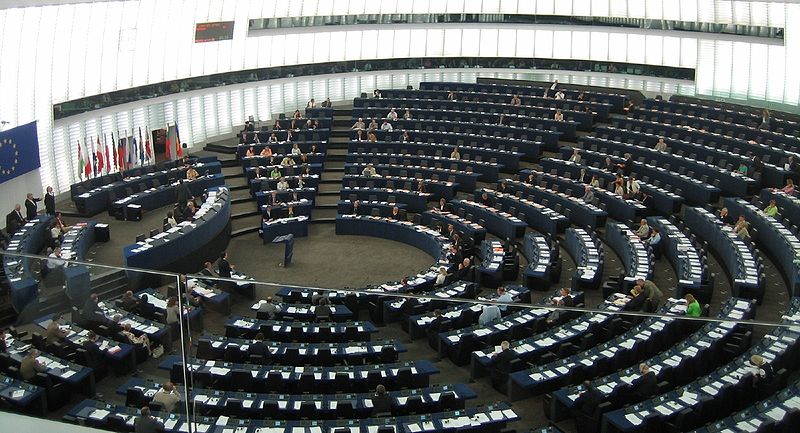
Every month the entire European Parliament is made to trek from Brussels to Strasbourg, France - which lies on the German-French border not far from Switzerland. This is because the original European Treaties designated Strasbourg as the headquarters of the parliament. Over time, the real work of the parliament has moved to Brussels in order to be closer to the other two EU institutions as well as lobbyists and NGOs. But the founding treaties still require the parliament to meet in Strasbourg twelve times a year, and all binding votes must take place there. The majority of members of the European Parliament (MEPs) hate the monthly "traveling circus" which requires them to go to Strasbourg for five days every month. A 2007 survey by Liberal MEP Alexander Nuno Alvaro showed that 89% of MEPs want to end the Strasbourg sessions.
But MEPs don't have a say in where they meet. Changing the Strasbourg requirement in the treaties would need the unanimous support of all member states, and France has always refused to support moving the parliament permanently to Brussels. In 1999 France built a massive new building for the parliament in Strasbourg, despite objections from MEPs who said they didn't want it. Now France points to the expense of the building to justify maintaining the Strasbourg seat.
Thursday, 9 April 2009
Obama's Europe Verdict
There's no doubt that a dramatic change in US foreign policy was officially unveiled during this trip. On the most symbolic level, the change in tone was striking. Obama seemed to be concentrating on putting distance between his policies and those of his predecessor. He admitted the mistakes America has made, while at the same time arguing that America is still the greatest hope for the world.
His speech in Prague, at the EU-US summit, was the main vehicle to deliver this message. "We must be honest with ourselves," he told the crowd. "In recent years, we've allowed our alliance to drift. I know that there have been honest disagreements over policy. But we also know that there's something more that has crept into our relationship. In America, there's a failure to appreciate Europe's leading role in the world. Instead of celebrating your dynamic union and seeking to partner with you to meet common challenges, there have been times where America's showed arrogance and been dismissive, even derisive. But in Europe, there is an anti-Americanism that is at once casual but can also be insidious. Instead of recognizing the good that America so often does in the world, there have been times where Europeans choose to blame America for much of what's bad."
"On both sides of the Atlantic, these attitudes have become all too common. They are not wise; they do not represent the truth. They threaten to widen the divide across the Atlantic and leave us both more isolated."
It is precisely because Obama remains so popular in Europe that he was able to deliver the critical second part of this message. Just imagine George W. Bush in Prague lecturing Europeans on their anti-Americanism. But Obama also warned Europe not to think it can sit back and relax now that Obama has been elected, expecting him to solve all their problems. "America is changing," he said, "but it cannot be America alone that changes."
This later expression of consternation was perhaps essential, as throughout all of these summits European leaders seemed to melt like jelly in Obama's presence, and there is a real risk that Europeans will think that Obama's election means that everything can return to the way it was before. As much as Obama insisted that he respects Europe as an equal partner and he will listen to it, the personal dynamic between the leaders seemed to suggest a very different sort of relationship. It was almost embarrassing to watch Gordon Brown smiling ear to ear during his press conference with Obama in London ahead of the G20, as he basked in the byproduct of the US president's celebrity. And Berlusconi was so overcome with Obamania during the group photo with the queen that he couldn't stop himself from screaming out the US president's name, which earned him a royal rebuke from her majesty.But after all of Obama's talk about respect for the EU as an equal partner, his speech in Turkey seemed to undermine that. He affirmed the United State's continued support for Turkey's membership in the EU, a very controversial issue within the union. For many this statement not only betrayed a bit of American arrogance in meddling in the internal affairs of the EU, but also seemed to place Obama firmly in the 'EU as a merely a free trade zone' camp. Many have argued, most notably Nicolas Sarkozy, that the issue of Turkey joining the union is really fundamentally about what type of EU Europe wants. They argue that a strong, federal EU could never work after taking on Turkey as a member, and that the Anglo-Saxon desire to see Turkey as a member is reflective of the British/American desire to see the EU be only a free trade zone. Whether or not one agrees with this analysis, it was perhaps unwise of Obama to wade into the thorny issue immediately after affirming is respect and admiration for the EU. Sarkozy has been willing to look the other way in response to the comments, but privately he must be pretty displeased.
All in all it was an impressive visit, plagued by some hypocrisy and inconsistencies of message but as a whole wildly successful in the main thing it set out to accomplish: unveiling a new US foreign policy that will be a dramatic departure from the previous eight years.
Monday, 12 January 2009
A Week in the Life of an MEP
The reporter, Brian Wheeler, is going to be blogging throughout the week, and this morning he hopped on the Eurostar over to Strasbourg to attend one of the monthly assemblies of the Parliament in that city. So for those of you wondering what an MEP actually does (and you have cause to be confused, it's hardly clear), this feature can shed some light on that topic. I know I'll be reading it with interest. This could be even better than the BBC Shipping Box!