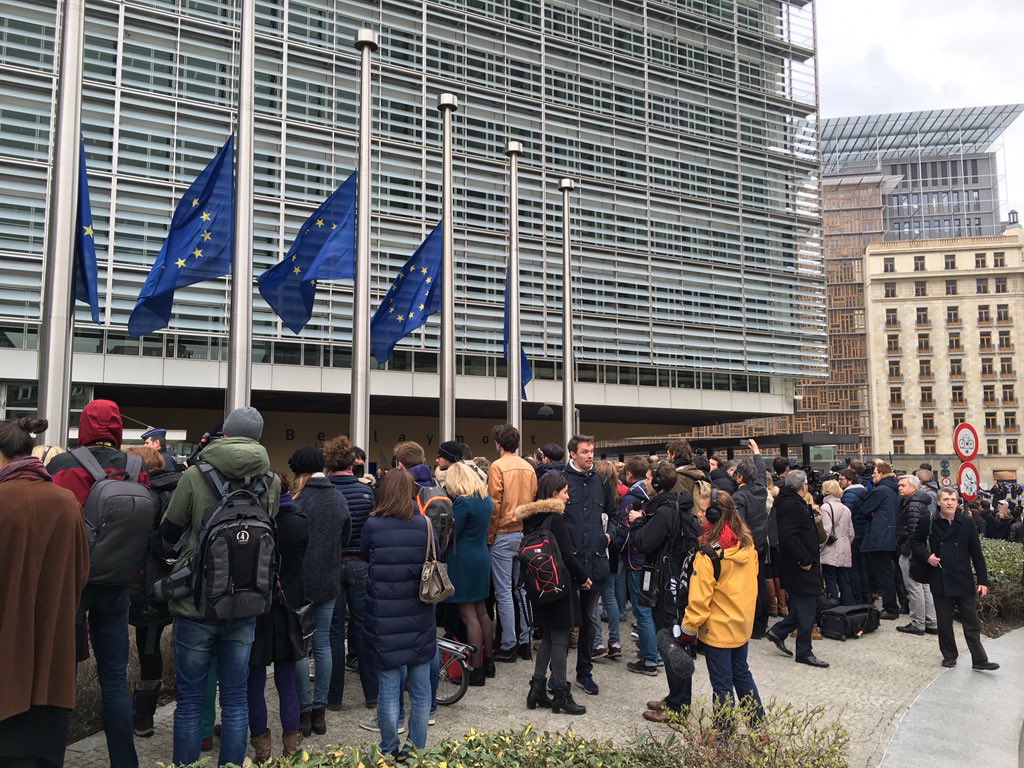
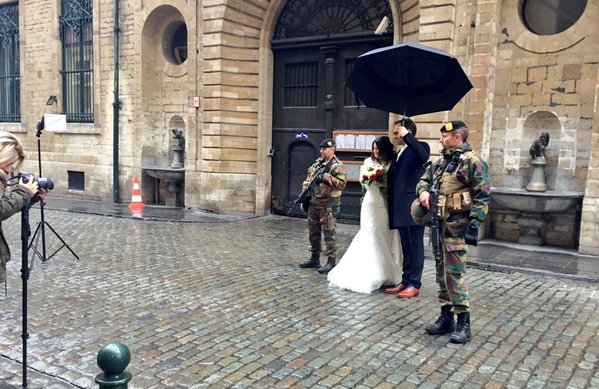
For two months after the Brussels attacks, the impromptu memorial at Place de la Bourse was left to decay. It will finally be cleaned up tomorrow.
In the hours immediately after the terrorist attacks in Brussels on 22 March, people were unsure what to do. It seemed safest to stay indoors, but as the afternoon developed without incident people wanted to come outside to show their solidarity.
Unable to reach the locations of the attacks themselves, they came to Brussels' most well-known meeting point to pay their respects: the steps outside the giant Leopold-era stock exchange, The Bourse. They began laying flowers and candles on the street in front of the steps, writing messages in chalk on the building and draping flags over the intimidating lions guarding the entrance.
Showing posts with label Brussels. Show all posts
Thursday, 19 May 2016
Monday, 25 April 2016
Is Brussels dead?
Media coverage in the aftermath of the terrorist attacks in Brussels have had a crippling effect on the city's economy. But it's only the latest setback for this unloved and underdeveloped city.
There have been reports in the Belgian media that over the past month, as many as 600 cafes, restaurants and hotels have filed for bankruptcy in Brussels. The normal amount is 40 per month.
The reports seem to reaffirm what people in Brussels have seen with their own eyes over the past weeks. Since the terrorist attacks of 22 March, Brussels city centre has been eerily quiet.
I have been mostly in Brussels over the past month rather than in Berlin, and I can confirm that the atmosphere has sometimes resembled a ghost town. At first, people were blaming it on the Easter break. "Brussels would always be empty at this time of year," they insisted. As the weeks wore on, their continued insistence that Easter was the culprit seemed less and less plausible.
Thursday, 24 March 2016
Would an EU Intelligence Service fix weak links like Belgium?
For reporters trying to cover the Brussels terrorist attacks this week, it has been a frustrating few days. As in any unfolding crisis, incorrect information been quick to spread. But in Belgium, the amount of conflicting information has had a surreal quality.
Information about whether suspects have been apprehended, or who blew themselves up where, has all depended on which Belgian authority you talk to. And in usual Belgian fashion, the authorities are not communicating with one another.
Yesterday the Turkish President said his country had arrested one of the suicide bombers last year and deported him, telling the Belgian embassy that he was a foreign terrorist fighter. The Belgian justice minister’s response today? “It’s only normal that a justice minister doesn’t know what happens in embassies. We could not know this.”
Tuesday, 22 March 2016
International targets
Across Belgium, people are extremely shaken up by the gruesome terrorist attacks today which took the lives of at least 34 people. But perhaps none more so than the people in Brussels' expat community.
The two targets in today's attacks are extremely public spaces - an airport departures hall and a metro station. But these two particular spots are ones that are visited over and over by the people working in and around the institutions of the European Union.
Monday, 23 November 2015
Brussels in 'lockdown'
Brussels is a lot tougher than people unfamiliar with the city might think.
I was in Brussels during the intense events of the last few days, and I would be lying if I said I didn't feel quite a bit of relief to be back in Berlin today.
At the same time, I'd have to say that the situation in Brussels wasn't quite as terrifying as the international media has made it out to be. And Brusselers are far more used to this kind of thing than one might assume.
The reports have been full of the same tired clichés that I often here about Brussels - that it's a quiet town "usually associated with the somnolent activity of the European Union", as the New York Times put it. In truth, the roar of helicopters, the whir of constant sirens and the sight of military personnel on the streets of Brussels is not an unusual sight. The city is, don't forget, the home of both the EU and NATO and therefor requires intense security for visiting leaders.
I was in Brussels during the intense events of the last few days, and I would be lying if I said I didn't feel quite a bit of relief to be back in Berlin today.
At the same time, I'd have to say that the situation in Brussels wasn't quite as terrifying as the international media has made it out to be. And Brusselers are far more used to this kind of thing than one might assume.
The reports have been full of the same tired clichés that I often here about Brussels - that it's a quiet town "usually associated with the somnolent activity of the European Union", as the New York Times put it. In truth, the roar of helicopters, the whir of constant sirens and the sight of military personnel on the streets of Brussels is not an unusual sight. The city is, don't forget, the home of both the EU and NATO and therefor requires intense security for visiting leaders.
Tuesday, 17 November 2015
Why is Brussels a terror nexus?
The combination of balkanised authorities and a marginalised North African population has made Brussels a natural terrorism hub.
I’m here in Brussels this week, doing a few TV spots and moderating some conferences. As soon as I arrived at the airport last night, I could sense the tension in the city as a result of this weekend's terrorist attack in Paris.
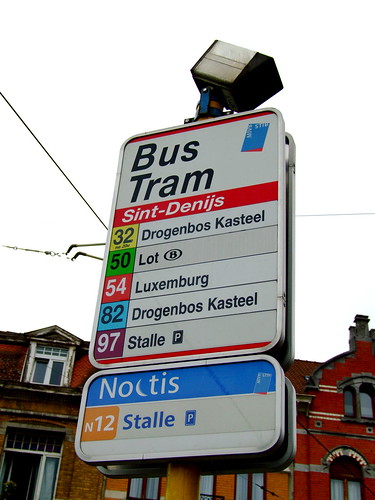
As I rode the nearly empty tram to my Brussels apartment, a group of young North African men got on the tram, engaged in a heated argument amongst themselves about the recent attacks (they were debating whether or not it was justified). I stopped into my local kebab joint and found another discussion between the Moroccan owners and a white Belgian customer, about how the authorities should respond. Outside, sirens wailed as police searched the city for one of the attackers believed to be on the loose in the city.
I’m here in Brussels this week, doing a few TV spots and moderating some conferences. As soon as I arrived at the airport last night, I could sense the tension in the city as a result of this weekend's terrorist attack in Paris.
As I rode the nearly empty tram to my Brussels apartment, a group of young North African men got on the tram, engaged in a heated argument amongst themselves about the recent attacks (they were debating whether or not it was justified). I stopped into my local kebab joint and found another discussion between the Moroccan owners and a white Belgian customer, about how the authorities should respond. Outside, sirens wailed as police searched the city for one of the attackers believed to be on the loose in the city.
Sunday, 25 October 2015
Rush Hour in Berlin
Due to a mixture of geographic and lifestyle factors, Berlin doesn't have much of a 'rush hour' to speak of.
I have a genuine question for Berliners - is there anything resembling a rush hour in this city? Perhaps it's the area in which I reside or the nature of my work, but after four months of living here I have yet to see any difference in traffic patterns or public transport ridership during the traditional commuting times of the day.
Maybe it just seems comparatively inactive because I'm coming from Brussels, which sees bumper-to-bumper gridlock throughout the city from 7h to 10h and 16h to 19h. I've noticed that it's only gotten worse since they closed Boulevard Anspach, the main thoroughfare in central Brussels, to pedestrianise it. During my Brussels weeks these past months I've seen traffic at an absolute standstill. I'm heading to Belgium tomorrow for another Brussels week, and I expect to spend much of the week sitting in traffic.
I have a genuine question for Berliners - is there anything resembling a rush hour in this city? Perhaps it's the area in which I reside or the nature of my work, but after four months of living here I have yet to see any difference in traffic patterns or public transport ridership during the traditional commuting times of the day.
Maybe it just seems comparatively inactive because I'm coming from Brussels, which sees bumper-to-bumper gridlock throughout the city from 7h to 10h and 16h to 19h. I've noticed that it's only gotten worse since they closed Boulevard Anspach, the main thoroughfare in central Brussels, to pedestrianise it. During my Brussels weeks these past months I've seen traffic at an absolute standstill. I'm heading to Belgium tomorrow for another Brussels week, and I expect to spend much of the week sitting in traffic.
Thursday, 15 October 2015
Coming home to the Brussels village
My 'Brussels weeks' feel a bit like coming back to my home village.
I’m on the train back to Berlin after a week in Brussels. Given that I’m now four months in with this dual-city life, I was naturally getting a lot of questions during this ‘Brussels week’ about how it’s going.
So far so good, has been my response. The two cities are so remarkably different so it’s nice to shake things up every two weeks. The train has served me well as a sort of ‘mobile office’, and so far it hasn't felt too disruptive.
I’m on the train back to Berlin after a week in Brussels. Given that I’m now four months in with this dual-city life, I was naturally getting a lot of questions during this ‘Brussels week’ about how it’s going.
So far so good, has been my response. The two cities are so remarkably different so it’s nice to shake things up every two weeks. The train has served me well as a sort of ‘mobile office’, and so far it hasn't felt too disruptive.
Wednesday, 29 July 2015
"You guys, we're about to get deutsched"
Is there life beyond Earth? That's the question a group of people I was with this weekend were asking themselves as we explored some crop circles that have recently formed in some wheat fields outside Berlin.
I was accompanying the group for a radio story I'm working on for Deutsche Welle, tying it in to the recent announcement of a new Stephen Hawking project to search for extraterrestrial life (it will air in the next few days on Inside Europe). It was a group of 15 or so youngish people from Berlin curious about UFOs, and you should have seen the looks we were getting as we walked through this small town in Brandenburg.
Perhaps the most alarmed look came as we emerged from the wheat fields. We had stopped to have a picnic within the crop circles, and when we were sitting down we were not visible from the road. Suddenly we all stood up, collected our things and started walking out of the field. I could see an elderly couple had stopped with their bikes and were staring at us, with a mixture of confusion and disapproval. "You guys, we're about to get deutsched," I told the group.
Wednesday, 16 April 2014
A noisier EU Quarter in Brussels
Today, members of the European Parliament rejected a European Commission proposal that would have allowed the European Union to overrule local authority decisions on the banning of flights at certain times.
The vote was only a rubber-stamping of a decision taken back in January to reject this part of the airport noise proposal. However, some MEPs saw this week's vote as an opportunity to bring up an airport noise issue closer to their hearts – new flight plans in Belgium that send planes from Zaventem airport straight over Brussels city centre and the EU quarter.
Since 6 February, planes taking off from Zaventem have been using a new route ordered by the Belgian federal government. The ‘Wathelet plan' – named after its designer Melchior Wathelet, Belgium's secretary of state of environment, energy, mobility and institutional reforms – has rerouted 80% of flights that used to fly over sparsely populated areas of Flanders east of Brussels. One hundred flights a day are now flying at low altitude through Brussels city - straight over the EU institutions.
Tuesday, 16 July 2013
The sandwich protest
One of the favourite pastimes of interns in Brussels is to go
‘pluxing' on Thursday nights – outdoor drinking at Place du Luxembourg.
As they sip (or gulp) their two-for-one happy hour beers, these young, wide-eyed new arrivals to Brussels can often be heard discussing the drudgery and disillusionment of the unpaid positions they've taken on since arriving. They speak of long hours, little or no pay, and highly questionable educational value. It's no wonder they want to let off some steam come Thursday evening.
Given their fondness for the square, it's perhaps little surprise that the interns have chosen Place du Luxembourg for the location of a walk-out protest on Wednesday (17 July), demonstrating against unfair internship conditions in Brussels.
The protest, which will take place between 11h and 13h, has been dubbed the ‘Sandwich Protest'. The idea is that Brussels interns are living such a hand-to-mouth existence that the only way they can feed themselves is by scouring for free sandwiches at conferences and other events. “When did you last have something else other than a sandwich for lunch?” the organisers ask on their Facebook page.
As they sip (or gulp) their two-for-one happy hour beers, these young, wide-eyed new arrivals to Brussels can often be heard discussing the drudgery and disillusionment of the unpaid positions they've taken on since arriving. They speak of long hours, little or no pay, and highly questionable educational value. It's no wonder they want to let off some steam come Thursday evening.
Given their fondness for the square, it's perhaps little surprise that the interns have chosen Place du Luxembourg for the location of a walk-out protest on Wednesday (17 July), demonstrating against unfair internship conditions in Brussels.
The protest, which will take place between 11h and 13h, has been dubbed the ‘Sandwich Protest'. The idea is that Brussels interns are living such a hand-to-mouth existence that the only way they can feed themselves is by scouring for free sandwiches at conferences and other events. “When did you last have something else other than a sandwich for lunch?” the organisers ask on their Facebook page.
Monday, 8 July 2013
Brussels' complicated expats
Tensions have been higher than usual in recent
months between the Belgian and expat communities here in Brussels, after
a series of articles by foreign journalists based here were seen as
disparaging the city.
In May, a two-page spread by the Brussels correspondent for the French newspaper Libération,
which called the Belgian capital 'ugly, dirty and dysfunctional',
kicked off the storm. Since then, the Belgian press has seemed
singularly obsessed with the outsiders' impressions. Much of the Belgian
media's coverage has expressed outrage that the expat community, who
have come to Brussels to work in and around the EU institutions, are so
often complaining about their host city.
It was in this context that today the
‘Brussels-Europe Liaison Office' - a body which was set up by the city
government to improve relations between expats and the natives - finally
released the long-awaited results of its expat survey.
The survey, which was conducted in May of last year with about 10,000
respondents, was meant to have results published last September. The
year-long delay had sparked speculation that the results were being
suppressed because the responses from expats were just too rude. Given
that the liaison office has the job of improving relations, it would
have been rather embarrassing to publish a survey where the expat
population vented their dissatisfaction.
Friday, 16 November 2012
Who is Captain Europe?
For two years, Brussels
has grappled with a mystery that has taken on a sort of legendary aura – who is
Captain Europe? Tonight, I may finally discover the answer.
The caped crusader – pictured right – appears suddenly at
various events around Brussels,
dressed head to toe in euro-blue spandex. When the EU won the Nobel Peace prize
last month, he was spotted at Place du Luxembourg (known
affectionately by Eurocrats as ‘Plux’) shortly afterwards waving an EU flag and working the crowd
into a frenzy of eurenthusiasm. Wherever euro-spirits are down, he suddenly
appears to save the day. His tweets are a consistent source of amusement.
Monday, 4 June 2012
Burqa ban leads to rioting in Brussels
The area of Molenbeek in Brussels was the scene of low-level rioting at the end of last week following the arrest of a woman for wearing a full face-covering niqab. It is the largest and most violent incident of resistance since France and Belgium enacted bans on face-covering in 2010 and 2011.
For those who oppose the burqa ban, the rioting is evidence that it is causing more problems than it solves and giving the garment more power as a symbol of resistance. For those who support the ban, the rioting is evidence that the state was right to take a stand against the increasing radicalisation they say is taking place among Belgium’s sizable Muslim minority of mainly North Africa immigrants.
On Thursday, Brussels police arrested a 23-year-old woman in Molenbeek – one of the neighborhoods of Brussels with a very high Muslim population at over 50% - for refusing to take off her face covering. That night, police say about 100 people surrounded the Molenbeek police station where she was being held, throwing stones at officers. A large number of riot police were deployed, giving the area the feeling of a city under siege. After Muslim prayers on Friday afternoon additional skirmishes broke out in the area, forcing the authorities to shut down some metro stations. The police say the violent demonstrations were organised by the group Shariah4Belgium
For those who oppose the burqa ban, the rioting is evidence that it is causing more problems than it solves and giving the garment more power as a symbol of resistance. For those who support the ban, the rioting is evidence that the state was right to take a stand against the increasing radicalisation they say is taking place among Belgium’s sizable Muslim minority of mainly North Africa immigrants.
On Thursday, Brussels police arrested a 23-year-old woman in Molenbeek – one of the neighborhoods of Brussels with a very high Muslim population at over 50% - for refusing to take off her face covering. That night, police say about 100 people surrounded the Molenbeek police station where she was being held, throwing stones at officers. A large number of riot police were deployed, giving the area the feeling of a city under siege. After Muslim prayers on Friday afternoon additional skirmishes broke out in the area, forcing the authorities to shut down some metro stations. The police say the violent demonstrations were organised by the group Shariah4Belgium
Tuesday, 10 April 2012
Brussels, the broken city
Public transport has been shut down in Brussels for four days now, a state of affairs we learned this morning will likely continue until Thursday. The entire situation has seemed to put people here in a more pronounced state of cynicism and disgust than normal, given both the circumstances of the incident which sparked the strike and the behaviour of the transit workers.
Early on Saturday morning, a city bus was involved in a traffic accident with a drunk driver. When a supervisor from Brussels’ public transport agency STIB came to investigate the accident and accused the car driver of being drunk, he became offended and called some friends to defend him. Those friends attacked the STIB supervisorand killed him.
In response, the STIB immediately shut down the network. This was done well before the facts of the incident were clear and before the employee had died (he didn’t die until later in the day at the hospital). Initial reports on the STIB’s web site said the trains weren’t running because of a “lightning strike”. Later it was a stabbing, until eventually it just said a “serious incident with dramatic consequences”.
The STIB employees said they wouldn’t go back to work until they had a meeting with the Belgian government about improving their safety on Monday night (this being Easter weekend, Monday was a public holiday). But last night, without providing much explanation, the STIB workers union said whatever had been offered them was not enough, and they would continue to stay home.
Early on Saturday morning, a city bus was involved in a traffic accident with a drunk driver. When a supervisor from Brussels’ public transport agency STIB came to investigate the accident and accused the car driver of being drunk, he became offended and called some friends to defend him. Those friends attacked the STIB supervisorand killed him.
In response, the STIB immediately shut down the network. This was done well before the facts of the incident were clear and before the employee had died (he didn’t die until later in the day at the hospital). Initial reports on the STIB’s web site said the trains weren’t running because of a “lightning strike”. Later it was a stabbing, until eventually it just said a “serious incident with dramatic consequences”.
The STIB employees said they wouldn’t go back to work until they had a meeting with the Belgian government about improving their safety on Monday night (this being Easter weekend, Monday was a public holiday). But last night, without providing much explanation, the STIB workers union said whatever had been offered them was not enough, and they would continue to stay home.
Tuesday, 3 January 2012
Protest over Ikea meatballs - welcome back to Absurdistan
I’m back in Brussels after spending the Christmas break home in the US. It was yet another trip where I spent most of the time regaling people with the insane stories of the strange place I now find myself living in. I’m pretty sure most of my American friends think I’m making this stuff up. I only wish.
After describing the impromptu general strike three days before Christmas which forced me to pay $500 to rebook my flight home, I moved on to describing to my friends the other union strikes I have witnessed since moving here. From the impromptu metro driver strike that was called after a driver claimed he was punched by a passenger (it turned out the driver had punched the passenger) to the October garbage strike in which the garbagemen went around town lighting the trash bags on fire and throwing them into the street, there’s plenty to describe. And let's not forget the time the taxi drivers blockaded Brussels Airport because an unlicensed taxi driver had been grazed by a bullet while he fled from police during a high-speed chase.
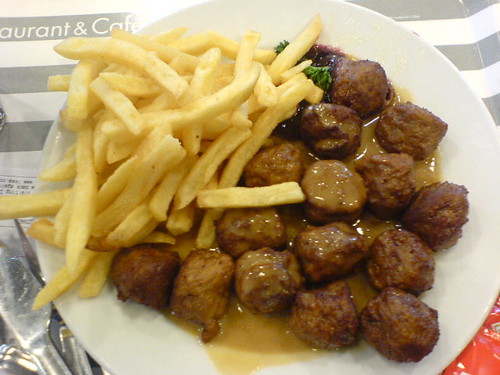
Today I learned about a whole new anecdote of insanity I could have described to my perplexed American friends. According to this story by Belgian news station RTL, the restaurant owners association in Belgium (Horeca) is busing homeless people to Ikea as a protest against their low meatball prices. When I first saw this story I assumed it had to be a joke. Clearly I’ve been in the US too long! Because I forgot that when you hear about something this absurd happening in Belgium, it’s probably true.
After describing the impromptu general strike three days before Christmas which forced me to pay $500 to rebook my flight home, I moved on to describing to my friends the other union strikes I have witnessed since moving here. From the impromptu metro driver strike that was called after a driver claimed he was punched by a passenger (it turned out the driver had punched the passenger) to the October garbage strike in which the garbagemen went around town lighting the trash bags on fire and throwing them into the street, there’s plenty to describe. And let's not forget the time the taxi drivers blockaded Brussels Airport because an unlicensed taxi driver had been grazed by a bullet while he fled from police during a high-speed chase.
Today I learned about a whole new anecdote of insanity I could have described to my perplexed American friends. According to this story by Belgian news station RTL, the restaurant owners association in Belgium (Horeca) is busing homeless people to Ikea as a protest against their low meatball prices. When I first saw this story I assumed it had to be a joke. Clearly I’ve been in the US too long! Because I forgot that when you hear about something this absurd happening in Belgium, it’s probably true.
Wednesday, 30 November 2011
Brussels – enter at your own risk
News of the attack, which has been spreading like wildfire through social media all week, seems to have left the city’s gay community shocked yet unsurprised at the same time. The storyline has become a familiar one in Brussels. Three drunk men entered the café, began hurling homophobic abuse at the people inside, and before long a violent altercation ensued. The details of what took place are still unclear, but the incident was serious enough to shut the doors of this Brussels landmark since Sunday. And although homophobic attacks are unfortunately common in Brussels city centre - an area of the city that is known for its crime and grime - this incident has still caused huge shock because the establishment is so well-known. Even the soon-to-be Belgian prime minister, who is openly gay, can often be seen there.
A movement has been growing to try to pressure the city authorities to do more to keep the city centre safe since a gay-bashing attack in June that many saw as the straw that broke the camel's back. A man was beaten by a group of young men near the Bourse (stock exchange), just next to Grand Place, because he was gay and behaving in an effeminate manner.
Thursday, 22 September 2011
Bike sharing coming to New York?
I’m in New York City today, I’ve come home again for a baptism that was rescheduled due to last month’s hurricane. It’s just a short trip for the weekend, so I’ve only brought a carry-on bag. Because I’m traveling light, I was able to take a bike to the train station this morning, which is always nicer than taking the tram.
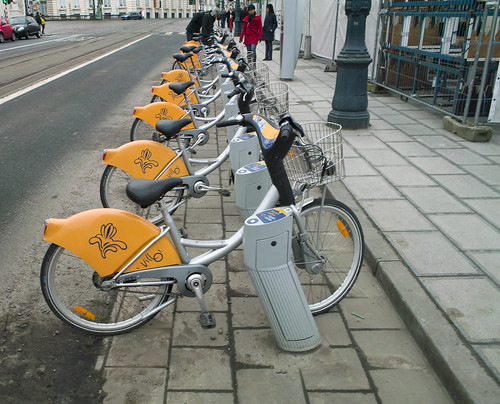
I use the Brussels bike-share scheme every day actually, it’s quite nice to have in a city with not very comprehensive public transportation. It’s quite simple really. For €30 a year I can check out a bike from any the stations scattered around Brussels and return it to a different station at my destination. It’s free as long as I return it to another station within a half hour. If I want to take it out for longer, it’s €1 for every 30 minutes. It’s particularly nice because my apartment is downhill from my office, so I take the metro to work and check out a bike to coast home.
Today I’ve learned that New York is considering implementing a similar scheme. But will it work in New York as well as it’s worked in European cities?
I use the Brussels bike-share scheme every day actually, it’s quite nice to have in a city with not very comprehensive public transportation. It’s quite simple really. For €30 a year I can check out a bike from any the stations scattered around Brussels and return it to a different station at my destination. It’s free as long as I return it to another station within a half hour. If I want to take it out for longer, it’s €1 for every 30 minutes. It’s particularly nice because my apartment is downhill from my office, so I take the metro to work and check out a bike to coast home.
Today I’ve learned that New York is considering implementing a similar scheme. But will it work in New York as well as it’s worked in European cities?
Tuesday, 14 June 2011
Belgium hits one year with no government
A rather embarassing anniversary was reached here in Belgium yesterday - it has been one year since an inconclusive election threw the country into a period with no government. At the time, it would have seemed obscene to suggest that there would still be no government in Belgium in a year's time. But that's where we are today, and perhaps the only thing more surprising than the length of this governmentless period is the barely noticeable effet it has had on the country.
In truth, it's hard to say whether the current governmentless period hit it's one year mark yesterday or a few months earlier. The previous government of prime minister Yves Leterme collapsed in April of last year, so in truth Belgium has not had a government for a year and three months. Either way, this is the longest period any country in modern history has ever gone without a government. In February Belgium surpassed the previous record held by the fledgling Iraqi democracy.
Wednesday, 25 May 2011
Music wars on the Brussels metro
If you've ever ridden the Brussels metro subway system you may have noticed that your journey is accompanied by catchy pop tunes. In fact this past Monday was 'Lady Gaga Day' on the metro, when the gaag was played all day long, non-stop. I've pretty much gotten used to the music and I barely notice it any more, but there's one aspect of it I never thought to question - the songs being played are almost always in English.
I never thought to question it because, as is the case in most European countries, the majority of songs on the radio are always in English as well. But I had never noticed before that despite the fact that this is a Francophone city, I have never heard a song in French. Nor have I ever heard a song in Dutch, the city's other official language (spoken as a primary language by 7% of the Brussels population).
Apparently there is method to this madness. According to an article today in FlandersNews, the Brussels public transport company STIB has a policy of only playing English songs on the metro, with a smattering of Spanish and Italian songs thrown in for good measure. French and Dutch songs have not been played for fear of aggravating tensions between the two sides of the language divide here.
I never thought to question it because, as is the case in most European countries, the majority of songs on the radio are always in English as well. But I had never noticed before that despite the fact that this is a Francophone city, I have never heard a song in French. Nor have I ever heard a song in Dutch, the city's other official language (spoken as a primary language by 7% of the Brussels population).
Apparently there is method to this madness. According to an article today in FlandersNews, the Brussels public transport company STIB has a policy of only playing English songs on the metro, with a smattering of Spanish and Italian songs thrown in for good measure. French and Dutch songs have not been played for fear of aggravating tensions between the two sides of the language divide here.
Subscribe to:
Comments (Atom)