A leaked internal document reveals Deutsche Bahn may halt all sleeper train services in Germany at the end of next year.
If you like the idea of rolling across Europe in the relaxed comfort of your bed, it looks like you've got just one year left to do it - in Germany at least.
Deutsche Bahn, the German rail operator, has reportedly signalled that it may end all city night line trains in December 2016. No more overnight trains.
Showing posts with label public transportation. Show all posts
Thursday, 3 December 2015
Tuesday, 10 April 2012
Brussels, the broken city
Public transport has been shut down in Brussels for four days now, a state of affairs we learned this morning will likely continue until Thursday. The entire situation has seemed to put people here in a more pronounced state of cynicism and disgust than normal, given both the circumstances of the incident which sparked the strike and the behaviour of the transit workers.
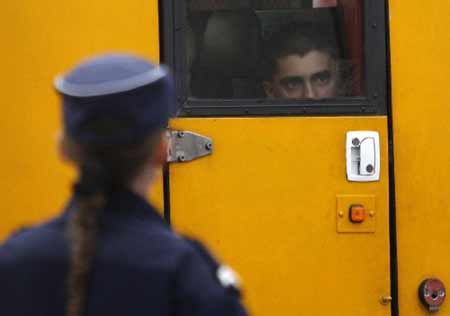
Early on Saturday morning, a city bus was involved in a traffic accident with a drunk driver. When a supervisor from Brussels’ public transport agency STIB came to investigate the accident and accused the car driver of being drunk, he became offended and called some friends to defend him. Those friends attacked the STIB supervisorand killed him.
In response, the STIB immediately shut down the network. This was done well before the facts of the incident were clear and before the employee had died (he didn’t die until later in the day at the hospital). Initial reports on the STIB’s web site said the trains weren’t running because of a “lightning strike”. Later it was a stabbing, until eventually it just said a “serious incident with dramatic consequences”.
The STIB employees said they wouldn’t go back to work until they had a meeting with the Belgian government about improving their safety on Monday night (this being Easter weekend, Monday was a public holiday). But last night, without providing much explanation, the STIB workers union said whatever had been offered them was not enough, and they would continue to stay home.
Early on Saturday morning, a city bus was involved in a traffic accident with a drunk driver. When a supervisor from Brussels’ public transport agency STIB came to investigate the accident and accused the car driver of being drunk, he became offended and called some friends to defend him. Those friends attacked the STIB supervisorand killed him.
In response, the STIB immediately shut down the network. This was done well before the facts of the incident were clear and before the employee had died (he didn’t die until later in the day at the hospital). Initial reports on the STIB’s web site said the trains weren’t running because of a “lightning strike”. Later it was a stabbing, until eventually it just said a “serious incident with dramatic consequences”.
The STIB employees said they wouldn’t go back to work until they had a meeting with the Belgian government about improving their safety on Monday night (this being Easter weekend, Monday was a public holiday). But last night, without providing much explanation, the STIB workers union said whatever had been offered them was not enough, and they would continue to stay home.
Thursday, 22 September 2011
Bike sharing coming to New York?
I’m in New York City today, I’ve come home again for a baptism that was rescheduled due to last month’s hurricane. It’s just a short trip for the weekend, so I’ve only brought a carry-on bag. Because I’m traveling light, I was able to take a bike to the train station this morning, which is always nicer than taking the tram.
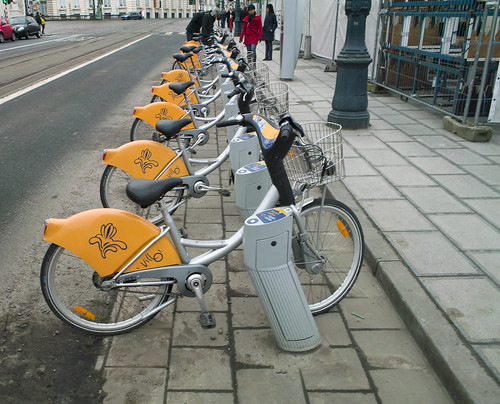
I use the Brussels bike-share scheme every day actually, it’s quite nice to have in a city with not very comprehensive public transportation. It’s quite simple really. For €30 a year I can check out a bike from any the stations scattered around Brussels and return it to a different station at my destination. It’s free as long as I return it to another station within a half hour. If I want to take it out for longer, it’s €1 for every 30 minutes. It’s particularly nice because my apartment is downhill from my office, so I take the metro to work and check out a bike to coast home.
Today I’ve learned that New York is considering implementing a similar scheme. But will it work in New York as well as it’s worked in European cities?
I use the Brussels bike-share scheme every day actually, it’s quite nice to have in a city with not very comprehensive public transportation. It’s quite simple really. For €30 a year I can check out a bike from any the stations scattered around Brussels and return it to a different station at my destination. It’s free as long as I return it to another station within a half hour. If I want to take it out for longer, it’s €1 for every 30 minutes. It’s particularly nice because my apartment is downhill from my office, so I take the metro to work and check out a bike to coast home.
Today I’ve learned that New York is considering implementing a similar scheme. But will it work in New York as well as it’s worked in European cities?
Wednesday, 25 May 2011
Music wars on the Brussels metro
If you've ever ridden the Brussels metro subway system you may have noticed that your journey is accompanied by catchy pop tunes. In fact this past Monday was 'Lady Gaga Day' on the metro, when the gaag was played all day long, non-stop. I've pretty much gotten used to the music and I barely notice it any more, but there's one aspect of it I never thought to question - the songs being played are almost always in English.
I never thought to question it because, as is the case in most European countries, the majority of songs on the radio are always in English as well. But I had never noticed before that despite the fact that this is a Francophone city, I have never heard a song in French. Nor have I ever heard a song in Dutch, the city's other official language (spoken as a primary language by 7% of the Brussels population).
Apparently there is method to this madness. According to an article today in FlandersNews, the Brussels public transport company STIB has a policy of only playing English songs on the metro, with a smattering of Spanish and Italian songs thrown in for good measure. French and Dutch songs have not been played for fear of aggravating tensions between the two sides of the language divide here.
I never thought to question it because, as is the case in most European countries, the majority of songs on the radio are always in English as well. But I had never noticed before that despite the fact that this is a Francophone city, I have never heard a song in French. Nor have I ever heard a song in Dutch, the city's other official language (spoken as a primary language by 7% of the Brussels population).
Apparently there is method to this madness. According to an article today in FlandersNews, the Brussels public transport company STIB has a policy of only playing English songs on the metro, with a smattering of Spanish and Italian songs thrown in for good measure. French and Dutch songs have not been played for fear of aggravating tensions between the two sides of the language divide here.
Thursday, 17 February 2011
Who punched whom? Brussels transit hangs in the balance
There are many expressions that expats have come up with to describe life in Belgium, but perhaps my favourite is this: "It's as if someone made surreal a country." No expression seemed more appropriate on Tuesday when the Brussels transit union suddenly called an immediate strike to protest the fact that a metro conductors had been punched by a passenger. But after a day of chaos with the city's entire transit system shut down, it emerged that in fact it was the conductor who had punched the passenger, not the other way around.
On Monday night the conductor got into an argument with a passenger and then throttled him. Afterward, fearing he would get in trouble, he lied and said the passenger had punched him. Upon hearing this, the transit workers union immediately rallied to his defence and that night, just two hours after the incident occurred, called an immediate strike. Every transit worker walked off the job, and did not come back the next morning.
So when I and everyone else went to the metro station Tuesday morning we found it shut - with no explanation. There was no sign, no people telling us what was going on, nothing. I had to go all the way back to my apartment and go online to find out what was going on. All metro trains, trams and buses didn't run the entire day. And with every cab taken, I had no choice but to work from home.
On Monday night the conductor got into an argument with a passenger and then throttled him. Afterward, fearing he would get in trouble, he lied and said the passenger had punched him. Upon hearing this, the transit workers union immediately rallied to his defence and that night, just two hours after the incident occurred, called an immediate strike. Every transit worker walked off the job, and did not come back the next morning.
So when I and everyone else went to the metro station Tuesday morning we found it shut - with no explanation. There was no sign, no people telling us what was going on, nothing. I had to go all the way back to my apartment and go online to find out what was going on. All metro trains, trams and buses didn't run the entire day. And with every cab taken, I had no choice but to work from home.
Friday, 12 September 2008
Eurotunnel Still Ablaze
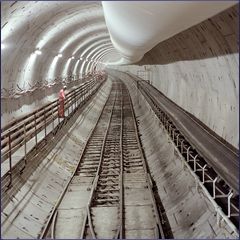
The fire in the rail tunnel, which since 1994 has connected the UK and France running under the English Channel, was apparently caused by a truck/lorry overturning on one of the vehicle transport trains. Some injuries have been reported and hundreds of passengers have been left stranded. By some miracle, there were no passenger trains in the tunnel at the time of the blaze, amazing considering that 100 trains pass through the tunnel each day. The injured people were evacuated through the central service tunnel (the BBC has a cool diagram of how the chunnel works here).
Even more worrying, the overturned truck/lorry reportedly contained phenol, a deadly chemical that isn't allowed to be transported through the tunnel. The people who are reportedly in the hospital for smoke inhalation could have inhaled this chemical as it burned.
As someone who was planning to take the Eurostar train many times over the next several months, this is quite worrying. But for the economies of England and France in general, a shutdown of the tunnel for several months could be devastating. The majority of freight traffic between the UK and continental Europe now goes through the chunnel. In addition, the Eurotunnel just recently turned a profit for the first time, and there were big plans for expansion of the passenger services through it.
Just hours before the fire broke out yesterday, Air France announced it was launching its own high-speed train company through the tunnel which would take less than 2 hours, breaking the Eurostar monopoly. The journey currently takes a minimum of 2h 15m. Clearly there's a lot riding on the tunnel and its activity is only increasing. If anything were to go wrong with the tunnel at this crucial time it would have huge reverberations through France and Britain's economy.
Wednesday, 9 April 2008
Finally, the chunnel turns a profit
Here’s an interesting item from Euronews today. It seems that at long last the chunnel has turned a profit! Eurotunnel, the operator of the underwater train tunnel linking Britain to continental Europe, has made a profit for the first time since it opened in 1994.Back then the cost of building the tunnel ran so over budget that the company has been paying off the massive debt ever since. And of course they were not helped by the fact that at the same time there was an explosion of budget airlines taking people from London to the continent for next to nothing. Ridership didn’t meet expectations, and over the past few years it looked like the company was headed for bankruptcy. It lost €204 million in 2006 and €2.8 billion in 2005.
It was a daunting task to turn it around but somehow they seem to have done it. Chief executive Jacques Gounon has managed to strictly cut operating costs and complete a financial restructuring that has lowered the company’s level of debt and therefore its interest payments.
Friday, 8 June 2007
Tube vs. Subway
A lot of people here ask me how London compares to New York. I usually answer that I like it here, but there are two things that really bug me about this city and make me miss New York.The first is how decentralized it is, how it’s really more of a collection of little villages than a core-oriented metropolis like NYC. I’m still really the only person I know who lives in central London, everyone here lives way out in the middle of nowhere, miles from the city center. Everyone says it’s because central London is so expensive, but honestly I don’t think it’s any more expensive (compared with the outskirts) than Manhattan is compared with the outer boroughs. The difference is in New York, people are willing to grin and bare it. They’ll put up with living in a shoe box and paying an exorbitant rent because it’s worth it to live in Manhattan. So, when I lived in New York I always lived in Manhattan (Roosevelt Island still technically counts!) and most of my friends did as well. And if I called a friend at 9 pm to see if they wanted to grab a drink, they could do so easily because they didn’t live too far away.
Tuesday, 25 April 2006
Best Gas Price Medicine? Build Public Transportation
Americans need to get something through their heads. The price of gas is not going to go down to $2 a gallon again. Ever. Period.
The emergence of China as a global power has and will fundamentally change our world, and we need to adjust to it. And part of that adjustment will be paying real prices for oil.
Congress is getting all in a tizzy about these gas prices, pointing their fingers this way and that. But Republicans seem to be forgetting about the enormous gift they gave the oil industry last year, an energy bill that gave huge subsidies and tax breaks to big oil. Last year the five largest oil companies, Exxon Mobil, BP, Royal Dutch Shell, Chevron Corp. and ConocoPhillips took home more than $111 billion in profits. As CNN’s John Roberts noted recently, that's greater than the GDP of 174 of the world's countries
To a large degree the US has brought this upon itself by not investing in an even rudimentary public transporation system. We are a nation obsessed with the car. So much so that in all the recent news reports asking how high gas would have to go before Americans stopped driving, noone’s thought to point out the obvious: They can’t stop driving no matter how much you charge for gas, because they have no other way to get around. Gas could go up to $20 and they’d still have to pay it.
The emergence of China as a global power has and will fundamentally change our world, and we need to adjust to it. And part of that adjustment will be paying real prices for oil.
Congress is getting all in a tizzy about these gas prices, pointing their fingers this way and that. But Republicans seem to be forgetting about the enormous gift they gave the oil industry last year, an energy bill that gave huge subsidies and tax breaks to big oil. Last year the five largest oil companies, Exxon Mobil, BP, Royal Dutch Shell, Chevron Corp. and ConocoPhillips took home more than $111 billion in profits. As CNN’s John Roberts noted recently, that's greater than the GDP of 174 of the world's countries
To a large degree the US has brought this upon itself by not investing in an even rudimentary public transporation system. We are a nation obsessed with the car. So much so that in all the recent news reports asking how high gas would have to go before Americans stopped driving, noone’s thought to point out the obvious: They can’t stop driving no matter how much you charge for gas, because they have no other way to get around. Gas could go up to $20 and they’d still have to pay it.
Subscribe to:
Comments (Atom)