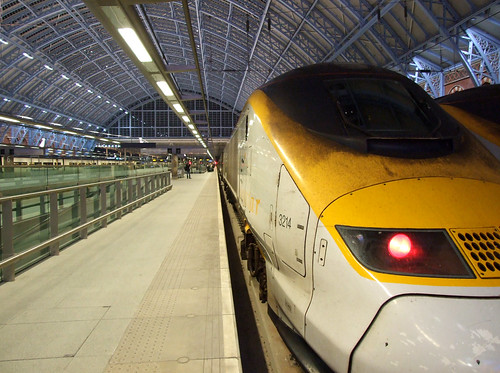
Showing posts with label train travel. Show all posts

Thursday, 3 December 2015

Auf wiedersehen, sleeper trains

A leaked internal document reveals Deutsche Bahn may halt all sleeper train services in Germany at the end of next year.

If you like the idea of rolling across Europe in the relaxed comfort of your bed, it looks like you've got just one year left to do it - in Germany at least.

Deutsche Bahn, the German rail operator, has reportedly signalled that it may end all city night line trains in December 2016. No more overnight trains.

Thursday, 3 September 2015

The coalition of the unwilling

Hungary, Poland, Spain and the UK were willing to invade Iraq in 2003, but they are unwilling to deal with the refugee crisis which that invasion has spawned 12 years later. Germany and France are the countries shouldering the responsibility.

Today I bought a ticket for the overnight train from Berlin to Budapest, to interview people next week for a radio story I'm working on about the disappearance of Europe's cross-border rail routes. As I was making the booking at the DB ticket office, the woman gave me a look of concern. "That train is going from Hungary to Germany," she said. "Be careful."

Despite watching the news reports about what is happening at Budapest Keleti Station the past few days, it did not occur to me until that moment that I am going to be on one of these international trains next week. This international train travel piece could end up being very different from what I had planned.

The images of Middle East refugees trampling each other trying to get onto trains to Western Europe in Budapest broadcast today were truly horrific. I'm still a bit unclear about whether these are regularly scheduled trains or specific migrant trains, and whether or not my Budapest-Berlin train will be affected at all. But it's hard to imagine it won't be.

Wednesday, 26 August 2015

A Hanseatic holiday

I've made it my mission to visit all the principle cities of the Hanseatic League. I started with the most powerful one.

This week I took a little trip to Hamburg and Lübeck. I had planned to do a lot of these trips within Germany when I moved to Berlin, but in fact this is the first one I've done since I moved here on 2 July.

No coincidence then that Hamburg is also the easiest German city to get to from Berlin. The high-speed ICE train travels the 260km in just an hour and a half, making no stops along the way. It doesn't make any stops because there is essentially nowhere to stop between these two cities, the train zips across the wide open flat fields of Northern Germany. High-speed lines are always the easiest to implement in unpopulated areas.

Thursday, 2 July 2015

A long move by train

Long-distance train journeys during record-high temperatures can take a bit longer than expected.

Over the past two months I've been going to and from Berlin by flight, but today, as I finally moved my things to my Berlin apartment, I decided to try out the train route. It will be my preferred way to get back and forth, because it's more comfortable and I can do work on the train.


But perhaps doing so with four suitcases, in the middle of a record-breaking heatwave, wasn't the best strategy.


I left at 10:30 this morning but am still on the train, 10 hours later. We're just pulling in to Spandau station though so it shouldn't be much longer. This journey is supposed to take 6.5 hours, but the intense heat caused lots of delays along the way.

Wednesday, 22 December 2010

Snow Chaos: Should Western Europe prepare for colder winters?

I've been at home in the US for the past five days, and boy am I glad I got out of Europe when I did. I decided to head home for Christmas earlier than normal this year because I had a lot of holidays left to take - normally I head home two or three days before Christmas. On Friday morning I woke up to get ready for my flight to find a winter wonderland outside my window. But though the heavy snow caused a delay in my train to the airport, somehow my flight to New York wasn't delayed at all

But apparently after I left that snow just didn't stop falling. It's kept coming and coming, grounding airports in Europe to a halt from London to Milan. Brussels Airport was set to shut down yesterday after they found they had run out of de-icer fluid, but then apparently they found some more. But Heathrow Airport and Charles de Gaul are still ground to a halt as they grapple with the snow and cold. The busiest airport in Europe has now become "Hotel Heathrow" as stranded travelers have been camping out for the fourth day in a row, sure to miss Christmas with their families. The same scene has been seen at London, Paris and Brussels' international train stations, as high-speed lines have been ground to a halt. I sure feel lucky to have gotten here to spend Christmas with my family, but I can't say the same for my friends stuck in London, Brussels, Frankfurt and Paris.

The travel chaos is prompting many questions in Europe, but perhaps the most important is this - is this a freak act of nature, or an example of egregious poor planning by these Western European airports?

Thursday, 3 September 2009

Ye Olde York

Driving up the A1 motorway yesterday, my friend and I had our eyes glued to the horizon, each of us hoping to be the first one to see the giant steel angel come soaring into the sky from beyond the hill. Considering my friend was driving, we realized this gazing perhaps wasn’t the smartest strategy as he had to slam on the brakes to avoid a rapid traffic slowdown ahead of us. Searching for angels in the sky can be dangerous!

Eventually the massive Angel of the North, which has come to be a symbol of Northern England since it was erected outside Newcastle in 1998, did at last emerge. If I’m honest, I was a bit underwhelmed. Having been told that with its wingspan it’s as wide as the Statue of Liberty is tall, I was expecting something much bigger. I suppose it was big, sure, but not BIG! Perhaps that’s just my American expectations creeping in.

We were approaching Newcastle, the last stop on an eight-city tour of the Northern England, usually referred to in the UK both affectionately and derisively as just “the North.” It’s a strange land of rolling green meadows, windy moors and bulging dunes – a place where the local accent changes every 10 miles and people cling to their locality and roots with a fierce pride rarely seen in the South. It’s also a land of striking contrasts. This was the industrial heart of Victorian England, a place whose abundance of raw materials gave rise to a rapid overdevelopment, turning small villages like Manchester, Liverpool and Middlesbrough into bulging metropolises virtually overnight. That flurry of industrial activity has long since faded away, leaving the relics of a poverty-stricken rust belt concentrated around the Mersey river on the Irish Sea coast and the Tees river on the North Sea coast.

At the same time the North, particularly Yorkshire, played a hugely important part in British history before industrialisation, and in between the urban conurbations lies some of the most beautiful, history-filled countryside in Britain. It was that contrast that I wanted to discover on this road trip.

Proud Manchester

I made the journey with two American friends who I know from New York but who are now fellow ex-pats in London with me. We first took a train up to Manchester, exploring the city Saturday morning before being entertained by the festivities of the annual Manchester Gay Pride in the afternoon. It’s universally acknowledged as Britain’s biggest and best pride celebration, and I have to say that description bore true. The dinky little London pride paled in comparison to this, and the city’s relatively small size meant that the pride celebration almost seemed to take it over. It was also clearly an activity for the whole city, with lots of straight families turning out for the parade and plenty of straight people at the pride celebration on Canal Street. Actually the whole area around Canal Street ws closed off and you had to pay 20 quid to get in! I had never heard of having to pay to get into Pride festivities, but my friend Lori says that's the way it's done in DC.

There were those in the parade who weren’t so happy with the increasingly celebratory/commercialised nature of gay pride, coming as it does now with corporate sponsorships and such. But when you take a step back, tt is pretty amazing how different a gay pride parade is in the UK than in Eastern Europe, for example, where the parades are still largely an expression of protest and are often met with violence (as happened last year in Budapest). I can sympathise with these marchers’ (pictured left) frustrations about the increasing commercialisation of the gay community and the phenomenon of the ‘pink pound’, but perhaps if they considered the alternative it wouldn’t seem so bad.

Beyond the Pride festivities, which were great, I was very impressed with Manchester as a city. Once a rotting industrial corpse just 15 years ago, today the city’s undergone a complete renovation that has made it England’s unrivalled second city. We went down to the old canals, which in the 19th century would have been heaving with ships bringing coals in to the factories, to find them completely fixed up into a beautiful business and entertainment district. The massive intersection of train tracks, roads and canals at Castlefields is actually quite beautiful, a truly stunning site hovering over the ruins of an ancient Roman fort. And though parts of the interior of the city have been turned into massive indoor shopping complexes, they were architecturally interesting and forgivable. The conversion of city centre spaces into massive indoor shopping malls was to be a theme for the rest of the trip.

On the Road

On Sunday we rented a car to begin our slow journey northeast, diverting first over to Liverpool. Although some redevelopment has been undertaken, notably along the waterfront in preparation for the city’s year as a “European Capital of Culture” in 2008, the city is still a marked contrast to Manchester because it has retained much of its post-industrial squalor. Albert Dock has been the main focus of regeneration, and the area is now rife with Beatles kitsch. In addition to seeing a performance by the ‘Cheatles” right on the dock (pictured) you can also take a Beatles tour of the city to see the houses in which the Liverpool lads grew up (we declined, though we did go to the Beatles experience museum). We also visited the Tate Liverpool, which was otherwise unremarkable save for an AWESOME floor where you listened to disco music in headphones while looking at sexually suggestive sculptures, surrounded by countless disco balls, flashing lights, and even a light-up disco floor in the centre. I kind of wanted it to be my apartment.

Aside from the dock, the other main thing to see in the city is the two cathedrals, one Anglican and one Catholic, facing each other on opposite ends of Hope Street. They were both built at a feverish pace during a time of increasing conflict between Anglican Protestants of Liverpool, native English, and the Roman Catholics, descendants of the Irish immigrants who had flooded into the city during the industrial revolution (cousins of the Irish who left at the same time for America during the potato famine). Both the cathedrals are massive, with the two sides desperate to outdo each other. But looking at the two today, it’s clear who won. Though it is the fifth largest cathedral in the world, the Anglican Liverpool Cathedral is pretty bland and uninteresting, clearly trying to mimic older architectural styles even though it was just completed in the 1950’s. The Catholic Metropolitan Cathedral of Christ the King, on the other hand, is a stunning modernist achievement. The outside is rather strange-looking, with locals often deriding it as the “Liverpool funnel”, but I thought the inside was beautiful. It has a theatre-in-the-round style, with stunning lighting leading up the interior of the cone to the roof. I was very impressed. I have to say, the most interesting modernist cathedrals I’ve seen in Europe have all been Roman Catholic – defying that denomination’s reputation for a staid rigidity in embracing new ideas.

We then checked out the inevitable massive indoor shopping centre complex next to the water, completed just a year ago. My friend Josh, who is an architect, was eager to see it. However it was pretty uninspiring, and in some parts heinously ugly.

However if we thought that was bad, we hadn’t seen anything yet. Our next stop was Leeds, which I can report has to be one of the most characterless cities I’ve ever seen in Europe. Like some of its Northern neighbours, Leeds has also undertaken a redevelopment project. However theirs has involved turning the city centre into a giant shopping mall. Almost the whole place has been turned into the massive indoor complexes. We arrived at night around six when the indoor centres were all closed. We found to our frustration that all of the restaurants were actually located inside the malls, so we had a hell of a time finding anywhere to eat. All we could find was street after street of bland high street chain stores, all closed. I suppose if you needed to do a whole lot of shopping in one day, Leeds would be a good place to go. Otherwise, the city seemed like a total waste of time to me. But then again, I don’t like shopping.

I enquired of my friend Josh if any rust belt cities in the US were considering turning their empty city centres into indoor shopping malls. “What city centres?” he responded. It’s true, Americans don’t want to go into a city centre even if it’s to buy things, they prefer their shopping malls to be out in the suburbs where they live. And judging by the results of such a redevelopment in Leeds, I’m not sure I would endorse such a plan for cities in the US. Josh says the problem is that all these redevelopment plans are centred around shopping, and when something like the recession hits it puts the breaks on the whole project. It’s not that the developers can’t get financing any more. Since the only thing they’ve planned for development are shops, the plan is going to hit a hurdle when people stop shopping. From what we saw of Leeds, it appears the recession is having a pretty bad effect on the city. The place was deserted.

Winding, Windy Moors

Nearby the city of York, our next stop, couldn’t have been more of a contrast. A hugely important city from the 11th to the 18th century, it was almost entirely bypassed by the Industrial Revolution and remains remarkably preserved. Even the city walls (pictured) remain standing, as do an original Norman castle and a stunning, massive cathedral. It’s all a bit Disney, but it is truly beautiful.

The Romans founded York about 2,000 years ago, and since then it’s had a sucession of rulers – first the Anglo-Saxons, then the Vikings, then the Normans. Each of the four rulers left their mark on the city (and progressively changed its name along the way – from Eboracum to Eoforwic to Jorvik to York. It was without a doubt the highlight of the trip, and a particular delight for us New Yorkers – an interesting view of the former glory of our city’s namesake.

We also stopped off at Harrogate, a town that was the first thing out of everyone’s mouths when I asked them what they recommended to do in Yorkshire. I have to say I don’t get why everyone was recommending it. It’s cute I guess, but there’s nothing to do there. We stopped and had the requisite tea and scones at Betty’s, and then headed over to the Royal Baths only to find the building had been taken over by a Chinese restaurant! So we headed out. Harrogate- am I missing something?

From York we drove up to Castle Howard, the sprawling estate of one of Yorkshire’s most famous aristocratic families. The grounds are massive – I particularly enjoyed frolicking with the cows next to the ‘Temple of the Four Winds’. The Howard family still lives in the castle, though most of it has now been opened to visitors. As we entered the main staircase we learned about the current owner of the house, the Baron Howard who lives there with his wife and two daughters (he’s in the portrait on the left in the photo below in a rather funny aristocratic outfit). Later on the tour the guide remarked casually as he looked out the window, “ah there he is now.” Sure enough, there was the guy from the portrait out in front of the house playing with his dog. Weird!

Like many aristocratic families, the current owner’s father Baron George Howard opened up the house to the public in the 1960’s, knowing it was the only way to be able to maintain ownership of it. For the most part, those aristocratic families who didn’t open up their massive estates for public viewing back in the 50’s and 60’s later found that it was too late to do so and had to sell them to the state. Interesting foresight on George Howard’s part. He came back from fighting in WW2 to find his estate burned down and his two surviving brothers dead. He decided to open up the house to the public and to this day the family still lives there. I guess the lack of privacy for the Howard family is a small price to pay to live in such an amazing home.

Next we drove through the North York moors, which were stunningly beautiful. I still don’t quite understand what a moor is, I just know that the Kate Bush song ‘Wuthering Heights’ refers to them as being wild and windy. I’ve never read the book but I’m thinking maybe I should. At least now I can picture the landscape in which it takes place. Or maybe I’ll rent the movie. The film Brideshead Revisted was shot at Castle Howard, so many I can watch the two of them some time as some kind of Yorkshire double bill.

We got the full moors experience at a little village called Hutton-le-Hole, where we stopped and had yet more tea and scones. The place was literally crawling with sheep, not fenced in or anything. One came up behind me while we were taking our tea and let out a deafening “BAAAAA!” right in my ear. It nearly scared the guts out of me.

We also stopped at Rievaulx Abbey in the moors as well, which was pretty amazing. It was established in the 12th century by a group of Cistercian monks from France, shortly after the Norman conquest. The ruins are in surprisingly good shape, and you’re really able to get a feel for the layout of the monastery as you walk around. The abbey was destroyed during the reformation by Henry VIII after he split from the Roman Catholic church and confiscated the property from most of the monasteries. This seemed to have a traumatic effect on the North akin to the “harrying of the North” by the Normans judging by the way it is described by the guides at the churches and monasteries up there. They all seemed ready to spit at the ground every time they mentioned Henry VIII’s name.

Northumbrian by Nature

As we headed further North, the local accents became more and more difficult to understand. We had already been struggling to understand Manc, Scouse, and Tyke accents, and we were hardly prepared for the Teesside, Pitmatic and Geordie accents waiting for us in the Northeast. Luckily I recently discovered this handy guide to the 37 different English accents in the UK) The Teesside accent we encountered in Darlington was particularly difficult to understand. The whole Tees Valley was kind of a nasty place, a blighted post-Industrial conurbation.

We spent the next night in Durham, another old city first set up by the Normans, with a remarkable Norman Castle and Cathedral. The Castle is in surprisingly good shape, but it is completely owned by the university at Durham and options to see it are fairly limited. As a town Durham was kind of underwhelming, it’s a university town and the fall term hasn’t yet started. Durham is considered the third best British university with a collegiate system (after Oxford and Cambridge), often derided as a fallback choice for people who didn’t get in to the first two (what we call “safety schools” in the US). I have to say if you were planning to go to Oxford or Cambridge and ended up at Durham instead, it would probably be a bit of a disappointment. The town is alright, but it just doesn’t compare to Oxford or Cambridge (and is obviously a lot further to London!).

We spent the first half of our last day looking at the ruins of Hadrian’s Wall, the defensive ramparts that marked the Northern boundary of the Roman Empire. The wall basically runs straight west from Newcastle to Carlisle, in the neck section of Great Britain that gets quite narrow before it becomes Scotland. We explored the ruins of a Roman Fort at Chesters, one of the border crossing points on the wall that would have served as a sort of immigration check and customs house of Celtic travellers wishing to enter and leave the Empire. Looking at the wall I thought a bit of the US-Mexico border, trying to imagine this line as the dividing point between wilderness and the greatest empire the world had ever seen to that point. The comparison probably isn’t too apt though because Mexico isn’t exactly barbarian wilderness, and even the areas to the South of the wall were still dangerous, wild places during Roman times. In fact the better comparison looking at the fort would probably have been to a small US base in Afghanistan, an outpost in the middle of a dangerous wilderness where the empire tried to recreate the comforts of home for the Roman troops. The bathhouse of the fort, located just to the side and by the river, is remarkably well-preserved. One can only imagine what the native Celtic population thought of these strange Romans and their bathing rituals. Perhaps it’s the same as what Afghanis think of the supermarkets and movie theatres set up on American bases. From my brother’s description of his time at Bagram Air Force Base, this is what it sounds like anyway.

The last stop was Newcastle, where we encountered the slightly underwhelming Angel offering us a greeting. Newcastle was pretty grimey, but they have made clear efforts to fix up the riverfront section along the Tyne. They’ve built this massive concert hall on the Gateshead side of the river that looks like some kind of giant glass worm. Neither me my architect friend cared for it.

The thing in Newcastle that will stick in my head the most though is the bizarre situation of the Norman Castle, which gave the town its name when it was built as a “new castle” by William the Conquerer’s son shortly after the Norman conquest (an event featured in the Bayeux Tapestry). However all that is left of the castle today is the central keep, and it is now surrounded by a dizzying intersection of Victorian-era railway bridges, under which it is almost lost (pictured below). It would be a bit as if the only thing left of the Tower of London complex was the central keep (the tower itself), and the City of London completely surrounded it with motorways and rail tracks. Not exactly picturesque! Still, it was interesting to go inside, and to learn about all of the various strange uses the Geordies have put it to through the centuries (it at various points held a barber shop, brothel, mansion home, cess pit and trash heap).

We then took the three-hour train ride back, which I mostly spent grumbling about the lack of high-speed railways in Britain. People often fly from Newcastle to London actually, as absurd as that may seem.

All in all it was a great trip, and I was able to experience a part of the UK I had very little knowledge of before. Living in London it often feels like you’re not really in England, and you can often feel like you’re in a little bubble separated from the rest of the country. So it’s good to get out into real Britain every once in awhile and see the sights.

View Larger Map

Thursday, 7 May 2009

The Greenest Way to Travel

I’m on the Eurostar at the moment heading back from a few days working in Brussels, so I thought it would be appropriate to write about this news item I just saw come across my RSS feed. While airlines still struggle to find any way to reduce their carbon emissions, it seems Eurostar is achieving reductions at a remarkable rate. Last week it announced it has achieved its target of a 35% per passenger reduction in emissions (from a 2007 baseline) two years early, and has now lowered its 2012 target for emissions reductions.

The train company, which carries passengers under the English Channel between London, Paris and Brussels, credited increased passenger numbers, a switch to nuclear energy supply for the Channel Tunnel and a series of on-train energy efficiency measures with the early success of its Tread Lightly initiative.

The results were released in a new sustainability report which also featured the results of a survey of over 1,500 travellers in the UK, France and Belgium showing that demand for high-speed rail continues to rise sharply. More than 40% of respondents said they regard the environment as a priority when making travel decisions.

A journey on the Eurostar train generates just one-tenth of the carbon dioxide emissions of an equivalent flight, with a return journey between London and Paris generates 6.6kg of CO2 per passenger compared with 102.8kg per passenger by air. In fact Eurostar estimates that since the advent of the Chunnel Eurostar travellers have emitted an estimated 40,000 tonnes of carbon less than they would have if they had gone by plane.

Of course none of this takes into account the enormous convenience of taking a train rather than a plane. When I take the Eurostar I breeze into the station a cool 15 minutes before my train departs, and since I can leave and arrive in city centres there’s no time loss getting out to distant airports. Add to that avoiding the hassle of checking luggage and the low occurrence of delays, and I think it’s clear why I always prefer to take a train even if it will end up being longer than the air journey.

How do you say ‘high-speed’ in English?

Despite these enormous advantages, the fact remains that once I cruise into London at super velocity, that is where my high-speed journey ends. The UK has no true high-speed rail lines apart from the one coming from the continent, and even those high-speed compatible tracks south of London were just completed in 2006 (before then the Eurostar trains could only go at true high speed once they crossed into France). If I needed to continue on from London to cities as close as Manchester or Edinburgh the most efficient thing to do might be to take a plane. The fact that people are flying from Manchester to London is pretty absurd, but with the British rail system in a dilapidated and neglected state, there really isn’t any good alternative.

Even so, the trains across the pond in North America make the British trains look like marvels of modern technology. The rail network in the US has been largely abandoned, left to rot over decades as the government made a conscious decision to subsidize gas prices rather than invest in public transportation. There isn’t any proper high-speed rail line in the US - Acela in the northeast certainly doesn’t count, slower than a car at 60mph because of track limitations, costing about twice the price of a normal train just to save about 20 minutes.

Last month President Obama unveiled a plan for developing high-speed rail lines in ten travel corridors in the US as part of the stimulus package, a plan that would both create jobs and update the nation’s crumbling rail network. Republicans mocked the inclusion of high-speed rail plans in the stimulus, deriding it as a waste of taxpayer money. I don’t know how to explain that logic, but I do know that the reality is it will be many, many years before any of these project are ready and functioning. In fact it’s been estimated that it would take 20 years for the US to get to where continental Europe is today in the area of high speed rail. It would take less time in the UK, but it would still be a long wait. In fact just about anywhere where the population speaks English, trains are creaking along quite inefficiently. Yet whether it’s on a TGV, ICE, AVE or Thalys, You can go from Holland to Germany to France to Spain all at ground speeds of up to 200mph/321kph.

The fact is that air travel is a necessity in a globalized world, and it can’t be limited without a viable alternative. Such an alternative may not exist for long-haul flights, but one certainly does for short-haul flights, particularly for those in densely populated areas like Western Europe or the Northeast US. High speed rail may be expensive (around $20 million per mile), but as the Eurostar and other lines has shown, the project can easily make the money back, and saving thousands of tons in carbon emissions in the process.

Wednesday, 9 April 2008

Finally, the chunnel turns a profit

Here’s an interesting item from Euronews today. It seems that at long last the chunnel has turned a profit! Eurotunnel, the operator of the underwater train tunnel linking Britain to continental Europe, has made a profit for the first time since it opened in 1994.

Back then the cost of building the tunnel ran so over budget that the company has been paying off the massive debt ever since. And of course they were not helped by the fact that at the same time there was an explosion of budget airlines taking people from London to the continent for next to nothing. Ridership didn’t meet expectations, and over the past few years it looked like the company was headed for bankruptcy. It lost €204 million in 2006 and €2.8 billion in 2005.

It was a daunting task to turn it around but somehow they seem to have done it. Chief executive Jacques Gounon has managed to strictly cut operating costs and complete a financial restructuring that has lowered the company’s level of debt and therefore its interest payments.

Tuesday, 5 February 2008

Brussels: first impressions

This weekend my friend Lori and I took a pleasant little mini-trip to Belgium. It was, believe it or not, my first visit to Brussels. Beyond being a little getaway, it was also a chance for me to check out the city and see if I could imagine myself living there.

If you're a regular reader of this blog you of course know that I have a keen interest in European politics, particularly those of the European Union. And given that I'm a journalist, I would very much like to translate this interest into a career. At the moment here in London I'm actually covering real estate investment in Asia, which is about as far away from European politics as you can get. But I'm currently in the process of getting Italian citizenship (through my grandparents), which would give me an EU passport and enable me to work anywhere in the EU. When and if that comes through, it will be time to evaluate my career options. Given that I have a big interest in the EU and am knowledgeable about the subject given my educational background, covering it seems a natural choice.

Of course such a transition would require a move to Brussels. So I figured it would be a good idea to check the city out to see if I could do it. We even got a hotel in the European Quarter to get the full experience.

Tuesday, 1 May 2007

Paris

I went to Paris this weekend with Josh and Lori, who are both also recent transplants to London from New York City. As you can imagine it was a weekend of esoteric New York references. We took the train there which was really nice, I loved not having to fly. I was a bit annoyed that we had to go through this extensive passport and immigration check on both ends though, because you don’t have to do that on most inter-country train routes elsewhere in the EU.

It was a great time to be in France because they are gearing up for round two of their presidential election, which I’ve been writing about in this blog. The atmosphere is quite heated and everyone is abuzz about it. France had an 86 percent turnout for the first round of elections, so really everyone you meet has some kind of opinion on it. The contest for the second round is for Socialist candidate Segolene Royal, who would be the first female president of France, and conservative Nicholas Sarkozy, who was the interior minister under conservative president Jacques Chirac, who is now retiring.

There were posters and flyers everywhere, and tons of people running around handing out campaign literature (all for Segolene, Paris is solidly Socialist). Actually the whole time we were there I only saw one poster for Sarkozy, and someone had drawn a little Hitler mustache on him. The rest were all for Royal. Actually it was funny, the two friends I was with didn’t know anything about the French election, and Lori thought the posters were ads for some kind of beauty product. “Easy breezy beautiful cover girl!” Because, as you can see in the photo, Segolene is hot!

I used every opportunity to chat up people we met about the election. It seemed most people, especially people we met at gay bars, were Segolene supporters. But we did make a new friend Mattieu, who took us to this spot under a bridge on the Seine where all these university students hang out to drink beer. Here’s a photo (ah the joys of having a camera phone). Mattieu is a Sarkozy supporter, and the reasons he gave for this support I thought sounded totally rational and reflect my own opinions on the race. If France is looking for change, Sarkozy inspires a lot more confidence that he is the candidate who can bring that change, whereas Segolene seems more like the status quo. Ironic when you consider that Sarkozy was actually a part of the conservative government that has done basically nothing for the past five years. In fact the last five years of conservative rule have seen nothing but social tension and economic struggles. But Sarkozy has billed himself as an “outsider,” and for the most part the characterization has worked. And considering he seems to not be a big fan of Chirac and was actually working behind the scenes to overthrow him while he was interior minister, this may not be an audacious claim to make. But in the debate coming up in a few days, Segolene really needs to emphasize that Sarkozy is part of the ruling party of the last five years and shoot down this "outsider" label.

In general I was very impressed with how excited and engaged everyone was with the election. In the US what I mostly hear in the runup to an election is how sick everyone is of it, as if they’re angry that this democratic exercise would take time away from their nightly Friends reruns. Coming from a country which struggles to get a 40 percent turnout for elections, I was certainly impressed with French civic participation.

Actually, funny story. Me and Lori were sitting outside of a bar in The Marais, and this group of college-age boys came down the street getting people's attention and giving them pieces of paper. “Ugh,” Lori exclaimed, “here come the twinks with their flyers!” I confess I thought the same thing, as they resembled the army of pre-pubescent looking boys who accost people with flyers on Old Compton Street in London.

But then the boys started shouting “Segolene! Segolene!” and gave Lori a flyer. “What is this Segolene place?” Lori demanded. I burst out laughing when I saw the flyer, a promotional brochure outlining Segolene’s policies and platform. Of course the cynical New Yorkers assume a group of young gay boys are doing something stupid and frivolous. In fact they were young campaign volunteers working for change. For the rest of the weekend every time we saw campaign flyers we would say, “damn twinks with their flyers” and share a good laugh at ourselves.

This trip to Paris was much better than my last one, which was in the winter with awful weather. I went for a week by myself on my way back to New York after living in Prague, and I was depressed because I didn’t want to be leaving, so I spent the whole time moping. This time was much more fun, and the weather was great.

Some observations about Paris. The Paris metro is 1,000 times better than the London tube, although still not as good as New York’s I don’t think. It’s just below the surface like New York’s so getting down to the tracks is easier, and switching trains is a breeze. They also have the RSS trains which run on the same metro system, which are big trains that make only a few stops in the city so they’re sort of like express trains.

We all speak French but out of the three of us Lori’s was the best. She also hasn’t taken French since high school and I was surprised by how good hers was, and it made me realize that mine is really bad! I think also when you’re with a person who’s a better French speaker than you, you tend to kind of tune out and let them handle all the talking, because I was much better with the French last time I was there.

I’m making the final preparations for my big Germany-Denmark-Sweden trip in 2 weeks. It will be about half working and half pleasure, so in total it should be pretty exhausting. But the nice thing is since I’m working I can actually stay in hotels rather than hostels. I made some sort of public map on google, I’m not sure how it works but here’s a link to it. I’m not exactly sure why you would want to share maps, but I guess this is an instance where you might want to do it.