Showing posts with label Iraq. Show all posts

Wednesday, 6 July 2016

A myopic focus on Tony Blair

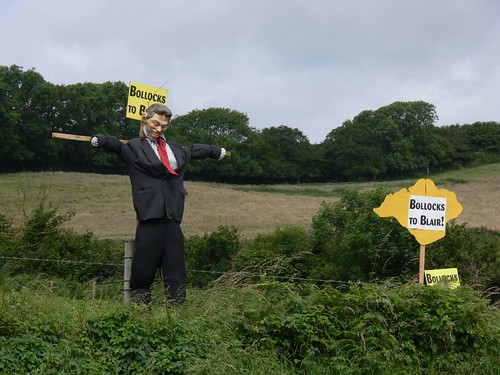
Judging by the public discourse, you might think Tony Blair was a dictator who railroaded the UK into war in 2003. But he was just one part of a foreign policy orientation incapable of saying no to the United States.

Today the long-awaited results of the Chilcot Enquiry into the UK's involvement in the 2003 Iraq War, the consequences of which the world is still living with, were finally published. 

Like the 9/11 Commission's report in the United States in 2004, it contains little in the way of bombshell revelations. Instead it paints an overall damning picture of the leadership of Tony Blair, the centre-left politician who was prime minister at the time. It gives ammunition to those who want to see Blair prosecuted. Perhaps the most memorable line of the report's executive summary is this:
"I will be with you, whatever."
These words were in a 2002 private memo between Blair and US President George W Bush. The line seems to vindicate a long-held perception in the UK that Blair was Bush's poodle. Indeed, the memo suggests that even a year before the war's launch, Blair had decided to go along with whatever the American president proposed.

The entirety of the media coverage of the report today has centred on Blair. But as I've written before, I find the UK's myopic focus on Blair in the aftermath of the Iraq disaster to be counter-productive. 

Why personalise it so? Was it really Blair who was Bush's poodle? Or was it the UK that was America's poodle?

Thursday, 3 September 2015

The coalition of the unwilling

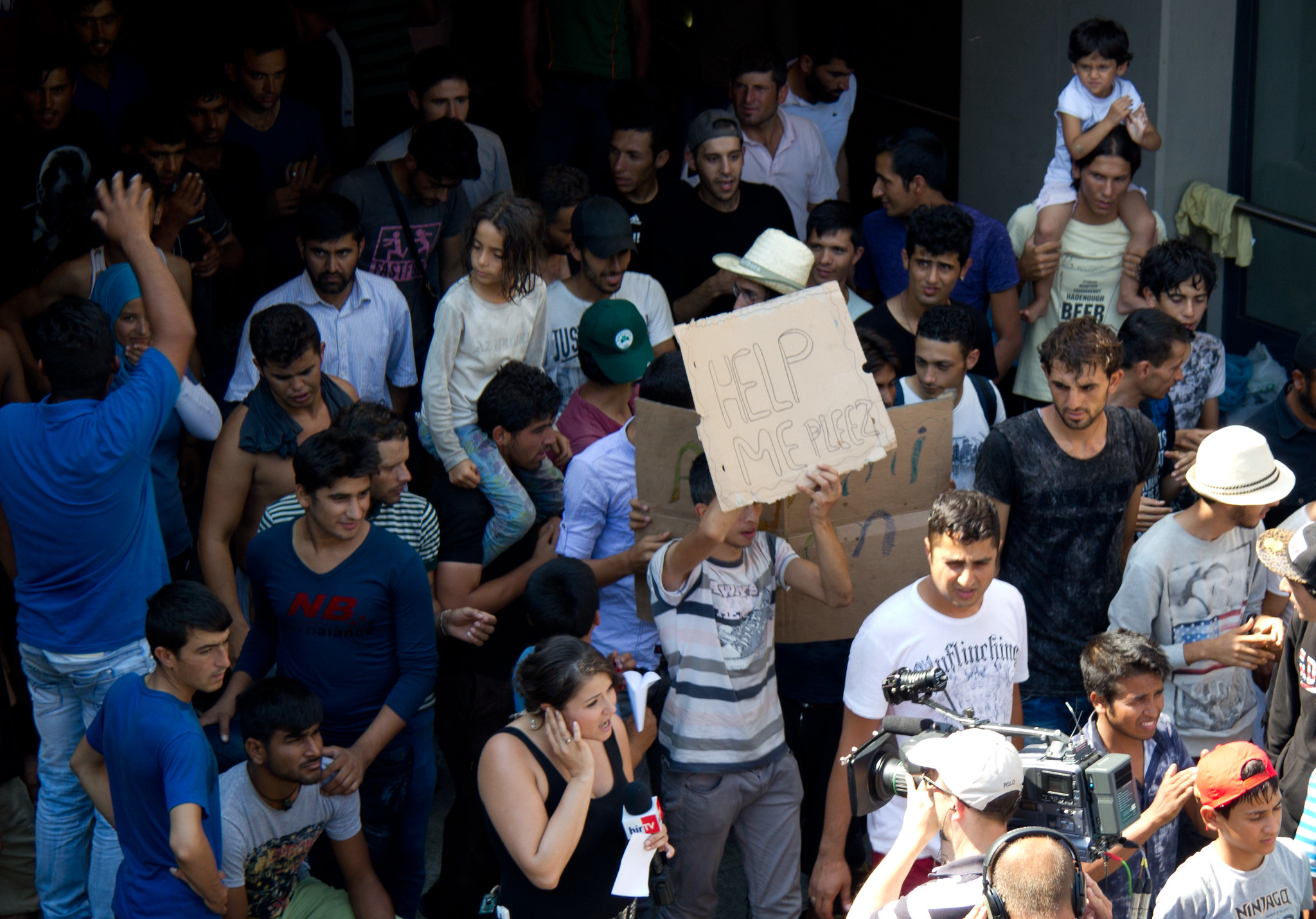
Hungary, Poland, Spain and the UK were willing to invade Iraq in 2003, but they are unwilling to deal with the refugee crisis which that invasion has spawned 12 years later. Germany and France are the countries shouldering the responsibility.

Today I bought a ticket for the overnight train from Berlin to Budapest, to interview people next week for a radio story I'm working on about the disappearance of Europe's cross-border rail routes. As I was making the booking at the DB ticket office, the woman gave me a look of concern. "That train is going from Hungary to Germany," she said. "Be careful."

Despite watching the news reports about what is happening at Budapest Keleti Station the past few days, it did not occur to me until that moment that I am going to be on one of these international trains next week. This international train travel piece could end up being very different from what I had planned.

The images of Middle East refugees trampling each other trying to get onto trains to Western Europe in Budapest broadcast today were truly horrific. I'm still a bit unclear about whether these are regularly scheduled trains or specific migrant trains, and whether or not my Budapest-Berlin train will be affected at all. But it's hard to imagine it won't be.

Friday, 6 May 2011

Europe uncomfortable with US Bin Laden celebrations

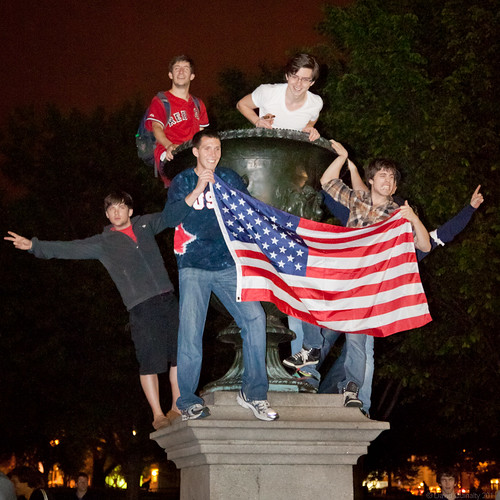
I've had a rather surreal experience this week watching reaction to the news that Osama Bin Laden was killed by American forces. On Monday morning I woke up and opened Facebook (before anything else, naturally), and saw a string of cryptic statuses chanting things like "USA! USA!" or "I'm so proud to be American today". But for whatever reason none of them said what had actually happened. So I had to open up Google News to learn what had inspired these rather unlikely chants from my "liberal elitist" friends in New York City.

The news was, of course, that Osama Bin Laden had been killed. The announcement by President Obama Sunday night prompted sudden exuberant celebrations in cities across America, the biggest outside the White House and in Times Square. It was reminiscent of the Victory Day celebrations at the end of World War II, a cathartic celebration unleashing a decade of angst Americans had felt since the 9/11 attacks. I found the magnitude of the celebrations a little surprising, but perhaps I had underestimated the effect that America's inability to capture Osama Bin Laden has had on the US psyche. A profound sense of anxiety and humiliation seems to have been lifted from Americans' minds with this killing. And both the left and right are jubilant over it. The American media seems to have regarded these celebrations as a universal good, heralding the way they have brought left and right together and united Americans in the same way that they were united after 9/11. The question does not seem to be asked whether Americans can be 'unified' in a counter-productive instinct.

Tuesday, 22 March 2011

Europe leads on Libya, but divisions persist

We are only in day four of the Libya War, but it doesn't seem to have taken long for confusion to settle in over where we go next and who is in charge. As the aerial bombardment tapers off and the skies clear into a no-fly zone over the Libyan desert, questions are now being asked that are not only causing disunity within the European Union but also between Europe and the United States.

"In most of the foreign policy issues we've talked about for decades, the US has been the lead player," conservative New York Times columnist David Brooks noted on PBS Newshour a few days ago. "Here we're clearly not the lead player, it's the UK and France and we're following along on the caboose. Now we feel like the UK often feels, as the secondary player. So the question is how much is the president really supporting this and how much is he being dragged along?"

So far the Obama administration has seemed disinterested in the Libya situation, and this wasn't helped by the fact that at the time military action was launched the US president was on a trip to South America and had to give comments on the war's launch from a shared podium in Brazil. Over the past few days US politicians haven't even made an effort to try to convince the American public that this war is in America's strategic interest.

Wednesday, 3 November 2010

Could a Franco-British military be the start of an EU army?

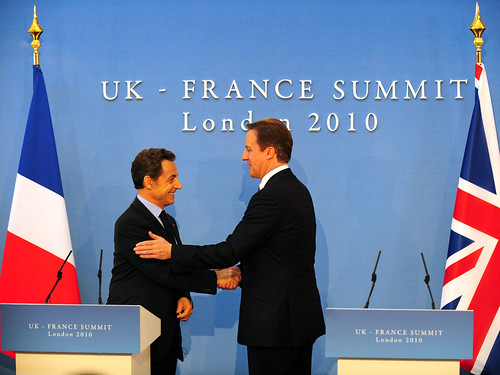
Today’s agreement for military cooperation between the UK and France may or may not be as “historic” as the media is claiming today – but it all seems to depend on which side of the channel you’re on. In the UK, political leaders have been keen to stress the “pragmatic” nature of the relationship between the two countries who are both pursuing austerity measures and looking for cuts wherever they can. The suggestion from Prime Minister David Cameron almost seems to be that this is a temporary arrangement. Meanwhile Nicolas Sarkozy and other French leaders are telling their newspapers that this is a “moment of history” and the start of a “long-term relationship” that essentially commits the two to work together for 50 years.

So who’s right? The answer is that it will be very dependent on what type of relationship the UK and France have over the next 50 years. After all, military agreements like this have been signed between the two countries before which came to nothing. Most famously, a more general agreement was made between Tony Blair and Jacques Chirac before their dramatic falling out over the Iraq War put an end to all that. So who’s to say that this agreement won’t also be scrapped as soon as the two countries differ again on foreign policy?

Thursday, 28 January 2010

Tony Blair the scapegoat

The UK has been in frenetic anticipation this week of Tony Blair’s testimony Friday in front of the Iraq War show trial, er I mean, inquiry. The British media has been baying for a dramatic crescendo to the three week grilling of former cabinet officials who were involved in the decision to join the war. So far it's failed to deliver the “smoking gun” of conspiracy they’ve wanted. My inbox this week has been flooded with emails from activists and NGOs demanding this or that question be asked of Blair. Anticipation is so high that Channel 4 News actually spent 15 minutes last night doing a staged enactment of how the proceeding might go on Friday.

But despite the high theatre, the inquiry has failed to reveal anything too interesting. Given that the panel has focused so relentlessly on the accomplice rather than the perpetrator of the Iraq War, one could have expected similar results from an inquest of Austrian officials after World War II to “unearth the truth” about the invasion of Poland.

Wednesday, 28 May 2008

Eight months of uncertainty

With the amount of worldwide press coverage that the US election has been getting, it’s easy to forget that there are still eight months left in George W. Bush’s presidency. Amid all of the excitement over Clinton, Obama and McCain, the unpleasant reality is that over the next 2/3 of a year the world is going to be living with the most handicapped lame duck US presidency in living memory. It’s something that the global community, and Europe in particular, should be feeling more than a little anxious about.

Lame duck’ periods are of course a repeating phenomenon in the United States, happening every time a president approaches the end of their term (if they are not running for reelection). During this period media attention shifts away from the current president and the administration is unable to propose any new initiatives. Diplomats are able to speak with less authority because they may be replaced in a matter of months, and the White House may not bother filling vacancies and instead wait for the new administration to make appointments. Because people know that everything is about to change in a matter of months, very little gets done during this period. It’s an impractical system, but it’s something that the US has come to live with.

However this year is different. Normally these periods last a few months, not the year and a half that has happened this cycle. And the widespread scorn for this outgoing administration is at unprecedented levels. Never in the past century has the US seen a presidency so delegitimized with so many months left in it. Bush’s disapproval rating, at 70 percent, is now higher than for any president in US history. It is even higher than Richard Nixon’s post-Watergate numbers immediately before his resignation (66 percent).

Tuesday, 12 February 2008

France to Europe: grow up

French president Nicolas Sarkozy may be considering returning French forces to NATO military command, but comments yesterday by the French defence minister reveal that the country might want something in return: the go-ahead from the Americans to build an EU army.

France has for years floated the idea to build up an EU army with a military headquarters, but it has met resistance from both Washington and its European allies. Washington has regarded the efforts as a threat to NATO unity and as an unnecessary duplication of NATO’s functions. At the same time, European nations have refused to increase their defence budgets in order to develop a European standing army.

French president Charles De Gaulle pulled the French military out of NATO (the North Atlantic Treaty Organisation) 40 years ago over concern about American domination of the alliance. The system, set up primarily for the defense of Europe from the Soviet Union after World War II, has historically been considered by many as an American military protectorate over Europe. In April a conference in Bucharest, Romania is scheduled to work out a major overhaul of the alliance, largely in reaction to its difficulties in Afghanistan but also to deal with its proposed enlargement to Eastern European and Caucasus nations bordering Russia. The conference could also bring a commitment by Sarkozy to hand French troops back over to the alliance.

Tuesday, 18 December 2007

Turkish troops enter Iraq

The AP is reporting that about 300 Turkish troops have crossed into northern Iraq. Ankara hasn’t confirmed the reports but Kurdish officials are saying that Turkish troops entered Iraq overnight and moved up to three kilometres (1.9 miles) inside

The operation follows air raids over the weekend in which Turkish warplanes bombed suspect Kurdish Workers Party (PKK) bases in northern Iraq over the weekend. Iraqi officials say the bombs hit 10 villages.

Today’s development is the first deployment of Turkish troops inside Iraq since Turkey’s parliament voted to allow the military to conduct operations into Iraq to fight the PKK. Ankara has since then assembled up to 100,000 troops near the Iraq border.

Thursday, 8 November 2007

Sarko fever: catch it!

Sacre Bleu! I can’t get over these headlines today from the US about Sarkozy’s visit. “We love America, Sarkozy tells Congress” screams ABC. “Bush, Sarkozy stand on common ground” says the LA Times. “Sarkozy -- a Frenchman conservatives can love,” declares the Baltimore Sun. “French President Says America Can Count on France,” contorts Voice of America.

Head to the other side of the Atlantic and the coverage is very different. The BBC focuses on the disaster Sarkozy heads back to today with the headline “France divided as Sarkozy woos US”. Reuters highlights the distaste Sarkozy’s reception in the US will leave with most French people saying “Sarkozy returns from US to skepticism” And the Belfast Telegraph notes that “Sarkozy's warm words mask deep divisions with US.”

Were they watching the same speech?

Thursday, 1 November 2007

Why are we bound by borders?

A Turkish friend of mine just sent me this map which I find extremely interesting. He was pointing to the AFJ-designed hypothetical creation as an example of “US arrogance,” but I think it makes for an interesting study as the crisis with the PKK pushes Turkey further and further toward an invasion of Iraq.

The map is a redrawing of the national borders of the Middle East based on ethnic and religious lines. It accompanied this 2006 article in the Armed Forces Journal about what a fair Middle East would look like. Apparently the map has been circulating around Turkey without the accompanying article (I had to do some super sleuthing to even find the article) and is being presented as actual plans of the US military to redraw the Middle East. This assumption, of course, is not only wrong but idiotic, considering that much of this redrawing would be not in American interest and the US is actively resisting such a redrawing by clumsily trying to hold together the nonsensical, European-drawn borders of Iraq. A group in Turkey even announced a competition to redraw the US map in retaliation. Check them out here, they’re absolutely absurd. Isn’t the fact that no Turk was able to draw new borders for the US that make any sense evidence against their own point? The US is a culturally and linguistically homogenous nation, and the ethnic and religious divisions that exist are spread out. None of these entries even takes into account the political differences that might actually be astute (like the infamous “Jesusland and United States of Canada” map that came out after the 2004 election).

Monday, 18 December 2006

Lessons not learned

One of the most commonly heard defenses heard from people who voted for the Iraq war resolution is that they with the “widely-held” belief at the time suggesting that Saddam Hussein possessed weapons of mass destruction and had links to Al Qaeda, and with the American media swallowing this excuse unquestioningly, I think it’s time for a reality check.

Despite David Kay's insistence that we were “all wrong” in Iraq, the evidence says otherwise. Many of the assertions that Bush and Blair made in the run-up to the war were highly dubious and viewed with a high degree of skepticism around the world, particularly in Britain. In the UK the media reported on these doubts in the run-up to the war. This is partly why the war was and has remained so unpopular there, prompting the largest public demonstration in London’s history right before the invasion.

Thursday, 30 November 2006

London Bridge wanna go down

Ouch. Some devastating comments by a state department official Tuesday night regarding the Atlantic Alliance and the UK's traditional role as a bridge between America and Europe. Namely, that it has been irreparably harmed by the Iraq War, and will probably never recover.

Kendall Myers, a senior State Department analyst, told an academic forum that for all Britain’s attempts to influence US policy in recent years, “we typically ignore them and take no notice."

The comments left government officials on both sides of the Atlantic scrambling. Denis MacShane, Labour MP for Rotherham and a former Foreign Office minister, who supported the Iraq war, said: “After the Republican defeat in the midterm election, every little rat who feasted during the Bush years is now leaving the ship. I would respect this gentleman, who I have never heard of, if he had had the guts to make any of these points two or five years ago.”

Sunday, 26 November 2006

"Arrogant self-delusion"

Wow. Did anyone else see Jordan's King Abdullah on This Week this morning? His observation that the middle east could see three simultaneous civil wars in 2007 was really scary. He painted a scenario in which the Palestinians, Iraq and Lebanon all descend into civil war and chaos. This would be an earth-shattering catastrophe that could easily spread even further to neighboring countries.

And as long as we're talking about all things shocking GOP Senator Chuck Hagel's editorial in today's Washington Post literally made my jaw drop to the floor. It was probably the most sobering, brutal and realistic assessment of what has happened and what needs to happen in Iraq to ever come from a Republican. And it's dead on.

Wednesday, 19 July 2006

Turkey invading Iraq?

As if things in the Middle East weren't bad enough, today it was revealed that Turkey may take a page from the Israeli playbook and invade Northern Iraq, one of the disaster scenarios that was posited before the war began.

The North of Iraq, which is predominantly Kurdish and controlled as an autonomous zone, has been the most stable and nonviolent part of the country since the occupation. This has mainly been because Kurds are sitting back and watching Sunni and Shia Arabs kill each other, hoping that if they wait it out eventually the country will break apart and an independent Kurdestan will be formed.

It would not be in their interest right now to attack American or Iraqi troops (neither of which can be found in great number in the North anyway). But it is in their interest to antagonize Turkey, because many Kurds hope that an independent Kurdestan will also include the Kurdish areas of Turkey and Iran.

Tuesday, 21 March 2006

Dueling Speeches Across the Atlantic

Some interesting language used in today’s simultaneous speeches/press conferences by George W. and Tony Blair.

The US Media seems to have picked up mainly on the answer W gave to a reporter about how long troops will be in Iraq, saying, “"That, of course, is an objective. And that will be decided by future presidents and future governments of Iraq." This of course, led to today’s headlines of, “Bush: Troops to stay in Iraq through '08” in the US media. I’m pretty sure this headline will shock a lot of people across the country.

Bush’s statement, of course, is a fairly obvious conclusion. There’s no reason to presume troops will have left by 2008. In fact it’s hard to see how the US could possibly withdraw before then without leaving the country in ruin and chaos.