Showing posts with label NATO. Show all posts

Thursday, 19 July 2018

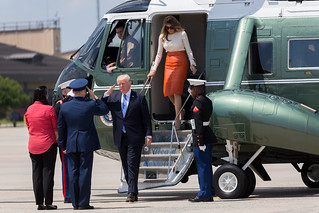
An Americaless NATO: should they be pushed before they jump?

Donald Trump threatened to pull the United States out of NATO at last week's summit in Brussels. Perhaps European leaders should call his bluff. A European Treaty Organisation may be the only logical way forward.


As Donald Trump stood beside Vladimir Putin on Monday and stated that he believes the Russian president over his own intelligence agencies, you could feel a collective shudder pass across Europe.

"If Trump isn't even willing to side with his own intelligence agencies over Russia right now, why would anyone think he would side with us?” one Latvian friend sent me in a text. “NATO is finished. And if NATO is finished, Latvia is finished."

There has been much speculation since Monday over why Trump would defy his own intelligence, his own party and even his own advisors in refusing to acknowledge that Russia interfered in the 2016 US election. But whatever the reason, Trump’s summit with Putin, immediately following his aggressive attacks on NATO during his visit to Brussels, have left many Europeans with only one conclusion: we’re on our own now.

Wednesday, 27 December 2017

Saturday, 27 May 2017

Who is Germany’s anti-Trump?

The US President heaped further scorn upon Germans during last week’s NATO summit. In a German election year, he will become the perfect foil.

Even before last week’s NATO and G7 summits in Europe, Angela Merkel knew that Donald Trump would not have kind words for the Germans.


Having already suffered the indignity of having him refuse to shake her hand during her state visit to Washington - possibly as revenge for her frosty response to his election - Merkel could have expected that Trump’s obsession with the German trade surplus and lack of military spending would again bring hostility during their second meeting. It did.

Friday, 26 May 2017

Hurricane Trump comes to Brussels

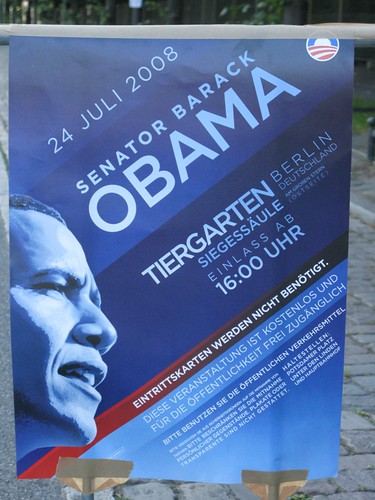
While the current US president bullied and berated in Brussels, Obama awed and inspired in Berlin. Which man truly represents the American people?

Perhaps no image of Donald Trump's visit to Brussels will be more enduring than the now-notorious video of him pushing the prime minister of Montenegro out of the way so that he could get to the front of a shot of NATO leaders.

As an US citizen, I felt a deep sense of shame watching the incident. There was something painfully American about it. The worst part was his expression after the shove - the brash sense of entitlement, the obscene strutting. In just a few seconds Trump had confirmed the stereotypes that so many Europeans have about Americans. And it was consistent with his behavior during the entire Brussels visit - bullying, gloating, preening.

Friday, 7 April 2017

Europe's misplaced relief after Trump's Syria strikes

Does Trump's military strike in Syria signal that the American military protectorate over Europe is back? 

Last night at a mixer of policy wonks here in Berlin, I could feel the relief in the air.

The details were still emerging, but we knew at that point that President Trump was launching airstrikes against Bassar Al Assad's forces in Syria in retaliation for a brutal chemical weapons attack against his own people.

"It took some time but he's finally becoming serious," one Berliner told me. "He can say all he wants on the campaign trail but now that he's president he has to live up to American responsibilities."

Thursday, 9 February 2017

Europe's 2017 elections are turning into referendums on Trump

Feelings of nationalism are running strong in France, but anti-Americanism may be stronger.

Three years ago, when a former investment banker named Emmanuel Macron was appointed as interior minister in the French government, nobody had ever heard of him. 

Today, he has come out of nowhere to second place in the French presidential election. It looks increasingly likely that he will be in a head-to-head with French far-right leader Marine Le Pen in May's second round of voting. More than anything else, there is one element that explains his meteoric rise: he is presenting himself as the anti-Trump.

His candidacy comes at a time when many in France, and indeed the entire European continent, are terrified that the French presidency will be snatched by Le Pen's far-right National Front - a party with anti-Semitic routes from the ashes of the Second World War. Were Le Pen to win, it would not only have implications for France. It would probably mean the collapse of the European Union, or at least its transformation into an irrelevance.

Thursday, 2 February 2017

Europeans have been lied to their whole lives. They have three months to learn the truth.

European politicians have never explained to their citizens how dependent they are on America. As the Trump emergency unfolds, many still do not understand the danger they are in.

At the tail end of 2016, as Europeans adjusted to the reality that Donald Trump had won the presidential election, I found myself having two very different conversations in Europe.

One was with my Brussels and Berlin friends from what some might derisively term the 'educated elite'. They were scared, talking about what the result meant for Europe and how things on the 'old continent' were about to change.

Then there was the conversation I found myself having with people I just met, or acquaintances - people who don't follow politics or world events very closely. "What do you think about Trump?" they snickered, as if he was entirely my problem and not theirs. They expected a reaction of, "I'm so embarrassed for my country" or "things are going to be bad in my homeland". I've told them the entire global order is about to be thrown into chaos, starting first here in Europe. They stared back at me in confusion. Surely, Trump is America's problem, not Europe's.

Wednesday, 11 January 2017

If it comes to US vs China, will Trump make Australia choose a side?

Militarily dependent on America but economically dependent on China, Australia could be the biggest loser in a coming trade war.

I'm in the middle of a three-week visit to Australia, currently on a flight to Brisbane after a fascinating week in Sydney. As I expected, as an American I have spent the week fielding confused and exasperated questions about Donald Trump.

The sentiments have largely echoed what I read in last month's 'Dear America, why did you let us down?' New York Times op-ed by Australian doctor Lisa Pryor. "You may not know us, the people beyond your borders, but we know you," she wrote. "And here we Australians are on the edge of Asia, a small and loyal ally of the United States, caught between our strategic alliance with you and our economic future with China. We feel worried, lucky — and alone."

Tuesday, 15 November 2016

Obama passes the torch to Merkel

For the past 70 years the US President has been known as the 'leader of the free world'. Tomorrow Barack Obama arrives in Berlin to hand that title to the German chancellor.

Barack Obama's European farewell tour, which is kicking off in Athens today, was meant to be a triumphant farewell to a continent where he remains enormously popular.

Instead, the trip has become a crisis tour. The US president must urgently reassure the European public that the continent is not about to be plunged into war by a Donald Trump presidency, and that American moral leadership remains intact. In his private meetings, however, he will have to acknowledge that he cannot assure any such thing. He will have to urgently plan with European leaders for how to peacefully transition to a post-Trump world.

The most important of these meetings will come tomorrow in Berlin, when he meets with the reluctant new leader of Western liberal democracy - Angela Merkel.

Thursday, 3 November 2016

As America votes, Europe holds its breath

Once again, Europeans wait while 300 million people on another continent determine their future. Why do they accept this state of affairs?

If you think things are tense in the United States right now, you should try it here in Central and Eastern Europe. 

People are incredibly anxious about what might happen on 8 November. There are the obvious concerns - a volatile and unpredictable man being given access to America's nuclear arsenal after a victory sending global markets into freefall. In an age when America is still the bedrock of the global military and economic order, such an earthquake would send shockwaves throughout the world.

These are the worries of the whole globe right now. But in Europe, they have additional reason to fear. No area of the world is more dependent on the United States for its peace and prosperity than Europe. And it is this dependence that makes the media's coverage of US presidential elections here so breathless. In many ways, Europeans devote more attention to the American election than they do their own.

Sunday, 18 September 2016

Europe's Trump remedy

France and Germany this week launched a proposal for common EU military defence. If Europeans are worried about developments in the US election, they should be open to the idea.

Here in Europe, reactions to the election fiasco taking place across the Atlantic vacillate between bemusement and panic. "He can't really win, can he?" is a question I am asked almost daily.

On Friday, the question was asked by my hairdresser, a Turkish-German woman who lives in the Wedding area of Berlin. There was a real look of fear in her eyes.

US presidential elections have for the past half century been watched closely by the rest of the world - particularly after 1990. As the world's sole superpower (for now), the US government takes decisions that directly impact the entire globe.

Nowhere is that more true than in Western Europe, where people have been living under American suzerainty since the end of the Second World War. In some parts of Europe, particularly the UK, people follow US elections closer than they do their own. It is an item of endless fascination, and the most mundane developments in the campaign make the front pages of European newspapers.

Tuesday, 19 July 2016

It's time for the EU to drop the Turkish accession charade

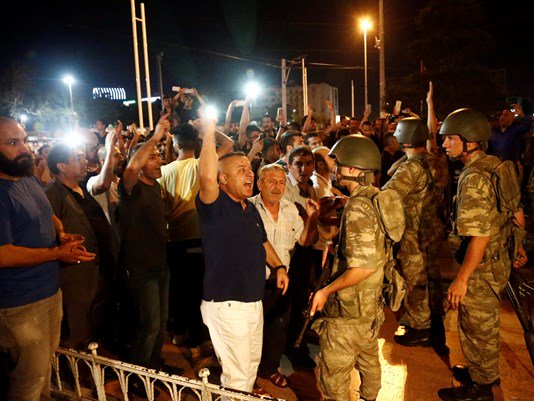
Whether the coup was real or staged, it is beyond time that the EU drop the pretence that Erdogan's Turkey will ever join the bloc.

As the implications of the events of Friday night have sunk in, world leaders have started to suggest what they dared not say over the weekend.

Since Friday Turkish President Recep Tayyip Erdogan has rounded up and arrested more than 6,000 members of the military and judiciary, accusing them of being involved in the supposed coup. "It looks at least as if something has been prepared," Johannes Hahn, the European Commissioner from Austria, said today. "The lists [of people to arrest] are available, which indicates it was prepared and to be used at a certain stage."

"I'm very concerned. It is exactly what we feared," he added.

Hahn's words carry significance because he happens to be the commissioner for EU enlargement. He is directly responsible for Turkey's accession process to join the EU. But in realty, that process is as theatrical and illusory as Friday night's coup probably was (more on that below).

Friday, 17 June 2011

US tells Europe 'we won't protect you forever'

Defence departments across Europe are bristling this week following the stern tongue-lashing delivered by outgoing US Defense Secretary Bob Gates last Friday. In a speech here in Brussels Gates lashed out at European nations for their weak military spending and their lack of troop commitments to the North American Treaty Organisation (NATO).

It was the clearest signal yet that the days of this military alliance, set up to defend Western Europe during the cold war, may be numbered. Gates implied the alliance may come to an end unless European countries agree to restructure it into an equal partnership rather than a US-led military fiefdom. Oddly enough, it is America that wants to see an end to the current state of US military dominance in Europe, and it is the Europeans who are resisting this.
"For the better part of six decades there has been relatively little doubt or debate in the United States about the value and necessity of the transatlantic alliance," he told the NATO dignitaries. "For most of the Cold War US governments could justify defense investments and costly forward bases that made up roughly 50 percent of all NATO military spending.  But some two decades after the collapse of the Berlin Wall, the US share of NATO defense spending has now risen to more than 75%"

Tuesday, 22 March 2011

Europe leads on Libya, but divisions persist

We are only in day four of the Libya War, but it doesn't seem to have taken long for confusion to settle in over where we go next and who is in charge. As the aerial bombardment tapers off and the skies clear into a no-fly zone over the Libyan desert, questions are now being asked that are not only causing disunity within the European Union but also between Europe and the United States.

"In most of the foreign policy issues we've talked about for decades, the US has been the lead player," conservative New York Times columnist David Brooks noted on PBS Newshour a few days ago. "Here we're clearly not the lead player, it's the UK and France and we're following along on the caboose. Now we feel like the UK often feels, as the secondary player. So the question is how much is the president really supporting this and how much is he being dragged along?"

So far the Obama administration has seemed disinterested in the Libya situation, and this wasn't helped by the fact that at the time military action was launched the US president was on a trip to South America and had to give comments on the war's launch from a shared podium in Brazil. Over the past few days US politicians haven't even made an effort to try to convince the American public that this war is in America's strategic interest.

Friday, 19 November 2010

Today’s EU-US 'summit': progress or face-saving?

All this week I was inundated with press releases, previews and briefing notices leading up to the big EU-US summit taking place in Lisbon today, the first such summit since the Lisbon Treaty went into force a year ago. From the way the EU institutions were hyping it, you would think this was some kind of massive meeting of powers set to define the course of the next century. The reality? Barack Obama is taking two hours out of his busy schedule while at a NATO summit in Lisbon to meet with European Council President Herman Van Rompuy and European Commission President José Manuel Barroso on the sidelines.

Apparently this is all that US officials were willing to offer the new “EU president” even though the EU was originally thinking they could get a separate day with Obama while he was on the continent for the NATO gathering. But the EU grabbed the opportunity for even a two-hour meeting, eager to avoid another massive humiliation after Obama snubbed the union last May when he suddenly backed out of a planned EU-US summit in Madrid. The entire summit was cancelled after that last incident, and apparently EU officials didn’t want to have to go all of 2010 with the US president not meeting with his new EU counterpart.

Friday, 25 June 2010

The snark heard round the world

It’s a strange turn of events when some snarky personal attacks made in Rolling Stone magazine can have an explosive worldwide effect that will change the course of history. But that is what has unfolded this week as Barack Obama has been forced to fire the top US general in Afghanistan, Stanley McChrystal, after he and his top aides made inflammatory remarks about the president and vice president to a reporter from the music magazine. Astonishingly, the general and those around him personally insulted Obama, who is the commander-in-chief of the armed forces, and cast doubt on the whole mission in Afghanistan. The trash-talking included calling Vice President Joe Biden 'vice president bite me'. 

It was the worst possible timing, coming at a time of increasing violence in Afghanistan when NATO forces appear increasingly bogged down there. Relations between NATO and Afghan president Hamid Karzai are at an all-time low following the almost surely rigged elections that kept him in power. The original mission to root out Al Qaeda has nothing to do with the current situation now that the terrorist organisation has moved its base to Pakistan, so the war has largely become focused on nation-building. The conflict recently became the longest war in US history, a grim milestone. This month has been the deadliest for NATO soldiers since the war began almost nine years ago.

Wednesday, 20 August 2008

US gets its missiles in Poland

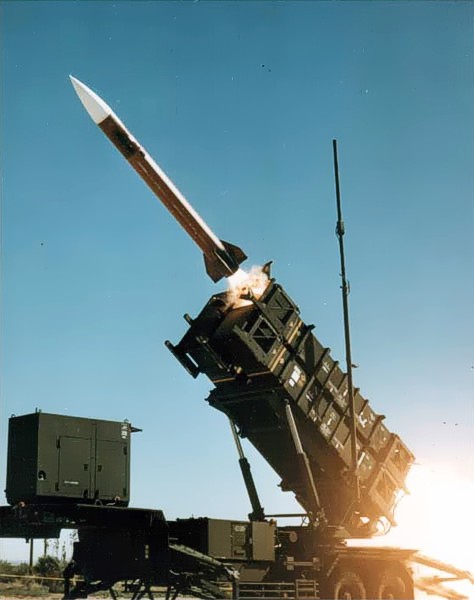
It’s official, the United States will install missiles in Poland pointed at Russia. The historic and highly controversial deal was signed in Warsaw this afternoon by Condoleezza Rice, ushering in a new era in Russo-Western relations.

The decision by Poland to allow the US to build its missile base there, and a mirror decision by the Czech Republic to build a twin radar facility in that country, seemingly couldn’t come at a worse time for relations between Russia and the West. Set as it is with the backdrop of the Georgia conflict, the timing is likely to enrage Russia even further.

The US insists the missiles are not directed at Russia but are rather for Europe’s protection from rogue states such as Iran. But there is no denying that the missiles are within easy striking distance of Russia, right at its doorstep. As part of the deal, the Americans will get a permanent garrison of US troops along with an agreement that the US will give Poland complete protection in the event of any conflict. All of this is outside the framework of NATO. Russia is obviously far from pleased that this is happening in its former satellite state. After all, they point out, the US didn't tolerate Russia putting missiles in Cuba. Why should the Russians tolerate this?

Thursday, 14 August 2008

Ring Around the Russia

Things seem to be getting worse before they get better in Georgia. At the moment, according to Georgia, there is a 100-vehicle tank convoy heading again toward the capital, and Russia now controls 1/3 of the country. The Sarkozy-brokered EU cease fire agreement doesn't appear to be working.

As the world tries to figure out what to do about this mess, I was struck by something in John McCain's editorial, entitled, We Are all Georgians, in the Wall Street Journal today. McCain's editorial was strongly worded and stark, and there's speculation tonight that President Bush's decision to send Secretary of State Condoleeza Rise to Tblisi was driven by not being a desire to not be overshadowed by McCain. Meanwhile Obama seems to be nowhere to be found.

McCain's editorial is almost like a little trip down memory lane, presenting a renewed us-versus-them approach when it comes to Russia. But most interestingly, it seems to display a complete misunderstanding of current geopolitics. Either that or he's being deliberately disingenuous.

Monday, 31 March 2008

Could the Bucharest NATO summit give birth to an EU army?

When it comes to great expectations, few summits could be said to be generating as much anticipation recently as the NATO summit in Bucharest this week. Besides hammering out a plan to rescue the military fiasco in Afghanistan, it is set to enlarge and restructure the alliance in a way that will fundamentally change it.

The Balkans are at the heart of this restructuring. With Kosovo having declared its independence in February, the nation is waiting with baited breath to see how NATO, which has been occupying the breakaway republic for eight years, will handle the situation. Some current members are insisting that stability in the region can only come from accelerating the membership of the region’s countries in NATO. Bulgaria, Greece, Romania and Turkey are already members, and Albania, Croatia and Macedonia may be invited to join at the summit.

However many EU countries are insisting it should be Europe itself that solves the crisis. The EU is working out a plan to create an EU police force to protect and stabilize the new country, allowing NATO to leave. With up to 1,800 police, judges and prosecutors it would be the largest such mission ever undertaken by the bloc. Whether or not this happens will depend on what occurs at the Bucharest summit.

Thursday, 27 March 2008

The Sarkozy show comes to London

Nuclear collaboration, economic turmoil and an EU army may have been at the top of the agenda for French President Nicolas Sarkozy’s official visit to London this week, but for the British media there was only one thing at the top of their agenda: Carla Bruni. The former supermodel singer and now first lady of France has dominated coverage of the visit. In fact the couple were greeted in London with naked photos of the first lady plastered all over the front pages of the British tabloids – one of the many nude photos of Bruni floating around out there is being auctioned in New York this week.

Out for drinks with some American friends last night, they expressed frustration that such trivial tabloid fare was dominating the coverage of this important state visit. Granted it is all rather silly, with some news reports even calling Bruni “France’s Princess Diana” (a stretch to say the least!) But Bruni’s visit was actually important for a clear reason: Sarko’s ‘celebrity’ lifestyle and his whirlwind courtship and marriage to Bruni following his divorce has invited the scorn of the French population which has seen his behavior as decidedly unpresidential. The visit to Windsor Castle to meet with Queen Elizabeth II needed to bring respectability back to the office and demonstrate to the French people that both Sarkozy and Bruni, whose former boyfriends have included Mick Jagger and Eric Clapton, could be taken seriously on the world stage. Essentially it wasn’t such a difficult mission, all they had to do was show up dressed appropriately and not screw up. But part of Bruni’s mission was to look elegant and sophisticated next to the Queen, and she seems to have succeeded in that.