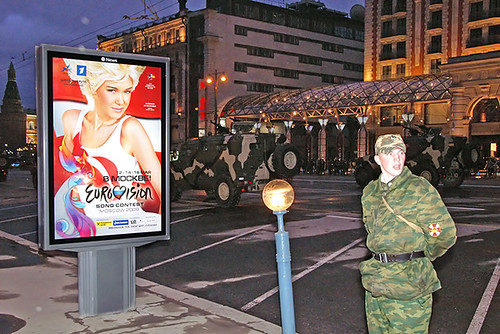
As tensions between Russia and the West continue, Ukraine fields an entry about the Soviet Union's horrific mass deportations in Crimea. How did it get past the censors?
In 2009, as the war between Georgia and Russia raged on, Georgian public broadcaster GPB tried to pull a fast one on the Eurovision censors.
They fielded a song called "We Don't Wanna Put In", a disco anthem ostensibly about not wanting to stop dancing. The Eurovision organisers weren't having it. Songs with political themes are not allowed in the contest.
The title of the song, and it's main chorus, did not grammatically make sense in English. Though this could be said about a lot of Eurovision entries, this one was clearly meant to be "We don't want a Putin".
Showing posts with label Georgia. Show all posts
Monday, 9 May 2016
Tuesday, 12 May 2009
Welcome to the New World of Eurovision
Last year’s finals in Belgrade were the last straw for many who had grown frustrated with tribal voting patterns that seemed to have completely shut out Western Europe from ever possibly winning the phone-in public voting final round. The Slavic countries of Eastern Europe have tended to vote for each other since they entered the song contest after the end of the Cold War, and for some this pattern explained why Russia’s sub-par entry-on-ice from Dima Bilan handily won last year (though admittedly none of the 2008 entries were very good). Long-time British Eurovision host Terry Wogan – a veritable institution for Eurovision in the UK - was so exasperated last year with the voting pattern that he quit his hosting job live on air!
Fearing an eventual withdrawal of the founding Western European countries from the contest (which France, Germany, Spain and the UK do pay for after all), Eurovision has changed the voting format this year to be 50% from a public vote and 50% from a panel of music industry experts in each country. So, for instance, the winner of the UK’s vote package will be decided by a combination of the results of the public phone-in vote and the decision of a British music industry panel who are charged with disregarding the nationality of the acts and looking only at talent. We won’t know until Saturday whether these panels will also fall into patterns of national prejudice, but people seem to be confident that they won’t. This year the odds-makers have picked Norway as the favourite to win, with Alexander Rybak’s folksy song “Fairy tale”.
“We Don’t Want a Putin”
Of course the publicity the song has received from the controversy is probably more valuable than actually appearing on Eurovision. The song is bizarrely number two in the UK's Music Week pop chart at the moment. It’s also getting radio play across Europe.
The Songs
As previously mentioned, the hands-down favourite this year with the bookies is Norway, but Greece, Turkey and Ukraine are considered to have a good shot as well. Much of the talent this year is made up of female ballad singers, and there is (sadly) little of the tongue-in-cheek camp of the past two contests. The UK’s entry, “My Time” is a light theatrical ballad penned by Andrew Lloyd Webber and sung by previously unknown Jade Ewan (though UK entrants are almost always previously unknown, and almost always still unknown afterwards!).
After receiving much criticism for its puppet entry last year (it didn’t help that Dustin the Turkey puppet was featured as a mascot for the ‘no’ vote in the Irish referendum on the EU Reform Treaty),
Ireland has gone with a more serious entry this year with a girl rock band – who I saw perform at a Eurovision preview party in London a few weeks back and loved. Perhaps this year’s entrant is reflective of Ireland’s newly humble attitude toward Europe?
The semi finals will be held tonight and Thursday, and the final will be held Saturday night, all at 8pm CET. The show airs in most every country in Europe on the national broadcaster, but sadly not in North America. But never fear, you can watch the show live on the Eurovision 2009 web page!
Wednesday, 20 August 2008
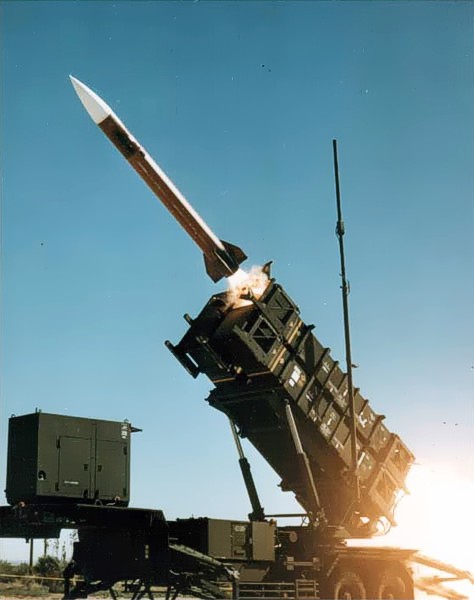
US gets its missiles in Poland
The decision by Poland to allow the US to build its missile base there, and a mirror decision by the Czech Republic to build a twin radar facility in that country, seemingly couldn’t come at a worse time for relations between Russia and the West. Set as it is with the backdrop of the Georgia conflict, the timing is likely to enrage Russia even further.
The US insists the missiles are not directed at Russia but are rather for Europe’s protection from rogue states such as Iran. But there is no denying that the missiles are within easy striking distance of Russia, right at its doorstep. As part of the deal, the Americans will get a permanent garrison of US troops along with an agreement that the US will give Poland complete protection in the event of any conflict. All of this is outside the framework of NATO. Russia is obviously far from pleased that this is happening in its former satellite state. After all, they point out, the US didn't tolerate Russia putting missiles in Cuba. Why should the Russians tolerate this?
Thursday, 14 August 2008
Ring Around the Russia
Things seem to be getting worse before they get better in Georgia. At the moment, according to Georgia, there is a 100-vehicle tank convoy heading again toward the capital, and Russia now controls 1/3 of the country. The Sarkozy-brokered EU cease fire agreement doesn't appear to be working.
As the world tries to figure out what to do about this mess, I was struck by something in John McCain's editorial, entitled, We Are all Georgians, in the Wall Street Journal today. McCain's editorial was strongly worded and stark, and there's speculation tonight that President Bush's decision to send Secretary of State Condoleeza Rise to Tblisi was driven by not being a desire to not be overshadowed by McCain. Meanwhile Obama seems to be nowhere to be found.
McCain's editorial is almost like a little trip down memory lane, presenting a renewed us-versus-them approach when it comes to Russia. But most interestingly, it seems to display a complete misunderstanding of current geopolitics. Either that or he's being deliberately disingenuous.
As the world tries to figure out what to do about this mess, I was struck by something in John McCain's editorial, entitled, We Are all Georgians, in the Wall Street Journal today. McCain's editorial was strongly worded and stark, and there's speculation tonight that President Bush's decision to send Secretary of State Condoleeza Rise to Tblisi was driven by not being a desire to not be overshadowed by McCain. Meanwhile Obama seems to be nowhere to be found.
McCain's editorial is almost like a little trip down memory lane, presenting a renewed us-versus-them approach when it comes to Russia. But most interestingly, it seems to display a complete misunderstanding of current geopolitics. Either that or he's being deliberately disingenuous.
Wednesday, 13 August 2008
Russia attacks
According to witness reports, Russian tanks are now making their way to the Georgian capital of Tblisi, and nobody seems to know what they’re going to do once they get there. The Russian military is denying the claims. At the same time, there have been reports that Russian planes are bombing Georgian ships in the Black Sea.
This is a key test for how Europe and the United States are going to respond, and it will be interesting to see whether they take different paths. French president Sarkozy seems to be trying to take a leading role in dealing with the conflict, even suggesting that there should be an EU peacekeeping force put into Georgia. US president Bush’s reaction has been muddled and strangle by the inability of the US to really do anything about it.
Subscribe to:
Comments (Atom)