Showing posts with label EU. Show all posts

Thursday, 5 November 2009

France: ‘Autistic’ Tories will Castrate UK

One could argue that there’s perhaps no better vote-getter for the Tories than having the French call them names, but the rather un-PC reaction from the continent to David Cameron’s speech yesterday deserves more that just a bemused reaction in Britain. It’s a reflection of how deeply concerned the continent is about a future Tory government.

I was at a conference in Copenhagen on Tuesday when the news broke that Czech President Vaclav Klaus had finally signed the Lisbon Treaty, following a Czech court ruling that the treaty did not violate Czech sovereignty. As soon as someone announced the news the room broke into applause – which is significant because this was an industry conference, not a gathering of EU policy-makers.

The capitulation by the Czech president meant that UK conservative leader David Cameron would have to abandon his crusade to put the treaty to a public referendum in the UK. He had made a “cast-iron” guarantee that the Tories would offer the British public a referendum on the document if the Tories were elected, but he had never addressed what he would do if the treaty went into effect before the Tories came into power. On Wednesday Cameron hastily arranged a speech acknowledging the obvious: now that the treaty has been ratified it is no longer a treaty, but EU law – making a referendum at this point essentially meaningless. At the same time he said he would work to "unravel" much of the treaty through negotiations over the coming years and would seek new "opt-outs" for Britain from EU policy.

In fact, a ‘no’ vote on the treaty would at this point mean a ‘no’ vote to the EU, and the implication of such a result would be that Britain must exit the union – something Cameron knows would be a disaster for the UK. His decision to abandon his plans for a referendum is less an active policy choice that an acknowledgement of reality.


The reaction to Cameron’s speech in the British press has been strangely schizophrenic. The right-leaning papers have focused on Cameron’s “capitulation to Europe” and a supposed “abandonment” of the Eurosceptic wing of the party. The Telegraph ran this headline yesterday: “David Cameron tells Eurosceptics: get over it,” followed by an interpretation that Cameron has rejected the Tory Eurosceptics by putting Europe low on the agenda. They point to the resignation of the two most rabidly anti-Europe MEPs, Daniel Hannon and Roger Helmer, from their front-bench positions in protest over Cameron’s decision.

On the other hand the left-leaning papers have focused on the nonsensical nature of Cameron’s speech yesterday, highlighting the fact that Cameron is still being antagonistic toward Europe yet he is not being clear in exactly what he wants from it. They point out that the UK already has many of the opt-outs Cameron said he would ask for in the coming years, including not being part of the Charter of Fundamental Rights (Brown already negotiated a UK opt-out to that part of the treaty). And they have recounted the baffled reaction of many leaders on the continent to the content of Cameron’s speech. Cameron’s promise to renegotiate employment law is almost laughably absurd, the continental politicians said, considering there is almost no chance Britain's European partners would approve an opt-out as it would be seen as giving the UK an unfair advantage in attracting foreign investment. And his promise that “never again” would a treaty pass without a public referendum in Britain is an empty gesture considering the Commission has already said it will not attempt any further institutional reform for at least a decade and probably much longer.

But it was the furious reaction from the French government to Cameron’s speech which the left-leaning papers focused on the most. In a stunning abandonment of diplomatic niceties, France’s Europe Minister Pierre Lellouche came out with a remarkable condemnation of the Tories, saying he was conveying French President Nicolas Sarkozy’s “sadness and regret” over the path Cameron has chosen to take. Lellouche told the Guardian:

"It's pathetic. It's just very sad to see Britain, so important in Europe, just cutting itself out from the rest and disappearing from the radar map …. This is a culture of opposition…I have told William Hague: go away for two to three years, in your political economic situation you're going to be all by your self and you'll come back. Go ahead and do it. That is my message to them … You want to be marginalised? Well, you go for it. But it's a waste of time for all of us.”
The minister’s comments reflect the depth of the anger felt by Europe’s Conservative parties at Cameron’s decision to take the Tories out of the main centre-right European party, the European People’s Party, to form a new “anti-federalist” party in alliance with hard-right parties from Eastern Europe. Lellouche said Cameron’s decision had “castrated” British influence in the parliament, and his continued antagonism toward the EU – saying the same thing over and over but not expressing any coherent question or demand – seemed like “a very bizarre sense of autism”.

The comments were particularly surprising considering that Lellouche is one of the most Anglophile members of Sarkozy’s government. It should be kept in mind that these unusually harsh diplomatic words are not coming from socialist governments on the continent, they are coming from fellow conservatives.

Despite the very different coverage of the issues from the different British papers, it is actually really heartening to see Europe being discussed so much in the British media this week. Though Cameron seems to be trying his best to get rid of Europe as a campaign issue, it would probably be the best thing for the UK if Europe were made a central part of next year’s campaign. Labour certainly has every interest in bringing it up as much as possible, considering it has historically been an issue that has caused civil wars within the Conservative Party, and Labour will be eager to exploit lingering fears and doubts the public has about the Tories’ ability to govern.

But more importantly, having Europe as a major issue of the campaign could mean that Britain will finally get the frank, honest Europe discussion it has never had. If the Tories want to unravel the European project then they need to present to the British public what their alternative vision is for the UK to be a relevant part of the 21st century. So far the discussion of the EU in the UK has focused on silly euromyths about the length of vegetables rather than a real education on what the EU does and that its purpose is to make Europe a relevant, strong global player in the 21st century. That discussion has never been had here because most politicians dance around the central truth regarding the necessity of Britain’s EU membership: the UK is no longer a world power and it faces a future of marginalisation and irrelevance if it tries to go it alone. As Lellouche said Wednesday:

"It is a time of tumultuous waters all around us. Wars, terrorism, proliferation, Afghanistan, energy with Russia, massive immigration, economic crisis. It is time when the destiny of Europe is being defined – whether or not we will exist as a third of the world's GDP capable of fighting it out on climate, on trade, on every … issue on the surface of the Earth. We need to be united, otherwise we will be wiped out and marginalised. None of us can do it alone. Whether you're big or small, the lesson is the same. And [Britain's] risk is one of marginalisation. Irrelevance."
It remains to be seen whether similiarly outraged words will be publicly expressed from Europe’s other conservative governments in Germany, Italy, Sweden and Denmark – but such views have already been expressed privately by Conservatives from all corners of Europe. Angela Merkel is reportedly refusing to even meet with Cameron, and joint policy groups between Germany’s CDU and the Tories have been cancelled.

If the Tories are elected next spring it would mean that all three major EU countries will have Conservative governments. Yet far from being an ideologically unified block that could plow through badly-needed reforms in Europe’s social model, there will be a huge chasm between the continent and Britain as a result of Cameron’s decisions.

Monday, 2 November 2009

Europe in Denial of a Changing World

The European Council on Foreign Relations came out with an interesting report today on the US-EU relationship, concluding that Europeans “remain in denial about how the world is changing, making a fetish out of the transatlantic relationship.”

In essence the report concludes that Europeans remain stuck in a ‘spectator’ mindset, harbouring damaging “illusions” acquired over “decades of American hegemony.” The result, the authors conclude, is “an unhealthy mix of complacency and excessive deference” to the United States, which has a “rapidly decreasing interest” in a Europe as it fails to speak with a strong united voice in the world.

The report is not just a rebuke of the nationalists and isolationists spread across Europe, it is also a rather grim summary of how the US views the prospects of the EU actually rising to the challenge. Though the US badly needs a strong partner to counter the rising influence of China and would like to see a more united EU, the consensus in Washington since 2005 has been that it is unlikely to see that materialise. So it now essentially takes a piecemeal approach to treating Europe as an equal partner. When Europe is strong and united in trade issues, Washington listens. When it is split in foreign policy however, it ignores them. In the later scenario, where different national governments act individually, the report concludes, “Europeans are asking to be divided and ruled.”

The result of all this, the authors concludes, is “a frustrated US and an impotent Europe.” The situation manifests itself, for example, in the Afghanistan conflice – where Europe has 30,000 troops yet virtually no say in strategy. They write:
“European governments need to get over the mistaken belief that their individual ‘special relationships' matter in Washington, and learn instead to act together and speak to the US with one voice.”
Reading this report, I can’t help but feel that it is in large part addressed to the UK in particular. The British public should keep these things in mind when they head to the polls next year. As I’ve written about before, Cameron’s Europe policy will have important ramifications for not only the future of the UK, but the future of Europe as a whole. As the report points out, the danger of ‘damaging illusions’ in policy-making are no insignificant matter.

Wednesday, 21 October 2009

US Alarmed by Cameron’s Europe Moves

It looks like worries about a future Tory government aren’t limited to Paris and Berlin. Reports are circulating today that US Secretary of State Hillary Clinton expressed concern last week during her visit to Europe over David Cameron’s increasingly combative stance toward the EU, saying the US is worried that the “direction of travel” from what will most likely be the next governing party of the UK could lead to a rupture between Britain and the rest of Europe.

Her concern is not in isolation. The Obama administration has been increasingly questioning the wisdom of Tory leader David Cameron’s recent hostile moves toward Europe, including his decision to take the Tories out of the main centre-right grouping in the European Parliament to form a new alliance with hard-right Eastern European parties and his antagonism toward the Lisbon Treaty. The Times reports today that the US Ambassador to Britain has also been voicing alarm over Cameron’s Europe plans, and that Jewish groups within the Democratic Party are expressing alarm over Cameron’s new ties to anti-Semitic politicians in Poland.

The concerns are further evidence that the Obama administration considers the so-called “special relationship” (a term I’ve never heard used in the US, though it is used almost obsessively in the UK) to be obsolete, and would prefer a united Europe to deal with in foreign policy. This is a sea change from the previous US administration, which notoriously used the idea of the “special relationship” to drive a wedge between the UK and Europe in the run-up to the Iraq war. As The Times notes,

“[Obama] believes that Britain should be at the heart of Europe — a position that has been put in doubt by French and German anger over Mr Cameron’s decision to sever ties with the federalist centre right grouping in the Strasbourg Parliament. Mr Obama is enthusiastic about the idea of a permanent EU president to replace the revolving chairmanship of the EU council, a measure opposed by the Conservatives.”
Wheras the Bush administration was hostile toward the EU and seemed to repeatedly seek to undermine it, the Obama administration has so far been an enthusiastic supporter, as demonstrated by Hillary Clinton’s speech in Brussels earlier this year. In fact I think I could without hyperbole call Obama a European federalist. He wants a strong, united Europe as a partner in combating terrorism, dealing with the financial crisis and providing a counterweight to China.

The administration’s reported comments seem to suggest that Obama has little patience for European leaders who cow-tow to old instincts of nationalism and divisiveness. And he has also demonstrated impatience with some of the more archaic, slow-moving aspects of the EU, and is likely eager for the streamlined reforms the Lisbon Treaty will bring about. Of course this is just speculation, but it’s what his administration’s statements and behaviour seem to suggest.

Tuesday, 6 October 2009

Both the Best and Worst Man for the Job


Now that the Irish have passed the Lisbon Treaty and it’s set to be ratified within months, the British press has transferred its characteristically ferocious obsession to what the treaty will do. And to hear them tell it, the sole purpose of this document is to make Tony Blair the “President of Europe”. Of course that is not true, and in reality no such position is being created. The position being referred to is the President of the European Council, which has always existed but will now go to a person rather than to a country (Sweden currently holds the presidency). The position doesn’t come imbued with much specific power like an American president, it's more of a symbolic coordinator role like the Secretary General of the United Nations.

But though it doesn’t come with executive power, the intention of the position – to designate a high-profile figure who can speak with one voice for all of the EU - is ambitious. Right now, the member state holding the Council presidency is unable to do that because they can essentially only speak for themselves, and they don’t have much time to develop a cohesive presentation of EU objectives given that they only hold the position for six months. So having an actual person in place for a longer term will make a big difference, although he is essentially "working for" the 27 European heads of government that make up the Council, not the other way around. He can only speak when he's been given permission by the entire council, a position he may find frustrating since he is used to the unilateral system of Westminster government.

The de facto “leader” of the EU up till now has been the president of the European Commission, a position currently held by Jose Manuel Barroso. But given that the Commission (made up of independent commissioners) and the Council (made up of the prime ministers of each member state) are often in conflict, Barrosso has never been able to convincingly speak for all of the EU even when he’s sitting in as its representative in bodies such as the G8. The Commission has no control over member states’ foreign or military policy. Of course the President of the European Council won't be able to unilaterally make foreign policy decisions (and nether can the new position of EU High Representative on Foreign Policy). The president is subject to the prime ministers of the member states, but he can work to attain a consensus amongst them and then announce and coordinate that policy (much in the same way Switzerland's executive branch works).

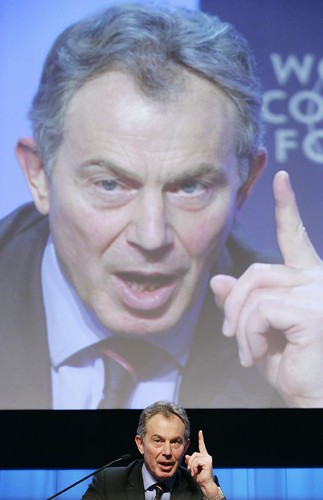
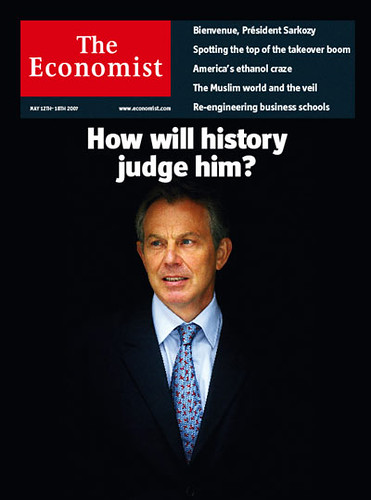
So the new presidency position calls for someone who has talents in two distinct areas: he or she needs to know how to work a room and twist arms in order to reach group consensus, and they need to be a high-profile, charismatic figure who can represent the EU on the world stage. Obviously, Tony Blair meets both of these requirements.

The problem is he also has one giant albatross hanging around his neck: Iraq. The fact that he was prime minister when the UK followed the US in its war with Iraq hasn’t endeared him to the British public or to Europeans in general. The centre-left of Europe is deeply mistrustful of Blair because of his role in the war, and this is a stigma he is never likely to live down. And in the UK, as has been evidenced by the vitriolic reaction by the British press to the likelihood of his presidency, Blair is still widely reviled by both the left and the right. The right hates him because he presided over the humiliating defeat of the Tories and pushed for a marginal social democratic agenda, the left hates him because he acquiesced to American power, and because they feel betrayed by many of New Labour's policies and promises it did not fulfil. He’s also become an openly religious Catholic since leaving office, and that doesn’t exactly endear him to the secular left either in Britain or on the continent.

Given the painful divisions that emerged in Europe in 2003 over the Iraq War, and how those divisions exposed how weak and incoherent Europe still is in the area of foreign policy, picking someone as president who conjures up those memories may at first seem like something Europe would want to avoid. But the reality is there just isn’t any other logical choice – such is the dearth of high-profile, charismatic politicians in Europe. The runners-up? Jan Peter Balkenende of Holland, François Fillon of France, Herman Van Rompuy of Belgium and Jean-Claude Juncker of Luxembourg. Not exactly household names.

Hated at Home

With this reality in mind I had long ago concluded that despite the Iraq problem Blair was probably the best pick. But in the past few days speaking with some of my friends here in the UK, I’m starting to get the full sense of how the wounds of the Iraq war have still not healed here. Even my most liberal friends have reacted with horror to the idea that Blair will assume the presidency, saying that after the British public and media worked so hard to push him to resign it would be an insult to see him appointed to an unelected position where he seems to be lording over them.

A recent survey showed that a majority of the British public (53%) is opposed to Blair becoming president. Perhaps even more surprising is the fact that only 66% of Labour party members want him to get the job. At their party conference this week the Conservatives seem to be content to make a bogeyman out of Blair, with Boris Johnson saying Britain is faced with the prospect of Blair “suddenly pupating into an intergalactic spokesman for Europe”. The media has been almost salivating with hostility toward the idea as well, with the Telegraph newspaper actually referring to a proposed British referendum on the Lisbon Treaty in a headline yesterday as the “Stop Tony Blair Referendum”.

Certainly, these fears are misguided. Logically the Tories should be rooting for the first president of the council to be British – that would give the UK the influence in Brussels to be able to push through the EU reforms they claim they are so intent on achieving. Opposing Blair is certainly a case of the Tories cutting off their nose to spite their face, perhaps succumbing to mob-pleasing populism over sound policy.

But this isn’t just the usual British paranoia about the EU revealing its ugly head. There is a real feeling of ill will toward Tony Blair in this country, and I’m starting to wonder if its really worth it for Brussels to further antagonize the British, who are already so hostile to the EU. It’s a bizarre situation – Blair being president would undoubtedly be a good thing for the UK (the vast majority of respondents to that survey admitted as much), but he remains so controversial in his home country that the appointment would infuriate many in the UK – particularly the liberal left which the EU so badly needs in its corner.

Perhaps this initial discomfort with the choice of Blair will go away after a short while, and the British people eventually will come to remember what it was that inspired and enthused them about Blair in the first place. If that were the case Blair could actually serve as the ambassador for Brussels who could finally make the British like Europe, or at least make them finally accept that they need Europe. It was always a shame that the Iraq War intervened to derail Mr. Blair’s hopes of making Britain a fully active and contributory member of the EU. Perhaps this is the opportunity for him to finally see out that goal. It would be one failed promise that New Labour could belatedly deliver on.

Wednesday, 23 September 2009

Angry Europeans and Embarrassed Americans in New York

There's no doubt about it, this week's UN climate change meeting in New York has been a humbling experience for America. Being shown up by China in the field of environmental protection isn't exactly a shining moment for the US, but it may be a harbinger of the century to come.

European diplomats at the summit are reportedly seething at US inaction, and their reaction to Obama's almost completely substanceless speech yesterday was nothing short of incredulity. But with the climate bill stalled in the US senate and the healthcare fight likely to push it off the agenda until after the hugely important Copenhagen summit in December, Obama's hands are tied. With no climate bill passed by December, the US will likely not be able to commit to the post-Kyoto framework being worked out at the December summit, considered by Europe to be the "last chance" to save the world from the effects of climate change. Though just a year ago it was thought India and China would be the biggest obstructionists to reaching a global agreement, this week it has become clear: the US may be the lone force standing in the way of fighting climate change.

China, on the other hand, unveiled some big commitments this week. Yesterday China's President Hu committed China to getting 15% of its power from non-fossil sources by 2020, planting enough forest to cover an area the size of Norway and limiting the growth of carbon emissions as a percentage of the country's gross domestic product. I'm also hearing word that today at 2pm there will be an announcement at the New York Stock Exchange that China will launch a carbon valuation system called the "Panda Standard", where companies have a certain carbon allowance and can buy or sell credits as they need to. I've even heard that this announcement later today by China may be followed by an announcement setting up a Chinese cap and trade system like Europe's Emissions Trading Scheme (ETS). I would be truly shocked if they do announce that, but if they do it would be hugely embarrassing for the US, which still has no cap and trade system or even a voluntary standard.

Once the Chinese government became convinced of the reality of climate change about a year ago, they have acted dramatically and rapidly with new environmental measures that now put them ahead of the US in several ways. They’ve restructured their development plans to cut down on high-emissions projects, and within two years they have phased out 54 million kw of coal-fired power capacity by small polluting power plants. Last year the issued new rules on the construction sector for the use of renewable products. They’ve poured money into the development of public transport and the promotion of environmentally-friendly vehicles. Also last year the government ordered retailers to stop providing free plastic shopping bags. China now has the world’s largest hydropower generating capacity and is currently the fourth largest wind power producer after the United States, Germany and Spain – and it’s catching up quickly. Last year renewable energy accounted for about nine percent of the country's energy total, surpassing the US.

Of course, with a top-down command economy China can afford to do these things at this speed. As Thomas Friedman has lamented, if only the US could be "China for a day". But no matter how they've attained these rapid results, the Chinese are putting the Americans to shame.

Needless to say with all the hope that was placed in Obama by Europeans, this has been a disappointing day across the pond. Newspapers over here have been questioning Obama's ability to deliver on climate change, with one particularly scathing article from the Guardian called 'Obama the Impotent' making the email rounds. The Guardian writes:
"On the campaign trail, Barack Obama promised to reverse the Bush administration's terrible ecological record. Yet so far the world has seen more symbolic gestures from the Obama administration than accomplishments. Its biggest achievement so far has been a disappointment. President Obama signed an executive order to increase US motor vehicle mileage standards – but only to a level that will push fuel efficiency by 2020 to a level that European and Japanese cars reached several years ago, and even China has already achieved."
However one consistent theme has been that the European papers are not blaming Obama himself for the inaction, but rather the government system he has the misfortune of having to lead. Writes the Guardian:
"Thwarting Obama on a regular basis is an unrepresentative senate where "minority rule" prevails and undermines what a majority of the country may want. With two senators elected per state, regardless of population, California with more than 35 million people has the same number of senators as Wyoming with just half a million residents. This constitutional arrangement greatly favours low population states, many of which tend to be conservative, producing what one political analyst has called "a weighted vote for small-town whites in pickup trucks with gun racks."
It should be no surprise that China is beginning to surpass the United States in several ways, after all this is slated to be the "China century," which will see a return to a two-superpower world with the US and China competing for power. But the fact that China is now surpassing the US in the fight against climate change should be a big wake-up call to Americans, especially liberals.

Tuesday, 30 June 2009

EU Takes a (Half-Hearted) Stand on Smoking Bans

Throughout my travels around Europe one of my favourite things to do is observe the differences between countries – and if you’re someone who enjoys a drink or two, many of those observable differences can often be found at bars.

From the availability of beer versus wine to the size of drinks to the closing times, bars can be a great place to see the particular cultural quirks of a society play out. In recent years one area of difference has become increasingly pronounced – who and who does not have a smoking ban. It's a blisteringly confusing patchwork of laws.

Today, the EU announced a move to ban smoking in enclosed spaces across the EU. But as we say in the US, Brussels seems to have shown up a day late and a dollar short.

Monday, 29 June 2009

Say hello to the standard EU phone charger

The European Union has reached an agreement with mobile phone makers today to create a standardized phone charger that will work across all models and brands. The agreement was reached after the EU told the phone companies that it did not reach a voluntary accord it would force their hand with legislation. And as the phone companies learned from the roaming rate cap battle, Brussels is willing to put its money where its mouth is when it comes to telecommunications.

Starting next year, new mobile phones will come with the same electrical input socket, mini USB, and they will all come with the same charger (with different prongs for the British Isles and the continent of course). MEPs noted that the new system would make it easier to use someone else’s charger if you’ve forgotten your own, with consumers no longer having to hunt around for a charger that matches the make of their phone.

Commissioner Verheugen demonstrated that difficulty at today's press conference, although perhaps with a bit of exageration!


Of course the main purpose of the change is environmental. Allowing consumers to reuse their old charger with a new phone will cut back on electrical waste

The agreement was reached with Apple, LG, Motorola, Nokia, Samsung, and Sony Ericsson, which together make up 90% of the EU phone market. Since most of these companies also design phones in the US and the rest of the world, I would assume that this standardization will eventually spread to the rest of the world. After all, why would they make phones with different electrical input jacks specifically for Europe?

While this change probably won’t have a huge impact on anyone’s life, it is interesting to note how quickly the companies responded to the EU’s threat of legislation. It’s clear that in the area of consumer rights, companies have learned a lesson from the roaming rate cap debate. From now on when the EU threatens to use legislation for force a consumer rights issue, companies may quickly decide it’s better to each a voluntary agreement than to dig in their heels and resist, only to be forced to change by legislation later on.

Wednesday, 13 August 2008

Russia attacks

It’s certainly been a tense couple days, with the west watching in disbelief as Russia launches what seems to be a full-scale invasion of its Southern neighbor Georgia. Considering this is a country that, theoretically, almost joined NATO at the Bucharest summit a few months ago, this is quite a provocation to the West. Nothing seems clear right now about what Russia’s intentions are or even what they’re doing, but one thing is certain: relations between the West and Russia have been fundamentally altered by the last few days events.

According to witness reports, Russian tanks are now making their way to the Georgian capital of Tblisi, and nobody seems to know what they’re going to do once they get there. The Russian military is denying the claims. At the same time, there have been reports that Russian planes are bombing Georgian ships in the Black Sea.

This is a key test for how Europe and the United States are going to respond, and it will be interesting to see whether they take different paths. French president Sarkozy seems to be trying to take a leading role in dealing with the conflict, even suggesting that there should be an EU peacekeeping force put into Georgia. US president Bush’s reaction has been muddled and strangle by the inability of the US to really do anything about it.

Friday, 11 July 2008

Watered down at Club Med

Along with the pomp of the Bastille Day celebrations this weekend in Paris, the city will see another grand occasion: the first meeting of the “Mediterranean Union,” Nicolas Sarkozy’s pet project that he has made the centrepiece of France’s EU presidency. But the way Sunday’s meeting is being discussed, you’d think it was nothing more than a Camp David-style retreat. So is it the inaugural meeting of a new international body, or lip service to an idea that has failed to take flight?

Sarkozy’s vision of an alternative union has been watered down so much it is now almost unrecognizable from what he proposed during the French election campaign. What was originally intended to be a full-blown union offered as an alternative to the EU has now become a loose association that will be managed by the EU itself. It’s not surprising then that the union is now being labelled ‘Club Med,’ suggesting it is just a diplomatic association which will exchange pleasantries. Press reports looking ahead to Sunday’s meeting have focused almost entirely on the diplomatic aspect, noting that some of the world’s most bitter enemies will be sitting at the same table for the first time, including the leaders of Israel and Syria. Little is being said of what the union is supposed to accomplish because no one is quite sure at this point – the projects it has announced so far are little more than feel-good cooperation initiatives on things like cleaning up pollution and sharing solar panel technology.

Thursday, 7 February 2008

President Tony Blair?

It looks like discussion around Tony Blair becoming the first “President of Europe” is heating up. According to the BBC, Blair is now discussing the prospect with current British prime minister Gordon Brown.

The network is claiming there are forces in the prime minister’s office who are actively encouraging such an idea. It is thought that Blair and Brown are discussing the pros and cons of such a move, and Brown is waiting for Blair’s green light before he voices his support for the idea, which would signal that Blair is actively campaigning for the job.

Blair’s recent activity suggests that he is leaning in that direction. Last month he delivered a speech to Sarkozy’s UMP party conference – in French! Sarkozy has in turn expressed his desire for Blair to take the job.

Monday, 21 January 2008

Time for Serbia to pick a side

The Serbian presidential election over the weekend could hardly have been encouraging for Brussels. Ultranationalist candidate Tomislav Nikolic emerged the winner with 39.4 percent of the vote, beating the 35.4 percent of incumbent candidate Boris Tadic. Since neither candidate won a majority, a second round of voting will be held in two weeks.

The election is being closely watched because it has huge implications for the future of the Balkans. The Serbian people can choose either Mr. Nikolic, who wants closer ties with Russia and is opposed to NATO, the US and the EU, or Mr. Tadic, who wants Serbia to join the EU and wants it to distance itself from Russia. In short, the election will determine whether Serbia takes the path toward Russia or the path toward the EU.

The 61 percent turnout – the highest since the fall of Milosevic in 2000 – shows how seriously the Serbs are taking the vote, and the result of the weekend shows that they are almost evenly split over which direction Serbia should take.

Friday, 21 December 2007

Today Eastern Europe wakes to no borders

It’s official. As of this morning you can now drive from the Russian border in Estonia to the Atlantic beaches of Portugal, across 24 countries, without passing through a single border crossing. As of midnight, the 2004 EU entrants are now part of the Schengen Zone, the border-free area that allows you to pass through European countries as easily as if you were going from Indiana to Illinois.

Considering the post-cold war implications of this day (all but one of the 2004 entrants are former Warsaw Pact countries), the scenes last night were dripping with symbolism. As Canada’s Global Mail reports, at the border of Germany and Poland the guards spent yesterday removing kilometres of tall steel fence, leaving unmarked and unguarded fields between them. Fireworks lit up the border bridge between Poland and Germany in Frankfurt on Oder early this morning. On the road between Vienna and Bratislava, Austrian and Slovakian leaders met to saw through border-crossing barriers. And in Estonia, the government put its border-inspection stations up for auction. Perhaps nowhere was the scene more striking than on the Czech-Slovak border, as the countries were split apart just in 1993 and now find themselves without a border between them once again.

Wednesday, 19 December 2007

Pan-Europe healthcare plan delayed

Though proposals were expected today on the controversial new plan that would make it easier for patients in Europe to travel to other EU countries to receive healthcare, a European Commission spokesman said this morning the proposals have been put off, citing “agenda reasons.”

The idea behind the plan is that patients should essentially be able to “shop around” Europe for their healthcare, having operations done in countries where the wait time and expertise most suits their needs, and then having their home healthcare system foot the bill. So, for example, a UK resident who needs a surgery but is facing a 4 year wait to do it at an NHS hospital, could travel to France and have the operation done sooner (and maybe better), and then get the NHS to foot the bill.
But the plan has been enormously controversial, and the UK is particularly opposed to it because some fear it will spell the “end of the NHS” because the system would be forced to transition to a more insurance-based continental system.

For this reason the proposals have been hitting consistent delays, being drafted and redrafted, and the proposals today were expected to offer countries like the UK the option to pre-approve such out-of-country treatment and to opt-out. Of course, the proponents of the plan say this would negate the very purpose of it.

Mark Mardell had an interesting package on the BBC last night about a woman who faced a four year wait for gastric bypass surgery in the UK, so she opted to have the operation performed in Belgium where there was no wait for £5,000 (insert joke about the weight difference between continentals and Brits here). He's detailed more about this issue in his Euroblog today.

Wednesday, 12 December 2007

Europe bans kiddie junk food commercials?

Well…kind of. Actually a consortium of the world’s largest food makers have voluntarily, in response to pending action by the EU commission, agreed to stop advertising unhealthy food during children’s television programs by the end of next year throughout Europe. Seriously, no joke. That means no more Coco Crispies or Count Chocula ads during Power Rangers.

In a joint statement 11 companies, which together account for more than 2/3 of cash spent each year on food and beverage advertising in the EU, agreed to stop advertising unhealthy food and beverages on television programs, Web sites or in print media where children under age 12 could be considered a target audience.

They also agreed not to engage in any commercial communications related to food and beverages in primary schools, unless part of a specifically requested educational program.

These are no small-fry companies either. They include Coca-Cola, Groupe Danone (Danon), Burger King, General Mills, Kellogg, Kraft Foods, Mars, Nestlé, PepsiCo, Ferrero and Unilever.

At some point in the next year the companies will set a “high nutritional hurdle” which foods will have to meet in order to be advertised during children’s programming.

It’s important to point out that this new policy will apply only to EUROPE, because that is where the regulatory threat was coming from. Since there’s no such regulatory threat in the US, fat American toddlers will still be transfixed by a magical little leprechaun running off with their lucky charms. USA! USA!

Monday, 15 October 2007

All set for Schengen

We’re getting down to the last months of the year and, surprisingly, we may actually see the Schengen expansion come to pass by year’s end, according to recent reports.

The Schengen Agreement is the system that came into effect in 1995 that got rid of border checks between certain European countries. So now, for instance, when you travel between Germany and France you don’t go through any border check, and when you fly between these countries you don’t have a passport control check point. It was named after Schengen, Germany, where the agreement was signed (there's now a little monument to it there which I've seen, pictured at right).

But, the Schengen membership is different from the EU membership, which makes it rather interesting. The UK and Ireland, for instance, are both in the EU but not part of the Schengen Agreement (they just love that whole ‘island nation’ thing). Norway and Iceland, on the other hand, are not in the EU but are part of the Schengen Zone. So, when I fly from London to anywhere in Europe, I have to go through passport control, which is quite annoying (particularly if you don’t have an EU passport, since they get a separate and shorter line). But if I flew from France to Norway, I would not go through a passport check. Switzerland, which is not part of the EU, is scheduled to join Schengen next year.

Monday, 25 June 2007

'We Have a Treaty'

Well the EU treaty has been drafted, and Tony Blair can walk away feeling quite pleased with himself, having won on virtually every ‘red line’ demand the British were making. Those who dream of a federalist state, however, will be bitterly disappointed by this compromise.

That’s not to say the
Eurosceptics in the UK won’t kick up a fuss about it, but they don’t have much of a leg to stand on now. Though the conservatives will demand one, there is no way Gordon Brown is going to hold a referendum on the treaty in the UK. And the reality is, even if David Cameron manages to defeat Gordon Brown in the next election, it is very unlikely that Cameron would put it to a referendum either. Because even this lukewarm treaty would be voted down by a British population generally hostile to Europe, and Cameron doesn't really want to be single-handedly responsible for either destroying the union or wresting the UK from it. Much like the gay marriage issue in the US, playing on the xenophobia of the Brits might win you elections, but it doesn't work as actual rational policy.

So who won here? Certainly not the federalists, and certainly not the Eurosceptics. It would be, I suppose what one could call the “moderates,” those who want to keep Europe moving forward and get it out of the quagmire it has found itself in since the constitution was voted down, even if it means making many sacrifices.

Just to explain a bit of the context, this treaty was made necessary when France and the Netherlands voted against passage of the original EU Constitution in 2005. Although 18 countries had already ratified the constitution, all it took was one state and the whole project came to a grinding halt. Europe has been trying to figure out what to do next for the last two years. When Germany assumed the rotating presidency of the EU this year (a policy which will thankfully be ended by this treaty), Angela Merkel made it her mission to revive the constitution, and she’s found a like-minded ally in newly-elected French president Nicholas Sarkozy. Both are pragmatists, and knew that they couldn’t just submit the same constitution to the public again. So all mentions of the word “constitution” were banned from the European political lexicon, and instead we get a “treaty.”

Eurosceptics here in the UK however will argue that the “treaty” is different from the “constitution” in name only, but the reality is there are some significant changes that dilute the power and efficacy of the original document. There is an opt-out for Britain from the Charter of Fundamental Rights (sort of like our Bill of Rights) so Britain can go ahead and torture as it pleases if it so chooses. There will not be a single foreign minister for Europe, so individual countries will still set their own foreign policy. And there won’t be any changes to the voting system until 2014. This last stipulation should keep Poland happy, which was clamoring for a “square root” voting system that would have given them as much voting power as more populous countries like Germany and France.

Of course the treaty still has to be approved by the individual countries, and each one gets to decide whether it will be put to a general referendum or voted on by the parliaments. Blair and Brown are saying the document doesn’t give any new power to Brussels so it doesn’t need a referendum. But neighboring Ireland is putting it to a referendum. The reason why is fairly obvious. In Ireland it will pass overwhelmingly. In Britain it would not.

So it will be interesting to see how this unfolds and which countries will go for direct referendums and which will not. To be honest I have no idea how long that will take. But if you want my two cents, I don’t think European governments should have to make up disingenuous excuses for why they’re not putting this to a referendum. I think all direct referendums are a bad idea, all the time, without exception. California horrifies me actually, with its constant and insane referendums constantly on the ballot. We live in representative democracies. People elect politicians because those politicians can become fully educated and involved in what’s going on. That’s why we entrust our representatives with making decisions for us. The idea that Joe Q. Public is well-equipped and knowledgeable enough to make these kinds of decisions is absurd, and worse yet it smells of mob rule. In this case, the British public is woefully misinformed about what the EU actually is and what it intends to do. The sheer insanity of the “Euromyths” that abound here never ceases to astonish me. What’s more, the British public unfortunately seems to let their smug sense of superiority overrule a rational, realistic assessment of how their country can remain relevant in the 21st century.

Politicians at least have the ability to see the forest for the trees. So it will be interesting to see who will be making the decisions on this treaty. But it is at least heartening to see Europe moving ahead again and perhaps moving out of the stagnation and pessimism of the last few years.

Tuesday, 19 June 2007

Will the Luxembourg summit end with a new treaty?

It looks like the EU foreign ministers meeting in Luxembourg may end without a document, after the leaders spent the weekend desperately trying to revive the EU constitution.

The meeting, which by dint of EU regulation must take place in this horrible building in Luxembourg nicknamed the “padded cell” (see photo, right) had a lot riding on it. To recap, the EU constitution, which would have given the EU a single constitution and framework of government, was voted down in referendums in France and the Netherlands in 2005, after many other countries had passed it in similar referendums. The constitution required the approval of every member state, so essentially the French “non” was the end of the road for it.

Now German chancellor, Angela Merkel, who now holds the rotating presidency of the EU, is trying to revive it, but in a different form. Gone is the talk of a “constitution,” and the nations are now trying to work out a “treaty” that will appease the eurosceptics but still have some teeth. The key objective for this week’s meeting was to give clear instructions for a symposium in the fall which will hopefully draw up a treaty to replace the constitution. The main sticking points that needed to be ironed out:

Sunday, 20 May 2007

Copenhagen-Malmo

I’m now on a train from Malmo to Gothenburg in Sweden. The high-speed trains here have internet access which is VERY nice. Especially since I’ve had a hell of a time getting access to internet the last few days. Copenhagen was fun, it’s a lot more cosmopolitcan than I would have imagined. The town hall square is just packed full of neon lights, kind of like Times Square as a medieval centre. I hit all the requisite sites, including the little mermaid statue, which yes, is very small.

Here are some things that there are a lot of in Copenhagen:

-7/11s
-bicycles
-squares
-Americans

There really were tons of Americans there, you couldn’t shake a stick without hitting one (and not just because they’re so fat). Even beyond just Americans, you hear tons of English there. So much so that there’s no need to ask if someone speaks English before you just start speaking, as opposed to France or Germany where that would be rude and somewhat presumptuous (I did ask the Danes I met if they were ok with that). 7/11 seems to have taken over all of Scandinavia, it’s almost eery. Literally there’s one on every corner.

Wednesday, 21 June 2006

Fiesty Exchange in Vienna

There's an interesting article in today’s Financial Times about the emerging European assertiveness toward the US. It is clear that the wounds of the Iraq war are not going to heal any time soon, and a change in Washington’s tone toward Brussels isn’t going to bring Old Europe back into the “lapdog camp.”

Nowhere was this more evident than in today’s fiesty exchange between Bush and European reporters during Bush's visit to Vienna to meet with EU leaders. Although he opened his statements with an emphasis on how far he had come from the days in which his administration had shown disdain for Europe and its diplomacy, pointed questions from reporters soon drove him into a defensive posture, the following being two of the more nasty retorts: