Showing posts with label Tony Blair. Show all posts

Wednesday, 6 July 2016

A myopic focus on Tony Blair

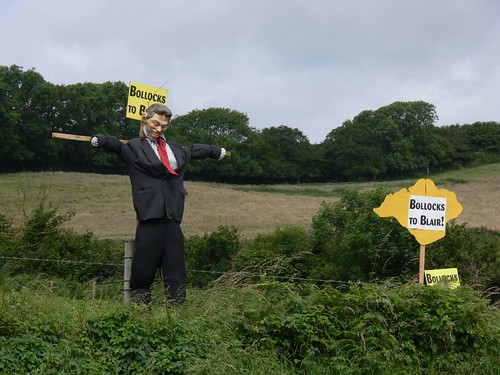
Judging by the public discourse, you might think Tony Blair was a dictator who railroaded the UK into war in 2003. But he was just one part of a foreign policy orientation incapable of saying no to the United States.

Today the long-awaited results of the Chilcot Enquiry into the UK's involvement in the 2003 Iraq War, the consequences of which the world is still living with, were finally published. 

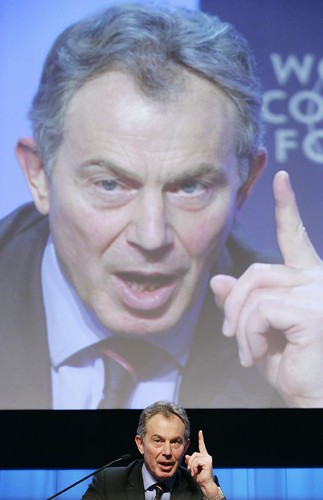
Like the 9/11 Commission's report in the United States in 2004, it contains little in the way of bombshell revelations. Instead it paints an overall damning picture of the leadership of Tony Blair, the centre-left politician who was prime minister at the time. It gives ammunition to those who want to see Blair prosecuted. Perhaps the most memorable line of the report's executive summary is this:
"I will be with you, whatever."
These words were in a 2002 private memo between Blair and US President George W Bush. The line seems to vindicate a long-held perception in the UK that Blair was Bush's poodle. Indeed, the memo suggests that even a year before the war's launch, Blair had decided to go along with whatever the American president proposed.

The entirety of the media coverage of the report today has centred on Blair. But as I've written before, I find the UK's myopic focus on Blair in the aftermath of the Iraq disaster to be counter-productive. 

Why personalise it so? Was it really Blair who was Bush's poodle? Or was it the UK that was America's poodle?

Thursday, 11 November 2010

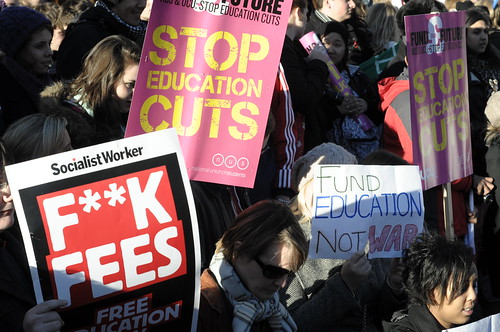
UK tuition increases spark student riot

Fury over the conservative government’s decision to raise university tuition fees as part of its massive spending cuts program boiled over into the streets of London today, culminating in violent clashes at the Conservative Party headquarters at 30 Millbank. What started as a peaceful student protest quickly spun out of control, as demonstrators smashed the windows of the headquarters, poured into the lobby, and scaled the roof. They lit fires, smashed cars and refused to move from the street outside the building. It was unprecedented for a student protest in modern British history, and was the first major violent demonstration against Prime Minister David Cameron’s austerity package.

The protests center around a proposal by Cameron’s government to allow universities to charge students between £6,000 ($9,600) and £9,000 ($14,400) in tuition per year. Currently, tuition fees are capped at £3,290($5,264). These fees may seem low by Americans standards, where university education can cost around $40,000 a year. But they are part of a general shift in the UK that has been a long time in coming. For over a decade, the English education system has been drifting away from the state-funded European model and toward the mass-education American model. In just 15 years, students in the UK will have gone from paying £0 for a four year university education in 1997 to £60,000 in 2012. It’s no wonder students are angry.

Tuesday, 28 September 2010

‘Red Ed’ elected new British Labour leader

As political theater goes, there’s nothing quite like sibling rivalry played out on the national stage. Such a drama has been playing out in the UK over the past several months as brothers David and Ed Miliband fought it out to become the next leader of the Labour party. This week it all came to a thundering climax as the Labour party conference chose younger brother Ed to be their leader.

The choice was not just between two different branches of a family tree – it was between two differing political ideologies. Or at least that’s the way it was being presented. Older brother David was the anointed successor to Tony Blair, and he was firmly entrenched in the “New Labour” makeover created by Blair and Gordon Brown in the 1990’s. That movement pulled the Labour party to the right to make it palatable to middle England and therefore electable. It came shortly after Bill Clinton remade the Democrats in the same way in the United States, though the term “New Democrat” has become almost an irrelevancy as the Democrats have settled comfortably into their new centrist role. That was never the case in the UK, where a large part of the Labour party resented Blair and Brown for pulling the party to the right and longed for a leader to end the New Labour project and return the party to its socialist routes.

Thursday, 28 January 2010

Tony Blair the scapegoat

The UK has been in frenetic anticipation this week of Tony Blair’s testimony Friday in front of the Iraq War show trial, er I mean, inquiry. The British media has been baying for a dramatic crescendo to the three week grilling of former cabinet officials who were involved in the decision to join the war. So far it's failed to deliver the “smoking gun” of conspiracy they’ve wanted. My inbox this week has been flooded with emails from activists and NGOs demanding this or that question be asked of Blair. Anticipation is so high that Channel 4 News actually spent 15 minutes last night doing a staged enactment of how the proceeding might go on Friday.

But despite the high theatre, the inquiry has failed to reveal anything too interesting. Given that the panel has focused so relentlessly on the accomplice rather than the perpetrator of the Iraq War, one could have expected similar results from an inquest of Austrian officials after World War II to “unearth the truth” about the invasion of Poland.

Friday, 20 November 2009

EU Low Representatives?


The look on Catherine Ashton’s face last night said it all. Shocked, flustered and almost a little embarrassed, the largely unknown British commissioner chosen to be the EU’s first “foreign minister” said it was a sign of her surprise that she had no acceptance speech prepared. Speaking in a softly reassuring tone, she said she would pursue a “quiet diplomacy” - characteristic of her low-profile approach to politics. 

Standing beside her, the expression of the unassuming Belgian prime minister Herman Van Rompuy was equally telling. Constantly switching languages every few minutes, he spoke of his reluctant acceptance of the offer from member state leaders to become the European Council’s first president. Oscillating between English, French and his native Dutch, a portrait emerged of a man who has gained a reputation as a quiet consensus-builder, having rescued the national Belgian government from collapse two years ago. 

And with them on the podium stood a beaming European Commission President José Manuel Barroso, a clear winner from last night’s announcement. In these two very low-profile picks Barroso will not have the competition for leadership he feared from a pick like Tony Blair or Jean-Claude Juncker. Since Rompuy will largely relegate his role to being a secretary-coordinator for the European Council, Barroso will continue to be the EU’s de facto leader. And with the demise of the rotating council presidency, he no longer has the prospect of an upstart national leader stealing the show every once in awhile. 

Together the three of them have been dubbed by bloggers today as the “Troika of Boredom” - three rather unengaging and unambitious politicians who are unlikely to give the EU the respected high profile it had sought to achieve by creating these new positions. Indeed, the reaction from Brussels blogs last night and this morning has been overwhelmingly unimpressed. Many are seeing the choice of two rather weak personalities as a deliberate effort by Angela Merkel and Nicolas Sarkozy to ensure that there is no strong supranational EU figure that could challenge their authority in the council. 

As for the fourth man standing in the group, his body language made it clear where his institution is headed. Frederik Reinfeldt, Prime Minister of Sweden (which currently holds the rotating council presidency), was practically being edged off the stage. The rotating country leadership will still continue to host meetings for the Council of Ministers, but it will no longer have any symbolic leadership role.

Franco-German Stitch-Up

Though the people selected for these new EU positions are being seen as boring, the selection itself is anything but. In fact, it is incredibly important. The remit of these two positions was left very vague in the text of the Lisbon Treaty, and all along its been said that the presidency would be defined by the first person who holds the job. 

If it were a high-profile person with much political clout, the presidency could become a powerful position capable of speaking with one voice for the EU on the world stage. If it was a low-profile choice, the presidency would become merely a coordinator role, a consensus-builder who would work behind the scenes to get the different leaders of member states to reach agreement. With the selection of Van Rompuy, member state leaders have made a clear decision about which way the presidency should go. His term length may just be two-and-a-half years, but if Rompuy takes a ‘low-profile coordinator’ approach to it as expected, it would be difficult for the next president to fundamentally reshape the precedent the Belgian set. 

But is this really what EU leaders wanted? Gordon Brown may have had his differences with Tony Blair in the past, but he seems to have been legitimately insistent that Blair should get the position. Indeed, it appears the choice of Ashton was made as a compromise to Brown in exchange for his abandoning the Blair cause. Sweden’s foreign minister seemed less than enthusiastic about the choice this morning, and many in Eastern Europe have been voicing grumbling discontent with the decision today. Certainly the Socialist leaders of Spain, Portugal and Greece can’t be pleased about it, considering they got the short end of the stick. Ashton is a fairly moderate politician who has little to no foreign policy experience. 

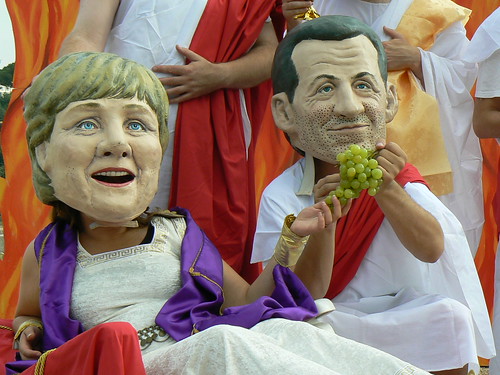
This will be largely seen as a Franco-German stitch-up. Merkel had indicated her preference for Van Rompuy early on, and after she persuaded Sarkozy to give up his preference for Tony Blair, the two announced they would be presenting a united front in their selection. This provoked accusations of bullying, with Sweden’s prime minister saying the decision should not be made by just the French and Germans. Certainly, it is a sign of Britain’s lack of influence in Europe that even as one of the ‘big three,’ it was unable to fight against a Franco-German alliance.

“Political Pygmies”

Certainly these two new ‘high representative’ positions were not the only part or even the main part of the Lisbon Treaty. Still, they were a significant part. And after eight long years of fighting for it, this decision has many asking, “What was the point?” The intention of the positions was to give someone the authority and clout to represent the EU on the world stage and stand toe-to-toe with the US and China. These two are unlikely to be able to do that, which bounces authority back to Barroso and back to the status quo, with no united voice for Europe. 

Many federalist Europhiles found themselves in the strange position of agreeing with UKIP leader Nigel Farage last night. Bizarrely, he told the BBC, "We've got the appointment of two political pygmies. In terms of a global voice, the European Union will now be much derided by the rest of the world."  But…isn’t that exactly what UKIP wants? The cognitive dissonance is even more impressive than usual on this one. 

For their part, the Tories praised the decision to go with a low-profile person rather than Tony Blair, with shadow foreign secretary William Hague saying, "I am very pleased that those of us across Europe who said that the president should be a chairman, not a chief, have won the argument.” 

Both the Tories and UKIP were also quick to point out that Baroness Ashton has actually never been elected to anything in her life. She spent most of her career working for a charity run by Prince Charles before being appointed as leader of the House of Lords in 2007 by Gordon Brown. When Peter Mandelson left his “Brussels exile” to return to Westminster in 2008, she took his place as EU Commissioner for Trade, where she’s served for about a year. Trade Commissioner is one of the most important roles in the EU and involves a lot of negotiation with foreign trade bodies (particularly those in the US and China). However it doesn’t necessarily involve any areas of foreign policy outside of trade. 

For his part, Van Rompuy is being lauded by his supporters as someone who united the warring Flemish and Frencophone factions of the Belgian parliament and brought the national government back from its year-long long shutdown in 2008. He reportedly took that job reluctantly after being asked by the Belgian king, who pleaded with him for 90 minutes. He had been set for retirement, and had already been on a long hiatus from politics. Merkel and Sarkozy have argued that his skills as a quiet consensus builder make him perfectly suited to coordinate the diverse member states of the EU. 

But it’s unclear whether this skill will translate to a European level. The disagreements in Belgium are between two parties, not 27. And authority in Belgium has been so devolved to the regions of Flanders and Wallonia by this point that the national government barely does anything at all – as evidenced by the fact that it was barely noticeable when the national government shut down for about a year. Is it that impressive that he was able to bring back to function a body that is largely symbolic by this point anyway? The EU may have it’s problems but it is by no means dysfunctional and is not about to shut down.

Realism

Perhaps the consensus reached last night appropriately reflects the fact that many Europeans are not ready for the notion of an “EU President.” The Liberal Democrats in the UK had an interesting interpretation of the decision yesterday, telling the BBC that the decision would expose the stupidity of the Eurosceptic British media referring to the Lisbon Treaty as if it was solely designed to create a powerful EU presidency for Tony Blair. Foreign affairs spokesman Ed Davey said,
"With low-profile appointees, no-one can take seriously any longer the Eurosceptic deception that these positions would challenge the supremacy of nation states acting together when they agree."
From the perspective of the UK and Scandinavia, where the prospect of an “EU President” was most unpopular, this may be true. But what about the many other Europeans who wanted the EU to speak with a stronger, more coherent voice on the world stage? Who now will have the clout to stand up to the United States in situations like the Iraq War? Who now will bring trade power to bear in negotiations over climate change? The decision to choose low-profile people may allay some of the fears expressed in the British media, but does it do so at the expense of offering a solution to the problem the Lisbon Treaty was trying to solve? 

Time will tell how these two will use their roles, but it looks like the wild card is more likely to be Ashton than Van Rompuy. She is younger, newer, and there is less known about her political stances on foreign policy issues (she by the way has a very left-of-centre husband I understand). Van Rompuy is unlikely to surprise anyone and will probably stick to a low-profile role. But it she wants to, the Baroness could shape the EU's foreign policy positions to be far more powerful than the presidency. 

That is, if she is so inclined.

Tuesday, 10 November 2009

Miliband says there’s no place like home

It would appear David Miliband decided to click his ruby slippers three times yesterday in Berlin, definitively turning down the new position of EU ‘foreign minister’ and opting to return home to a troubled government in the UK.

Of course this could all just be a ruse to take him out of the ‘frontrunner’ status, a notorious handicap when it comes to getting EU appointments. But all indications are that his conversation with the head of Europe’s socialist group yesterday in Berlin was genuine – he will not take the new high representative position if offered. Given that it appears Tony Blair is now out of the running for the position of EU president, it looks like there will be no Brits filling either of these two new roles. Given the UK’s lack of participation within the EU, there will be many on the continent who feel this result is appropriate.

Miliband had gained increased attention after a remarkably pro-Europe speech he delivered two weeks ago, saying the UK needed to abandon its ‘hubris and nostalgia’ and engage fully with the EU, working to reform it and make it strong. Given that this kind of talk is so rarely heard from a senior British politician, many Socialists in Europe were so elated they immediately began pushing for Miliband to take the foreign minister post.

However there was always some trouble with this logic. Miliband’s words were so encouraging precisely because he was such a senior politician delivering a pro-Europe speech in the UK. Take him out of the UK, and the beneficial aspect of that is nullified. David Miliband may have a moderately high profile in Britain, but its doubtful that his presence in Brussels would have focused British media attention on the EU in the way that Tony Blair being there would have. As I’ve written about before, a posting to Brussels is often considered a ‘banishment’ in the UK, and politicians sent there quickly disappear from the British media landscape. Having a pro-European in Brussels rather than in Westminster won’t do much to change the UK’s attitude toward the EU.

There was also a question on the mind of continental Socialists as to what sort of benefit he would bring for them as foreign minister. Though New Labour is part of Europe’s socialist grouping it is certainly at the more centrist, Atlanticist end of the spectrum. Miliband is after all a committed Blairite, which taints him with the brush of the Iraq War legacy. There were concerns that an EU foreign policy under Miliband would too often acquiesce to the plans of the United States, rather than offering a strong alternative. Then again, given that the governments of Europe will be dominated by conservative parties next year, it’s difficult to see how a far-left Socialist foreign policy chief could bring Europe to a consensus.

Miliband is still viewed by many as the last great hope for the dying Labour party, and there will be many within Labour who are relieved at today’s news. Many would have seen Miliband’s move to Brussels as a rat fleeing a sinking ship, given that Labour is almost guaranteed to lose the upcoming UK general election next year. In fact there are many who think Miliband is Labour’s last hope, and that the only way the party can win the upcoming election is if he leads a revolt against Gordon Brown and stands as Labour’s leader instead.

Given the widespread loathing of the British Conservative party in Europe these days, there were probably many on the continent from both the left and the right who thought their best hope was to keep Miliband in the UK and hope that he can somehow deal a miracle defeat to David Cameron. Of course if Labour does lose and Miliband becomes the head of the opposition, it's hard to see what benefit his pro-European views will bring then. It's all a bit up in the air, but one thing is certain - you haven't heard the last of David Miliband.

Friday, 30 October 2009

Little Support for 'President Blair'

The big European Council meeting is wrapping up this afternoon, and it looks like two definite conclusions are emerging: the Lisbon Treaty will shortly be signed by Czech president Klaus and Tony Blair will not be the first “president of Europe”.

Sources at the council
meeting are saying that almost all EU leaders are now unfavourable toward the prospect of Blair getting the presidency - most notably the leaders of Portugal, Spain and Greece (basically the only socialist governments in the EU other than the UK) and Angela Merkel, the main power broker as the leader of the largest EU country. It looks like the only leader supporting Tony Blair is his former rival, Gordon Brown. How bitterly ironic.

The British media has run with this story today
, effectively proclaiming the idea of a Blair presidency dead. In fact the story has been so widespread, and Downing Street so willing to publicly accept defeat, that I can’t help but wonder if this is an attempt by New Labour to feed this story to the media in order to take Blair out of the “frontrunner” status. Frontrunners are notoriously handicapped when it comes to getting nominated for EU positions. It may be that Blair now thinks the best way of getting the position is by appearing to be out of the race.

Much of the British media has been focusing on Blair’s role in Iraq and economic policies that stoked the financial crisis as the reason so may on the continent are opposed to his presidency. But I can tell you the biggest objection I hear coming from Brussels is there mere fact that he is British. They say the presidency should not go to someone from a country that is not really a fully participatory member of the EU – considering that it doesn’t use the euro, is not in the borderless Schengen zone, is the only country to receive a rebate from its EU financial contributions and has opted out of the charter of fundamental human rights.

Interestingly it would appear that the socialists are not backing Blair because they’ve made the political calculation that David Miliband is the only socialist who stands a chance of getting the new foreign policy chief position. And since both new positions can’t go to Brits, they want to squash talk of Blair right now in order to get Miliband in the running early. And his very pro-European speech earlier this week certainly ingratiated him to many on the continent.

So it looks like we’re back to square one, though Blair could conceivably pull it off. There is a lot working against him, but in the end the powers that be in continental Europe may decide that the appeal of having a “heavy hitting” president outweighs the baggage that Blair would bring to the position with him.

Thursday, 8 October 2009

"We Face an Aggressive Secular Attack"

The words above raised some eyebrows when they were bellowed yesterday at a conference at Georgetown University in Washington, but they weren’t from a fiery American evangelical – they were from former UK Prime Minister Tony Blair. The same Tony Blair who is currently the bookies’ favourite to become the first “president of Europe”.

Continuing my look
at the factors in the choice of the first person to take up the President of the European Council position, I thought I'd look at how these comments yesterday might affect the debate. Considering he is currently lobbying to be the symbolic leader of largely secular Europe, the speech seems remarkably ill-timed in its vitriolic attack on atheism (full text of the speach here). According to the Times, Blair said of the world’s religions:
“We face an aggressive secular attack from without. We face the threat of extremism from within.” Arguing that there was “no hope” from atheists who scorn God, he said the best way to confront the secularist agenda was for all faiths to unite against it. “Those who scorn God and those who do violence in God’s name, both represent views of religion. But both offer no hope for faith in the twenty first century.”
Apparently to Blair, Atheists and terrorists are two sides of the same coin. To call the comments incendiary is an understatement, and they may well come up during the difficult deliberations over the next month over who should take up the position of Europe’s first symbolic “president”. And it certainly won’t help Blair with secular Europeans that his speech was delivered in ultra-religious America.

Indeed it is Blair’s ties with America that are proving the biggest stumbling block to his candidacy, particularly his relationship with former President George W. Bush. The European left already reviles him for tearing Europe apart in 2003 by being an unquestioning defender of the Iraq war.

For me personally, there is just no way I could support someone for this position who said those words above. So my hesitation is over, I can unequivocally say that putting Tony Blair in that position would be a bad move for Europe, and it would not be worth the celebrity and energy he would bring to the role.

Contrary to the conclusions already drawn by the British tabloid media, I actually don’t even think it is very likely he will get the position. As the Economist’s Charlemagne column points out today, the fact that Tony Blair's name has been connected with this position for two years now actually works against him, as front-runners rarely secure euro-jobs in the end. And the reasons for various and disparate groups to oppose him are too high in number to see how he could overcome them easily. Small states don’t want to see the position go to anyone from the big three. The left hates him for the Iraq War, his abandonment of socialism to win UK elections and his sudden conversion to aggressive religiosity. The continental right is at best lukewarm toward him and at worst jealous of his celebrity. The British right reviles him. Who exactly is supporting this man?

So who am I backing? He may not be famous or charismatic, but my hopes are being placed in Luxembourg’s Jean-Claude Juncker. As leader of the Eurozone finance ministers he is keenly placed to help Europe through the recovery and to put in place new safeguards and regulatory regimes to prevent another crisis. Of course there are significant hurdles for him to overcome as well. Both Labour and the Tories hate him for his unabashed federalism, and Sarkozy reportedly thinks he bungled the start of the financial crisis.

So even though I was on the fence, there’s just no way I can hold my nose and cast my lot for Blair after hearing what he said in Washington yesterday, no matter how much his celebrity would give the EU some much-needed glamour and cache. Juncker may not be a Barack Obama, but given the disillusion many American progressives are now feeling about that presidency across the pond, maybe celebrity presidencies aren’t all they’re cracked up to be.

Tuesday, 6 October 2009

Both the Best and Worst Man for the Job


Now that the Irish have passed the Lisbon Treaty and it’s set to be ratified within months, the British press has transferred its characteristically ferocious obsession to what the treaty will do. And to hear them tell it, the sole purpose of this document is to make Tony Blair the “President of Europe”. Of course that is not true, and in reality no such position is being created. The position being referred to is the President of the European Council, which has always existed but will now go to a person rather than to a country (Sweden currently holds the presidency). The position doesn’t come imbued with much specific power like an American president, it's more of a symbolic coordinator role like the Secretary General of the United Nations.

But though it doesn’t come with executive power, the intention of the position – to designate a high-profile figure who can speak with one voice for all of the EU - is ambitious. Right now, the member state holding the Council presidency is unable to do that because they can essentially only speak for themselves, and they don’t have much time to develop a cohesive presentation of EU objectives given that they only hold the position for six months. So having an actual person in place for a longer term will make a big difference, although he is essentially "working for" the 27 European heads of government that make up the Council, not the other way around. He can only speak when he's been given permission by the entire council, a position he may find frustrating since he is used to the unilateral system of Westminster government.

The de facto “leader” of the EU up till now has been the president of the European Commission, a position currently held by Jose Manuel Barroso. But given that the Commission (made up of independent commissioners) and the Council (made up of the prime ministers of each member state) are often in conflict, Barrosso has never been able to convincingly speak for all of the EU even when he’s sitting in as its representative in bodies such as the G8. The Commission has no control over member states’ foreign or military policy. Of course the President of the European Council won't be able to unilaterally make foreign policy decisions (and nether can the new position of EU High Representative on Foreign Policy). The president is subject to the prime ministers of the member states, but he can work to attain a consensus amongst them and then announce and coordinate that policy (much in the same way Switzerland's executive branch works).

So the new presidency position calls for someone who has talents in two distinct areas: he or she needs to know how to work a room and twist arms in order to reach group consensus, and they need to be a high-profile, charismatic figure who can represent the EU on the world stage. Obviously, Tony Blair meets both of these requirements.

The problem is he also has one giant albatross hanging around his neck: Iraq. The fact that he was prime minister when the UK followed the US in its war with Iraq hasn’t endeared him to the British public or to Europeans in general. The centre-left of Europe is deeply mistrustful of Blair because of his role in the war, and this is a stigma he is never likely to live down. And in the UK, as has been evidenced by the vitriolic reaction by the British press to the likelihood of his presidency, Blair is still widely reviled by both the left and the right. The right hates him because he presided over the humiliating defeat of the Tories and pushed for a marginal social democratic agenda, the left hates him because he acquiesced to American power, and because they feel betrayed by many of New Labour's policies and promises it did not fulfil. He’s also become an openly religious Catholic since leaving office, and that doesn’t exactly endear him to the secular left either in Britain or on the continent.

Given the painful divisions that emerged in Europe in 2003 over the Iraq War, and how those divisions exposed how weak and incoherent Europe still is in the area of foreign policy, picking someone as president who conjures up those memories may at first seem like something Europe would want to avoid. But the reality is there just isn’t any other logical choice – such is the dearth of high-profile, charismatic politicians in Europe. The runners-up? Jan Peter Balkenende of Holland, François Fillon of France, Herman Van Rompuy of Belgium and Jean-Claude Juncker of Luxembourg. Not exactly household names.

Hated at Home

With this reality in mind I had long ago concluded that despite the Iraq problem Blair was probably the best pick. But in the past few days speaking with some of my friends here in the UK, I’m starting to get the full sense of how the wounds of the Iraq war have still not healed here. Even my most liberal friends have reacted with horror to the idea that Blair will assume the presidency, saying that after the British public and media worked so hard to push him to resign it would be an insult to see him appointed to an unelected position where he seems to be lording over them.

A recent survey showed that a majority of the British public (53%) is opposed to Blair becoming president. Perhaps even more surprising is the fact that only 66% of Labour party members want him to get the job. At their party conference this week the Conservatives seem to be content to make a bogeyman out of Blair, with Boris Johnson saying Britain is faced with the prospect of Blair “suddenly pupating into an intergalactic spokesman for Europe”. The media has been almost salivating with hostility toward the idea as well, with the Telegraph newspaper actually referring to a proposed British referendum on the Lisbon Treaty in a headline yesterday as the “Stop Tony Blair Referendum”.

Certainly, these fears are misguided. Logically the Tories should be rooting for the first president of the council to be British – that would give the UK the influence in Brussels to be able to push through the EU reforms they claim they are so intent on achieving. Opposing Blair is certainly a case of the Tories cutting off their nose to spite their face, perhaps succumbing to mob-pleasing populism over sound policy.

But this isn’t just the usual British paranoia about the EU revealing its ugly head. There is a real feeling of ill will toward Tony Blair in this country, and I’m starting to wonder if its really worth it for Brussels to further antagonize the British, who are already so hostile to the EU. It’s a bizarre situation – Blair being president would undoubtedly be a good thing for the UK (the vast majority of respondents to that survey admitted as much), but he remains so controversial in his home country that the appointment would infuriate many in the UK – particularly the liberal left which the EU so badly needs in its corner.

Perhaps this initial discomfort with the choice of Blair will go away after a short while, and the British people eventually will come to remember what it was that inspired and enthused them about Blair in the first place. If that were the case Blair could actually serve as the ambassador for Brussels who could finally make the British like Europe, or at least make them finally accept that they need Europe. It was always a shame that the Iraq War intervened to derail Mr. Blair’s hopes of making Britain a fully active and contributory member of the EU. Perhaps this is the opportunity for him to finally see out that goal. It would be one failed promise that New Labour could belatedly deliver on.

Friday, 30 May 2008

Welcome to the religion century

Tony Blair made some interesting comments at a fundraising dinner in Toronto last night. Coming on the eve of the launch of his new Faith Foundation, which was unveiled to the world today in New York, it offered a stark and blunt assessment of the century we are entering. While probably true, his comments will no doubt be quite troubling to secular Europe.

Speaking at the Women’s College Hospital in Toronto, Blair described the impetus behind his new faith foundation as an effort to “get faith in action,” saying that the goal of his new foundation is to help various religions work together to make the process of globalisation more humane. Sounds innocuous enough. But it was his blunt assessment of the power religion will have over the world over the next century that got my attention. Spoke Blair:

“Religious faith will be of the same significance to the 21st Century as political ideology was to the 20th Century.”

Friday, 15 February 2008

Report: Blair dropped Saudi probe after being threatened

This story in today's Guardian reveals an absolutely shocking allegation made against Tony Blair in court: Saudi prince and close Bush ally Bandar Bin Sultan cajolled Tony Blair into dropping Britain's bribery investigation into a Saudi oil deal by threatening to unleash terroist attacks on Britain.

Bandar bin Sultan, who was the Saudi Ambassador to the US for 20 years, and a close personal friend of the Bush family, is under investigation for taking $2bn in bribe payments from BAE for arranging an arms deal. The British government investigation into this was mysteriously halted after Bandar visited Tony Blair in December 2006.

Now people have testified in court that Bandar, who's now the head of the Saudi National Security Council, basically told Blair that if he didn't stop investigating his corruption, he'd withhold information on suspected terrorists and there'd be a loss of "British lives on British streets." The Guardian writes:

Thursday, 7 February 2008

President Tony Blair?

It looks like discussion around Tony Blair becoming the first “President of Europe” is heating up. According to the BBC, Blair is now discussing the prospect with current British prime minister Gordon Brown.

The network is claiming there are forces in the prime minister’s office who are actively encouraging such an idea. It is thought that Blair and Brown are discussing the pros and cons of such a move, and Brown is waiting for Blair’s green light before he voices his support for the idea, which would signal that Blair is actively campaigning for the job.

Blair’s recent activity suggests that he is leaning in that direction. Last month he delivered a speech to Sarkozy’s UMP party conference – in French! Sarkozy has in turn expressed his desire for Blair to take the job.

Friday, 11 January 2008

Obama's loss: the view from Europe

Given that I wrote about Europe's reaction to Obama's win in Iowa last week, I thought it logical to now write about its reaction to his loss this week. Just from personal observation, I've been surprised at the huge level of relief being expressed by most people I know here in the UK. It seems that though they were impressed with and surprised by Barack's win, they are still rooting for Hillary to win the Democratic nomination. In fact I don't know a single European who actively wants Obama to win.

Part of this of course is that they know Hillary, they adored Bill Clinton and are eager to see a return to the Clinton years. They know almost nothing about Obama, and being removed from the domestic situation in the US they can't quite understand the enthusiasm for a man who has outlined little of his actual platform or policy plans.

Wednesday, 12 December 2007

Brown ashamed of Europe?

I'm starting to view Gordon Brown with some "Britoscepticism."

Throughout all the troubles of the past few months, the British media have been picking on Brown and labeling him a 'ditherer'. With each unfolding embarrassment, it seemed there was a plausible defense for Brown. When the elections fiasco happened, it could be argued that Brown hadn’t “intended to call an election and then chickened out,’ but had rather failed to squash unprovoked rumors of an election early enough. When the Northern Rock bank run and bailout happened, many, such as the ECB, believed that the government stepping in was probably the best option. When the government lost the identity records of thousands of people in the second largest data loss in history, one could say it would be foolish to blame Brown because he had nothing to do with it. And as the controversy over “dodgy donations” has unfolded, with new stories of Labour improperly accepting campaign money unfolding every day, it seemed that the only reason this was a story was because Labour had put those campaign finance laws into effect in the first place and these were the inevitable growing pains as the system figures itself out.

Friday, 7 December 2007

Secular society in the UK

As an American living in the UK, people often ask me what some of the biggest differences are between living in the two countries. Always eager to please, I usually list the positive differences first. For instance, for me, quality of life here is better. Music is more to my taste. Nearby places to travel are more interesting and London is more international than New York City. And of course, free healthcare!

But beyond all these things, there’s been an underlying difference which I wasn’t able to really put into words until recently. And it's historically one of the biggest differences two societies can have between one another: religion.

As an Atheist, I feel much freer to express my religious beliefs in the UK than I ever did in the US. In America, I usually felt that I had to keep my religious affiliation to myself, and I knew few others who also openly identified as atheists. Here in the UK, most people I know identify as atheists. For me, it means I feel a greater degree of religious freedom in the UK.

Tuesday, 25 September 2007

UK election next month?

It’s party conference season here in the UK. If you took the word ‘conference’ out of that phrase it would sound a lot more fun. But from what I heard from my friend Francis about the Lib Dem conference down in Brighton, these things are actually a raucous good time.

Party conference season refers to the three weeks in the fall when the three main political parties in the UK each have a big event outlining their platform for the coming year. They’re a bit like the national conventions in the US, except that they happen every year rather than every four years and are not expressly for the purpose of choosing a candidate to run for the country’s leadership (although sometimes such a leadership change is made).

Tuesday, 27 March 2007

Britain's leadership crisis

There’s been some really interesting revelations today about the Tony Blair – Gordon Brown succession here in the UK. Brown, who joined forces with Blair in the 1990’s to develop the “new Labour” movement (paralleling Bill Clinton’s “new Democrats” in the US), is the logical successor to Blair because he has been the Chancellor of the Exchequer throughout Blair’s tenure. There have also been reports that, when Blair and Brown sat down to develop their new Labour strategy, they agreed that Blair would be the public face of the movement at first, but would eventually step aside and let Brown take over. That stepping aside, according to these reports, is now long overdue.

But Blair and Brown have never actually gotten along so well, and there has been tension brewing between the two for many years. This has made the handover particularly awkward, as Blair seems to be holding out to see if anyone will challenge Brown.

The gathering storm on the horizon, of course, is David Cameron, the charismatic leader of the “new Tories” who is hard at work rebranding the conservative party as environmentally friendly and concerned about social welfare. The young, energetic and magnetic Cameron is a sharp contrast from the aging, dour and cranky Gordon Brown. Eventually, Brown will have to call an election (although he gets to choose when this will occur) and at that time Cameron will be ready for attack. It’s anybody’s guess what will happen then, but if Brown wants to defeat him he’s going to have to work pretty hard after becoming PM. People generally don’t like him too much here.

Thursday, 30 November 2006

London Bridge wanna go down

Ouch. Some devastating comments by a state department official Tuesday night regarding the Atlantic Alliance and the UK's traditional role as a bridge between America and Europe. Namely, that it has been irreparably harmed by the Iraq War, and will probably never recover.

Kendall Myers, a senior State Department analyst, told an academic forum that for all Britain’s attempts to influence US policy in recent years, “we typically ignore them and take no notice."

The comments left government officials on both sides of the Atlantic scrambling. Denis MacShane, Labour MP for Rotherham and a former Foreign Office minister, who supported the Iraq war, said: “After the Republican defeat in the midterm election, every little rat who feasted during the Bush years is now leaving the ship. I would respect this gentleman, who I have never heard of, if he had had the guts to make any of these points two or five years ago.”

Tuesday, 21 March 2006

Dueling Speeches Across the Atlantic

Some interesting language used in today’s simultaneous speeches/press conferences by George W. and Tony Blair.

The US Media seems to have picked up mainly on the answer W gave to a reporter about how long troops will be in Iraq, saying, “"That, of course, is an objective. And that will be decided by future presidents and future governments of Iraq." This of course, led to today’s headlines of, “Bush: Troops to stay in Iraq through '08” in the US media. I’m pretty sure this headline will shock a lot of people across the country.

Bush’s statement, of course, is a fairly obvious conclusion. There’s no reason to presume troops will have left by 2008. In fact it’s hard to see how the US could possibly withdraw before then without leaving the country in ruin and chaos.