Members of the British parliament were called back from their vacations for an emergency session yesterday to deal with the country's riots earlier this week. The past two nights have been quiet - a combination of bad weather and a surge in police forces seems to have done the trick. But now the political storm begins, with the public demanding to know how the situation could have gotten so out of control.
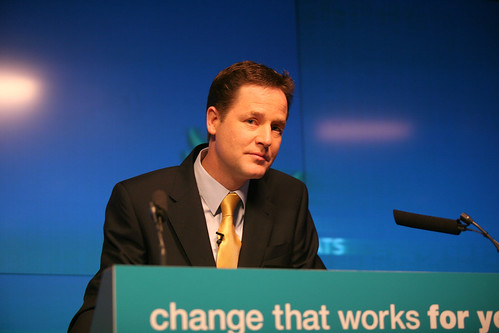
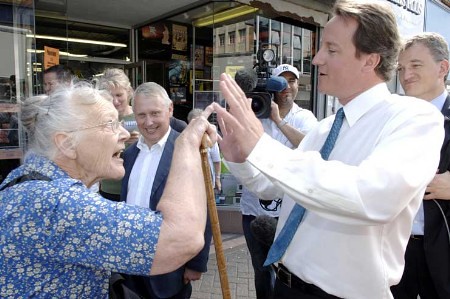
The focus of much of the public's ire has been prime minister David Cameron. He was seen to be back-footed during the crisis, spending the first few days of the rioting insisting he would not cut short his vacation in Italy, and only returning to the country after the riots got very serious Monday night. The media has been referring to it as his "Katrina moment", referencing the back-footed response of US president George W. Bush to Hurricane Katrina in 2005. The incident is being seen as a defining moment of his premiership, and he has been much maligned for it. The above gag photo of his speech on Tuesday from photoshoplooter illustrates the public's perception of his response.
Cameron has been working overtime to dispel that image over the past few days. In yesterday's emergency session he aggressively denounced the riots, saying the behavior of this bad element of society could not be excused by social factors or circumstances. And though his party often criticised the opposition Labour party for introducing "knee-jerk legislation" after crises during their time in government, he floated no fewer than six new policies. These include a ban on face masks in public, increased curfew powers, allowing courts to ban children from gathering in certain places and, most controversially, he said he is considering allowing temporary bans on social media during times of social unrest.
Showing posts with label Labour Party. Show all posts
Friday, 12 August 2011
Thursday, 11 November 2010
UK tuition increases spark student riot
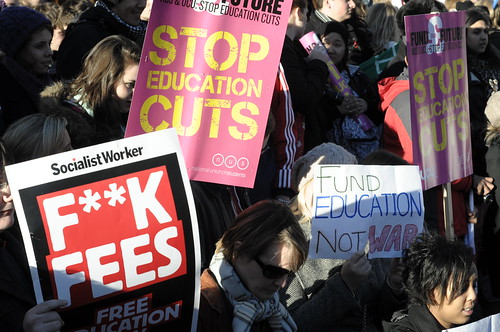
Fury over the conservative government’s decision to raise university tuition fees as part of its massive spending cuts program boiled over into the streets of London today, culminating in violent clashes at the Conservative Party headquarters at 30 Millbank. What started as a peaceful student protest quickly spun out of control, as demonstrators smashed the windows of the headquarters, poured into the lobby, and scaled the roof. They lit fires, smashed cars and refused to move from the street outside the building. It was unprecedented for a student protest in modern British history, and was the first major violent demonstration against Prime Minister David Cameron’s austerity package.
The protests center around a proposal by Cameron’s government to allow universities to charge students between £6,000 ($9,600) and £9,000 ($14,400) in tuition per year. Currently, tuition fees are capped at £3,290($5,264). These fees may seem low by Americans standards, where university education can cost around $40,000 a year. But they are part of a general shift in the UK that has been a long time in coming. For over a decade, the English education system has been drifting away from the state-funded European model and toward the mass-education American model. In just 15 years, students in the UK will have gone from paying £0 for a four year university education in 1997 to £60,000 in 2012. It’s no wonder students are angry.
Tuesday, 28 September 2010
‘Red Ed’ elected new British Labour leader
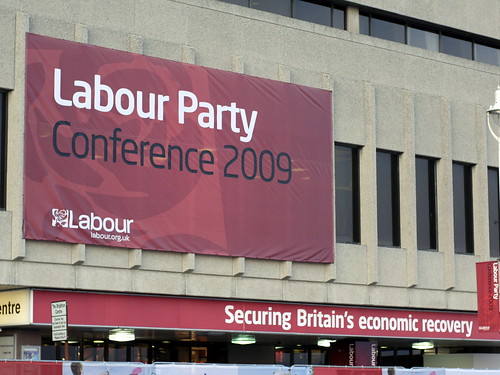
As political theater goes, there’s nothing quite like sibling rivalry played out on the national stage. Such a drama has been playing out in the UK over the past several months as brothers David and Ed Miliband fought it out to become the next leader of the Labour party. This week it all came to a thundering climax as the Labour party conference chose younger brother Ed to be their leader.
The choice was not just between two different branches of a family tree – it was between two differing political ideologies. Or at least that’s the way it was being presented. Older brother David was the anointed successor to Tony Blair, and he was firmly entrenched in the “New Labour” makeover created by Blair and Gordon Brown in the 1990’s. That movement pulled the Labour party to the right to make it palatable to middle England and therefore electable. It came shortly after Bill Clinton remade the Democrats in the same way in the United States, though the term “New Democrat” has become almost an irrelevancy as the Democrats have settled comfortably into their new centrist role. That was never the case in the UK, where a large part of the Labour party resented Blair and Brown for pulling the party to the right and longed for a leader to end the New Labour project and return the party to its socialist routes.
Wednesday, 12 May 2010
An unholy alliance
Well, that was a crazy couple days. But last night it all came to a dramatic and sudden end as Gordon Brown abruptly drove to Buckingham Palace to hand in his resignation to Queen Elisabeth II, making Conservative leader David Cameron prime minister. So now it’s all done and dusted right? Hardly.
The excitement started Monday afternoon when, as the Conservatives and Liberal Democrats were still holding their negotiations, Gordon Brown emerged from 10 Downing Street to announced that Lib Dem leader Nick Clegg had approached the Labour Party to see what they could offer instead. And, most dramatically, Brown announced that he would be resigning as leader of the Labour Party.
That announcement soon sparked breathless speculation throughout the media. Gordon Brown stepping down was considered by many to be a precondition for a Liberal Democrat – Labour coalition. Surely, the media inferred, Brown would not have made that dramatic (and rather humiliating) announcement unless some kind of deal had been worked out. For the rest of the day Monday the assumption was that some kind of Lib-Lab coalition was being formed. The problem of course was that a Lib-Lab union would still not meet the threshold of reaching a majority in the parliament.
The excitement started Monday afternoon when, as the Conservatives and Liberal Democrats were still holding their negotiations, Gordon Brown emerged from 10 Downing Street to announced that Lib Dem leader Nick Clegg had approached the Labour Party to see what they could offer instead. And, most dramatically, Brown announced that he would be resigning as leader of the Labour Party.
That announcement soon sparked breathless speculation throughout the media. Gordon Brown stepping down was considered by many to be a precondition for a Liberal Democrat – Labour coalition. Surely, the media inferred, Brown would not have made that dramatic (and rather humiliating) announcement unless some kind of deal had been worked out. For the rest of the day Monday the assumption was that some kind of Lib-Lab coalition was being formed. The problem of course was that a Lib-Lab union would still not meet the threshold of reaching a majority in the parliament.
Saturday, 8 May 2010
The British election explained
Many Americans I've talked to have been confused about what exactly is going on here, and I can certainly sympathize. First they were hearing that this was the Liberal Democrats' year, that following the televised debates the "Clegg effect" was going to transform this election and make the UK's third party politically relevant for the first time in decades. But then when the results came in Thursday night, Americans heard that the Liberal Democrats had suffered a stunning defeat, actually losing seats in the parliament. Oh well, so much for that then. But wait, come Friday they learn that the Liberal Democrats are now the most important factor in these post-election days, as they will be selecting who will be prime minister. So how does someone lose so badly and yet end up selecting who the winner will be?
Friday, 7 May 2010
Westminster in chaos
It’s looking as if a Liberal Democrat – Labour coalition may not be enough for a majority either, which may rule out that option. It was a disastrously disappointing night for the Lib Dems and their supporters. Despite all the speculation after the first televised debate that this could be their year, the Lib Dems actually lost seats in this election. It’s truly stunning.
Of course along with all the polling showing surging support for the Lib Dems after the first debate came notes of caution that the pollsters did not know how the increased support would affect the actual vote. UK elections still use a peculiar first-past-the-post system for their elections which heavily favours the two main parties. This type of electoral system is normal in the presidential system of the US, but it is unusual in a parliamentary system. Most other parliamentary democracies use a ranked voting system where people indicate your first choice and then a second choice. The Lib Dems have made switching to a proportional representation or ranked system a cornerstone of their campaign, and recently Labour agreed to put it to a referendum. The Tories have refused to consider such a change, but it is likely that the Lib Dems would demand this if they were to enter into a coalition with the Conservatives..
Thursday, 29 April 2010
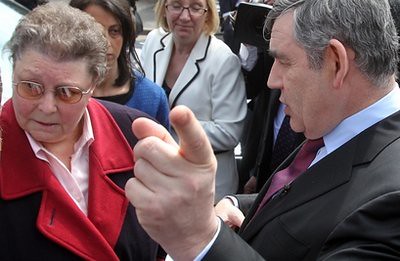
"That bigoted woman”
It was almost the perfect storm to sink Prime Minister Gordon Brown – an aloof, awkward politician with a reputation for behind-the-scenes temper tantrums disrespects a middle England voter by deriding her as “bigoted” because she brought up a question about immigration, the most sensitive political issue in Britain. Add to that the fact that this was an elderly woman who had actually stated her concerns to Brown in a fairly reasonable manner and you’ve got a concoction that is virtually guaranteed to spell the end of Gordon Brown’s political career.
Brown has never liked the schmoozing, glad-handing aspect of politics. He has long been known to get frustrated with the American-style 'popularity contest'that Tony Blair brought to British politics. It is likely that on this occasion, his frustration boiled over. Unfortunately for him, it happened while he was still on mic.
Wednesday, 28 April 2010
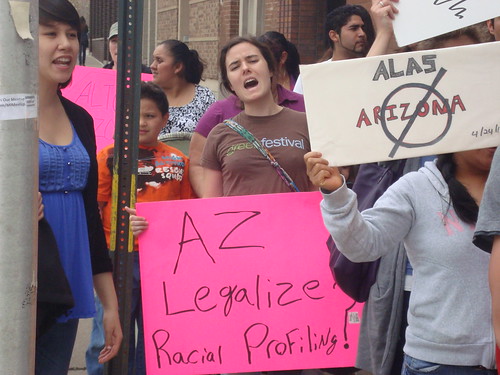
Arizona moves toward Europe with ‘papers, please’ law
The Arizona immigration law signed by the state’s Republican governor this week would require police officers to stop anyone who looks like an illegal immigrant and demand that they produce paperwork showing they have the right to be in the United States. The law’s passage has resulted in a furor in America, where critics say it mandates police to conduct racial profiling and is likely to be used by local officials to harass minorities. ‘Boycott Arizona’ movements are spreading like wildfire, and if there is speculation they could be as successful as the 1991 boycott when the state refused to recognize Martin Luther King Day. That boycott cost the state an estimated $400 million. On that issue, Arizona eventually caved.
Friday, 16 April 2010
The big debate
There was a lot of skepticism in the UK over whether this was really a useful exercise. After all, the party leaders already have a televised debate every week with prime ministers questions, when the full parliament sits and the leaders ask each other questions for 30 minutes. PMQs get very raucous, with hooting and hollering, accusations, jeers, laughter, you name it. Over the years they’ve gotten increasingly theatrical and bombastic, to the point where these days it seems a lot more like political theatre than legitimate debate.
There have been calls for the UK to start doing American-style televised debates during their general elections for decades, but every prime minister from Thatcher to Blair has always refused. It was, according to conventional wisdom, the sitting prime minister who had the most to lose by participating in a debate that would put them on an equal playing field with the opposition. But this year Gordon Brown relented, and of course, there’s no putting the lid back on that jar. Last night was the dawn of a new era in British politics. Never again will a sitting prime minister be able to avoid a televised debate.
Thursday, 15 April 2010
The UK election and the EU – a stark choice
It’s really an incredible thing to witness – British elections apparently don’t slowly emerge and gather pace, but instead arrive with a loud thud. Last week Prime Minister Gordon Brown called an election, and on Monday the Queen ceremoniously dissolved parliament. Almost on cue, my Facebook feed suddenly lit up with status messages from Brits asking who they should vote for.
It’s strange, because it’s been known for months that the election would be at some point in May. it’s literally the last moment at which Gordon Brown could have called an election since the last one was 5 years ago. But I guess it isn’t ok to start thinking about how you will vote until the Queen tells you to!
This will be the first UK election I will have observed since moving there. The process is extremely different from that in the US. Once the parliament is dissolved, MPs have just a few weeks to rush home to their constituencies to campaign. On 6 May the Brits will go to the polls, and whichever party gets the most votes will be able to appoint the prime minister. But one part of this year’s election will be very American. For the first time ever, the leaders from the three main parties will take place in an American-style TV debate. The first one will air tonight.
It’s strange, because it’s been known for months that the election would be at some point in May. it’s literally the last moment at which Gordon Brown could have called an election since the last one was 5 years ago. But I guess it isn’t ok to start thinking about how you will vote until the Queen tells you to!
This will be the first UK election I will have observed since moving there. The process is extremely different from that in the US. Once the parliament is dissolved, MPs have just a few weeks to rush home to their constituencies to campaign. On 6 May the Brits will go to the polls, and whichever party gets the most votes will be able to appoint the prime minister. But one part of this year’s election will be very American. For the first time ever, the leaders from the three main parties will take place in an American-style TV debate. The first one will air tonight.
Tuesday, 2 March 2010
A tea party for Britain?
This week, Tory Member of the European Parliament Daniel Hannan was on Fox News in America, where he is frequently found, and talked about his efforts to bring the anti-government “tea party” movement to the UK.
The idea that this rag-tag movement of disaffected, gun-toting right-wingers with funny hats could ever catch on in the United Kingdom is a stretch. I probably couldn’t think of a more un-British phenomenon. But, given the rising anti-EU rhetoric in this country, is it inconceivable to see Hannan's vision become a reality here?
Who knows how many people actually turned up to Hannan’s little gathering, I certainly didn’t hear anything about it in the British media (a quick check suggests about 100 people showed up). But though he may be on the fringe of British politics and is an unwanted thorn in the side of Tory leader David Cameron, it is important to remember Hannan is still a Tory politician. His brand of populist, anti-government rhetoric is just an extreme representation of a strain of thought that is active and growing in the Conservative Party.
The idea that this rag-tag movement of disaffected, gun-toting right-wingers with funny hats could ever catch on in the United Kingdom is a stretch. I probably couldn’t think of a more un-British phenomenon. But, given the rising anti-EU rhetoric in this country, is it inconceivable to see Hannan's vision become a reality here?
Who knows how many people actually turned up to Hannan’s little gathering, I certainly didn’t hear anything about it in the British media (a quick check suggests about 100 people showed up). But though he may be on the fringe of British politics and is an unwanted thorn in the side of Tory leader David Cameron, it is important to remember Hannan is still a Tory politician. His brand of populist, anti-government rhetoric is just an extreme representation of a strain of thought that is active and growing in the Conservative Party.
Tuesday, 10 November 2009
Miliband says there’s no place like home
Of course this could all just be a ruse to take him out of the ‘frontrunner’ status, a notorious handicap when it comes to getting EU appointments. But all indications are that his conversation with the head of Europe’s socialist group yesterday in Berlin was genuine – he will not take the new high representative position if offered. Given that it appears Tony Blair is now out of the running for the position of EU president, it looks like there will be no Brits filling either of these two new roles. Given the UK’s lack of participation within the EU, there will be many on the continent who feel this result is appropriate.
Miliband had gained increased attention after a remarkably pro-Europe speech he delivered two weeks ago, saying the UK needed to abandon its ‘hubris and nostalgia’ and engage fully with the EU, working to reform it and make it strong. Given that this kind of talk is so rarely heard from a senior British politician, many Socialists in Europe were so elated they immediately began pushing for Miliband to take the foreign minister post.
However there was always some trouble with this logic. Miliband’s words were so encouraging precisely because he was such a senior politician delivering a pro-Europe speech in the UK. Take him out of the UK, and the beneficial aspect of that is nullified. David Miliband may have a moderately high profile in Britain, but its doubtful that his presence in Brussels would have focused British media attention on the EU in the way that Tony Blair being there would have. As I’ve written about before, a posting to Brussels is often considered a ‘banishment’ in the UK, and politicians sent there quickly disappear from the British media landscape. Having a pro-European in Brussels rather than in Westminster won’t do much to change the UK’s attitude toward the EU.
Miliband is still viewed by many as the last great hope for the dying Labour party, and there will be many within Labour who are relieved at today’s news. Many would have seen Miliband’s move to Brussels as a rat fleeing a sinking ship, given that Labour is almost guaranteed to lose the upcoming UK general election next year. In fact there are many who think Miliband is Labour’s last hope, and that the only way the party can win the upcoming election is if he leads a revolt against Gordon Brown and stands as Labour’s leader instead.
Given the widespread loathing of the British Conservative party in Europe these days, there were probably many on the continent from both the left and the right who thought their best hope was to keep Miliband in the UK and hope that he can somehow deal a miracle defeat to David Cameron. Of course if Labour does lose and Miliband becomes the head of the opposition, it's hard to see what benefit his pro-European views will bring then. It's all a bit up in the air, but one thing is certain - you haven't heard the last of David Miliband.
Tuesday, 6 October 2009
Both the Best and Worst Man for the Job
Now that the Irish have passed the Lisbon Treaty and it’s set to be ratified within months, the British press has transferred its characteristically ferocious obsession to what the treaty will do. And to hear them tell it, the sole purpose of this document is to make Tony Blair the “President of Europe”. Of course that is not true, and in reality no such position is being created. The position being referred to is the President of the European Council, which has always existed but will now go to a person rather than to a country (Sweden currently holds the presidency). The position doesn’t come imbued with much specific power like an American president, it's more of a symbolic coordinator role like the Secretary General of the United Nations.
But though it doesn’t come with executive power, the intention of the position – to designate a high-profile figure who can speak with one voice for all of the EU - is ambitious. Right now, the member state holding the Council presidency is unable to do that because they can essentially only speak for themselves, and they don’t have much time to develop a cohesive presentation of EU objectives given that they only hold the position for six months. So having an actual person in place for a longer term will make a big difference, although he is essentially "working for" the 27 European heads of government that make up the Council, not the other way around. He can only speak when he's been given permission by the entire council, a position he may find frustrating since he is used to the unilateral system of Westminster government.
The de facto “leader” of the EU up till now has been the president of the European Commission, a position currently held by Jose Manuel Barroso. But given that the Commission (made up of independent commissioners) and the Council (made up of the prime ministers of each member state) are often in conflict, Barrosso has never been able to convincingly speak for all of the EU even when he’s sitting in as its representative in bodies such as the G8. The Commission has no control over member states’ foreign or military policy. Of course the President of the European Council won't be able to unilaterally make foreign policy decisions (and nether can the new position of EU High Representative on Foreign Policy). The president is subject to the prime ministers of the member states, but he can work to attain a consensus amongst them and then announce and coordinate that policy (much in the same way Switzerland's executive branch works).
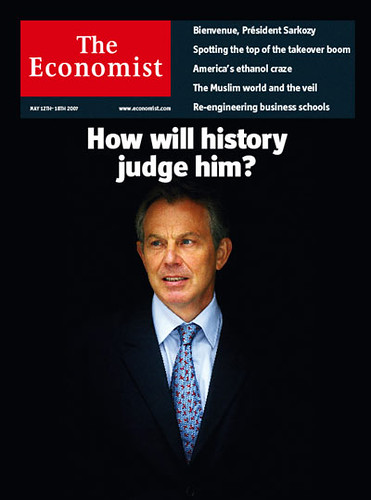
So the new presidency position calls for someone who has talents in two distinct areas: he or she needs to know how to work a room and twist arms in order to reach group consensus, and they need to be a high-profile, charismatic figure who can represent the EU on the world stage. Obviously, Tony Blair meets both of these requirements.
Given the painful divisions that emerged in Europe in 2003 over the Iraq War, and how those divisions exposed how weak and incoherent Europe still is in the area of foreign policy, picking someone as president who conjures up those memories may at first seem like something Europe would want to avoid. But the reality is there just isn’t any other logical choice – such is the dearth of high-profile, charismatic politicians in Europe. The runners-up? Jan Peter Balkenende of Holland, François Fillon of France, Herman Van Rompuy of Belgium and Jean-Claude Juncker of Luxembourg. Not exactly household names.
Hated at Home
With this reality in mind I had long ago concluded that despite the Iraq problem Blair was probably the best pick. But in the past few days speaking with some of my friends here in the UK, I’m starting to get the full sense of how the wounds of the Iraq war have still not healed here. Even my most liberal friends have reacted with horror to the idea that Blair will assume the presidency, saying that after the British public and media worked so hard to push him to resign it would be an insult to see him appointed to an unelected position where he seems to be lording over them.
A recent survey showed that a majority of the British public (53%) is opposed to Blair becoming president. Perhaps even more surprising is the fact that only 66% of Labour party members want him to get the job. At their party conference this week the Conservatives seem to be content to make a bogeyman out of Blair, with Boris Johnson saying Britain is faced with the prospect of Blair “suddenly pupating into an intergalactic spokesman for Europe”. The media has been almost salivating with hostility toward the idea as well, with the Telegraph newspaper actually referring to a proposed British referendum on the Lisbon Treaty in a headline yesterday as the “Stop Tony Blair Referendum”.
But this isn’t just the usual British paranoia about the EU revealing its ugly head. There is a real feeling of ill will toward Tony Blair in this country, and I’m starting to wonder if its really worth it for Brussels to further antagonize the British, who are already so hostile to the EU. It’s a bizarre situation – Blair being president would undoubtedly be a good thing for the UK (the vast majority of respondents to that survey admitted as much), but he remains so controversial in his home country that the appointment would infuriate many in the UK – particularly the liberal left which the EU so badly needs in its corner.
Perhaps this initial discomfort with the choice of Blair will go away after a short while, and the British people eventually will come to remember what it was that inspired and enthused them about Blair in the first place. If that were the case Blair could actually serve as the ambassador for Brussels who could finally make the British like Europe, or at least make them finally accept that they need Europe. It was always a shame that the Iraq War intervened to derail Mr. Blair’s hopes of making Britain a fully active and contributory member of the EU. Perhaps this is the opportunity for him to finally see out that goal. It would be one failed promise that New Labour could belatedly deliver on.
Wednesday, 30 September 2009
Gordon Brown the Populist?
Of course this year there is a real election these conferences are preparing for, as these will be the last gatherings before the polls which should take place next April or May. The three main party conferences are all gearing up for that big showdown, and with the governing Labour party down at record low poll levels (recent polls have put them in third place behind the Liberal Democrats) it has become a natural assumption that the Conservatives will win.
In his rally-the-troops speech yesterday “Our Prime Minister Gordon Brown” basically threw the policy kitchen sink at the crowd, announcing a barrage of blatantly populist measures in a desperate bid to reverse the Labour Party’s fortunes. In the hall it seemed to work – the talk of insurrection was ended and the delegates seemed to resign themselves to the uncomfortable reality that Gordon Brown is not going to step down, and no one in the party is going to challenge him. But considering it was just a few weeks ago that Brown uttered the dreaded ‘c word’ in a speech (cuts – what were you thinking?) and said that Labour was going to have to make some difficult choices, I couldn’t help but wonder where those difficult choices were in his speech. Despite this barrage of people-friendly policies there wasn’t any indication of how any of it would be paid for.
Responding to the MPs expenses scandal, Brown said he will change the law to allow constituents to recall their elected MP – even though this doesn’t really make much sense in a parliamentary democracy. He said Labour would scrap its plans to introduce a national identity card – even though the UK is one of the only countries in Europe to not have one. Labour will increase taxation on the very top earners – even though they already did this last year. Labour will reverse the 24-hour drinking law (which allows pubs to stay open after 11pm if they purchase a special license) in certain areas - even though numerous studies have shown that an enforced 11pm cut-off encourages closing-time punch-ups and traffic accidents. And Labour will scale up efforts to target "anti-social behavior" by menacing youths - even though already those youths are now wearing the ABSOs with pride around their necks.
‘Fat cat’ businessmen will be subject to new regulation that can curb their bonuses – even though it is unclear how this could be enforced by law. Free care for pensioners (seniors) is to be extended in England, though it is unclear where the money for that will come from. And Labour will hold a referendum on whether to change the voting system from the current first-past-the-post system (as exists in the US) to a proportional representation system (as exists in continental Europe).
Free care for old people? No identity cards? Sobering up yobs in city centres? Way to make the tough decisions Gordon. Though this conference was meant to highlight the difference between Labour and the Tories, to me it seemed to only highlight a similarity – both seem to be basing their policy decisions on popular will rather than good decision-making. Granted, several of Brown’s policy announcements are good ones. But his speech was suspiciously lacking in the belt-tightening measures he said were necessary just weeks ago.
I was pleased to hear him mention the Tories dangerous Europe policy in his speech, but I wish he had gone into more detail about it as most British people don’t know anything about the Tories’ move to the fringes of the European Parliament. Of course ‘Europe’ isn’t such a crowd-pleasing word to use in British politics, so I’m surprised it got a mention at all.
The big story of the conference however was Lord Mandelson’s speech. It’s incredibly entertaining, you really should watch it. Unsurprisingly it was almost all about him, but it was remarkably engaging and animated for a British politician’s speech. In fact the general media commentary is that it was overly so, with some comparing his performance to an overdramatic drag queen in a panto show. Of course any American watching this speech would be perplexed as to why the British media is characterising it in this way, but you have to keep in mind that British politicians are not known for their engaging speaking style.
Personally I loved the Mandelson speech. It was exactly what the Labour Party needs right now – dynamism, self-confidence, pizzazz. Mandelson was a close ally of Tony Blair and is known for his cut-throat ways, accused by many of trying to convert British politics to an “American style” of personality-driven politics. His performance was so animated that, if it weren’t for his constant praise of his former enemy Gordon Brown, I would have thought he had designs on challenging Brown for the leadership himself. Watching his speech I thought to myself, “Well, why not?” He’s engaging, intelligent, charismatic – and has a breath of new ideas and experience. I’m not sure whether it’s the fact that he’s gay or his reputation for treachery that has made him calculate that he could only ever be the power behind the throne, but as Labour’s fortunes continue to decay, maybe they should just try it. But I’m not as clued in to British politics as others, is this a crazy thing to suggest?
Incidentally, I was a bit perturbed by Mandelson’s characterisation of his time in Brussels as an EU Commissioner as a banishment to the wasteland. The UK’s EU Commissioner is arguably the second-most powerful position the British have, though it may not come with the kind of fame and recognition Lord Mandelson relishes. Mandelson is a smart man and he did great work as EU Trade Commissioner. It was a bit annoying to see him toss that off as ‘lost time’ while playing to the home troops.
The conservatives’ party conference will be next, and it will be equally as important. A lot of people I know here in London are thinking about voting Tory but have many reservations about it. Lord Mandelson on Monday told the conference that Tory party leader David Cameron is just a new face on old Tory policy, a cheap sell job presenting a face of moderation that masks old Tory intentions to gut public services and reverse socially progressive legislation. Cameron needs to convince those still on the fence that the Tory party really has changed, that it really has pulled to the centre. Right now a lot of the people who say they will vote conservative in polls may not have the guts to actually do it come election time, because they still have lingering concerns about what the Tories would do.
Cameron knows that if such a referendum was held and the vote was ‘no’ (as it would probably be), it would be a violation of international law and would most likely result in Britain leaving the EU – which would spark a diplomatic and economic crisis for Britain. It’s a delicate issue, and it will be interesting to see how Cameron dances around it next week.
Wednesday, 10 June 2009
Euroelection: BNP Overshadows the Real Story
Anti-EU parties did enormously well in Britain’s European Parliament vote. The UK Independence Party, which believes that Britain should secede from the EU, got 16.5% of the vote, beating Labour and coming in second with 13 seats. With the far-right British National Party – which also wants to exit the EU – gaining two seats, Britain will be sending 15 MEPs to represent them in the European Parliament who don’t believe the institution should exist at all. And of course “sending” is perhaps a misleading term here, since all 15 of these MEPs are unlikely to ever show up in Brussels to cast a vote, preferring to remain in Britain in protest.
Yesterday I was at a sustainability conference in London’s Docklands, and was listening to an opening speech given by Tory MEP Caroline Jackson, who represents Britain’s Southwest region. She said she was dismayed that British voters had chosen to waste 15 of their seats in parliament. Those 15 seats which will remain conspicuously empty for the next five years, as the British people have elected them in based on an issue that has absolutely nothing to do with the European Parliament, which decides neither which countries are in the EU nor the makeup and structure of the union.
Jackson went on to point out that with the departure of the Tories from the main centre-right group European People’s Party (EPP), the reality was that the UK has now effectively relinquished 30 out of its 72 seats.
“It’s a sad moment for me, as a Conservative, to find that the Conservatives have put themselves in this bottom group, leading effectively nowhere,” she said. She isn’t alone in this observation. Many Tory MEPs have pointed out that this decision will put the Conservatives on the fringes of Europe, with no influence in the parliament and shut out of decision-making. If they had stayed in the EPP, the Conservatives would have been one of the largest parties in the EP’s largest block. It would have been a powerful position in an increasingly powerful body within the EU, which now controls the majority of British policy in the areas of environment, agriculture and trade.
As it stands, the second-largest country in the EU will have just 42 real usable seats in the European parliament (minus 30 wasted seats), compared to Germany’s 99 effective seats and France’s 68 (minus their 4 wasted seats from fringe parties). While the rest of mainstream Europe is fully engaged in the EU as it works to solve problems that cannot be solved nationally - such as climate change, terrorism and the financial crisis – Britain will have taken its toys and gone home. They’ll remain part of the EU, governed by its laws, but refusing to actively take part in shaping its policy. The Tories are now going to lose most of their ranking seats on the parliament's committees. Representatives of British industry and NGOs will now have few MEP to go to to influence EU policy in Britain's favour. Essentially, the UK has cut off its nose to spite its face. Many in Brussels are scratching their heads at what could motivate what they see as an idiotic, irresponsible decision.
Far-Right Ascendance in Britain
The British Media hasn’t taken much notice of the diminished influence the UK now has in the parliament. They’ve instead focused on the fact that the British National Party, the far-right group that doesn’t allow non-whites as members and espouses the ideas of Adolph Hitler, won two MEP seats. The victories, which were won in the North of England, have caused alarm and revulsion across the UK. When notorious BNP leader Nick Griffin tried to hold an impromptu victory press conference outside the houses of Parliament yesterday he was confronted by a group of anti-fascist protestors who pelted him with eggs. The anti-fascist group says they will trail the far-right leader wherever he goes to remind the public of his extreme racist views, but the reality is such protests will probably bring him more attention than having the seat will.
Of course Britain won’t be the first EU country sending far-right MEPs to Brussels. Jean-Marie Le Pen’s Front National has long been sending elected members to the body, and there are far-right MEPs from Eastern Europe that have called for the mass deportation of Roma (gypsies). But this is the first time that Britain, the mother of all Democracies, has sent a fascist representative to Europe. In fact, this is the first high office that the BNP has been elected to (so far they’ve only managed to get seats on local town councils), and without a doubt it gives them some legitimacy (if not any actual power since they’re unlikely to ever make a trip to Brussels to cast a vote, lest they mix with the foreigns).
Such a win for the BNP does great damage to the nation’s psyche because it challenges many of the narratives the British people have for themselves. Most British people forget that there was significant fascist movement here during the 1930’s that in the end was unable to wrest power. The sad reality is that this win means the BNP is now a bit player in British Politics that isn’t going away, but they are unlikely to become a significance force with anywhere near the reach of Oswald Mosley’s fascists of the ‘30s.
The British people’s attitude about the irrelevance of the European Parliament has enabled two fascists to sneak into their representation in Brussels. In the long-run, the more important consequence of that will be the European disengagement and isolationism that one day Britain may look back on and regret if it finds itself alone and irrelevant in the 21st century. “And all we were talking about was the bloody BNP,” they may remark with a larf.
Tuesday, 9 June 2009
Europe Goes Conservative in Crisis
Considering this result has come at a time when a majority of Europeans want to see more state action in the economy and people are reeling with anger against "fat cat capitalists", the result has left Europe's socialists scratching their heads, wondering what to do next. Though there is a mood of public anger across the EU, the ruling conservative governments in Germany, France, Italy and Poland didn't see their parties punished at the polls, in fact some of them even gained seats. On the other hand, the governing socialists in Spain, Hungary and Britain all took a drubbing at the polls. The Party of European Socialists (the block of various centre-left parties in the European Parliament that includes Britain's Labour, France's Socialists and Germany's Social Democrats) lost 20 seats.
So does this mean Europeans are turning to traditional conservative economic theory to guide them out of the current crisis? Not a chance, say most analysts. The poll result is being attributed more to the chaotic and fractured state Europe's socialists find themselves in today than any kind of ideological shift for the continent. As the Socialists have been in chaos, Europe's centre-right has hijacked the traditional tenants of socialism, co-opting the ideas of the left. Sarkozy suddenly went from being "Sarko l'Americain" to Sarko the French champion against unrestrained Anglo-Saxon-style capitalism. It would seem that Europe is now asking, what is Socialism in Europe in 2009? What is it the socialists represent?
So the coming months will see the socialists regrouping, in each country, and figuring out who they are and what they represent. It's clear they have lost control of the narrative, and they have lost credibility with much of the public. Socialist floor leader Martin Schultz was probably right Sunday night when he called the result "a very sad evening for social democracy in Europe."
Wednesday, 6 May 2009
Cameron Set to Leave Europe's Centre-Right
The details are still being worked out, but it looks certain that Cameron will push ahead with a plan to take the Tories out of the European parliament’s centre-right grouping, the European People’s Party (EPP), and form a new eurosceptic party. The plan would unite the Tories with several far-right parties across Europe, one of which warns that homosexuality will cause the “downfall of civilisation.”
It’s a strange move considering that the Tories are not a far-right party but rather a centre-right one, and that some of the European parties they will be joining with more closely resemble philisophically the British National party (BNP) than themselves. It is even more strange considering the Tories are probably poised to take over the British government next year, and yet they are bolting from the EPP which is composed of the governments of Europe’s most important countries including the parties of Germany’s Angela Merkel and France’s Nicolas Sarkozy.
According to The Independent on Sunday, separation talks with the EPP have been completed and 20 MEPS from seven countries have signed on, giving the new grouping enough members to receive EU funding as a party. That grouping will include the Polish Law and Justice Party (PiS), the party of the infamous Kaczynski twins who until recently were president and prime minister of the country. That party has banned gay rights marches for being "sexually obscene” and a prominent member has warned that Barack Obama's victory would mean "the end of the civilisation of the white man". The grouping will also reportedly include a Latvian hardline nationalist party.
So what do all these parties have in common? Seemingly, only that they don’t think the EU should exist. The only problem is that Tory party is hardly of one mind on that subject. Cameron pledged to leave the EPP in his 2005 campaign for the Tory leadership, winning over the Conservative right wing and giving him the edge to defeat David Davis. So Cameron could be in hot water if he reneges on his promise. On the other hand many Tory MPs and MEPs are very worried about this decision to leave the EPP, fearing it will leave the Conservatives as an isolationist party outside the mainstream of Europe.
At the event launching the Conservative’s 4 June election campaign yesterday, Cameron was clearly trying to make the upcoming vote a referendum on Gordon Brown’s handling of the economic crisis. “With every Conservative vote, the message will be simple, 'Enough is enough - you're the past'," he sad at a community centre in north-east England, referring to Gordon Brown. "With every day that passes, this government is running our country into the ground. Borrowing eye-watering amounts of money, presiding over social decline, letting our politics descend into the quagmire.”
Labour would be wise to quickly educate voters about Cameron’s plans for the far-right European alliance, reminding them that though they may be dissatisfied with Labour, they may be cutting off their nose to spite their face by casting a vote that could indirectly create a new far-right block in Europe. However, considering the reticense of any British politician to talk about Europe (It was telling that Cameron’s speech today focused almost entirely on domestic issues in the local elections rather than the EP), I think it’s unlikely Labour will be able to get this message out clearly over the next month.
Thursday, 23 April 2009
Who's Going to Pay?
It’s perhaps telling that yesterday’s budget day was so momentous and yet as usual, St. George’s Day today (England’s patron saint's day) was completely ignored. I didn’t even realize it was St. George’s Day until I happened to notice a sad little steel drum performance celebrating it in Hammersmith this afternoon while getting lunch.
Budget Day is always a big deal here, but this year it was attracting a particular amount of attention. Everyone knew that this was going to be a momentous budget, both in terms of the dire state of the economy the Labour government would have to reveal and in terms of the drastic measures everyone assumed were going to need to be taken. But despite being primed for eye-popping numbers by the bank bailouts last year, The City seemed to be absolutely shocked by the astronomical amount of debt Chancellor Alistair Darling announced yesterday. UK debt was set to reach a whopping £1.4 trillion in 2009 - equivalent to almost 80 per cent of the UK’s economy. Collapsing tax revenues, the chancellor admitted, will mean he will have to borrow £175 billion in 2009,12.4 percent of GDP. That will be the biggest annual deficit for the UK ever in peacetime.
And yet Darling seemed to offer little in the way of spending cuts or tax rises in order to pay off that debt. His announcement of a tax hike to 50 percent for people making over £150,000 may have raised eyebrows (while not uncommon on the continent such a tax rate in the UK hasn’t been seen in a very, very long time), but cynics in the UK suspected it was a cheap ploy to distract the media from the larger issue – the huge amount of debt announced. The budget included no rise in the tax rate for the middle class, and the reality is that those who make large sums of money are usually pretty adept at getting out of paying tax rises, so the 50% tax rate is likely to raise little revenue. The British media seems to have almost uniformly assumed that the Labour Party will not be in power much longer, but perhaps the real question now is what exactly will the Tories be inheriting if they take over the government next year? Eventually someone’s going to have to pay for all this expenditure, as necessary as it may be, and who is going to deliver the bad news to the middle class that they are going to have to chip in? It’s a surefire election loser, but with his plummeting poll numbers it would have been interesting to see Brown fall on his sword and broadly raise taxes to pay for the debt, knowing it would guarantee a Labour defeat in the upcoming election.
Tea-Bagging Across the Pond
These are extraordinary times, and they will likely call for extraordinary levels of sacrifice from all people. Sooner or later, the middle class is going to have to contribute financially to solving the mess. The problem, on both sides of the Atlantic, is that nobody wants to be the one who has to tell them that.
Monday, 19 January 2009
Will Clarke change Tories' Europe stance?
The former chancellor, who has lost elections to lead the Tories three times, is being brought on as the shadow business secretary. Under the British system of government, the opposition parties form "shadow governments," which advise the public on what they would do instead of the ruling party if they were elected. Though they have no actual power, they help shape the policies of the party on which they campaign in elections.
Clarke's pro-Europe views are well-known. He even favours Britain joining the Euro. However Clarke has insisted that he won't rock the boat over Europe, telling the British media, "I accept that the party has come to a settled view on European matters, and I will not oppose the direction David will set on European policies in the future."
Saturday, 15 November 2008
The Imminent Collapse of the Pound?
Gordon Brown is in Washington this weekend, along with the other leaders of the G20 countries, attempting to come up with a solution to the global economic crisis. The ambitions for the group are huge, with suggestions of a global stimulus package and perhaps the creation of a global financial regulatory body. And it is the first time that the leaders of the G8 countries have met to discuss the current crisis with the growing economies like India, China and Brazil, which analysts say will be crucial in jolting the world out of the financial mess its in. But despite the big plans, everyone knows that at this weekend's meeting little is likely to be committed because of one very important absence from the conference: Barack Obama. With the Bush Administration leaving office in two months, countries see little point in making firm commitments now when everything could change come January.Just now the summit has released a declaration of intent, with key points saying that each country has committed to financial stimulus, with each using government money to prop up the economy. It's also come out with pretty damning language about what got us into this mess, laying the blame on the door of the US and the lack of macroeconomic regulation.
But with little concrete policy news coming out of the meeting, the media in the UK has focused today largely on some side comments made by prime minister Brown on the sidelines. The comments were a response to something said by the Tory shadow chancellor George Osbourne in the Times newspaper today. Osbourne told the Times that Brown's stimulus plans could cause a "proper sterling collapse, a run on the pound." From Washington Brown lashed out at the comments as "irresponsible," suggesting that talk like that could become a self-fulfilling prophecy.
As someone who lives in continental Europe but whose savings and salary are in pounds, this is obviously not good for me. In fact the timing of my little jaunt over to the continent apparently couldn't have been worse. Considering I'll be moving to Zurich at the end of this month (the pound-franc exchange is also not good), it's really hitting home how volatile working across borders can be, especially in times of economic turmoil such as these.
It is clear that Osbourne and many other Tories are hoping that a currency collapse could damage Labour in the same way that the Tories were hurt by the sterling crisis in 1992. But as someone who's livelihood depends on that not happening, I share Brown's annoyance at Osbourne's seeming attempt to use the economic crisis to score political points.
Subscribe to:
Comments (Atom)