Showing posts with label BNP. Show all posts

Thursday, 5 May 2011

Today Britain votes on how to vote

Today's the big day in the UK – the nation goes to the polls for a referendum on whether the country's voting system should be changed from a US-style first-past-the-post method to something closert to a European-style proportional system.

Polls going into the voting today indicate that the likely result will be a 'no', which would be a crushing blow for the Liberal Democrats who made this referendum their central demand for entering into a governing coalition with the Conservatives. Then again, so much about this referendum depends on who actually turns out, and voter interest in this referendum is incredibly low. No matter how people have been responding to the pollsters, it may only be the people who are enthusiastic about switching to a new system that turn out today.

Monday, 20 September 2010

The mainstreaming of Europe's 'stealth far-right'

The results from yesterday’s general election in Sweden are in – and continuing the narrative of European elections over the past five years, the results are bad news for the left. The centre-left Social Democrats lost 17 seats in the parliament – just the latest blow for a party that until recently had dominated Swedish politics.

But the ruling centre-right coalition, who will hold on to power, weren’t exactly jumping out of their seats last night in celebration. Only Prime Minister Fredrik Reinfeldt's party managed to gain seats, while his three coalition partners all lost seats. This left the coalition just short of a majority, and they will have to ally with the Swedish Greens in order to put them over the threshold. So if everyone seemed to lose seats, where did the votes go? They went to the far-right Sweden Democrats (SD), who will now enter the parliament for the first time after winning 20 seats in yesterday’s election. It's a stunning development for a historically left-of-centre country like Sweden.

Friday, 23 October 2009

Race-Focused 'Question Time' Ignored Griffin's Europe Role

It was the dramatic conclusion of a month-long drama – Nick Griffin, the controversial leader of the whites-only British National Party, appeared on revered public affairs program Question Time last night amidst massive protests outside the studio, and the largest audience in the programme’s history glued to their TV sets at home.

There’s been much written today about what went on last night, but for me what was most interesting was what was not said on last night’s program. Almost unitarily focused on race, host David Dimbleby went out of his way to avoid any discussion of the institution Griffin was actually elected to in June, the European Parliament. I found this bizarre considering it was that election which the BBC says necessitated Griffin’s appearance on the programme in the first place. If it’s the June election that changed the equation in the BBC’s mind, why was the program unitarily focused on things that were said and done well before June 2009?

The level of public attention this program and the build-up to it received has been astounding. Griffin is the leader of the far right British National Party, which has advocated for an “all-white Britain.” His own extremist history has included membership in the violent Neo Nazi group National Front in the 1970’s, denying the holocaust and advocating the criminalisation of homosexuality, the deportation of British Muslims and the denunciation of multiculturalism. He has in the past professed admiration for both the Klu Klux Klan and Adolf Hitler.

Normally a person with such extreme views would not be featured as a guest on a major British public policy show, but the BNP has a significant electoral success in June, garnering one million votes in the European Parliament election which netted them two seats in that body, their first elected positions ever (Griffin and his deputy took up the seats). The BBC said now that Griffin has been elected to a national position by the British public, it cannot justify refusing to allow him on the broadcaster’s main programs – since it has a mandate as an unbiased public institution.

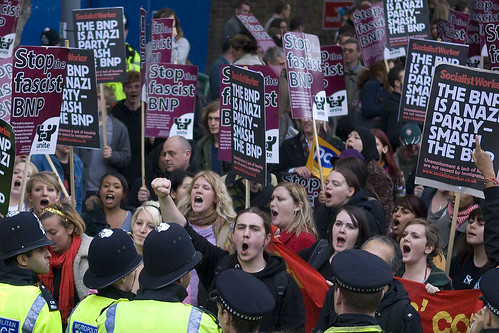
This sparked a huge outcry, culminating in a massive protest yesterday at BBC Television Centre during the taping of the episode. The show itself ended up being rather predictable. Both the other panellists and the audience took turns berating him for his racist views, and Griffin gave blathering incoherent responses that showed he is essentially a rather confused idiot. The program quickly turned into a game of cat and mouse – with Griffin working hard to project an image of a new moderated mainstream BNP which isn’t overtly “racist,” and the panellists and audience reminding him of all the racist things he’s said in the past, which he repeatedly denied saying.

Of course his excuses for why he had “changed his mind” about many of the odious things he’s said in the past were as inept as they were implausible. He twisted, laughed and clapped bizarrely as he was confronted by his past statements. And he seemed completely unprepared when presented with a quote from before the June election, on video, in which laid out a plan to pretend to moderate his beliefs on race and religion in order to make the BNP palatable and get it into office. Surely, if you’re planning some kind of Machiavellian coup like that, you probably shouldn’t talk about your plans on video!

The main aim of both the BBC and the panellists seemed to be to highlight Griffin’s racist views for the BNP voters at home who don’t consider themselves to be ‘racist’ but voted for them as a “protest vote.” The BNP has tried to gloss over their racist foundations with pamphlets full of images of British flags, happy families, proud soldiers and Churchill, Churchill, Churchill. The Tory representative, Baroness Sayeeda Warsi (herself British Asian), seemed to actually be making a concerted effort to steal away those “protest vote” BNP voters over to the Tory side. (Incidentally, I thought she and the Tories were the clear winners from last night’s show. She did a great job, though I was a little creeped out by her efforts to woo BNPers to the Conservative bosom).

Race-Baiting

But throughout it all Dimbleby was hell-bent on keeping the conversation focused on race and sexuality, as Griffin’s previous statements on those subjects are repugnant to the vast majority of British people. But the newly politically calculating Griffin refused to be drawn in, saying very few overtly offensive things during the conversation. In fact the most offensive thing he said was probably that Islam is an “evil” religion, a view I suspect many in Britain share (even many on the left). Throughout the whole discussion I kept thinking what some BNP-voter up in the East Midlands would be thinking watching this – a bunch of smug West Londoners seemingly putting racist words in the mouth of Griffin while he just sat there and said very little. For people who already feel alienated from the political system, this probably just played right in to their admiration of Griffin as an ‘underdog standing up for the working class’.

The fact is that outside its positions on race and sexuality, much of the BNPs political platform are grievances shared by an increasingly large swathe of the British public – xenophobic attitudes toward the EU, immigration and resource sharing. But Dimbleby was intent on steering the conversation away from those issues so the program could highlight Griffin’s differences with mainstream British opinion rather than the overlap. He didn’t want to highlight the aspects of the caged monster shared with the stone-throwing audience. But if Griffin’s opinions are supposedly so uniformly vile to the British public, how did he attract a million votes in the last election?

The omission was evidenced by the almost absurd non-inclusion of any discussion about the body Griffin was actually just elected to, the European Parliament. Toward the beginning of the program a questioner tried to ask Griffin about Europe and Dimbleby shut him down. “We’re talking about race!” he bellowed. “We’ll get to that later.”

Of course they did not get to that later. Clearly Dimbleby considered this to be an irrelevant question. Nevermind the fact that that Griffin is now representing the UK in the European Parliament!

The fact is probably many in the audience probably agreed with Griffin’s opinion that the EU is dangerous and tyrannical, and after all, finding commonalities between Griffin and the British public was not what this show was all about. No no, let’s stay focused on race so we can all boo and jeer Mr. Griffin’s medieval views (views which, by the way, have now been largely erased or covered over in the official BNP party platform). God forbid any of the audience, or on the panel, should look in the mirror to see how their assumption of British superiority over the rest of Europe, their subtle xenophobia rather than overt racism, informs their attitude toward European integration. That probably wouldn’t have been very comfortable for them, seeing their opinions mirrored in the spittle-flecked ramblings of a far-right nationalist.

It’s puzzling to see how, while Griffin has been a unitary obsession of the British media over the past month, his new position in Brussels has been almost completely ignored. The most egregious example came yesterday in this article from the Guardian, which called on the Question Time panel to grill Griffin about his views on climate change (he denies its existence except when warning of overpopulation). Of course the show should have asked him about climate change (they didn’t, as it’s not race-related). Griffin is now on the European Parliament’s Environment Committee, meaning he has a sizable influence over environmental policy affecting the UK (the majority of which comes from Brussels), far more influence than the vast majority of MPs in Westminster. Yet the Guardian article manages to not mention Griffin’s position on the Committee even once, even though the whole purpose of the article is to rail about Griffin’s views on climate change.


I don’t mean to be a one-trick pony here, but it really irked me that this very significant development – that Griffin is now representing Britain in the EU and has a particular influence on environmental policy, was completely ignored. Perhaps there was good reason to focus on Griffin’s racism since he is so keen to gloss over it. And perhaps it was better not to delve into an actual policy discussion with him for fear of legitimising his position. But from my vantage point it was just yet another example of the British public’s steadfast determination to ignore the existence of the EU at all costs.

The British Tancredo

But perhaps I’m too hard on the British. After all I have to say, as an American I’ve actually been quite impressed and heartened by the energetic resistance to the rise of Griffin’s ideology. Much of the BNP’s current platform (the cleaned-up version that omits the group’s overtly racist origins) is nearly identical to the platform of mainstream Republican politicians in the US. Griffin’s immigration policy, as expressed on Question Time last night, is very similar to that of Republican Congressman Tom Tancredo, who was a major contender for the 2008 Republican presidential nomination. That’s not to mention the BNP platform’s similarities to right-wing American television commentators like Glenn Beck and Lou Dobbs. And Griffin’s current stated view on homosexuality, though it was condemned by the representatives of all three major UK parties on the Question Time panel, would easily be at home in the Republican Party’s official platform. So it’s nice to see that I live in a country where these kinds of views, so common in my home country, are so reviled.

Also, Britain should keep in mind that it is hardly the first European country to send far-right politicians to the European Parliament, France beat them to that by many years. In fact the experience of France with far right Front Nationale leader Jean Marie Le Pen (also of the European Parliament) has been repeatedly brought up as a cautionary tale by British commentators. An invite by the French broadcaster for Le Pen to appear on the French equivalent of Question Time was equally controversial, and resulted in a doubling in the size of the party. Le Pen eventually rode that wave of popularity all the way to victory in the 2002 presidential race, when a fluke in the 1st round voting meant that the second round was a one-on-one contest between him and French President Jacques Chirac. There are fears that Griffin’s appearance on Question Time could lead to a similarly meteoric rise in the UK, but I just don’t see that happening.

By the way, the BBC has a great article here about how the media deals with far-right parties across Europe. It’s a very interesting side-by-side comparison, and I think helps to set all this within a larger context.

Of course, that would require some thinking about Europe, which as we learned last night, the Brits are loathe to do.

Friday, 17 July 2009

Britain’s Education Omission

This week I undertook a little experiment, asking friends across Europe if and where they learned about how the European Union functions. The response from the British was, if perhaps not surprising, still incredible. And they go a long way in explaining some of the things I’ve observed over the past week.

This week was the first assembly of the new European Parliament in Strasbourg, at which I got to witness the media circus as Nick Griffin, the newly-elected leader of the far-right, whites-only British National Party, took his seat as a UK MEP. The British media had their knickers in a twist on Tuesday as they breathlessly reported the act of a man sitting down in a chair. But in Strasbourg it was clear this event wasn’t of much interest to anyone except the throng of British reporters. After all, Mr. Griffin will be joining a dozen other far-right racist MEPs from countries across Europe, including France.

The continent wasn’t all that concerned about Mr. Griffin, they were more interested in the big decisions being taken at this week’s session – the selection of the new parliament president and committees. But I grew frustrated over the course of the day, charged with reporting on the developments in this first meeting of the new parliament, and coming up with only articles about Nick Griffin in my English-language searches on Google News. As far as the British media was concerned, this was apparently just a Nick Griffin-sitting ceremony.

The fact is once the British media stops focusing on Mr. Griffin’s activities in Brussels and Strasbourg he will probably stop showing up. After all, his main purpose in being there is to get himself more attention back in blighty. I really doubt he has much interest in the Environment Committee, to which he was appointed this week.

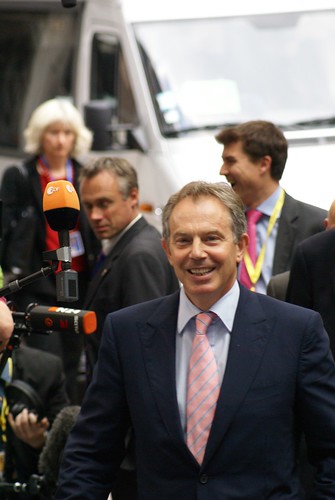
It was yet another illustration of how much the British media don’t understand how the EU works. Faced with the challenge of having to explain the complexities in the formation of a new parliament, they preferred to go with the easy “British fascist takes a seat” story. Their inclination for the easy story was again born out later in the week when Gordon Brown is nominating Tony Blair to be the first “president of Europe” (should such a position be created by the passing of the Lisbon Treaty) further demonstrated the astonishing ignorance of the British on all things European. Last night on Question Time, an audience member asked the guests whether Tony Blair would make a good European president. The panel, composed of senior politicians and journalists, proceeded to descend into a string of bizarre statements that betrayed the fact that they actually didn’t know what the new president position is. For that matter, they didn’t seem to know much of anything about the EU at all.

The “president of Europe” position, as the British media have dubbed it, is actually merely the presidency of the European Council – one of the three governing EU institutions which is made up of the leaders and top ministers from all the member states. That position already exists, but is currently held by entire countries on a rotating basis for 6-month terms. At the moment, the President of the Council is Sweden. That means that the council’s informal meetings are held in Sweden, and Sweden controls the agenda and the message of the council for that period. For instance next week Sweden is hosting a Council meeting on the environment that I’ll be attending in the resort town of Åre, where all the Environment Ministers (Ed Milliband from the UK) will meet.

So the Treaty of Lisbon will change this position so that instead of being held by a country for six months, it’s held by a single person for 2 1/2 years. That is the position Tony Blair is being nominated for. It is mostly symbolic, and therefore it’s important to get someone in there who has a high profile. However the president won’t specifically make policy, he or she will merely loosely control the agenda of the European Council which is NOT the executive branch of the EU. The executive branch of government in the EU is the Commission, which has a president (currently Jose Manuel Barroso) who serves a five year term. That position is the only thing that comes close to really resembling a “president of Europe”, and it’s already existed for decades.

Last night on Question Time British MP Margot James responded to the Blair question by saying that she doesn’t think there should be a president position because the British public are already funding too many government positions and so one more shouldn’t be created. I found it to be an odd comment, because this European Council presidency position already exists, and in fact by changing it to be one person rather than moving it to a new country every six months at enormous expense, I assume the EU will actually be significantly reducing the cost of the European Council presidency (though the rotating country designation will still exist in abridged form for the council of ministers, thanks Andreas!). I also find it strange for James to blame the EU for having too many government officials when the number of Euro MEPs has actually just been significantly reduced, while the British Parliament continues to heft at a grotesque 1,384 members representing just 62 million people. The European Parliament has 736 members representing 500 million people.

The fact that this panel of high-ranking MPs and media figures seemed to have little idea how the European Union works reflects just how widespread “EU ignorance” is across Britain. In any society the poor and undereducated are likely to know little about the structures which govern them, but what I’ve been shocked by is the almost complete lack of EU knowledge from educated, intelligent people in the UK. Most of my intelligent British friends have no idea what the European Commission is, even though it effectively dictates probably about 40% of the laws that govern them. These same people could tell me inside and out how the American government works, in fact they are probably better versed in American civics than most of my friends in the US. Yet if I talk about anything related to the EU I’m met with a blank stare and a shrug.

Bad Education?

So why is this? I’ve lived across Europe and I’m not labouring under any kind of delusion that people on the continent know their EU civics inside and out. But in my experience intelligent people on the continent tend to know what the Commission is and how it functions with the other two branches. So why do they know this? I’ve been asking a few of my European friends to find out.

A French friend from Paris, who doesn’t work in politics but takes a marginal interest in it, says his knowledge of the EU (which is good) is shaped by what he reads about it in the media. Ah, there’s the rub. The British media do a notoriously horrible job reporting on Europe. The EU is hardly ever mentioned in British news outlets, and when it is, the reports on it are rife with inaccuracy. By contrast the French media does cover important EU stories, when a piece of legislation will directly effect French people in an important way. But still, EU stories can be fairly boring, and I would be imagine it would be pretty easy for even intelligent French people to tune them out or give them only cursory attention. So that can’t be the entire explanation of the difference.

A German friend from Hamburg told me that though he doesn’t usually read articles about the EU in newspapers (he’ll usually skip them because he thinks they’re boring), he does know the fundamentals of how the EU works because he learned it in school. I tested his knowledge a bit and found that yes, he does have a good mastery of the basics of how the EU works, so I asked him when he learned this. He said he learned it in secondary school, in a required class that was coupled with a course on German civics. Social Studies 101 basically.

Ah ha, so there’s the rub. Education. I suppose it’s understandable that people my age wouldn’t have had extensive education on the EU, as when they were in any secondary school civics course it had only recently become a real significant entity. So I quizzed a few of my British friends on what kind of education they received in school about the structure of the EU.

Again, I was met with blank stares.

I asked several people, and all of them told me they had never received any education in how the EU works, not even as part of a general civics course on British government.

I figured I was getting closer to my answer. British people were never educated in how the EU works and they don’t hear anything about it from their media, so how on earth are they supposed to know what it even is? Yet this is now a body which affects vast areas of their daily life. Education is always a catch-up game I suppose. Perhaps this just takes time to change. Surely young students now must be being taught about how the EU works, given its rapid increase in importance over the past 10 years.

So I asked a friend of mine who teaches in a secondary school here if EU civics is now being taught in school. I was shocked by his response. “Nope, nothing,” he answered matter-of-factly. “Not even in a civics class? Or a government course?” I asked. “I’ve definitely never heard of it being taught,” he answered.

This situation seems rather incredible to me. This may be a hyperbolic example, but it would be like a school system in Texas teaching students only how the Texas state government operates, and completely ignoring the federal government in Washington as if it didn’t exist. It’s a huge disservice to the students who will have to live in a framework where those laws made at the federal level will have a huge impact on their lives, and they will have no idea how they’re made.

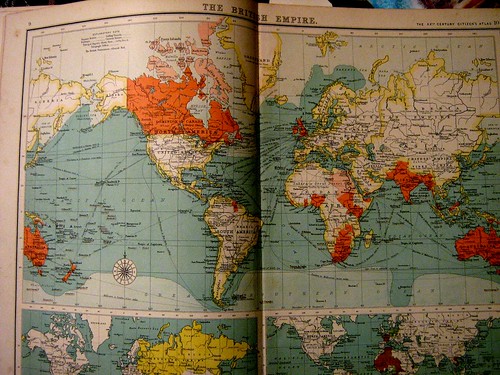
I suppose it’s reflective of the general attitude of educated Britain toward the EU. Deep down they may know its necessary, they may not want to leave it, but they would prefer to just ignore it because to acknowledge that they need it is just too damaging to their national pride. Perhaps it would just be too humiliating for a British history teacher to transition from telling his students about the glories of standing astride the world as the British Empire to telling them the modern reality of being one part of a European coalition. Maybe it’s just a symptom of post-imperial trauma. After all, they say the second stage of any trauma is denial.

But in the mean time, it seems to me the British education system is doing young people a real disservice if they really are ignoring the EU.

Wednesday, 10 June 2009

Euroelection: BNP Overshadows the Real Story

Europe’s centre-left is licking its wounds this week after the European Parliament vote, and nowhere is the pain being felt more acutely than by Labour in Britain. But perhaps the larger significance of the poll results for this island nation, which the British media have so far failed to pick up on, is the fact that the British will not be using 60% of their potential voting power in the new European Parliament.

Anti-EU parties did enormously well in Britain’s European Parliament vote. The UK Independence Party, which believes that Britain should secede from the EU, got 16.5% of the vote, beating Labour and coming in second with 13 seats. With the far-right British National Party – which also wants to exit the EU – gaining two seats, Britain will be sending 15 MEPs to represent them in the European Parliament who don’t believe the institution should exist at all. And of course “sending” is perhaps a misleading term here, since all 15 of these MEPs are unlikely to ever show up in Brussels to cast a vote, preferring to remain in Britain in protest.

Yesterday I was at a sustainability conference in London’s Docklands, and was listening to an opening speech given by Tory MEP Caroline Jackson, who represents Britain’s Southwest region. She said she was dismayed that British voters had chosen to waste 15 of their seats in parliament. Those 15 seats which will remain conspicuously empty for the next five years, as the British people have elected them in based on an issue that has absolutely nothing to do with the European Parliament, which decides neither which countries are in the EU nor the makeup and structure of the union.

Jackson went on to point out that with the departure of the Tories from the main centre-right group European People’s Party (EPP), the reality was that the UK has now effectively relinquished 30 out of its 72 seats.

Fulfilling a pledge he made back when he was campaigning for the Conservative Party’s leadership, David Cameron is taking the Tories out of the EPP, the largest block in the European Parliament with all the continent’s centre-right parties – including those of Angela Merkel and Nicolas Sarkozy – saying that the block is too federalist. He is instead trying to form a new Eurosceptic party, finding strange far-right allies from Eastern Europe to join him. Jackson, who has decided to leave the parliament after this term, could barely conceal her disdain as she listed these parties, which include the Czech Republic’s ODS (which she pronounced o-di-ous) and Poland’s PIS (which she refrained from making into a word). “Rather unfortunate acronyms” she observed dryly.

“It’s a sad moment for me, as a Conservative, to find that the Conservatives have put themselves in this bottom group, leading effectively nowhere,” she said. She isn’t alone in this observation. Many Tory MEPs have pointed out that this decision will put the Conservatives on the fringes of Europe, with no influence in the parliament and shut out of decision-making. If they had stayed in the EPP, the Conservatives would have been one of the largest parties in the EP’s largest block. It would have been a powerful position in an increasingly powerful body within the EU, which now controls the majority of British policy in the areas of environment, agriculture and trade.


As it stands, the second-largest country in the EU will have just 42 real usable seats in the European parliament (minus 30 wasted seats), compared to Germany’s 99 effective seats and France’s 68 (minus their 4 wasted seats from fringe parties). While the rest of mainstream Europe is fully engaged in the EU as it works to solve problems that cannot be solved nationally - such as climate change, terrorism and the financial crisis – Britain will have taken its toys and gone home. They’ll remain part of the EU, governed by its laws, but refusing to actively take part in shaping its policy.
The Tories are now going to lose most of their ranking seats on the parliament's committees. Representatives of British industry and NGOs will now have few MEP to go to to influence EU policy in Britain's favour. Essentially, the UK has cut off its nose to spite its face. Many in Brussels are scratching their heads at what could motivate what they see as an idiotic, irresponsible decision.

Far-Right Ascendance in Britain

However the fact remains that a vast swathe of the British people have yet to be convinced that the EU serves any purpose, and they see no reason why the UK can’t single-handedly solve these large problems all on its own. And there is a growing segment of the country that believes the “British race” would also be better off on its own.

The British Media hasn’t taken much notice of the diminished influence the UK now has in the parliament. They’ve instead focused on the fact that the British National Party, the far-right group that doesn’t allow non-whites as members and espouses the ideas of Adolph Hitler, won two MEP seats. The victories, which were won in the North of England, have caused alarm and revulsion across the UK. When notorious BNP leader Nick Griffin tried to hold an impromptu victory press conference outside the houses of Parliament yesterday he was confronted by a group of anti-fascist protestors who pelted him with eggs. The anti-fascist group says they will trail the far-right leader wherever he goes to remind the public of his extreme racist views, but the reality is such protests will probably bring him more attention than having the seat will.


Of course Britain won’t be the first EU country sending far-right MEPs to Brussels. Jean-Marie Le Pen’s Front National has long been sending elected members to the body, and there are far-right MEPs from Eastern Europe that have called for the mass deportation of Roma (gypsies). But this is the first time that Britain, the mother of all Democracies, has sent a fascist representative to Europe. In fact, this is the first high office that the BNP has been elected to (so far they’ve only managed to get seats on local town councils), and without a doubt it gives them some legitimacy (if not any actual power since they’re unlikely to ever make a trip to Brussels to cast a vote, lest they mix with the foreigns).

Such a win for the BNP does great damage to the nation’s psyche because it challenges many of the narratives the British people have for themselves. Most British people forget that there was significant fascist movement here during the 1930’s that in the end was unable to wrest power. The sad reality is that this win means the BNP is now a bit player in British Politics that isn’t going away, but they are unlikely to become a significance force with anywhere near the reach of Oswald Mosley’s fascists of the ‘30s.

The British people’s attitude about the irrelevance of the European Parliament has enabled two fascists to sneak into their representation in Brussels. In the long-run, the more important consequence of that will be the European disengagement and isolationism that one day Britain may look back on and regret if it finds itself alone and irrelevant in the 21st century. “And all we were talking about was the bloody BNP,” they may remark with a larf.