Showing posts with label European Parliament. Show all posts

Monday, 26 February 2018

In rejecting spitzenkandidaten, Macron has let the perfect be the enemy of the good

National leaders, led by Emmanuel Macron, have refused a European Parliament demand that citizens should select the next EU president. The reasons have more to do with institutional rivalries than citizens’ interests.


“Don’t count your spitzens before they hatch,” tweeted Lithuanian President Dalia Grybauskaitė ominously as she entered Friday’s summit of EU leaders in Brussels. 

The Lithuanian president was referring to the so-called ‘spitzenkandidaten’ process, used in the last European Parliament elections in 2014 for the first time to select the European Commission President as a result of the public vote. National leaders of the 27 future EU member states (that is, all except the UK) were meeting Friday to decide whether to use the process again in next year’s election.

Friday, 15 September 2017

One speed or two? Juncker challenges Macron's EU vision

In this week's podcast, we dissect President Juncker's State of the European Union speech and talk to journalist Soeren Kittel about next week's German election.
 

Monday, 20 February 2017

A Canada-EU alliance is forming against a Russia-US-UK axis

Simultaneous visits to the EU by Justin Trudeau and Mike Pence reveal the ideological rift that is rapidly tearing the West apart.

If Mike Pence was expecting a warm welcome in Brussels today, he will have been unpleasantly surprised. The arrival of the US vice-president was greeted with protests from citizens on the streets and scowls from European Union lawmakers, in scenes reminiscent of the 2003 fallout from the Iraq War.

The hostility in the air was all the more palpable when compared to the reception of the Canadian prime minister Justin Trudeau just three days earlier. The European Parliament had Trudeau-mania, and some lawmakers were even seen being moved to tears by Trudeau's call for EU-Canadian unity, as detailed hilariously by Euractiv's James Crisp on Friday:

Tuesday, 5 July 2016

The EU can, and should, reject any new UK commissioner

The British government is trying to find the most palatable candidate to survive European Parliament confirmation. But it is unclear why the EU should accept any British commissioner.

Prime Minister David Cameron's resignation in the hours after the Brexit referendum result on 24 June was the abdication heard round the world. But later that day, there was a less-noticed but also significant resignation in Brussels.

Lord Jonathan Hill, the European Commissioner from the UK, who is in charge of EU financial services, also stepped down. "As we move to a new phase, I don't believe it is right that I should carry on as the British Commissioner as though nothing had happened," he said in a statement. "In line with what I discussed with the President of the Commission some weeks ago, I have therefore told him that I shall stand down."

For awhile, it was unclear whether any new British commissioner would be sent to take his place. But today the Financial Times reported that the UK is about to nominate Sir Julian King, the current British ambassador to France. The Times writes that King would be considered an "apolitical appointment to ensure Britain is not left unrepresented at the EU’s executive body". 

The paper said the European Parliament is likely to reject any nominee that backed Brexit. At the same time, an incoming pro-Brexit government in the UK might be unhappy about having the pro-remain King be their man in the Commission.

But it is unclear to me why any UK nominee should be acceptable to the European Parliament.

The 'Brexit delegation' at Trump's convention

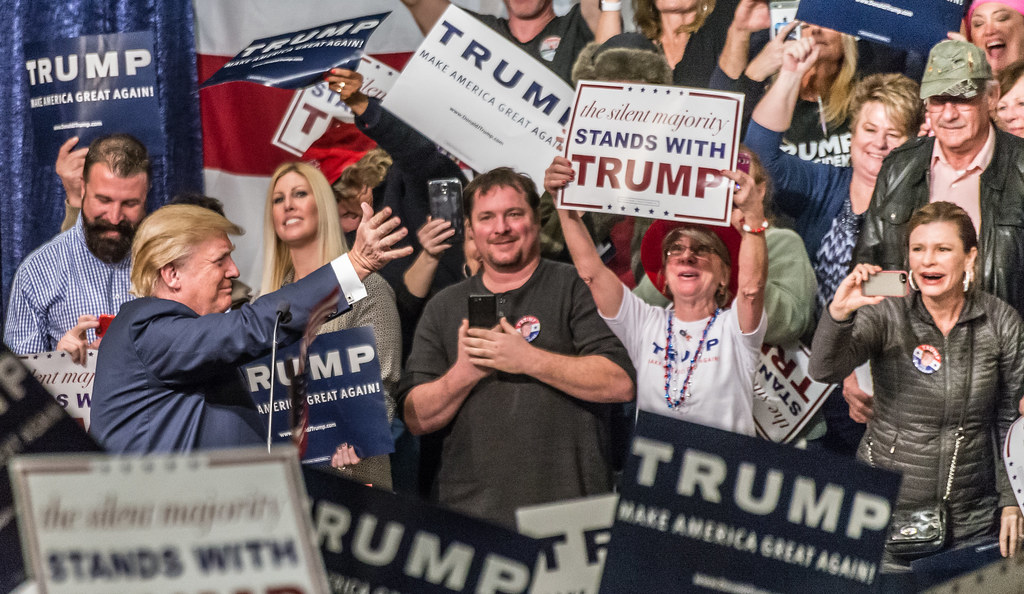
The Tory-led ECR group will attend Donald Trump's nominating convention, but Merkel's center-right EPP will not. It reflects the path British Conservatives have chosen to take.

Years before his faustian bargain to offer an EU referendum to maintain his Conservative Party leadership, David Cameron tossed the eurosceptics another bone to become party leader.

In his 2005 campaign to become Conservative leader, he promised to take the Tories out of the main-centre-right bloc in Europe, the European Peoples Party (EPP), and form a new eurosceptic bloc. For years, the eurosceptic wing of the Conservative Party had complained that the EPP, which contains the main center-right parties of Europe including those of Germany, France, Italy and Spain, was too 'federalist' in its approach to the European Union.

Friday, 4 March 2016

Good at the big things, bad at the small things

Eurosceptics are wrong when they say the UK has no influence in the EU, but they are right that Britain is outgunned and outmanoeuvred in Brussels lawmaking. What they don't tell you is that this is self-inflicted impotence.

When the new European Commission of Jean-Claude Juncker took office in 2014, they promised to counteract increasing euroscepticism by being "big on the big things and small on the small things". In other words, no more 'Brussels meddling' in small issues that should be left to national governments. 

Of course, they had a British audience and an upcoming Brexit referendum chiefly in mind. Years of media reports on bendy bananas and 'Anglo-French Friendship ponds' have led to an impression, generally accepted as gospel in the UK, that eurocrats like legislating for legislating's sake. The Commission's 'better regulation' drive is meant to counter this impression, whether or not it's an accurate one.

As I've written before, these UK media outrages over small regulations are not really about the laws themselves, but about who has the right to make them. The regulations being complained about in the British media, when they are actually a real thing (which is maybe 40% of the time), would attract no attention at all if they were made at Westminster. 

Saturday, 7 November 2015

Germany's privacy preoccupation

Can Germans convince other Europeans to feel as strongly about data privacy as they do? A new documentary tries to make the case.

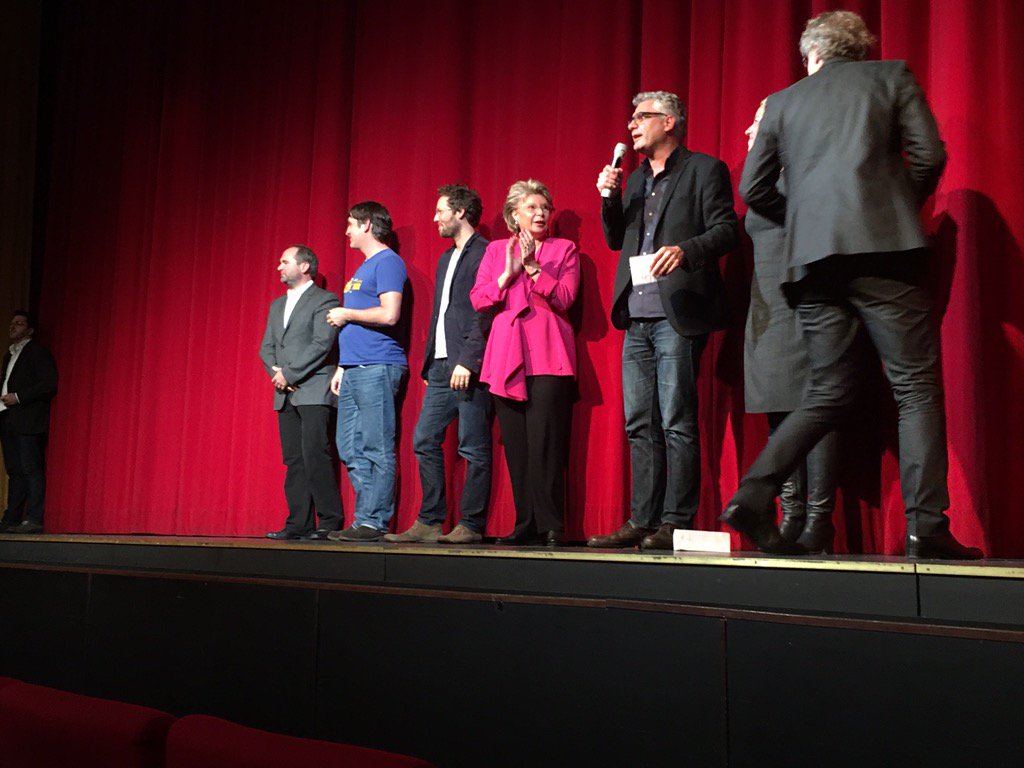
Last night I attended the Berlin premier of Democracy, a documentary about the European Union's proposed data privacy regulation. The director, David Bernet, has been following the main actors involved in the legislation since it was first proposed in January 2012.

The film strives to be a call-to-arms for Europe as a whole, drawing attention to the threat posed by data surveillance and the current make-or-break moment for this legislation which would put controls on snooping. It opens and closes with shots of the Parthenon in Athens, with an ominous-looking government helicopter flying overhead. The not-so-subtle message: all democracy is under threat from unrestrained data surveillance.

But despite the pan-European scenes, the film seems to be coming from a very German perspective on these issues. And as somewhat of a privacy-sceptic, I came away feeling that while film told me what is happening with the legislation, it didn't tell me why I should support it.

Wednesday, 16 April 2014

A noisier EU Quarter in Brussels

Since 6 February, planes have been rerouted from their route over the leafy suburbs of Flanders east of Brussels to straight over the EU quarter. People in the eurobubble say it's another example of Belgium dumping problems on people who cannot vote in general elections.

Today, members of the European Parliament rejected a European Commission proposal that would have allowed the European Union to overrule local authority decisions on the banning of flights at certain times.

The vote was only a rubber-stamping of a decision taken back in January to reject this part of the airport noise proposal. However, some MEPs saw this week's vote as an opportunity to bring up an airport noise issue closer to their hearts – new flight plans in Belgium that send planes from Zaventem airport straight over Brussels city centre and the EU quarter.

Since 6 February, planes taking off from Zaventem have been using a new route ordered by the Belgian federal government. The ‘Wathelet plan' – named after its designer Melchior Wathelet, Belgium's secretary of state of environment, energy, mobility and institutional reforms – has rerouted 80% of flights that used to fly over sparsely populated areas of Flanders east of Brussels. One hundred flights a day are now flying at low altitude through Brussels city - straight over the EU institutions.

Tuesday, 19 November 2013

Quebec: no need for readmission

Given that it is the only significant independence movement in the developed world outside Europe, the cause of Quebec secession is often used as an example in discussions of separatism in the European context. And so it was perhaps not surprising that at an event at the European Parliament last week about independence movements within the EU, a Quebecer was on hand to share his experiences.

The European Free Alliance (EFA), a collection of seven separatist members of the European Parliament from Scotland, Wales, Corsica, Flanders, the Russian community in Latvia and the Basque Country, hosted the event on “the right to decide” last Wednesday (13 November). The group sits in a sometimes uncomfortable common group with the Greens, who notably had little by way of promotion of the event on the group’s website.

In addition to Quebec, the event looked at the independence referendum situations in Scotland, Catalonia, the Basque Country, Wales and Galicia.

Europe has long had a strange relationship with Quebecois separatism. The situation in Belgium is often compared to that of Canada. France has been a strong supporter of Quebecois separatism, while simultaneously suppressing separatist movement sin Corsica, Brittany and Savoy. But are there really lessons for Europe from Quebec’s experience?

Friday, 15 November 2013

International nationalists

The far right has a poor history of working together in international forums. An alliance brokered by Geert Wilders and Marine Le Pen is seeking to reverse that trend.

"There is nothing harder to set up than a nationalists' international," wrote political scientists Michael Minkenberg and Pascal Perrineau when they analysed the performance of the radical right in the 2004 European Parliament elections. The latest attempt to disprove that truism was launched last week by Marine Le Pen, leader of France’s Front National (FN), and Geert Wilders, the Dutch maverick anti-Islam campaigner.

At a press conference held at the Dutch parliament in The Hague this week, Le Pen and Wilders announced a pact to work together to build an alliance in the next European Parliament to slay “the monster in Brussels” and wreck the Parliament from within. Given the patchy – to say the least – record of populist and nationalist groups’ attempts to join forces at European level, it was hardly surprising that scepticism dominated the initial reaction.

In the last Parliament, far-right groups briefly forged an alliance under the “Identity, Tradition, Sovereignty” group banner. But that pact fell apart after Romanian and Italian nationalists rowed over Alessandra Mussolini calling Romanians “habitual lawbreakers”. Perhaps it is not surprising that nationalists whose principal policy platform is being anti-foreigner have trouble co-operating with “foreigners”.

Tuesday, 12 November 2013

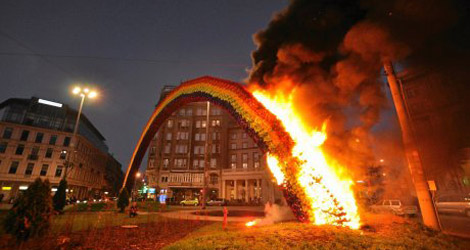
Torch the rainbow

A monument to peace displayed by Poland outside the European Parliament during that country's presidency of the EU was burnt to the ground last night in Warsaw.

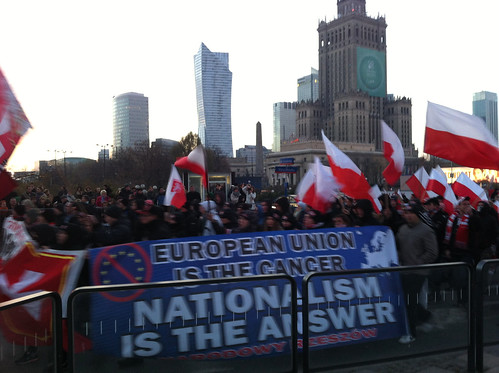
Chalk it up to some very unfortunate timing. Yesterday, as delegates arrived for this year's UN climate summit in Warsaw, they were warned to exercise caution and to stay out of the city centre. Violent demonstrations had broken out throughout the city.

The demonstrations actually had nothing to do with the climate summit. The meeting just happened to be opening on the same day as Polish national day, when far right and far left Polish groups have traditionally clashed in street brawls during demonstrations.

The violence isn't ordinarily noticed by the world's media. But given that international journalists have converged on the city this week for the climate summit, it was embarrassing timing for the Polish government.

It didn't help that the most iconic image from the violence was the sight of a giant rainbow in central Warsaw burnt to the ground last night. Those in Brussels might recognize the rainbow shown burning in this photo. It was displayed in front of the European Parliament by the Polish government during their EU presidency in 2011.

Thursday, 24 October 2013

Immigrant-on-immigrant xenophobia

Italians were shocked yesterday to learn that a Northern Italian teenager who had recently gone to the UK to study and find work had been beaten to death over the weekend. Joele Leotta, 19, was brutally attacked by a group of young men who accused him of “stealing English jobs”, the Italian papers reported.

The Italian papers were quick to make a connection to increasing anti-European and anti-immigrant rhetoric from the Conservative government in the UK. Some intitial reports in Italy mentioned the new campaign by the government to send vans into certain neighbourhoods telling illegal immigrants to “go home” in big letters.

The initial press coverage prompted Hannes Swoboda, the leader of the Socialist (S&D) group in the European Parliament, to issue a press release saying the murder was the result of the xenophobic climate created by the government. "The xenophobic, aggressive climate inflamed by populists such as UKIP and by the rhetoric of the Conservatives in government is now leading to murder in the streets of Britain,” said Swoboda in a statement. “Campaigns such as vans with slogans telling immigrants to 'go home' and continuous negative rhetoric against foreigners – including EU citizens – are creating an ugly mood in Britain, which has long prided itself on being an open-minded and tolerant nation.”

Tuesday, 8 October 2013

Vapers win the battle, but not yet the war

Despite the message being sent today by Europe's media, the e-cigarette war is not over. Chalk it up to an oft-repeated confusion about EU policymaking.

Following today's vote on new EU tobacco rules in the European Parliament, a wave of jubilation from the so-called ‘vapers' spread across the Twittersphere.

These enthusiasts of new electronic cigarettes have been working tirelessly to convince MEPs to block a European Commission proposal to regulate the new contraptions as medicines for the purposes of market approval.

Today they got their wish. Members of the European Parliament voted 350-300 to instead classify the cigarettes as tobacco, even though they in fact do not contain any tobacco.

The cigarettes deliver nicotine electronically, without the smoke or tobacco responsible for most adverse health effects from smoking. The vapers had argued that the bureaucracy involved in getting a medicine to market would be too much for the small companies getting started in this sector and kill the industry. Some health advocates agreed with them.

Thursday, 12 September 2013

The pan-sceptic ticket

Nigel Farage's state of the union response suggests UKIP will make climate change denial a centrepiece of their European election campaign.

I was a bit taken aback on Wednesday when, during his response to President Barroso's State of the European Union speech in Strasbourg, UKIP leader Nigel Farage devoted almost the entirety of his speech not to warnings about the creeping European super-state, but to an impassioned denial of climate change.

The subject is nothing new for UKIP. The official party line is that there is no proof that climate change is man-made, and this is often brought up by UKIP MEPs. The party has been particularly vocal about renewable energy, blasting “ugly” wind turbines blotting the English countryside and biofuel subsidies it says are responsible for fuel poverty in the UK. This was made clear by UKIP MEPs during Monday's debate on biofuel legislation, which strangely put UKIP on the same side as the Greens.

But it was surprising to see Farage devote so much time to the issue during a big-picture debate on the EU that had nothing to do with climate change. The EU had fallen victim to a “green obsession”, he said. The resulting legislation had driven manufacturing away from the UK and forced people into fuel poverty.

Tuesday, 10 September 2013

Selling the parliament

For any journalist who has previously covered the start of a national election, today's launch of the 2014 European Parliament elections was a different sort of animal. As I sat in today's launch in Strasbourg and watched the promotional video, I had to ask myself – what other parliament would have to sell its own existence at the same time as overseeing a campaign?

Indeed, where I come from, politicians are these days bending over backwards to criticise and disassociate themselves from the Congress they want to be elected to. Sitting at today's launch, one had the sense that a main job for MEPs campaigning will be to explain the virtue of the Parliament to their constituents. Or at the very least, to explain what the European Parliament is.

“Many do have the opposite opinion to what is actually happening,” Parliament vice president Othmar Karras told us. “It is incumbent on the members of this house to put the facts on the table so there are no more misunderstandings.”

Monday, 9 September 2013

Emotional debate

I'm on the train to Strasbourg this morning, ready for a busy week including the European Commission president's annual ‘state of the union' address and a controversial proposal on bank supervision.

But what I'll be watching most closely is Wednesday's vote on what has been an enormously emotional issue – proposed new restrictions on biofuel in the EU.

When the EU devised its renewable energy legislation in 2008, biofuels were still in their relative infancy but were meant to be a savoir for weaning transport off of fossil fuel. The legislation required that by 2020, 10% of transport fuel would have to come from renewable sources, i.e. biofuels. But even then there were concerns within the Commission about the wisdom of this policy. What if the EU law created a rush for biofuel that caused food shortages by turning food to fuel? Or, more frustratingly, what if the process of clearing new land to make room for growing the biofuel crops actually caused more emissions than the biofuels abate?

Tuesday, 16 July 2013

The sandwich protest

One of the favourite pastimes of interns in Brussels is to go ‘pluxing' on Thursday nights – outdoor drinking at Place du Luxembourg.

As they sip (or gulp) their two-for-one happy hour beers, these young, wide-eyed new arrivals to Brussels can often be heard discussing the drudgery and disillusionment of the unpaid positions they've taken on since arriving. They speak of long hours, little or no pay, and highly questionable educational value. It's no wonder they want to let off some steam come Thursday evening.

Given their fondness for the square, it's perhaps little surprise that the interns have chosen Place du Luxembourg for the location of a walk-out protest on Wednesday (17 July), demonstrating against unfair internship conditions in Brussels.

The protest, which will take place between 11h and 13h, has been dubbed the ‘Sandwich Protest'. The idea is that Brussels interns are living such a hand-to-mouth existence that the only way they can feed themselves is by scouring for free sandwiches at conferences and other events. “When did you last have something else other than a sandwich for lunch?” the organisers ask on their Facebook page.

Friday, 28 June 2013

Much ado about colouring

The Brits are in a tizzy over an EU childrens book. But their own Parliament has produced four of them.

At the last EU summit, it was olive oil. At this summit, the burning issue that UK prime minister David Cameron wanted to discuss at his post-summit press conference was even more insidious – an EU-funded colouring book.

The multilingual children's exercise book produced by the European Parliament, first reported by the Telegraph earlier this week, is called ‘Mr and Mrs MEP and their helpers'. It contains exercises centred around a day in the life of two MEPs. Cameron distributed 30 copies of the children's book to the other EU leaders at the summit, saying something had to be done to reign in this reckless EU spending.

"[The other leaders] were shocked,” he told journalists after the summit. “First of all they thought it was a hoax done by the Telegraph and I had to convince them that it was a genuine, scandalous waste of money, and pretty sexist at that as well, because Mrs MEP stops at six o clock to go shopping and Mr MEP goes on until 6:40."

The colouring book is, admittedly, pretty awful. Its layout more closely resembles an IKEA manual than children's exercises, and its depiction of Parliamentary life makes it easy fodder for mockery.

Wednesday, 28 March 2012

EU internet roaming charges to be slashed

From 1 July this year using a mobile phone to surf the web in another EU country will be about 70% cheaper, following an agreement on rate caps reached today by European Parliament and member state negotiators.

For the first time, the EU roaming caps will limit the rates phone companies can charge you for using the internet in a different EU country. The cost per downloaded megabyte will be capped at 70 cents as of 1 July 2012, 45 cents in 2013 and 20 cents as of 1 July 2014. The current average cost of roaming within the EU is €2.23 per megabyte.

The EU first started limiting the rates EU carriers could charge for roaming within the EU back in 2009, limiting the charge for making calls to 45 cents a minute. That cap has steadily decreased over the past three years, and today's agreement will lower them a further 20% from the current 35 cents to 29 cents, dropping to 19 cents in 2014. Before then, it used to cost an average of €1.50 per minute to make a call elsewhere in the EU. Now, for the first time, internet usage will be capped as well.

Of course this only applies to people with an EU phone carrier. So if you're travelling to Europe from the United States, you'll still pay the high fees.

Thursday, 26 January 2012

Europe’s SOPA?

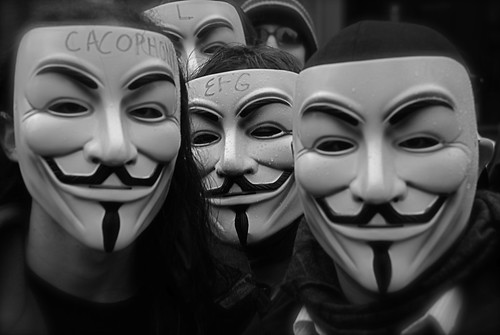
The European Parliament’s website has been shut down by hackers today, allegedly in a denial-of-service attack from Anonymous in protest of imminent anti-piracy legislation restricting internet freedom. But as the IT folks in parliament scramble to fix the problem, the functionaries are sitting around scratching their heads in confusion. Did we pass internet piracy legislation?

Their confusion is warranted. By all accounts the EU has been on the internet-freedom-lovers side during this debate. During the fallout from the Wikipedia ‘blackout’ last week, US politicians weren’t the only ones beating a path to the door to distance themselves from the now toxic SOPA legislation on internet piracy. On Friday the EU’s Digital Agenda Commissioner Neelie Kroes tweeted that she was “glad the tide is turning on #SOPA,” adding “speeding is illegal too: but you don't put speed bumps on the motorway”.

Home Affairs Commissioner Cecilia Malmström also tweeted against the US legislation, noting that ‘sopa’ in Swedish means garbage. Notably, no public statements about the US anti-piracy bills had been made before the Wikipedia blackout. It’s quite unusual for the EU to make comments about US legislation. But such was the effect of the blackout – which was, after all, global (Eurocrats felt quite helpless without Wikipedia last week!), that even politicians not involved in US lawmaking felt the need to make a statement about it.