Showing posts with label Republican Party. Show all posts

Tuesday, 5 July 2016

The 'Brexit delegation' at Trump's convention

The Tory-led ECR group will attend Donald Trump's nominating convention, but Merkel's center-right EPP will not. It reflects the path British Conservatives have chosen to take.

Years before his faustian bargain to offer an EU referendum to maintain his Conservative Party leadership, David Cameron tossed the eurosceptics another bone to become party leader.

In his 2005 campaign to become Conservative leader, he promised to take the Tories out of the main-centre-right bloc in Europe, the European Peoples Party (EPP), and form a new eurosceptic bloc. For years, the eurosceptic wing of the Conservative Party had complained that the EPP, which contains the main center-right parties of Europe including those of Germany, France, Italy and Spain, was too 'federalist' in its approach to the European Union.

Monday, 27 June 2016

Like Trump, Brexit won by accident

Brexiteer fumbling this weekend gives an impression of self-interested politicians who launched a campaign they didn't expect to actually win. Sound familiar?

This morning's appearances on the Sunday shows by the politicians who campaigned for Brexit was a full-on car crash. Perhaps the most extraordinary was Ian Duncan Smith's interview with Andrew Marr.

After trying to get any shred of information from IDS, Marr finally asked, exasperated, “What’s the plan?” “How do you mean?” IDS responded defensively. So Marr cited, for example, the leave campaign's promise to spend the "£350m per week that the UK sends to Brussels" (a completely inaccurate figure) to instead fund the NHS. 

“We never said that,” IDS replied. Marr was indignant. “Yes you did. So even if there was £350m per week, which there isn’t, how are you going to fulfil all of your other spending promises?”

“We never made any commitments. We just made a series of promises that were possibilities," IDS responded.

Thursday, 8 November 2012

A relief for Europe - but will gridlock persist?

Anxious Europeans have been able to breathe easier the past two days, after Tuesday’s reelection of US president Barack Obama. But the relief has much more to do with the defeat of Mitt Romney than with Obama himself.

Europe isn’t the only place feeling relieved because of a dislike for Romney. Outside Israel, there probably wasn’t one country on the globe that was excited about the prospect of a Romney presidency.

The Republican candidate's dangerous rhetoric seemed almost guaranteed to launch a war with Iran which no US allies would have been keen to sign up to. He had described Russia as America’s “greatest geopolitical foe” and had spoken of China as if it was the evil empire, promising to “get tough” with them in a way Obama hadn’t (although he never provided details about what that would mean). Latin America recoiled at his extreme anti-immigration rhetoric, and Africa was less than excited about his promises to cut US overseas aid.

In Brussels, there is a sense that long-stalled bilateral issues that were waiting until the resolution of the election can finally be taken off the back burner. There is (perhaps naïve) hope that a second-term Obama can show up to the UN climate summit in Doha next month with a reverse-course on the US intransigence in taking action to combat global warming. Negotiations on a US-EU free trade deal can now begin. Most importantly – fears that Europe was about to see a return to the trans-Atlantic tensions that marked the George W. Bush era have now been allayed.

Friday, 20 January 2012

The biggest American political story Europeans haven't heard of

The US presidential primary race has attracted its usual amount of fascination here in Europe, and yesterday’s developments - with the Iowa race being re-called for Santorum and Rick Perry dropping out - were front page material. But behind the spectacle of the drawn-out US primaries, there is a far more interesting story going on in the state capitals.

Of course it’s not surprising that the European media is ignoring these huge developments at state level, because the Washington beltway media has also ignored them. They also ignored the unprecedented political revolution in 2010 that the recent events are a reaction to. While in Europe the media tends to ignore ‘federal’ (EU) politics and focus only on member state politics, in the US it is the opposite. The US media (even local state media) tends to focus on federal politics in Washington and there is little interest in what goes on in state capitals.

Thus, when the Republicans enjoyed an unprecedented victory in the 2010 midterm elections, the focus was almost entirely on the fact that they had taken control of the US House of Representatives. What was largely ignored was the fact that they had at the same time taken over state legislatures with unprecedented majorities – giving Republicans the most power in state governments they have had in decades. Republicans wrested six governorships from Democrats, giving them control of 30 of the 50 state executives. Five states saw both legislative chambers (state senate and state house) switch from Democrat to Republican majorities. In seven other states they gave themselves control of the entire legislature by picking up huge majorities in an additional chamber. The elections left Republicans controlling the entire government of half of US states, leaving them with Hungary-like majorities capable of passing whatever state legislation they like.

Wednesday, 4 January 2012

Is Iowa the problem, or is it the primary system?

While I was home in the US over the past few weeks I witnessed the quadrennial spectacle of the Iowa caucuses - shivering reporters in front of the capital dome in Des Moines, candidates eating corn on the cob while clutching plump cord-fed babies, the usual fare. And I was also able to witness the quadrennial griping about why the United States allows “a few hundred farmers” to pick its president.

The complaining about the Iowa caucus, where the first nominating primary for both political parties’ presidential candidates is held, is both predictable and legitimate – even if the language used sometimes smacks of regional snobbery. The Iowa caucus makes or breaks politicians running for the presidency. Barack Obama owes his presidency to winning the Iowa Democratic caucus in 2008. This year, the result of the Republican caucus will force Michele Bachman and Rick Perry to drop out of the race. And the Iowans have elevated Rick Santorum from obscurity to be the main challenger to frontrunner Mitt Romney.

But the Iowa caucus is a big deal only because it is first. And being first means presidential candidates promise Iowa all sorts of lovely things (just look at the corn subsidies of the past four decades – and you wonder why Americans have corn syrup in most of their food for no reason?). The Iowans go through outrageous lengths to make sure they are first. When South Carolina and New Hampshire tried to move their primaries ahead of them this year, Iowa moved theirs to the earliest possible day in 2012 – 3 January.

This year the criticism went perhaps a little too far. A professor at the University of Iowa (himself a transplant from New Jersey) wrote a column for The Atlantic about a much-asked question – why should a state that is not ethnically or ideologically reflective of the country as a whole be given such a prominent role in selecting the nation’s president? But he asked it in a way that was incendiary to say the least, calling Iowa a place that's "culturally backward" and teeming with "slum towns”, where the 96% white population “clings to guns and religion.”

Friday, 7 October 2011

Two different animals

If you needed evidence of just how different the British Conservative Party is from the American Republican Party, this week's party conference provided two particularly illuminating illustrations.

Conservative Prime Minister David Cameron stood before the yearly gathering of Conservative Party members – similar to the 'national conventions' in the US – and said he wholeheartedly supports gay marriage and will work to enact it in the UK next year (to replace the current civil unions). This was met with thundering applause in the hall. Try to imagine the reaction if a presidential candidate said this to the Republican National Convention!

In the second example, a huge row has developed after the Conservative Home Secretary Theresa May used an incorrect fact in her speech to the conference. Explaining why she wants to dismantle the Human Rights Act, which is the British transposition of the European Convention on Human Rights, she listed as an example a case where the act's requirements meant that there was an "illegal immigrant who cannot be deported because – and I am not making this up – he had a pet cat."

As it turns out, she was making this up. As the decision shows, the actual verdict against deportation had nothing to do with a pet cat, the decision was instead due to a mistake made by the Home Office's prosecution. A pet cat, which had been mentioned in the appellant's brief along with his partner as reasons why he has a home life in the UK, was merely mentioned by the judge in his verdict as an attempt at humour. It was later revealed that May had taken the cat story from a speech made by UK Independence Party leader Nigel Farage.

Tuesday, 2 August 2011

Is America too old to function?

One of the most frequent clichés I hear as an American living in Europe is that the US is a 'new country' while nations on this continent are 'old'. It is usually used to explain away American peculiarities, as if the US is a naïve child who just hasn't had the time to attain the wisdom of the more mature, centuries-old European states.

But however often it's repeated, this common wisdom is patently false. As a country, the United States is older than the vast majority of European states. At the time of the US declaration of independence in 1776, the states of Belgium, Germany, Italy, Finland, Romania, Slovakia, Greece and Latvia had all never existed yet in any form. And that's just to name a few. The fact is that European nations are actually quite young - and that is what makes them more agile in the face of modern problems than the United States.

Even the European countries which did exist in some form in 1776 - such as Spain, Portugal, the Netherlands and France - today barely resemble what they were at that time. The Kingdoms of France and Portugal in 1776 are now republics with completely different systems of government. And going in the other direction, the Dutch Republic in 1776 - a loose confederation of provinces - bears little resemblance to today's Kingdom of the Netherlands.

The US has had the same governing structure since 1789, the date that marks the founding of the current American republic with the adoption of the US constitution (which replaced the previous Articles of Confederation in place since 1776). The US has used the same government system since then. Contrast this with France - whose current republic has only been in place since 1958 – or the Federal Republic of Germany, which dates from 1949. Other founding dates of current European government systems include: Italy – 1947, Spain – 1978 and Poland – 1997.

In fact the only European governments that could legitimately claim to be older than the US government system are the constitutional monarchies of Britain, Denmark and Sweden – but even this is arguable since they have had significant constitutional changes over the past 200 years.

Monday, 25 July 2011

Political games are exacerbating both Atlantic debt crises

These are not exactly inspiring times for leadership in the Western world. On both sides of the Atlantic, a potential catastrophic default is looming largely as a result of short-sighted political manoeuvring. This is leading some to question whether the 20th century democratic institutions we have built our societies around are adequate to handle the challenges of this century.

In the United States, Republicans are holding hostage an authorisation to raise the amount of money the US is authorised to borrow – normally a routine housekeeping operation done by every congress – until the Obama administration agrees to massive cuts in government spending. The Democrats have offered to give them those cuts, but only if they are accompanied by an increase in taxes on the wealthiest Americans and the closure of corporate tax loop holes. The Republican leadership, terrified of the reaction of their base voters to any tax increase (even if it will have no effect on 98% of Americans) have refused the offer.

If the United States does not raise the debt ceiling by 2 August, it will go into default. This would almost surely have a disastrous effect on the worldwide economy. This weekend UK Business Secretary Vince Cable said that the "rightwing nutters" who are holding the debt ceiling authorisation hostage for their short-term political gain are a bigger threat to the world economy than the problems in the eurozone.

But conservatives in America aren't the only ones playing with fire in order to reap short-term political gain. The same kind of thinking seems to be guiding Cable's coalition boss. Over the past week UK Prime Minister David Cameron and his ministers have been saying that the UK intends to exploit the current eurozone crisis in order to "maximise what we want in terms of our engagement in Europe."

Friday, 11 March 2011

IRA-supporting US congressman launches terrorism hearings

In order to not be considered a terrorist, Muslims in America don't just have to not participate in terrorist activities – they need to actively renounce terrorism and fight to end it. So says Republican Congressman Peter King, the new head of the Homeland Security Committee in the House of Representatives. King is leading hearings this week investigating the "radicalisation of the American Muslim community," calling Muslim religious and business leaders before congress to test their loyalty to the United States.

The hearings, which to many are reminiscent of the anti-communist hearings conducted in the 1950's by Senator Joseph McCarthy, are proving enormously controversial in the United States. Democratic Congressman Mike Honda, who was interned in Japanese internment camps in California during World War II as a little boy, wrote in an editorial this week that King's intent is, "to cast suspicion upon all Muslim Americans and to stoke the fires of anti-Muslim prejudice and Islamophobia."

Keith Ellison, who is on the homeland security committee and is one of two Muslims in congress, shed tears on the opening day of the hearings as he said the hearings may "increase suspicion of the Muslim American community, ultimately making us all a little less safe." But King has been outspoken in his defence of the hearings, saying they are completely necessary as more and more American Muslims become radicalised. He has asserted that the "vast majority" of mosques in the US are run by radicals.

Wednesday, 23 February 2011

American labour fights back

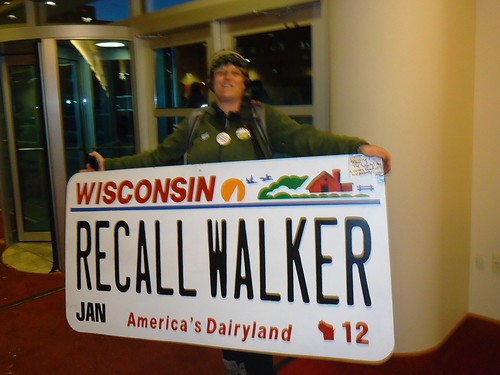
As the Middle East continues to be rocked by protests, in America the Middle West is experiencing its own protest movement spreading like prairie fire. It started in Wisconsin last week, where the newly-elected Republican governor is trying to pass a union-busting bill that would strip collective bargaining rights from public employees. Union public employees - teachers, prison guards, firefighters - took over the Wisconsin state capital building in Madison and haven't left the area since. And the 14 Democratic senators in the state's senate have left the state so that a quorum can't be reached to vote on the bill.

Since then the protests have spread to other states where Republican governors are trying to push through anti-union bills. Democratic lawmakers in Indiana fled their state yesterday to prevent a vote on a similar bill. Also yesterday thousands of protesters converged on the statehouse in Ohio to protest an anti-union bill there. And in Michigan protests broke out in the state capital of Lansing against that state's union-busting bill.

This isn't all part of a coordinated nation-wide union movement. Rather, it is captal-by-capital rection to a coordinated effort by Republican governors and state representatives to introduce bills which they say are needed to balance the state budgets. But these bills also contain, in the fine print, provisions to strip union organising rights from state public employees. They say the state governments, which are largely broke due to the economic crisis, can no longer afford to pay out the benefits the labor unions have spent decades negotiating for. And in large part, they're right. But in addition to proposing to cut salaries and benefits for public employees, the Republican governors and legislators are also pursuing a secondary tactic: strip the unions of their right to collectively bargain, or their ability to even exist at all. And that is what has attracted the protests.

Monday, 10 January 2011

America unhinged

Perhaps the only thing more depressing than this weekend's assassination shooting of US Congresswoman Gabrielle Giffords was the fact that it was so utterly unsurprising. The shooting, which for the moment remains an attempted assassination as its intended target fights for her life in hospital, so far has a death toll of six out of 20 people shot. For many observers in the US, the shooting is the culmination of two years of incendiary rhetoric from the right, an episode of far-right violence that people have been warning was coming soon. When you have mainstream American politicians telling people that the government is trying to establish "death panels" in its healthcare legislation and that there has been a "Socialist takeover" of the government that can only be brought to an end using "second amendment remedies", it was only a matter of time before some unhinged person on the far right acted out in violence.

The motives of the shooter, Jared Lee Loughner, are not yet clear. In fact authorities are looking into the possibility of a second shooter. It is not yet known whether Loughner had any specific ties to the Tea Party movement, whether he was an admirer of Sarah Palin, or whether he was a fan of incendiary Fox News hosts such as Glenn Beck and Bill O'Reilly. But from his online postings and notes, it already seems clear that Loughner subscribed to far right ideology. His online postings and YouTube videos rant against government tyranny, using language that is eerily reminiscent of the language the mainstream right has been increasingly using. In one of his postings, Loughner refers disparagingly to 'currency that's not backed by gold or silver' - an idea that is the subject of regular rants on Mr. Beck's show (right before his commercials for gold investment). This idea that a non-gold-backed currency is unconstitutional was also a main focus of the anti-government 'patriot movement' of the 1990's that was responsible for violence in the middle part of that decade. Loughner also went on long rants about immigration, particularly Hispanic immigrants in Arizona.

Wednesday, 8 December 2010

Is Obama the world's worst negotiator?

Barack Obama is being attacked by his own party this week after a massive capitulation to Republicans giving large tax cuts to the wealthiest two percent of Americans. For Democrats, two years of frustration over the president's frequent urge to compromise with the opposition while getting nothing in return seems to have bubbled over and exploded in a torrent of anger.

From pundits to politicians, many Democrats were furious on Tuesday over what they see as Obama's lack of appetite for political fights. There was talk of a party revolt in the congress, with Democrats saying they would vote against the Obama-backed deal. The anger got so loud that the president was forced to summon a hastily arranged press conference where he forcefully defended himself against the accusations by his own party and insisted he is indeed a fighter. But his speech, which at times seemed dismissive of the disappointment  felt by his own party, has done little to quell the fury. Take a look some choice clips from the speech in this video clip below.

Sunday, 7 November 2010

Daily Show 'sanity' rally: more harm to the left than good?

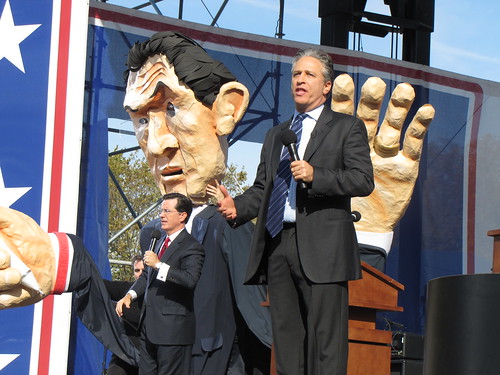
I thought I'd post a video from this weekend's Real Time with Bill Maher show on the subject of Jon Stewart's "Rally to Restore Sanity" because I remember last weekend a lot of Europeans were asking me about it and whether I was going to watch. "No," I told them, "I'm not going to watch it, and if I was in the US this weekend I wouldn't be attending it either." At the time I don't think I was articulating my annoyance with Stewart and the rally all that clearly, but I told my friends I thought the rally was going to be almost depressingly irrelevant. Of course in the end it was. Though the rally had a huge turnout, the youth vote in last Tuesday's election was the lowest in years. On Friday night, Bill Maher delivered a monologue that I think will resonate with a lot of American Daily Show viewers who were uncomfortable with Stewart's rally but couldn't articulate why.

Yes, the Daily Show rally, held on the national mall in Washington, may have attracted twice as many people as tea party pied piper and Fox News host Glenn Beck's "Rally to Restore American Honor" which it was meant to lampoon. But that was cold comfort to some in the dwindling ranks of the politically active American left, who saw the rally more as a depressing reminder of the current state of things than anything they could be proud of. The Daily Show's writers and producers have an undeniable liberal viewpoint, and the show spends most of its time making fun of Fox News and Republican politicians. But the show also likes to present itself as being "non-political." After showing outrageous clips from politicians on the right, host Jon Stewart frequently insists that the same level of craziness exists on the left. But he rarely provides any actual examples of this phantom American left.

Wednesday, 20 October 2010

UK cuts 1/5 of government spending - is it possible in the US?

As rolling strikes and violent protests against austerity measures continue to cause chaos in France today, across the channel the new conservative government of David Cameron introduced their much-anticipated package of budget cuts, the biggest slash to the UK budget since World War II. Naturally, the stoic British public is not reacting in the same 'take to the streets' manner of the French in their reaction to Sarkozy's attempts at budget cuts. Instead, there seems to be a sense of profound sadness and anxiety in the UK today.

Put quite simply, the cuts are massive. £83 billion ($130 billion) in cuts were announced this afternoon, an average of 20% out of every government department. 490,000 government employees will lose their jobs. Government offices in London will be cut by a third. Rent will be increased for people in public housing, police services will be cut, local town councils will get less money, and prisons will have less space. The retirement age will be raised to 66 (compared to 62 in the US). Both the sales and income tax will rise, with most of the increases coming out of the salaries of top earners. University teaching budgets will be cut by 75%, meaning the cost of tuition will rise considerably. And the British military isn't immune either, it will see an 8% cut in its budget. Even the queen will have to make do with less. Cameron is giving her a 14% pay cut.

Wednesday, 18 August 2010

Mosque hysteria: an ugly reflection on America

It makes me a bit queezy to have to write about this, but considering that this “ground zero mosque” issue has now crossed the Atlantic and is making the news in Europe, it would seem I have no choice. It’s incredible that such a ginned-up controversy has reached proportions so big that people are hearing about it here. Over the weekend while in Paris a French friend asked me incredulously, “I hear Obama is planning to build a giant mosque on ground zero?? What is he thinking??”

Le sigh. Yes, that’s it, Obama is personally flying down to the former site of the world trade center to build a mosque brick by brick. Honestly I don’t blame Europeans for being misinformed about this, the US media coverage has been almost completely fact-free, and that then gets passed on over here during a slow news month. And it’s an issue that easily resonates here in Europe because let’s face it, when it comes to Islam, America and Europe can be sisters in hysteria. So, forget whatever you’ve heard. Let’s review the facts, shall we?

Thursday, 12 August 2010

After November: A Tea Party congress in America?

I just watched a somewhat bemused news story on French TV about Steven Slater, the US flight attendant who had had ENUF Monday, swearing at passengers before jumping out of a plane using the emergency slide. Apparently both sides of the Atlantic are in the full throes of the “silly season”, the term journalists use for the month of August when a lack of news results in an increased news focus on trivialities and non-stories. I myself am facing the daily frustration of having to write news stories at a time when no EU news is being made. Brussels basically shuts down in August and everyone takes their month-long vacations. Ah, Europe!

Consequently I don’t have much to write about for the blog either. So I thought I’d write a little something about the upcoming US midterm elections in November – since everyone keeps asking me about them. The spectre of them has had global implications in recent months, most notably in the Democratic leadership's decision to abandon the climate change bill because of fears its passage could anger voters before November. But the biggest effects of the election will be felt after November. It is looking ever more likely that the Democrats will lose their majority in the House of Representatives. And the new crop of ‘movement conservative’ Republicans that could be entering the congress will be the furthest to the right that the US has seen in decades. It could be an explosive result.

Wednesday, 5 May 2010

Populism, David Cameron, and the gulf oil spill

The election campaign is in its last heated days here in London, and it really is inescapable. I’m just here for a few days staying with my partner, and it seems like it’s been all anyone can talk about. Sarah Brown, the prime minister’s wife, even made a bizarre special appearance at a Vauxhall gay club Saturday night. Hey, gotta get those votes wherever you can! But I found it amusing that the next morning she was up early to attend mass at a black church in South London.

I’m on the Eurostar back to Brussels at the moment and feeling pretty bummed to be leaving right before the big day. I have a feeling the real excitement is going to begin Friday when the parties have to somehow hash out how they form a government from a hung parliament.

If I had to sum up the mood of my London friends in one word it would be anxious. They all come from various political stripes, but interestingly most everyone I know is planning to vote Lib Dem. Whatever their political ideology they have one thing in common – David Cameron makes them very nervous. They fear the former PR-turned-politician is all window-dressing with little real policy ideas, and in reality it will be the “nasty Tories” of the 1990’s that will be taking power. Having not lived through this period in Britain I can’t entirely relate, but some of them feel very strongly about this fear. But an opinion piece in the Independent this weekend compared the situation with the campaign of George W. Bush in 2000. He also promised "compassionate conservartism" but in the eyes of many he turned out to be just a populist front man for a Neo Conservative cabal with a very specific agenda. That agenda included going to war with Iraq.

Thursday, 4 February 2010

New survey shows what Obama's up against

I realise I've been writing about North America a lot lately, and that's only going to shift to the Southern variety over the next two weeks while I'm in Brazil. I'm flying to Porto, Portugal later today to spend a some time there before flying to Salvador, Brazil tomorrow. It will be a very colonial-type journey, retracing the steps of Portuguese sailors hundreds of years ago as they made their way to the first Brazilian capital. It's a history dork's delight! My boyfriend and I will be in Salvador for five days, then we fly down to Rio de Janeiro for Carneval. I'm very excited. I've actually never been to South America before, so it should be very interesting. Come to think of it, it will be my first time south of the equator!

I probably won't be writing for the next two weeks, so here's something to ruminate on while I'm gone (and once I'm back I'll stop writing about US politics so much I promise). Just in case you forgot what Barack Obama is up against in terms of domestic opposition, take a look at this survey released this week by the non-partisan polling firm Research 2000. The group polled a random sampling of American citizens who are self-identified Republicans and found that a shocking 39% say President Obama should be impeached. What should he be impeached for exactly? Well the rest of the survey results would indicate what they believe his crimes are:

Thursday, 21 January 2010

When 40 is more than 60: Why Republicans always win

In the wake of Tuesday’s game-changing Republican victory in Massachusetts I’ve been inundated by questions from perplexed Europeans. How is it, they ask incredulously, that one year after Barack Obama came into office on a wave of popular euphoria, he has somehow come to attract the rage of the very Americans he’s been trying to help?

The answer lies in this not-often-observed reality: despite the fact that voters banished Republicans from the leadership of every branch of government in the 2006 and 2008 elections, since Obama's inaugeration they have been able to wage one of the most effective oppositions in American history. Though the Grand Old Party is in the midst of a leadership vacuum and is no longer coming up with any actual policy ideas, they've somehow managed to stymie the Obama agenda to such a degree that in practice they are effectively a co-equal power in government. You’ve got to hand it to them, it’s truly a remarkable feat. They’ve managed to get the American public demanding a return to the party of George W. Bush.

Tuesday, 19 January 2010

Today's election could doom Obama presidency

Without hyperbole, one can say that today’s special election in Massachusetts is the most important poll of Barack Obama’s first term. Stunned into action, Democrats are madly criss-crossing the state to prevent a shocking political defeat that could not only kill the healthcare bill, but could also doom prospects for passing climate change legislation and financial reform. In other words, the result of today’s election could deal the new president such a grievous injury that he will be unable to recover and spend the next three years in lame duck status.

Exaggeration? Not really. The special election is to fill the senate seat held for 40 years by the legendary Democrat Ted Kennedy, who died last year. Massachusetts (often derided as “Taxachusetts” by the right) is without a doubt the most liberal state in America, and it is almost entirely dominated by Democrats. The entire congressional delegation (both senators and all ten representatives) are Democrats. In the Massachusett’s 200-person state legislature, only 21 representatives are Republicans.