 Barack Obama is being attacked by his own party this week after a massive capitulation to Republicans giving large tax cuts to the wealthiest two percent of Americans. For Democrats, two years of frustration over the president's frequent urge to compromise with the opposition while getting nothing in return seems to have bubbled over and exploded in a torrent of anger.
 From pundits to politicians, many Democrats were furious on Tuesday over what they see as Obama's lack of appetite for political fights. There was talk of a party revolt in the congress, with Democrats saying they would vote against the Obama-backed deal. The anger got so loud that the president was forced to summon a hastily arranged press conference where he forcefully defended himself against the accusations by his own party and insisted he is indeed a fighter. But his speech, which at times seemed dismissive of the disappointment felt by his own party, has done little to quell the fury. Take a look some choice clips from the speech in this video clip below.
At his news conference yesterday the president compared the tactic to a hostage crisis, saying the Republicans were holding the American middle class and unemployed hostage. But Obama blinked and gave in to their demands, freeing the hostage. The Republicans won, and they won big time – which was evident from the huge smiles on their faces as they emerged from the deal-making yesterday.
What the tax cuts are about
To understand what these tax cuts are all about, we have to go back to the year 2000 – the advent of the George W. Bush presidency. As has been often noted, President Bush entered office with a $230 billion budget surplus inherited from the Clinton era and left office with a $1.2 trillion budget deficit. Now part of that had nothing to do with the Bush presidency but was a result of the bad economy of the 2000's versus the booming economy of the late 1990's. But there were three main Bush-era government policies that contributed hugely to the massive deficit the US has today: the launch of two enormously expensive foreign wars, the creation of a new prescription drug entitlement for seniors on Medicare, and the Bush tax cuts of 2001.
After he was elected President Bush said the budget surplus was evidence that Americans were being taxed to much, and they deserved their money back. So the president signed into law $1.3 trillion in tax cuts. Tax rates were lowered by 3 to 5% in all income brackets, the estate tax was phased out, new tax incentives for marriage were introduced and the per-child tax credit was doubled. But the tax breaks overwhelmingly favoured the wealthy, as the chart below shows - with the highest earners getting the biggest tax breaks. Many Democrats were vehemently opposed to the plan in 2000, but the administration was able to get enough moderate Democrats to support the plan to enable its passage. But the Democrats did so on one condition – the cuts had to be temporary and expire at the end of 2010.
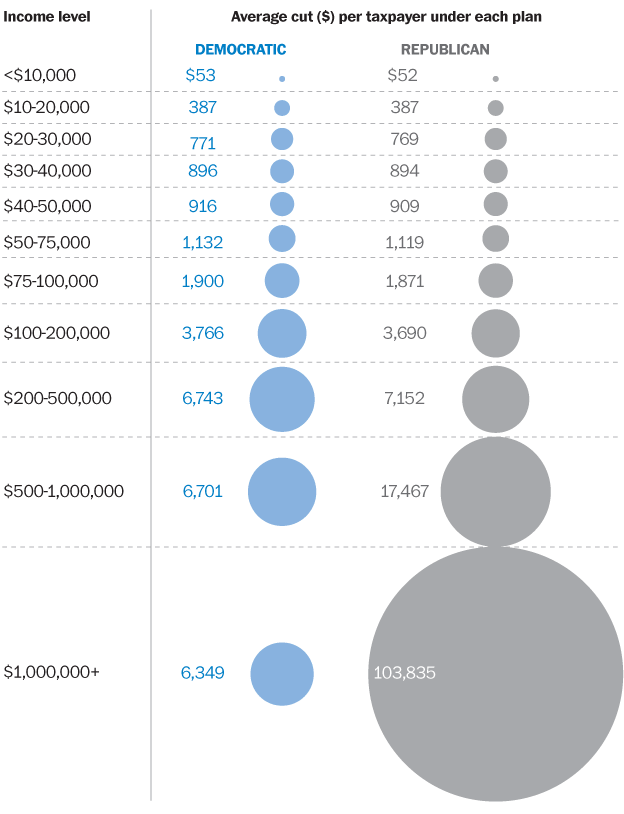 Flash forward to 2010. Economists are generally of the mindset that the tax cuts had little stimulative effect on the economy over the past decade and instead have caused the budget deficit to increase significantly. But because of the economic crisis, nobody in Washington was about to suggest that everyone's tax rates should be raised back up to the levels they were at in the 1990's. At the same time, it seemed obscene to Democrats to extend the huge tax cuts for the wealthiest 2% of Americans (the huge gray circle at the bottom of the graph on the right), which alone would have added $700 billion to the national debt over the next ten years. So the Democrats proposed extending the tax cuts for income below $250,000 per year, but end the tax cuts for any income above that. The cost of the Democrats plan is shown in blue on the right, while the cost of keeping the existing Bush tax cuts is shown in gray.
The Democrats wanted everyone making over $250,000 to get roughly the same tax break. Republicans reacted furiously, saying many small businesses pay tax as individuals in the top bracket and would stop hiring if they saw their taxes go up. They refused to back any partial extension of the Bush tax cuts, saying it had to be the whole thing or nothing. They felt so strongly that the wealthiest 2% of Americans shouldn't have their tax rates go back to 1990 levels that they have blocked an extension of unemployment benefits, which are set to expire at the end of the month, at a time of record unemployment.
Of course what the Republicans weren't mentioning was that most of those small businesses who file as individuals in that top bracket are people like investors or lawyers who wouldn't be hiring many people anyway. And of course the problem with giving rich people money is that they tend to save or invest it, whereas if you give poor people money they tend to spend it right away because they have to – particularly the unemployed. The non-partisan Congressional Budget Office concluded earlier this year that every $1 spent on unemployment benefits generates up to $1.90 in economic growth. But for every $1 in Bush-era tax cuts, only 10 cents to 40 cents are returned to the economy. And of course the problem with the US economy right now isn't that companies don't have enough money - it's that they're hesitant to hire because consumers aren't spending anything.
Disillusioned Democrats
For many Democrats the fact that Obama has capitulated on this enormously important issue is less surprising than it is disillusioning. This has really been the overwhelming narrative of the last two years. President Obama starts conceding things to Republicans even before negotiations have begun, displaying a willingness to abandon core principles in order to appease Republicans. This has been done despite the fact that the Republican opposition made it very clear from the begining that they would say no to everything Obama proposed, even if it was something they used to support. So Obama watered down the healthcare proposal in order to get Republican votes - and how many Republican votes did that win him in the end? None. The financial oversight legislation was also watered down, with the same result. And yet time and again, with each new issue, Obama keeps going for compromise - as if things are suddenly going to change. It's a bit like the old bit in the Chalrie Brown comics when Lucy would hold a football out for Charlie Brown to kick, then pull it away at the last minute forcing Charlie to land on his behind. President Obama has been the Charlie Brown of American politics over the past two years, seemingly never learning that the Republicans will always pull away the football at the last minute, no matter how much he offers them. Satirist Stephen Colbert did a pretty good job summing up the situation Monday night.
| The Colbert Report | Mon - Thurs 11:30pm / 10:30c | |||
| The Word - Unrequited Gov | ||||
Overall this tax cut issue is a very demoralizing development for Democrats. Many no longer feel that Obama is in their corner. Some are even saying he looks like he's given up, or that he doesn't seem to enjoy being president. And while it's true that both Ronald Reagan and Bill Clinton came back from similiar lows after their first two years in office, they still commanded the respect and support of their base. Obama appears to be quickly losing that, and that could spell big trouble for his chances of reelection in 2012.
But beyond being bad politics, the tax deal that has been worked out is just bad policy. Extending the Bush era tax cuts, which were irrisponsible enough when they were enacted, is absolute lunacy when the US is faced with this enormous deficit. While the countries of Europe are making serious efforts to tackle their budget challenges, cutting entitlements and raising taxes (particularly on the wealthy), the US seems to be living in a fantasy land regarding their economic situation. The system is so broken in Washington that nobody can propose real solutions to the deficit problem. And nobody's even willing to have an adult conversation about it. The recomendations of the president's budget task force last month were almost completely ignored. Things just aren't looking good these days in the United States.

3 comments:
I often wonder at which point in time (2050? 2100?) it will be more or less universally accepted that the US was, once, the most powerful nation on Earth but that they very clearly are not any more. Much like how Italy, Greece and China and, to a lesser degree, the UK are now.
This is not to say the US is at that point right now - they are not. It is though a sad state of affairs that so many people seem so intent on ignoring the signs or of apparently actively working to hasten the country towards a some truly apocalyptic end.
I hope I do not see the end of its reign (for lack of a better word) during my lifetime because the alternatives are even more disturbing.
Great piece of writing there Dave. Must be a very, very depressing time to be a Democrat
Very good post on the state of the union. It so hurts my heart to see such an inventor and champion of modern democracy come to a situation where the system prevents meaningful actions to be taken. Congress is supposed to be a body of balance with a fickle house and a deliberate senate but the balance is totally out.
I don't know if it's the media, as Jon/Stephen talks about, specifically Fox, the general lack of feeling secure about your self and your community or something else but it's Rome all over again. A legislative branch not capable of thinking for themselves anymore, just indulging in populism and excess. A judicial branch so politicized they can't even be professional. And an executive branch bent on distracting the people with wars and appearances.
Post a Comment