Showing posts with label US media. Show all posts

Wednesday, 10 April 2013

Thatcher's rose-tinted American legacy

The American media’s reverential depiction of Margaret Thatcher this week says much about how the US and UK differ when looking at history.

As I’ve watched the international media coverage of the death of Margaret Thatcher over the past few days, I’ve almost felt like we're talking about different women.

In America, the wall-to-wall coverage – quite unusual for a foreign leader – has been downright worshipful. This tone has been matched by politicians on both sides of the aisle. "The world has lost one of the great champions of freedom and liberty, and America has lost a true friend,” declared Barack Obama on Monday. “She helped restore the confidence and pride that has always been the hallmark of Britain at its best."

Here in continental Western Europe, where Thatcher was far less popular, the coverage couldn’t be more different. One French politician remarked that Thatcher will see the miners she put out of work in hell, while German MP Michael Roth declared "her radical market policies and her Europe-sceptical politics will certainly not be missed.”

In the UK the coverage has been more nuanced. As people say, she was a bit like Marmite – you either loved her or you hated her. The political persuasions of British papers has determined which side they’ve chosen to emphasise. But no media outlet has ignored the fact that she split opinions. Even Conservative Prime Minister David Cameron’s statement to the Parliament on Monday acknowledged this.

Monday, 4 July 2011

France rocked by new twist in DSK case

Revelations last week challenging the credibility of the New York chambermaid who says she was raped by former IMF chief Dominique Strauss-Kahn have triggered a whirlwind of speculation, recrimination, and of course good old-fashioned America-bashing in France.

Even before the revelations on Friday and DSK's subsequent release from house arrest, there was already widespread doubt in France that he was guilty. Polling indicated that 57% of French people thought DSK, who was until his arrest the leading contender to challenge Nicolas Sarkozy in next year's presidential election, was set up. The French media was scandalised by the US media's coverage of the case, which they said seemed to be presuming DSK's guilt. They were particularly outraged by the so-called 'perp walk' of a handcuffed DSK in front of the news cameras, something that is illegal to show in France if someone has not been convicted of a crime.

The case against DSK now looks almost certain to be dropped after it emerged that the woman has allegedly worked as a prostitute in the past. It also came to light that she had changed her story to investigators. Rather than reporting the incident to the hotel right away, she actually cleaned another room after the alleged attack and then went back to Strauss-Kahn's room to finish cleaning it.

Friday, 6 May 2011

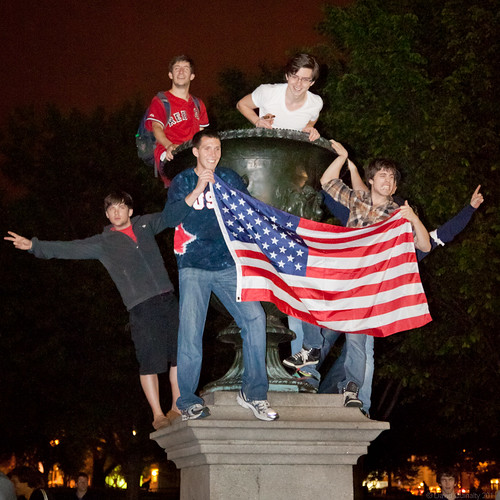
Europe uncomfortable with US Bin Laden celebrations

I've had a rather surreal experience this week watching reaction to the news that Osama Bin Laden was killed by American forces. On Monday morning I woke up and opened Facebook (before anything else, naturally), and saw a string of cryptic statuses chanting things like "USA! USA!" or "I'm so proud to be American today". But for whatever reason none of them said what had actually happened. So I had to open up Google News to learn what had inspired these rather unlikely chants from my "liberal elitist" friends in New York City.

The news was, of course, that Osama Bin Laden had been killed. The announcement by President Obama Sunday night prompted sudden exuberant celebrations in cities across America, the biggest outside the White House and in Times Square. It was reminiscent of the Victory Day celebrations at the end of World War II, a cathartic celebration unleashing a decade of angst Americans had felt since the 9/11 attacks. I found the magnitude of the celebrations a little surprising, but perhaps I had underestimated the effect that America's inability to capture Osama Bin Laden has had on the US psyche. A profound sense of anxiety and humiliation seems to have been lifted from Americans' minds with this killing. And both the left and right are jubilant over it. The American media seems to have regarded these celebrations as a universal good, heralding the way they have brought left and right together and united Americans in the same way that they were united after 9/11. The question does not seem to be asked whether Americans can be 'unified' in a counter-productive instinct.

Wednesday, 18 August 2010

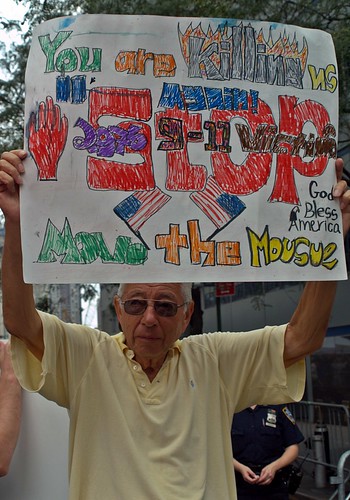
Mosque hysteria: an ugly reflection on America

It makes me a bit queezy to have to write about this, but considering that this “ground zero mosque” issue has now crossed the Atlantic and is making the news in Europe, it would seem I have no choice. It’s incredible that such a ginned-up controversy has reached proportions so big that people are hearing about it here. Over the weekend while in Paris a French friend asked me incredulously, “I hear Obama is planning to build a giant mosque on ground zero?? What is he thinking??”

Le sigh. Yes, that’s it, Obama is personally flying down to the former site of the world trade center to build a mosque brick by brick. Honestly I don’t blame Europeans for being misinformed about this, the US media coverage has been almost completely fact-free, and that then gets passed on over here during a slow news month. And it’s an issue that easily resonates here in Europe because let’s face it, when it comes to Islam, America and Europe can be sisters in hysteria. So, forget whatever you’ve heard. Let’s review the facts, shall we?

Thursday, 12 August 2010

After November: A Tea Party congress in America?

I just watched a somewhat bemused news story on French TV about Steven Slater, the US flight attendant who had had ENUF Monday, swearing at passengers before jumping out of a plane using the emergency slide. Apparently both sides of the Atlantic are in the full throes of the “silly season”, the term journalists use for the month of August when a lack of news results in an increased news focus on trivialities and non-stories. I myself am facing the daily frustration of having to write news stories at a time when no EU news is being made. Brussels basically shuts down in August and everyone takes their month-long vacations. Ah, Europe!

Consequently I don’t have much to write about for the blog either. So I thought I’d write a little something about the upcoming US midterm elections in November – since everyone keeps asking me about them. The spectre of them has had global implications in recent months, most notably in the Democratic leadership's decision to abandon the climate change bill because of fears its passage could anger voters before November. But the biggest effects of the election will be felt after November. It is looking ever more likely that the Democrats will lose their majority in the House of Representatives. And the new crop of ‘movement conservative’ Republicans that could be entering the congress will be the furthest to the right that the US has seen in decades. It could be an explosive result.

Wednesday, 14 July 2010

Belgium and France in race to ban the burqa

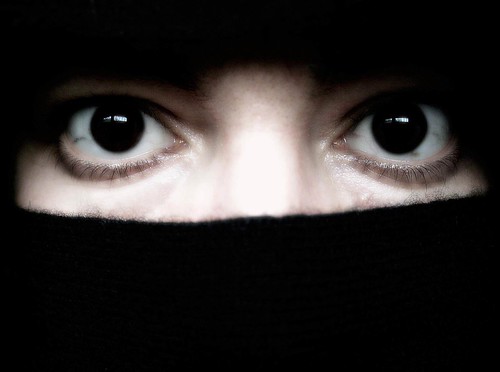
Who will emerge victorious? Belgium and France are currently falling over each other racing to be the first country in Europe to ban full face coverings. Whoever wins the race, both bans are guaranteed to eventually become law. The bans are illustrative not just of the conflict between Europeans and Muslim immigrants, but also of the ideological divide that separates continental Europe from the Anglo-Saxon world.

Both European and the Americans/British may dislike the burqa, but when it comes to how to deal with it, the English Channel and the Atlantic present a wide gulf. On the continent I don't know one person who thinks the ban is a bad idea. Yet I don't know a single American or British person who doesn't think it is a semi-fascistic disgrace.

Yesterday French MPs voted 335 to one in favour of legislation to ban face coverings in public areas. The ban does not specifically mention the Islamic burqa, a full-body garment that covers the entire face except a small slit for the eyes. Rather, it forbids anyone to cover their face in a public place. This would include costume masks or ski masks. A police officer would first ask a person to remove their face covering, and if they refuse, they can be fined €150.

Though the ban doesn’t specifically target Muslims, many Islamic groups and human rights activists are saying its main intent seems to be to send a hostile message to Muslims. They have accused French President Nicolas Sakozy of purposefully exacerbating tensions for electoral purposes. Though only a small minority of French Muslims would be affected by the ban (police figures say fewer than 2,000 of France's 2 million Muslims wear the burqa), Muslim groups have said they think the law stigmatizes all Muslims.

Monday, 21 December 2009

Europeans and Americans see Copenhagen through different eyes


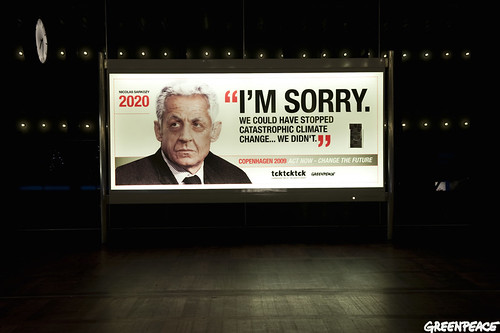
So, was Copenhagen a failure or not? It would appear the answer depends on which side of the Atlantic you’re on when you ask the question.

The Copenhagen Accord, finalised after hours of intensive negotiations, theoretically recognises a goal of limiting global warming to two degrees Celsius, but contains no targets to achieve that. There are no specific emission reduction actions by developing countries and no specific commitments on long term financing for mitigation and adaptation efforts. Not only is it non-binding, the agreement wasn’t even adopted by all UN countries. Instead it has just been 'noted', which means that countries recognise its existence but don’t necessarily agree with it.

European NGOs and governments were united in their condemnation of the Copenhagen climate summit’s result this weekend, which failed to include any kind of binding agreement and was only able to muster an optional “accord”. Though the language the political leaders were using was obviously more diplomatic than that being used by the climate activists (Greenpeace’s director called Copenhagen a “crime scene”), the basic message is still the same: the summit failed. Swedish prime minister Frederik Reinfeldt, still holding the EU presidency, said the agreement, “will not solve the climate pressures, the climate threat to mankind.” Commission president Jose Manuel Barroso said, "The level of ambition is not what we were hoping for." The British leadership has been railing against the Chinese all weekend, pointing the finger of blame squarely in their court. Brown said that they were, "clinging to their version of what an international organisation should not do,” and British environment minister Ed Milliband delivered the extraordinary charge today that the Chinese hijacked the summit. If there is a mainstream European publication that did not use the word ‘failure’ today to describe the summit, I am not aware of it.

Wednesday, 11 November 2009

The Sun Overplays its Hand

I’m loath to write about this, as I’m effectively jumping on the same bandwagon I’m about to deride. But given the intense level of media attention “handwritingate” has received over the past three days, it seems it may be impossible to ignore.

I first realized I was eventually going to have to write about this nonsense on Monday, as I was watching a live announcement on SkyNews from UK environment minister Ed Miliband (David’s brother) on a planning approval overhaul that will make it easier for the UK to build nuclear and coal plants. As the speech ended, the 24-hour British news network (owned by Rupert Murdoch’s News Corp) carried about three minutes of the ensuing parliamentary debate, then cut back to the studio. Ah good, I thought, now we’ll hear some analysis of what this announcement means. But no analysis came, in fact there was no mention of the speech we had just seen at all. Instead, the station delved into hour 13 of its non-stop coverage of the fact that UK prime minister Gordon Brown has bad handwriting.

Basically the story goes like this: there have been an extraordinary number of British casualties in Afghanistan over the past few months, attracting increasing public discussion about whether the UK should still be involved in the fight there and whether the troops are properly resourced. Apparently, possibly out of political calculation but more likely out of genuine concern, Gordon Brown has started writing personal handwritten letters to the families of the fallen soldiers. Seems like a nice gesture right? Only problem is the prime minister has horrible handwriting, owing to the fact that he is blind in one eye.

One mother named Jacqui Janes received such a letter from Mr Brown offering condolences for the loss of her son and found it sloppy and riddled with what are either spelling mistakes or illegibilities, depending on your perspective. She was most offended by the fact that the prime minister had appeared to spell her name with an ‘m’ instead of an ‘n’, addressing the letter to “Mrs. James”.

Janes rung up The Sun newspaper, which recently publicly switched its support from New Labour to the Conservatives, and the paper ran with it, making it a lead story two days in a row. The rest of the British media have followed suit, even the venerated BBC. The furore forced the prime minister to personally call the woman to apologise. Janes proceeded to emotionally berate Brown, tape recording the phone conversation and giving (some have speculated selling) it to the Sun, which then released it. Here is the audio below, though I warn it feels like something you shouldn't listening to. (Incidentally, and as awkward as it is to point out, a lack of equipment most likely had nothing to do with her son's death). Brown has since had to address the issue publicly twice in news conferences.


Of course the Sun is also owned by Rupert Murdoch’s NewsCorp, so it is under the same umbrella as another news organisation famous for this kind of thing across the pond – Fox News. The formula works like this: the media outlet picks up a fairly trivial but emotionally charged story, runs it relentlessly as a campaign against the government, and encourages reader/viewer outrage on the subject. It then reports on the viewer outrage, continuing coverage for several more days. Other media outlets worry that they are missing a major story (after all it must be a major story if the Sun/Fox are devoting so much time to it) so they run it as well. Pretty soon the issue is dominating all the front pages, be it manufactured outrage over bad handwriting or created controversy over a presidential address to school students.

However here in Britain there are already signs of pushback against this tried-and-true Newscorp strategy. Much of the readers’ comments under the web version of the original story were defending Brown, perhaps prompting the Sun to block commenting on their subsequent story.

Other papers have begun to note that the Sun risks overplaying its hand in its vigorous crusade against Gordon Brown, which is being fought with all the intensity the newly-converted usually display. The Standard, The Guardian and The Mirror have all been pointing out that much of the public has been disgusted with the Sun’s naked (and rather clumsy) attempt to exploit a grieving mother for its own ideological gain. Even many who dislike Brown are defending him from this rather crude attack.

Given his incredibly low approval rating, the Sun surely sees Gordon Brown as an easy target. And it is a reflection of Brown’s weak position that the paper could so easily bring him to his knees and force three separate grovelling apologies in just three days. However they may have underestimated the British public’s tolerance for cheap shots or blatant manipulation on this occasion. This kind of thing may work across the pond, but in Britain News Corp should perhaps tread a bit more carefully with these kinds of tactics.

After all, as evidenced in the screengrab to the right, perhaps people in glass houses shouldn't throw stones!

Saturday, 15 August 2009

UK Enraged by US Healthcare Portrayal

The US healthcare debate came to the UK in a very explosive way yesterday, when video of a British politician slagging off the NHS spread across the internets like wildfire. It was the twitterati who first started spreading the word, creating tags like #welovetheNHS to defend the NHS from this particular Tory politician, who happens to be a member of the European Parliament. My previous blog post on this subject has made the rounds pretty heavily on that tag actually.

The US media tour by Conservative MEP Dan Hannan has created a huge headache for Conservative leader David Cameron, who was scrambling yesterday to assert his love for the NHS and describe Dan Hannan as a fringe politician with "extreme views". The message is clear: the British National Health Service is a cherished institution in the UK, and politicians left or right criticise it at their peril. Whether this sort of "love it or leave it" mentality is helpful is debatable, but one thing is clear - any Briton can tell you that Dan Hannan's portrayal of the NHS doesn't bear the slightest resemblance to reality.


His description of the NHS, seen in this video above from Fox News, is so outrageously made-up that the Labour party - long trailing in the polls and virtually guaranteed to lose the next election - has pounced on it to show that the Conservative party can't be trusted with the NHS because they intend to make drastic cuts (Blair used the same argument in '97). The political headache for Cameron grew to such a fever pitch yesterday that some analysts were predicting that Cameron might sack Hannan from the partyand hence he would be out of the European Parliament). I know plenty in Brussels who would be relieved at this prospect, as Hannan has a long history of causing trouble in Strasbourg. But we'll see if the pressure remains through the weekend.

Of course as I pointed out in my previous healthcare blog post, the fact that the US media is focusing on the NHS at all doesn't make any sense. The healthcare plan being proposed by Obama and the US congress is not a single-payer system as exists in the UK Canada or France, but rather a hybrid multi-payer system as exists in Germany. Germany has a universal multi-payer system with two main types of health insurance: the public fund and private funds. Everyone is mandated to have healthcare, which is provided by the public fund to people below a set income level for a low rate. So, the wealthy can pay for exceptional private health coverage if they want to, or they can pay a small amount for the state insurance (many opt to do this). The end result is that everyone is covered and Germany spends 10% of GDP on health care, compared to 16% in the US. Obviously Germany would be the better example for the US media to use, yet the country, to my knowledge, has never been once by the US mainstream media.

This whole US "debate" (if you can call it that) has just been downright painful to watch, and has reminded me just how lucky I am to live in Europe. What's really unfortunate is that the hysteria and lies in the US are drowning out any actual debate on this bill - which will create one of two results. A bill will be passed without that perhaps lacks restraining measures that would have been helpful to it, or no bill will be passed which will represent the triumph of the mob, the victory of misinformation over reason. It's really a very sad thing to watch.

As for the British, perhaps watching the way this whole thing is unfolding in the US will make them feel a little more European. After all, this is one of those crucial ways in which the UK is much closer to the continent than to America. And the British should be grateful for it.