The credulousness of the UK public when it comes to all things EU-related was on full display Monday in the British media's coverage of the EU's much-awaited policy paper on transport.
Contrary to what you may have read in The Telegraph, The Daily Mail or the Evening Standard, the European Commission has not unveiled a plan to ban all cars from cities in 2050. This is just wrong. No journalist who actually looked at this policy paper could have reasonably come to the conclusion that the EU is banning cars. But the British tabloids never let the truth get in the way of a good story, especially one that fits their pre-defined narrative of how the EU oppresses the beleaguered British public.
The transport policy paper is a non-legislative roadmap that outlines a plan to reduce transport emissions while at the same time seeing an increase in transport over the next 40 years. It sets a goal of eliminating petrol-fueled combustion engines from vehicles meant for city driving by 2050. So, vehicles used for short-haul journeys within cities should either be electric or use alternative fuel in 40 years.
Showing posts with label global warming. Show all posts
Wednesday, 30 March 2011
Monday, 21 December 2009
Europeans and Americans see Copenhagen through different eyes
So, was Copenhagen a failure or not? It would appear the answer depends on which side of the Atlantic you’re on when you ask the question.
The Copenhagen Accord, finalised after hours of intensive negotiations, theoretically recognises a goal of limiting global warming to two degrees Celsius, but contains no targets to achieve that. There are no specific emission reduction actions by developing countries and no specific commitments on long term financing for mitigation and adaptation efforts. Not only is it non-binding, the agreement wasn’t even adopted by all UN countries. Instead it has just been 'noted', which means that countries recognise its existence but don’t necessarily agree with it.
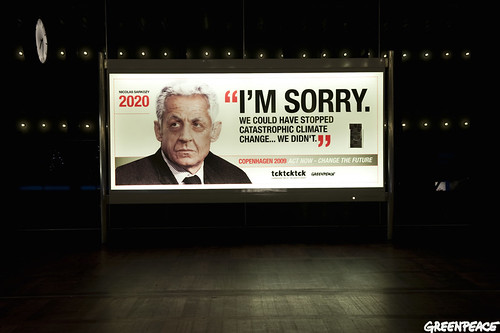
European NGOs and governments were united in their condemnation of the Copenhagen climate summit’s result this weekend, which failed to include any kind of binding agreement and was only able to muster an optional “accord”. Though the language the political leaders were using was obviously more diplomatic than that being used by the climate activists (Greenpeace’s director called Copenhagen a “crime scene”), the basic message is still the same: the summit failed. Swedish prime minister Frederik Reinfeldt, still holding the EU presidency, said the agreement, “will not solve the climate pressures, the climate threat to mankind.” Commission president Jose Manuel Barroso said, "The level of ambition is not what we were hoping for." The British leadership has been railing against the Chinese all weekend, pointing the finger of blame squarely in their court. Brown said that they were, "clinging to their version of what an international organisation should not do,” and British environment minister Ed Milliband delivered the extraordinary charge today that the Chinese hijacked the summit. If there is a mainstream European publication that did not use the word ‘failure’ today to describe the summit, I am not aware of it.
The Copenhagen Accord, finalised after hours of intensive negotiations, theoretically recognises a goal of limiting global warming to two degrees Celsius, but contains no targets to achieve that. There are no specific emission reduction actions by developing countries and no specific commitments on long term financing for mitigation and adaptation efforts. Not only is it non-binding, the agreement wasn’t even adopted by all UN countries. Instead it has just been 'noted', which means that countries recognise its existence but don’t necessarily agree with it.
European NGOs and governments were united in their condemnation of the Copenhagen climate summit’s result this weekend, which failed to include any kind of binding agreement and was only able to muster an optional “accord”. Though the language the political leaders were using was obviously more diplomatic than that being used by the climate activists (Greenpeace’s director called Copenhagen a “crime scene”), the basic message is still the same: the summit failed. Swedish prime minister Frederik Reinfeldt, still holding the EU presidency, said the agreement, “will not solve the climate pressures, the climate threat to mankind.” Commission president Jose Manuel Barroso said, "The level of ambition is not what we were hoping for." The British leadership has been railing against the Chinese all weekend, pointing the finger of blame squarely in their court. Brown said that they were, "clinging to their version of what an international organisation should not do,” and British environment minister Ed Milliband delivered the extraordinary charge today that the Chinese hijacked the summit. If there is a mainstream European publication that did not use the word ‘failure’ today to describe the summit, I am not aware of it.
Thursday, 7 May 2009
The Greenest Way to Travel
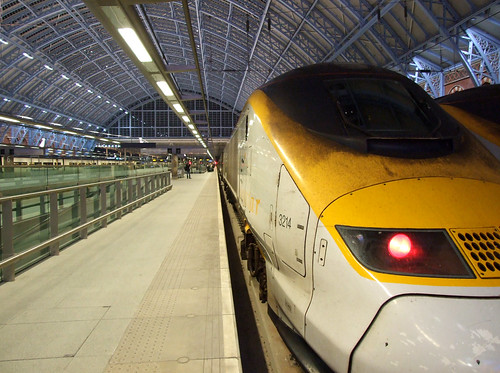
The train company, which carries passengers under the English Channel between London, Paris and Brussels, credited increased passenger numbers, a switch to nuclear energy supply for the Channel Tunnel and a series of on-train energy efficiency measures with the early success of its Tread Lightly initiative.
The results were released in a new sustainability report which also featured the results of a survey of over 1,500 travellers in the UK, France and Belgium showing that demand for high-speed rail continues to rise sharply. More than 40% of respondents said they regard the environment as a priority when making travel decisions.
Of course none of this takes into account the enormous convenience of taking a train rather than a plane. When I take the Eurostar I breeze into the station a cool 15 minutes before my train departs, and since I can leave and arrive in city centres there’s no time loss getting out to distant airports. Add to that avoiding the hassle of checking luggage and the low occurrence of delays, and I think it’s clear why I always prefer to take a train even if it will end up being longer than the air journey.
How do you say ‘high-speed’ in English?
Despite these enormous advantages, the fact remains that once I cruise into London at super velocity, that is where my high-speed journey ends. The UK has no true high-speed rail lines apart from the one coming from the continent, and even those high-speed compatible tracks south of London were just completed in 2006 (before then the Eurostar trains could only go at true high speed once they crossed into France). If I needed to continue on from London to cities as close as Manchester or Edinburgh the most efficient thing to do might be to take a plane. The fact that people are flying from Manchester to London is pretty absurd, but with the British rail system in a dilapidated and neglected state, there really isn’t any good alternative.
Even so, the trains across the pond in North America make the British trains look like marvels of modern technology. The rail network in the US has been largely abandoned, left to rot over decades as the government made a conscious decision to subsidize gas prices rather than invest in public transportation. There isn’t any proper high-speed rail line in the US - Acela in the northeast certainly doesn’t count, slower than a car at 60mph because of track limitations, costing about twice the price of a normal train just to save about 20 minutes.
The fact is that air travel is a necessity in a globalized world, and it can’t be limited without a viable alternative. Such an alternative may not exist for long-haul flights, but one certainly does for short-haul flights, particularly for those in densely populated areas like Western Europe or the Northeast US. High speed rail may be expensive (around $20 million per mile), but as the Eurostar and other lines has shown, the project can easily make the money back, and saving thousands of tons in carbon emissions in the process.
Friday, 27 June 2008
Europe goes after the skies
Amid all of the hand-wringing and fear that the Ireland ‘no’ vote will bring the EU to a chaotic standstill in January, judging by the news yesterday Brussels isn’t ratcheting down its ambition in the mean time.
After much negotiation, the EU at long last reached an agreement Thursday to add airlines to the ‘carbon credits’ scheme that requires big polluters to purchase credits in order to pollute. It is a truly landmark agreement because it will force not just European airlines, but foreign ones as well, to participate in the carbon scheme in order to use European airports. That part of the agreement is surely going to result in a fiery showdown with the United States, which today called the scheme both “illegal” and “unworkable.”
The Emissions Trading Scheme was started in 2005, and so far has only included heavy industry. It requires them to buy credits for each set amount of carbon dioxide they release into the atmosphere beyond a specific allotted amount. The European Commission and EU regulators have been eyeing adding airlines to the scheme for some time, as heavy industry argued it was being unfairly targeted. It’s the first such requirement in the history of aviation, requiring all airlines arriving or leaving from airports in the European Union to buy pollution credits beginning in 2012. The proposal still needs the approval of the European Parliament and the EU member states, but Slovenia, which currently holds the EU presidency, has apparently already gotten member states on board.
After much negotiation, the EU at long last reached an agreement Thursday to add airlines to the ‘carbon credits’ scheme that requires big polluters to purchase credits in order to pollute. It is a truly landmark agreement because it will force not just European airlines, but foreign ones as well, to participate in the carbon scheme in order to use European airports. That part of the agreement is surely going to result in a fiery showdown with the United States, which today called the scheme both “illegal” and “unworkable.”
The Emissions Trading Scheme was started in 2005, and so far has only included heavy industry. It requires them to buy credits for each set amount of carbon dioxide they release into the atmosphere beyond a specific allotted amount. The European Commission and EU regulators have been eyeing adding airlines to the scheme for some time, as heavy industry argued it was being unfairly targeted. It’s the first such requirement in the history of aviation, requiring all airlines arriving or leaving from airports in the European Union to buy pollution credits beginning in 2012. The proposal still needs the approval of the European Parliament and the EU member states, but Slovenia, which currently holds the EU presidency, has apparently already gotten member states on board.
Thursday, 24 January 2008
British MEPs say global warming is bunk
It strikes me that if people in Britain actually knew anything about their MEPs (Member of European Parliament) they might be a bit embarassed about some of the things that come out of their mouths. But seeing that the British often hand-select MEPs who don't think the European Union should exist at all, it shouldn't be surprising that they might say some things to offend.
The climate change plan has been the pride and joy of EC President Barroso, since he sees it as a sure-fire way for the EU to gain popularity. Many have pointed out that in order to restore the European public's trust and enthusiasm for the EU project, the union needs to highlight the areas in which union would do the most good. Since the economic arguments don't seem to be making much headway with the broader public (in fact it's been used as a main criticism of the EU, only protecting business interests and all that), the two areas which would be popular would be global warming and protecting the public from terrorism. Only a large block with a unitary policy could make real productive progress in either of these areas.
Wednesday, 23 January 2008
EU unveils climate change package
At long last, the European Commission unveiled its much anticipated energy and climate change package today, and it's a doozy.
As reported on Certain Ideas of Europe, the plan promises to deliver steep cuts in greenhouse gases, job security for heavy energy users like steel works, a whopping increase in renewable energy production, lots more biofuels and greater energy security, with reduced dependence on unstable energy suppliers. The overarching theme is to make Europe the leader in combating global climate change.
But as the Economist points out, even as they were unveiling the new policy one of their main policy goals - a common European energy policy - was again being thwarted right in their backyard. Today Serbia’s government agreed to sell its oil and gas company, NIS, to Russia’s Gazprom. It's one more step toward Russia's goal of building a pipeline called "South Stream" to send gas directly into the EU. Gazprom has also done similar deals with EU members Italy, Hungary and Bulgaria. All of this is a direct challenge to the European pipeline project Nabucco, which would bring gas to Europe from Iran and Azerbaijan via Turkey, reducing EU dependence on Russia.
The energy and climate change package is in many ways just as much about giving Europe a common energy policy as it is about combating climate change. The hope is that if the EU could get enough energy weight that the smaller countries won't be tempted to do individual deals with Gazprom. It could work, but the Nabucco project so far seems to be going nowhere while Russia is churning ahead. And a future in which the EU is dependant on Russia for its energy needs is a future no one in Brussels wants to see. Well, maybe no one except the Russian ambassador.
As reported on Certain Ideas of Europe, the plan promises to deliver steep cuts in greenhouse gases, job security for heavy energy users like steel works, a whopping increase in renewable energy production, lots more biofuels and greater energy security, with reduced dependence on unstable energy suppliers. The overarching theme is to make Europe the leader in combating global climate change.
But as the Economist points out, even as they were unveiling the new policy one of their main policy goals - a common European energy policy - was again being thwarted right in their backyard. Today Serbia’s government agreed to sell its oil and gas company, NIS, to Russia’s Gazprom. It's one more step toward Russia's goal of building a pipeline called "South Stream" to send gas directly into the EU. Gazprom has also done similar deals with EU members Italy, Hungary and Bulgaria. All of this is a direct challenge to the European pipeline project Nabucco, which would bring gas to Europe from Iran and Azerbaijan via Turkey, reducing EU dependence on Russia.
The energy and climate change package is in many ways just as much about giving Europe a common energy policy as it is about combating climate change. The hope is that if the EU could get enough energy weight that the smaller countries won't be tempted to do individual deals with Gazprom. It could work, but the Nabucco project so far seems to be going nowhere while Russia is churning ahead. And a future in which the EU is dependant on Russia for its energy needs is a future no one in Brussels wants to see. Well, maybe no one except the Russian ambassador.
Subscribe to:
Comments (Atom)