Germany's powerful carmakers got what they wanted from yesterday's diesel summit. But everything may change after the election.
At the press conference following yesterday's crisis summit in Berlin to deal with the unfolding Dieselgate scandal, you would have been forgiven for losing track of who was who.
With only five lecterns and around 20 participants, they had to play a round-robin of auto executives, each taking the stand to say how very, very sorry he was over revelations of cheating and collusion that have come out. Each middle-aged white German man was more indistinguishable than the next.
But all the while there was one woman standing to their left, looking very out of place. It was the summit's co-host, the center-left German environment minister Barbara Hendricks. And as the German auto chiefs detailed the agreement reached inside, an agreement in which she had been politically defeated, you would see on her face that she was already plotting her revenge.
Showing posts with label cars. Show all posts
Thursday, 3 August 2017
Tuesday, 1 August 2017
Is Berlin overthinking dieselgate and Russia sanctions?
Friday, 28 July 2017
The German autostate
Whether or not it was illegal, revelations about German automakers cheating the system are denting ‘brand Deutschland’. Do Germans play by a different set of rules?
The allegations that have surfaced this month against German automakers seem to confirm the worst suspicions that many in Europe hold about the EU’s largest country: while they insist on rigid enforcement of rules for everyone else, Germans seem to think the rules don’t apply to them.
A report by Der Spiegel magazine last week alleged that Germany’s five biggest automakers - Volkswagen, BMW, Daimler, Porsche and Audi - have been colluding for two decades on pricing, suppliers and diesel technical standards, in order to give them leverage over foreign competitors. This week the European Union said it is investigating the issue, and has appointed a vice president to oversee the investigation.
The allegations that have surfaced this month against German automakers seem to confirm the worst suspicions that many in Europe hold about the EU’s largest country: while they insist on rigid enforcement of rules for everyone else, Germans seem to think the rules don’t apply to them.
A report by Der Spiegel magazine last week alleged that Germany’s five biggest automakers - Volkswagen, BMW, Daimler, Porsche and Audi - have been colluding for two decades on pricing, suppliers and diesel technical standards, in order to give them leverage over foreign competitors. This week the European Union said it is investigating the issue, and has appointed a vice president to oversee the investigation.
Thursday, 17 October 2013
The car chancellor
Allegations of nefarious influence have abounded this week
in Brussels, with German chancellor Angela Merkel accused of controlling the
Council of Ministers, and automaker BMW accused of controlling her.
So who's really pulling the strings? And how did we get here?
On Monday, Germany overturned a deal on car emission limits in some very unusual circumstances, somehow convincing several other member states to switch positions on a deal that had already been agreed in June.
On Tuesday, it was revealed that Merkel's Christian Democratic Union (CDU) party received a donation of €690,000 from the Quandt family, which owns 46.7% of BMW, just days before Monday's fateful meeting. The revelation has prompted German media to dub Merkel "the car chancellor" and question whether hers is a pay-for-play government.
A gift from a partial stakeholder of an automaker might not have raised eyebrows were it not for the very heavy-handed and unusual way Germany has gone about trying to avoid this emissions limit at the last moment - a limit the industry has known was coming since 2008.
In terms of how Germany has worked to change this EU proposal, the country has technically not violated any rules. But Berlin has become involved in this legislation at two highly inappropriate times that are outside the normal legislative procedure – during the Commission drafting of the proposal and during a vote to rubber-stamp an already-agreed deal.
So who's really pulling the strings? And how did we get here?
On Monday, Germany overturned a deal on car emission limits in some very unusual circumstances, somehow convincing several other member states to switch positions on a deal that had already been agreed in June.
On Tuesday, it was revealed that Merkel's Christian Democratic Union (CDU) party received a donation of €690,000 from the Quandt family, which owns 46.7% of BMW, just days before Monday's fateful meeting. The revelation has prompted German media to dub Merkel "the car chancellor" and question whether hers is a pay-for-play government.
A gift from a partial stakeholder of an automaker might not have raised eyebrows were it not for the very heavy-handed and unusual way Germany has gone about trying to avoid this emissions limit at the last moment - a limit the industry has known was coming since 2008.
In terms of how Germany has worked to change this EU proposal, the country has technically not violated any rules. But Berlin has become involved in this legislation at two highly inappropriate times that are outside the normal legislative procedure – during the Commission drafting of the proposal and during a vote to rubber-stamp an already-agreed deal.
Wednesday, 30 March 2011
The EU is not going to 'ban cars'
The credulousness of the UK public when it comes to all things EU-related was on full display Monday in the British media's coverage of the EU's much-awaited policy paper on transport.
Contrary to what you may have read in The Telegraph, The Daily Mail or the Evening Standard, the European Commission has not unveiled a plan to ban all cars from cities in 2050. This is just wrong. No journalist who actually looked at this policy paper could have reasonably come to the conclusion that the EU is banning cars. But the British tabloids never let the truth get in the way of a good story, especially one that fits their pre-defined narrative of how the EU oppresses the beleaguered British public.
The transport policy paper is a non-legislative roadmap that outlines a plan to reduce transport emissions while at the same time seeing an increase in transport over the next 40 years. It sets a goal of eliminating petrol-fueled combustion engines from vehicles meant for city driving by 2050. So, vehicles used for short-haul journeys within cities should either be electric or use alternative fuel in 40 years.
Contrary to what you may have read in The Telegraph, The Daily Mail or the Evening Standard, the European Commission has not unveiled a plan to ban all cars from cities in 2050. This is just wrong. No journalist who actually looked at this policy paper could have reasonably come to the conclusion that the EU is banning cars. But the British tabloids never let the truth get in the way of a good story, especially one that fits their pre-defined narrative of how the EU oppresses the beleaguered British public.
The transport policy paper is a non-legislative roadmap that outlines a plan to reduce transport emissions while at the same time seeing an increase in transport over the next 40 years. It sets a goal of eliminating petrol-fueled combustion engines from vehicles meant for city driving by 2050. So, vehicles used for short-haul journeys within cities should either be electric or use alternative fuel in 40 years.
Wednesday, 2 March 2011
Low taxation of company cars: a perverse incentive to pollute?
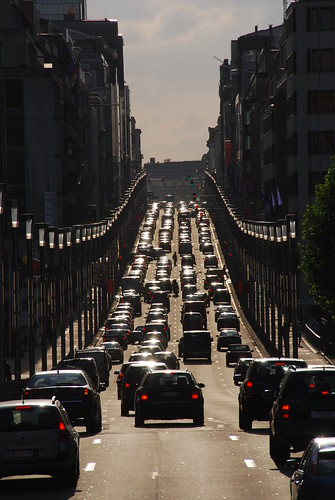
As residents of Brussels know all too well, this is a car city. Sure, there's an efficient metro system – but it has only two lines and doesn't cover large swathes of the city's more affluent areas, which are instead covered by glacially slow trams and buses. The city is small enough to be easily covered by bike, but the extremely poor quality of the roads, the hilly terrain and the lack of cycle lanes often make cycling here more of a nuisance than it's worth (take it from a cyclist). That leaves only driving by car, an activity I would say the vast majority of my friends here are engaged in.
I myself have never owned a car, having always lived in large cities with good public transport systems. I still don't own a car in Brussels, but after living here a year I can say I've never before felt such temptation to get one. Not necessarily because I have difficulty getting around here. Despite its flaws I find the public transport to be sufficient for my needs, and when it's not I go by bike. But I feel like a bit of an oddity sometimes for getting around the city by metro, tram and bike. Peer pressure? Car envy? I'm not sure, but the fact that most of my friends drive is making me suddenly want a set of wheels. By contrast, none of my friends in London or New York had cars.
But if the Brussels public transport system is sufficient, why do all of these white collar workers I'm friends with – many of whom are only in Brussels temporarily – have cars? The answer is simple – Belgium pays them to have one.
I myself have never owned a car, having always lived in large cities with good public transport systems. I still don't own a car in Brussels, but after living here a year I can say I've never before felt such temptation to get one. Not necessarily because I have difficulty getting around here. Despite its flaws I find the public transport to be sufficient for my needs, and when it's not I go by bike. But I feel like a bit of an oddity sometimes for getting around the city by metro, tram and bike. Peer pressure? Car envy? I'm not sure, but the fact that most of my friends drive is making me suddenly want a set of wheels. By contrast, none of my friends in London or New York had cars.
But if the Brussels public transport system is sufficient, why do all of these white collar workers I'm friends with – many of whom are only in Brussels temporarily – have cars? The answer is simple – Belgium pays them to have one.
Tuesday, 1 March 2011
EU bans cheaper auto insurance rates for women
Insurance companies across Europe as well as in North America generally charge women much less for auto insurance than their male counterparts. Statistics show they are less risky drivers and are therefore less likely to get into an accident. The difference in pricing is particularly large for people under the age of 30, where women typically pay half of what men pay.
Previously such a distinction in pricing was allowed through an exemption for insurers from having to follow national discrimination laws. But a Belgian consumer group challenged the exemption, saying that assuming men are dangerous drivers simply based on their gender constitutes unlawful discrimination. The court agreed, and insurers in the EU will have to end their systems of separate rates by December 2012.
Tuesday, 25 April 2006
Best Gas Price Medicine? Build Public Transportation
Americans need to get something through their heads. The price of gas is not going to go down to $2 a gallon again. Ever. Period.
The emergence of China as a global power has and will fundamentally change our world, and we need to adjust to it. And part of that adjustment will be paying real prices for oil.
Congress is getting all in a tizzy about these gas prices, pointing their fingers this way and that. But Republicans seem to be forgetting about the enormous gift they gave the oil industry last year, an energy bill that gave huge subsidies and tax breaks to big oil. Last year the five largest oil companies, Exxon Mobil, BP, Royal Dutch Shell, Chevron Corp. and ConocoPhillips took home more than $111 billion in profits. As CNN’s John Roberts noted recently, that's greater than the GDP of 174 of the world's countries
To a large degree the US has brought this upon itself by not investing in an even rudimentary public transporation system. We are a nation obsessed with the car. So much so that in all the recent news reports asking how high gas would have to go before Americans stopped driving, noone’s thought to point out the obvious: They can’t stop driving no matter how much you charge for gas, because they have no other way to get around. Gas could go up to $20 and they’d still have to pay it.
The emergence of China as a global power has and will fundamentally change our world, and we need to adjust to it. And part of that adjustment will be paying real prices for oil.
Congress is getting all in a tizzy about these gas prices, pointing their fingers this way and that. But Republicans seem to be forgetting about the enormous gift they gave the oil industry last year, an energy bill that gave huge subsidies and tax breaks to big oil. Last year the five largest oil companies, Exxon Mobil, BP, Royal Dutch Shell, Chevron Corp. and ConocoPhillips took home more than $111 billion in profits. As CNN’s John Roberts noted recently, that's greater than the GDP of 174 of the world's countries
To a large degree the US has brought this upon itself by not investing in an even rudimentary public transporation system. We are a nation obsessed with the car. So much so that in all the recent news reports asking how high gas would have to go before Americans stopped driving, noone’s thought to point out the obvious: They can’t stop driving no matter how much you charge for gas, because they have no other way to get around. Gas could go up to $20 and they’d still have to pay it.
Subscribe to:
Comments (Atom)