Showing posts with label burqa bans. Show all posts

Monday, 4 June 2012

Burqa ban leads to rioting in Brussels

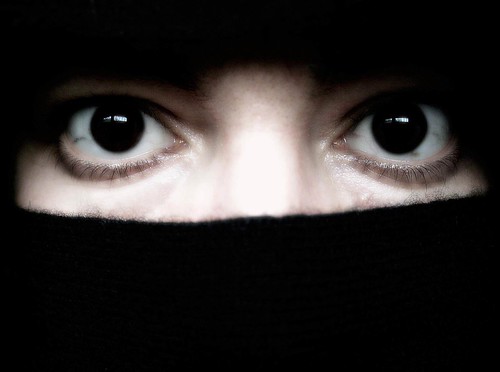
The area of Molenbeek in Brussels was the scene of low-level rioting at the end of last week following the arrest of a woman for wearing a full face-covering niqab. It is the largest and most violent incident of resistance since France and Belgium enacted bans on face-covering in 2010 and 2011.

For those who oppose the burqa ban, the rioting is evidence that it is causing more problems than it solves and giving the garment more power as a symbol of resistance. For those who support the ban, the rioting is evidence that the state was right to take a stand against the increasing radicalisation they say is taking place among Belgium’s sizable Muslim minority of mainly North Africa immigrants.

On Thursday, Brussels police arrested a 23-year-old woman in Molenbeek – one of the neighborhoods of Brussels with a very high Muslim population at over 50% - for refusing to take off her face covering. That night, police say about 100 people surrounded the Molenbeek police station where she was being held, throwing stones at officers. A large number of riot police were deployed, giving the area the feeling of a city under siege. After Muslim prayers on Friday afternoon additional skirmishes broke out in the area, forcing the authorities to shut down some metro stations. The police say the violent demonstrations were organised by the group Shariah4Belgium

Wednesday, 14 July 2010

Belgium and France in race to ban the burqa

Who will emerge victorious? Belgium and France are currently falling over each other racing to be the first country in Europe to ban full face coverings. Whoever wins the race, both bans are guaranteed to eventually become law. The bans are illustrative not just of the conflict between Europeans and Muslim immigrants, but also of the ideological divide that separates continental Europe from the Anglo-Saxon world.

Both European and the Americans/British may dislike the burqa, but when it comes to how to deal with it, the English Channel and the Atlantic present a wide gulf. On the continent I don't know one person who thinks the ban is a bad idea. Yet I don't know a single American or British person who doesn't think it is a semi-fascistic disgrace.

Yesterday French MPs voted 335 to one in favour of legislation to ban face coverings in public areas. The ban does not specifically mention the Islamic burqa, a full-body garment that covers the entire face except a small slit for the eyes. Rather, it forbids anyone to cover their face in a public place. This would include costume masks or ski masks. A police officer would first ask a person to remove their face covering, and if they refuse, they can be fined €150.

Though the ban doesn’t specifically target Muslims, many Islamic groups and human rights activists are saying its main intent seems to be to send a hostile message to Muslims. They have accused French President Nicolas Sakozy of purposefully exacerbating tensions for electoral purposes. Though only a small minority of French Muslims would be affected by the ban (police figures say fewer than 2,000 of France's 2 million Muslims wear the burqa), Muslim groups have said they think the law stigmatizes all Muslims.

Monday, 26 April 2010

Belgian government collapses, yet again

I'm in Trier, Germany today, attending a seminar for journalists on the European Court of Justice (the EU equivalent of the US Supreme Court, though with some important differences). Though I may be away from Brussels for the day the news feed on my iphone started blowing up this afternoon with news about my new host country as it became official - the Belgian government has fallen. Though the country's king worked tirelessly over the weekend to try to sort out a compromise between the warring Frencophone and Dutch-speaking parties, he has been unable to bring peace to the parliament, and today accepted the resignation of the prime minister.

International media reaction to the news has been muted, most likely because this is starting to become such a routine event. The government last collapsed in July 2008, during a period where at one point there was no Belgian government for well over a year. Not that you would have noticed. Belgium has become so decentralised - with authority split between the three regions of Wallonia, Flanders and Brussels - that the national government hardly does anything any more.

Sunday, 29 November 2009

Switzerland Declares War on Architecture

In a shocking result, 57% of the Swiss have voted to ban mosques with minarets in their country. Both the majority of cantons and the majority of people have voted to ban the mosques, reflecting the increasingly xenophobic mood of Swiss politics.

The vote follows the win of the anti-immigrant Swiss People’s Party (SVP) two years ago. Now the largest party in Switzerland’s parliament, the SVP strongly backed the constitutional ban, saying that minarets (the tall slender towers on traditional mosques) are a sign of militant Islam and a threat to Switzerland. However the rest of the political parties in government opposed the ban and warned that it was not only unnecessary, but also sending a hostile message to the country’s minority populations.

Of course in Switzerland it doesn’t matter that the majority of the government strongly opposed a ban, it is easy for citizens to put virtually anything to a national referendum for people to vote on. And with a saturation of posters like the one above, it’s relatively easy to whip up hysteria about what is essentially a non-issue.As demonstrated time and time again, referendums can never be counted on to protect the rigthts of minorities.

Switzerland has 4 minarets in the entire country, an incredibly low number for a Western European country. This is the result of two factors – the Muslim population is fairly small at 400,000, and planning applications for minarets are almost always refused by local authorities.

The campaigners for the ban have insisted that minarets are a symbol of militant Islam. SVP member of parliament Ulrich Schluer said "A minaret is a political symbol. It is a symbol for introducing, step-by-step, Sharia rights also in Switzerland, parallel to the Swiss law which is a result of Swiss democracy. And this is the problem. It is nothing against Muslims."

The reality of course is that the vast majority of Switzerland’s Muslims are either fellow Europeans from the Balkans or immigrants from Turkey. They’re not exactly coming from hotbeds of Islamic extremism. In fact Switzerland probably has one of the lowest penetrations of Islamic extremism in Western Europe, considering that immigration from geographic areas where Islamic extremism is a problem – North Africa, the Middle East, Pakistan and Indonesia – is very restricted. So it’s hard to see how such a drastic measure as changing the constitution to ban a piece of architecture is necessary.

Essentially it’s an imaginary solution to an imaginary problem. There is no Islamic extremism problem in Switzerland, and even if there were, how on earth would getting rid of minarets solve it?

The media has been making a lot of comparisons to the French head scarf ban in public schools, but I don't really think this is an apt comparison. The argument was made that the veil disrupted learning and encouraged hostility by providing visable markers of difference between students. There were also safety and practicality questions raised about students being allowed to cover their face in school. This Swiss minaret ban is entirely different, as there is no legitimate practical issue that this resolves - it's entirely symbolic. Muslim calls to prayer are already not allowed in the country because of blanket noise ordinances, so the presence of a minaret really has no practical effect on the population. A girl wearing a veil in a classroom arrguably has a very real effect on the learning environment for her, her teacher, and other pupils.

In any event, this is a dismaying result for a country that seems to be sliding into increasing xenophobia and nastiness. There is a debate to be had about Islam's place in Europe and in European law, but this largely symbolic vote has no practical effect other than alienating Swiss muslims. Perhaps even more importantly, it sends a troublingly hostile message to the world at large.

***Added 30/11/09: Analysis following the vote has found that the ban is most likely illegal under European and international law. I’ve heard a few comments in the UK about how the vote will be ok because Switzerland is not part of the EU. Actually Switzerland is a member of the Council of Europe and is party to the European Convention on Human Rights and subject to the European Court of Human Rights. Grahnlaw has a good entry summing up the various legal analysis, and the overall conclusion is that the ban is contrary to Switzerland’s obligations under European human rights law and will require corrective measures.