Showing posts with label architecture. Show all posts

Sunday, 29 November 2009

Switzerland Declares War on Architecture

In a shocking result, 57% of the Swiss have voted to ban mosques with minarets in their country. Both the majority of cantons and the majority of people have voted to ban the mosques, reflecting the increasingly xenophobic mood of Swiss politics.

The vote follows the win of the anti-immigrant Swiss People’s Party (SVP) two years ago. Now the largest party in Switzerland’s parliament, the SVP strongly backed the constitutional ban, saying that minarets (the tall slender towers on traditional mosques) are a sign of militant Islam and a threat to Switzerland. However the rest of the political parties in government opposed the ban and warned that it was not only unnecessary, but also sending a hostile message to the country’s minority populations.

Of course in Switzerland it doesn’t matter that the majority of the government strongly opposed a ban, it is easy for citizens to put virtually anything to a national referendum for people to vote on. And with a saturation of posters like the one above, it’s relatively easy to whip up hysteria about what is essentially a non-issue.As demonstrated time and time again, referendums can never be counted on to protect the rigthts of minorities.

Switzerland has 4 minarets in the entire country, an incredibly low number for a Western European country. This is the result of two factors – the Muslim population is fairly small at 400,000, and planning applications for minarets are almost always refused by local authorities.

The campaigners for the ban have insisted that minarets are a symbol of militant Islam. SVP member of parliament Ulrich Schluer said "A minaret is a political symbol. It is a symbol for introducing, step-by-step, Sharia rights also in Switzerland, parallel to the Swiss law which is a result of Swiss democracy. And this is the problem. It is nothing against Muslims."

The reality of course is that the vast majority of Switzerland’s Muslims are either fellow Europeans from the Balkans or immigrants from Turkey. They’re not exactly coming from hotbeds of Islamic extremism. In fact Switzerland probably has one of the lowest penetrations of Islamic extremism in Western Europe, considering that immigration from geographic areas where Islamic extremism is a problem – North Africa, the Middle East, Pakistan and Indonesia – is very restricted. So it’s hard to see how such a drastic measure as changing the constitution to ban a piece of architecture is necessary.

Essentially it’s an imaginary solution to an imaginary problem. There is no Islamic extremism problem in Switzerland, and even if there were, how on earth would getting rid of minarets solve it?

The media has been making a lot of comparisons to the French head scarf ban in public schools, but I don't really think this is an apt comparison. The argument was made that the veil disrupted learning and encouraged hostility by providing visable markers of difference between students. There were also safety and practicality questions raised about students being allowed to cover their face in school. This Swiss minaret ban is entirely different, as there is no legitimate practical issue that this resolves - it's entirely symbolic. Muslim calls to prayer are already not allowed in the country because of blanket noise ordinances, so the presence of a minaret really has no practical effect on the population. A girl wearing a veil in a classroom arrguably has a very real effect on the learning environment for her, her teacher, and other pupils.

In any event, this is a dismaying result for a country that seems to be sliding into increasing xenophobia and nastiness. There is a debate to be had about Islam's place in Europe and in European law, but this largely symbolic vote has no practical effect other than alienating Swiss muslims. Perhaps even more importantly, it sends a troublingly hostile message to the world at large.

***Added 30/11/09: Analysis following the vote has found that the ban is most likely illegal under European and international law. I’ve heard a few comments in the UK about how the vote will be ok because Switzerland is not part of the EU. Actually Switzerland is a member of the Council of Europe and is party to the European Convention on Human Rights and subject to the European Court of Human Rights. Grahnlaw has a good entry summing up the various legal analysis, and the overall conclusion is that the ban is contrary to Switzerland’s obligations under European human rights law and will require corrective measures.

Monday, 15 June 2009

Prince-on-Prince Contact

In a shock turn of events, it was revealed on Friday that Prince Charles has been successful in his bid to stop the Qataris from constructing modernist apartment blocks on the site of the old Chelsea Barracks, which is across the street from my flat. As you can imagine my flatmate, who has been intimately involved with the negotiations between our building’s residents and the Qataris, is none too pleased that the concessions he’s worked for two years to get have now gone up in smoke.

So what did it take for Qatari Diar (a real estate firm owned by the Qatari royal family) to abandon their planned development, designed by one of the worlds most prominent architects for a site that they purchased in the most expensive land transaction in British history? From the looks of it, it was a little princely camaraderie. The decision follows communication between Prince Charles and the Emir of Qatar in which the Prince of Wales asked him to stop the modernist development and instead start over with a more classic, traditional design.

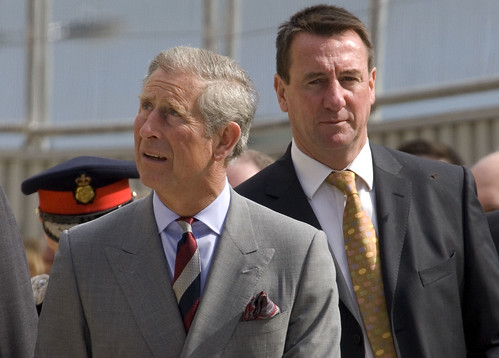
So is this really the result of some royal influence, or is the royal contact angle just an over dramatisation by the British press? Right now it’s a bit unclear. As I wrote about in my previous post on this topic, the letter my flatmate received from the prince last month seemed to indicate that he probably didn’t want to see his royal name too associated with this mess - an effort that, judging from the headlines on Friday, clearly failed. One can easily see why he wanted to avoid it though. The heir apparent has been the target of considerable anger following this news, particularly from architects who say he should stop his “meddling”.

However the fact is that Charles was not really the driving force behind the opposition to this plan. The resistance was led by a proactive and energetic residents association (one that my building wasn’t a part of). It was that group, the Chelsea Barracks Action Group, that commissioned the ‘alternative’ Chelsea Barracks blueprint by traditional architect Quinlan Terry that much of the media has presented as being the brainchild of the prince (the one on the right in the above photo, compared to the planned design on the left). The prince, in fact, was really just peripherally involved in this whole dispute, from the looks of it. This was really a victory for CBAG chairwoman Georgie Thorburn, who has pursued this issue with almost messianic zeal over the past year.

But as peripheral as his involvement may have been, was Prince Charles the factor that tipped this in CBAG’s favour in the end? We’ll probably never know, as the intimate chats between royalty aren’t usually public knowledge, especially in Arabia! But what is for certain now is that the Chelsea Barracks site is back to the drawing board, and will continue to lie as a giant pit in the middle of posh Chelsea, with its two abandoned high-rise barrack dorms sticking up like rotting teeth. Not so great for the neighborhood’s aesthetic, but hey, at least I’m not going to be woken up by construction equipment in the morning any time soon!

Incidentally I’m in Amsterdam this week for work, on a press tour of some environmental projects throughout Holland. I’ll try to write a little bit about some of the things I’ve seen later in the week.

Wednesday, 13 May 2009

Prince Charles and the "Monstrous Carbuncle"

Earlier this week I was surprised to open the door and find a royal messenger holding a letter from Prince Charles. Of course I assumed it was my invitation to be knighted as “Best American Blogger in Britain,” but alas it was for my flatmate, who is head of the resident’s association in my building. That position probably doesn’t do much to account for why he gets letters from Prince Charles, but allow me to explain.

I live across from the Chelsea Barracks, a moderately-sized British army barracks that was sold and vacated last year. It now stands empty, with only two garish dormitory towers and a military chapel left as a reminder of its former use. The towers haven’t been torn down yet because of an ongoing conflict between the buyers - the Qatari royal family - and the neighborhood residents. Qatari Diar bought the property from the Ministry of Defence for £959 million, making it Britain’s most expensive residential development site in history at £70.3m per acre.

The Qataris have hired famed architect Richard Rogers to develop a modernist residential community that would be 50% affordable housing. The proposed projects would include tall buildings that would block the sunlight of neighboring buildings like mine (apparently the courtyard would be put permanently in shadow).

Earlier this year it was reported that Prince Charles wrote to Qatar Emir Sheikh Hamad bin Khalifa Al-Thani asking for Rogers’ design to be scrapped in favour of a more traditional scheme devised by classicist Quinlan Terry. Prominent London architects were outraged and called on the Prince to but out. But given that the site is right next to the Royal Chelsea Hospital and Sloane Square, many in this posh traditionally conservative area have been horrified by the though of a modern development towering over the venerable Chelsea.

The prince was then invited to speak at the to speak to the Royal Institute of British Architects last night, exactly 25 years after a highly controversial speech he made there 25 years ago blasting modern architecture and shooting down an idea to build an extension to the National Gallery at Trafalgar Square that resembled Paris’s Pompidou Centre. He famously likened the idea to seeing a “monstrous carbuncle on the face of a much-loved and elegant friend". That plan was scrapped quickly after those comments, and London modernist architects have never forgiven him for it. That’s why many were surprised that the Prince, who is often described as being inappropriately activist for a British royal, was invited back this year, and several architects boycotted the speech. You can judge for yourself in hindsight how a Pompidou Centre would have looked in Trafalgar Square.

This is where my flatmate entered the scuffle. Suspecting the Prince would make for a welcome ally in the residents' quest to stop the skyscraper development, so he sent him a letter. Surprisingly the prince wrote back quite fast, and the response came on Monday, one day before he was slated to speak to the institute. Though many thought he might take the opportunity of his speech to lambast the Chelsea Barracks development plan, we could tell from his letter on Monday that he had no such intention. The letter said that the prince's letter to the Qatar royal family was leaked to the press and was not meant to be public, and essentially that the prince was going to stay out of the controversy. Sure enough, last night saw a contrite, milder prince who even apologized for his remarks 25 years ago.

So, it looks like no prince ally for the Chelsea residents, at least not for now. And it remains to be seen whether the prince's contrition will heal his rift with the architects. But the war between classicists and modernists is far from over The modernists insist the classicists are trying to build fairy tale villages, and the classicists say modern architecture is cold and quickly outdated. Personally, I like them both.

As for the prince, he spent most of his speech actually railing about how new buildings should be eco-friendly. When it comes to pet issues, it's clear this "activist prince" moved on from architecture to climate change long ago.