Showing posts with label populism. Show all posts

Saturday, 21 October 2017

Today's divides aren't between states, they're across them


In Europe and America, today's urban educated elites have more in common with their counterparts in other countries than their own compatriots. It is resulting in a new type of international nationalism.

I was in Belgrade last week moderating at the Belgrade Security Forum, an annual policy dialogue about Balkan and European issues. 

During a discussion on challenging inequality, one of the panelists made a point that stuck with me. Responding to a comment from former Greek prime minister George Papandreaou about the uneven benefits of globalization, Hakan Altinay from the Global Civics Academy noted that the benefits are being felt by a certain class in each country, and that is bringing them closer together across borders while they drift ever-further apart from their countrymen. 

People working in and around the European Union institutions in Brussels are often accused of living in a bubble, forming an international echo chamber in which they have more in common with each other than with people back home in their own countries. But in fact, this is a phenomenon that is linking national capitals across Europe - and it has little connection to the EU. The bubble isn't just in Brussels. It is spread across Europe's cities.

A few days later, I heard a very similar description of the situation in the US on NBC's Meet the Press, America's main public affairs program. During a 'data download' segment, host Chuck Todd described how NBC News had crunched the numbers. Despite the caricature of America being divided between red and blue states, the divide is really between red and blue people - and that split defies geography.

Friday, 18 November 2016

3/4 of electorate gave their nod to Trumpism

In the week since the US presidential election I've seen a lot of people posting that "only one in five Americans" endorsed Trump for president. No.

While it is true that only 19.5% of Americans cast a vote for Donald Trump last Tuesday (versus 19.8% for Clinton), one cannot then make the leap to say that 80% of Americans are opposed to Trump and are being dragged along unwillingly. That is nonsense.

First off, 29% of Americans are not eligible to vote, either because they are too young or because they have committed a crime. We have no way of knowing how those people feel about Trump. Then we have to people who were eligible to vote but chose not to - 45% of the eligible population.

Friday, 29 July 2011

Where does the Norway shooting leave Europe’s conservatives?

Last week’s far right terrorist attack in Norway has prompted a lot of questions in European capitals, and many of the hardest questions are being asked inside the party headquarters of Europe’s center-right. Many of Europe's conservative parties have spent the last few years courting the far right vote, by co-opting some of their messages on immigration and cultural identity issues. In several countries including Denmark, Italy and the Netherlands the mainstream conservative parties have even allied themselves with the far right and invited them into governing coalitions. After the Norway attack, are those days over?

To answer this question, one must understand the current political balance in Europe, and why it has come about. Conservative parties now dominate the national governments of Europe as well as the EU institutions, relegating the left to just a few Southern countries. The Guardian put out a great interactive map today where you can trace Europe’s left-right balance over the past 50 years. Contrast the map just ten years ago in 2001 on the left with today’s situation in 2011 on the right (left-of-center in red and right-of-center, including Liberal parties, in blue). Considering that Spain and Greece now have their policies dictated to them by their conservative Northern European creditors, the left has effectively disappeared from Europe.


So why has Europe veered rightward at a time of economic crisis? There are probably many contributing factors – but the biggest cause is the complete disarray of the European left. From Scandinavia to Germany to France to Italy, European Social Democrats are in complete chaos, torn by infighting, a lack of enthusiasm and confusion over ideology. Europeans have voted conservative not because of some great ideological shift toward economic liberalism and laissez-faire capitalism. They have done so because the parties of the left have not offered any credible alternative for governance.

Wednesday, 5 May 2010

Populism, David Cameron, and the gulf oil spill

The election campaign is in its last heated days here in London, and it really is inescapable. I’m just here for a few days staying with my partner, and it seems like it’s been all anyone can talk about. Sarah Brown, the prime minister’s wife, even made a bizarre special appearance at a Vauxhall gay club Saturday night. Hey, gotta get those votes wherever you can! But I found it amusing that the next morning she was up early to attend mass at a black church in South London.

I’m on the Eurostar back to Brussels at the moment and feeling pretty bummed to be leaving right before the big day. I have a feeling the real excitement is going to begin Friday when the parties have to somehow hash out how they form a government from a hung parliament.

If I had to sum up the mood of my London friends in one word it would be anxious. They all come from various political stripes, but interestingly most everyone I know is planning to vote Lib Dem. Whatever their political ideology they have one thing in common – David Cameron makes them very nervous. They fear the former PR-turned-politician is all window-dressing with little real policy ideas, and in reality it will be the “nasty Tories” of the 1990’s that will be taking power. Having not lived through this period in Britain I can’t entirely relate, but some of them feel very strongly about this fear. But an opinion piece in the Independent this weekend compared the situation with the campaign of George W. Bush in 2000. He also promised "compassionate conservartism" but in the eyes of many he turned out to be just a populist front man for a Neo Conservative cabal with a very specific agenda. That agenda included going to war with Iraq.

Thursday, 21 January 2010

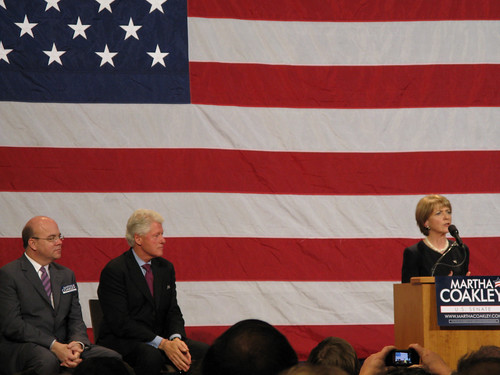
When 40 is more than 60: Why Republicans always win

In the wake of Tuesday’s game-changing Republican victory in Massachusetts I’ve been inundated by questions from perplexed Europeans. How is it, they ask incredulously, that one year after Barack Obama came into office on a wave of popular euphoria, he has somehow come to attract the rage of the very Americans he’s been trying to help?

The answer lies in this not-often-observed reality: despite the fact that voters banished Republicans from the leadership of every branch of government in the 2006 and 2008 elections, since Obama's inaugeration they have been able to wage one of the most effective oppositions in American history. Though the Grand Old Party is in the midst of a leadership vacuum and is no longer coming up with any actual policy ideas, they've somehow managed to stymie the Obama agenda to such a degree that in practice they are effectively a co-equal power in government. You’ve got to hand it to them, it’s truly a remarkable feat. They’ve managed to get the American public demanding a return to the party of George W. Bush.

Tuesday, 19 January 2010

Today's election could doom Obama presidency

Without hyperbole, one can say that today’s special election in Massachusetts is the most important poll of Barack Obama’s first term. Stunned into action, Democrats are madly criss-crossing the state to prevent a shocking political defeat that could not only kill the healthcare bill, but could also doom prospects for passing climate change legislation and financial reform. In other words, the result of today’s election could deal the new president such a grievous injury that he will be unable to recover and spend the next three years in lame duck status.

Exaggeration? Not really. The special election is to fill the senate seat held for 40 years by the legendary Democrat Ted Kennedy, who died last year. Massachusetts (often derided as “Taxachusetts” by the right) is without a doubt the most liberal state in America, and it is almost entirely dominated by Democrats. The entire congressional delegation (both senators and all ten representatives) are Democrats. In the Massachusett’s 200-person state legislature, only 21 representatives are Republicans.