Merkel’s decision to allow same sex marriage is a calculated political move ahead of the election. For several years, Germany has seemed like a strange anomaly in Western Europe on one of the key cultural issues of the modern era. As country after country passed gay marriage in Europe and the Americas, Germany held out. On the gay marriage map of Europe, a wave of dark blue came rushing in from the West. Starting with The Netherlands and Belgium in 2001, countries adopted full gay marriage. The most surprising development came in 2015, when the Irish voted in a referendum to allow gay marriage - the first country to do so by public vote. Long known as a conservative country dominated by the Catholic church, it was a chance for the country to demonstrate just how much it has changed over the past three decades. But meanwhile in central Europe, everything remained frozen.
The Memorial to the Murdered Jews of Europe can sometimes seem more like a playground than a place for somber reflection.
Today I made a visit to the holocaust memorial in the center of Berlin. I had been there once before, shortly after it opened in 2006. My impressions this time were the same as the last; this would be a powerful memorial, were it not for all the other people in it.
The memorial is a forest of 2,711 concrete slabs, arranged in a maze with varying elevation. The architect, Peter Eisenman, took his inspiration from the Jewish cemetery in Prague, where the gravestones are crammed in tightly at odd angles. I used to visit that cemetery often when I lived in Prague in 2002, it's very moving (photo below).
Angela Merkel this week re-asserted that marriage in Germany will only be between a man and a woman. But the country's civil unions are increasingly looking like a half-measure, out of step with modern times.
Last month's US supreme court ruling was something I wouldn't have been able to imagine ten years ago as an American. In 2004, no state in the union had gay marriage. In fact, a majority of states had constitutional bans on gay marriage (largely thanks to George W. Bush's re-election strategy that year). It's amazing how much changed in just a decade (check out the GIF below).
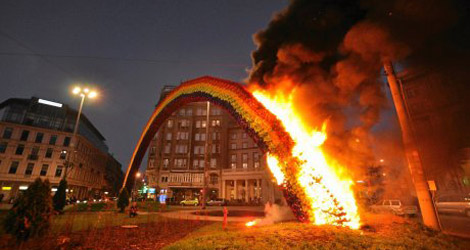
A monument to peace displayed by Poland outside the European Parliament during that country's presidency of the EU was burnt to the ground last night in Warsaw.
Chalk it up to some very unfortunate timing. Yesterday, as delegates arrived for this year's UN climate summit in Warsaw, they were warned to exercise caution and to stay out of the city centre. Violent demonstrations had broken out throughout the city.
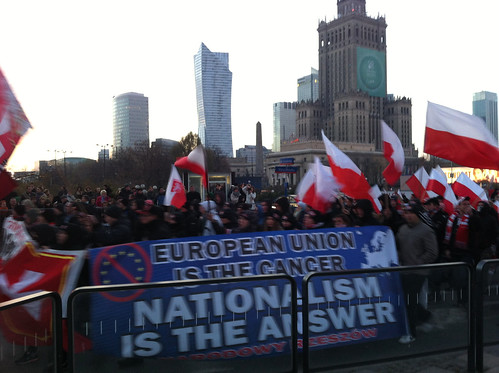
The demonstrations actually had nothing to do with the climate summit. The meeting just happened to be opening on the same day as Polish national day, when far right and far left Polish groups have traditionally clashed in street brawls during demonstrations.
The violence isn't ordinarily noticed by the world's media. But given that international journalists have converged on the city this week for the climate summit, it was embarrassing timing for the Polish government.
It didn't help that the most iconic image from the violence was the sight of a giant rainbow in central Warsaw burnt to the ground last night. Those in Brussels might recognize the rainbow shown burning in this photo. It was displayed in front of the European Parliament by the Polish government during their EU presidency in 2011.
Relations between the United States and Russia seemed to hit a post-cold-war low this week when president Barack Obama cancelled a bilateral meeting with Vladimir Putin ahead of next month's G20 summit in St. Petersburg.
After years of tension over Syria, missile defense and human rights, Russia's decision to grant asylum to NSA leaker Edward Snowdon was the straw that broke the camel's back.
But the real low point in relations may have come during an appearance this week by the US president on America's most watched comedy show.
During an interview on The Tonight Show on Tuesday (6 August), the US president sat impassively as the show's long-time host Jay Leno compared the Russian regime to the Nazis and Vladimir Putin to Hitler. Leno was referring specifically to Russia's recent passage of a law banning the ‘promotion' of homosexuality and an accompanying rise of gruesome vigilante attacks on Russian gays by far-right groups.
Across Europe and the Americas, gay
marriage has been enacted peacefully and with minimal protest. Meanwhile, in France...
Yesterday, an estimated one million people flooded the
streets of Paris to protest plans to enact
same-sex marriage in France.
It was the second such massive demonstration, following one held
in January againstFrench President Francois Hollande’s effort to
enact gay marriage - a fulfilment of a promise made during last year’s
presidential campaign.
This time, the demonstration took a nasty turn. The
protestors became violent. The police resorted to using tear gas, which
allegedly injured some of the many children being used in the protest. The
police counter that the anti-gay-marriage protestors were using children as
human shields. The president of France's Christian Democrat party says she was injured by police during the protest. Today, the opposition UMP party of Nicolas Sarkozy is calling
for the resignation of the Paris
chief of police and French interior minister Manuel Valls in response to the
tear gas 'used against children'.
On Tuesday of this week, I was sitting in the press room of
the European Parliament in Strasbourg - waiting for a press conference on the 2014 EU elections - when suddenly a woman
clad in hot pink burst into the room. Her leathery brown skin and wild hair stood in stark contrast to the suited conservative members of
parliament who were ushering her in. By her side was a young man with
bleach-blond hair, also clad in pink.
This, the journalists learned, was Frigide Barjot - the
leader of France’s
anti-gay-marriage movement. The Conservative MEPs had invited her to the
European Parliament to speak about her desire to extend her anti-gay-marriage
movement to all of Europe. While notorious in France, Ms
Barjot is unknown outside the country, and the journalists were perplexed as to
why she was there. But I knew of her already, if only from the many Facebook
posts I see from my French friends decrying her antics.
The British House of Commons has just concluded a historic
vote, voting 400 to 175 to adopt gay marriage in England. But despite its historic nature, the legislation will prove to be of more symbolic than practical importance –
particularly for its author, Conservative Prime Minister David Cameron.
In effect, the UK has already had gay marriage for eight
years – but by another name. The Civil Unions signed into UK law in 2004 confer
the exact same rights as a marriage – to the letter. Interestingly, as I’ve
written about before, this made the gay marriage debate fade out of
the limelight for many years in the UK. Because the civil unions were
theoretically “equal”, gay rights activists weren’t really pushing too hard to
have the word changed to ‘marriage’.
That was until an unlikely hero came along – David Cameron,
leader of the British Conservative party. Cameron made it the central mission
of his leadership to “detoxify” the conservative brand in the UK after years of
being successfully cast as the “nasty Tories” by Tony Blair. Part of his effort
to modernise the party was an campaign pledge in 2010 to enact gay marriage if
elected. The response from gay UK was, “well, alright then I guess.”
Azerbaijan’s
close historical and ethnic relationship with Iran is causing
discomfort in the lead-up to the Eurovision Song Contest final next weekend, hosted in Baku.
Last week angry Iranian demonstrators, probably government-organised, surrounded the Azerbaijani consulate in Tabriz condemning the country for hosting
a ‘gay contest’.
This week a Eurovision news website was attacked by Azeri
hackers in protest of Eurovision, which they said was a “gay pride event”. It
is not yet known whether these were Azeris in Azerbaijan or Iran - but the later is more likely.
The contest
organisers have appeared unsure of how to respond to the protests. Eurovision is,
after all, not actually a “gay event” as the Iranians have claimed. But it is
true that it has a large gay following, and there has been concern about the
safety of the many gay fans who will be converging on Baku this week for the
show.
Azerbaijan, as
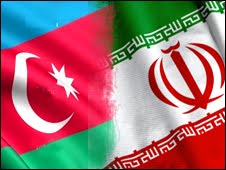
is evident from its flag, is a Muslim country. But given that the former Soviet
Socialist Republic is largely secular, it has been a matter of speculation
whether this would cause problems for gay fans (homosexuality was decriminalised in
the country in 2000, in order to join the Council of Europe). Turkey, another
Muslim but nominally secular country, hosted the contest in 2004 without
incident.
But interestingly, much of the religious-based
resistance to the hosting of the conference has come from neighbouring Iran,
where the majority (3/4) of the Azerbaijani people live. Iran’s population is 30% Azerbaijani.
As predicted, this is going to be one tumultuous year for Eurovision, the yearly singing competition where European countries compete with original songs (for Americans, it's a bit like American Idol and Miss America combined). News this week that Armenia has pulled out of the competition after Azerbaijan's president described Armenians as the country's "main enemies" has noticably rattled the competition's organisers.
The song contest, which has been held since 1956, is hosted each year by the country which one the previous year. Last year the contest was won by Azerbaijan, the Muslim former Soviet republic in the Caucasus on the border with Iran. The definition of 'Europe' has been stretched over the past decades to encorporate new countries such as Turkey, Israel and even one year Morocco.
But this year's contest in Baku is going to be an awkward one, given that Azerbaijan is still in an active conflict with its neighbor Armenia, which also participates in Eurovision and takes it very seriously. Having the warring countries both participating in Eurovision has caused problems in the past. In 2009 a number of Azerbaijanis who had voted for Armenia's entry Anush and Inga (pictured below) during the contest that year were reportedly summoned for questioning by the Ministry of National Security.
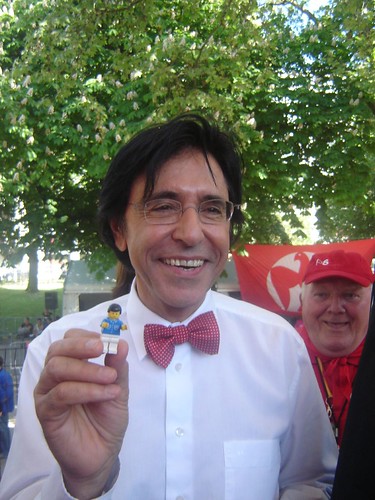
Belgium will make history this weekend in two ways. When a new government is finally formed on Sunday it will end the longest period that any country has gone without a government in modern history. And when Elio di Rupo is appointed prime minister, Belgium will become the first country in the world to have an openly gay male head of government.
I've specified 'male' because Iceland actually beat Belgium to the punch for the first gay leader of any sex – their openly lesbian Socialist Prime Minister Johanna Sigurdardottir was elected in 2009. In both countries the leader’s sexual orientation has been of little concern to the public or the media. In Belgium it is rarely ever mentioned, and in Iceland people were actually confused in 2009 when their PM’s sexual orientation received worldwide attention.
The sexual orientation of Di Rupo, also a Socialist, isn’t the only thing that makes him a different sort of politician. He is the son of Italian immigrants – a sizable population in Belgium’s Wallonia region who are descendants of the Italians who came to work in the mines in the early 20th century. This fact prompted one Belgian politician to say Di Rupo was evidence that the “American dream” is possible in Belgium.
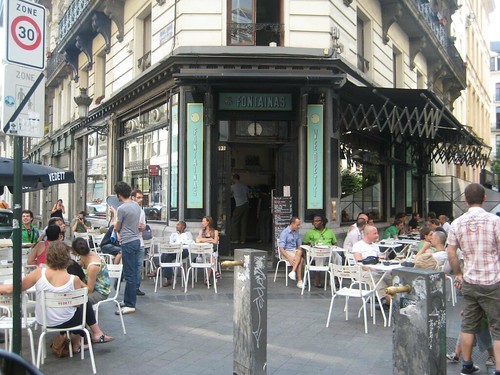
Fontainas, a cafe in central Brussels that could best be described as the headquarters of the city’s gay community, is shut down this week. Its doors have been closed since an incident Sunday night that sent a man to the hospital with severe stab wounds.
News of the attack, which has been spreading like wildfire through social media all week, seems to have left the city’s gay community shocked yet unsurprised at the same time. The storyline has become a familiar one in Brussels. Three drunk men entered the café, began hurling homophobic abuse at the people inside, and before long a violent altercation ensued. The details of what took place are still unclear, but the incident was serious enough to shut the doors of this Brussels landmark since Sunday. And although homophobic attacks are unfortunately common in Brussels city centre - an area of the city that is known for its crime and grime - this incident has still caused huge shock because the establishment is so well-known. Even the soon-to-be Belgian prime minister, who is openly gay, can often be seen there.
A movement has been growing to try to pressure the city authorities to do more to keep the city centre safe since a gay-bashing attack in June that many saw as the straw that broke the camel's back. A man was beaten by a group of young men near the Bourse (stock exchange), just next to Grand Place, because he was gay and behaving in an effeminate manner.
Yesterday America's infamous Don't Ask, Don't Tell ban on gays in the military was officially repealed. It was a hard-fought battle for the Democratic Party, and the Obama administration was keen to publicize the fulfillment of one of the president's key campaign promises. It wasn't easy, and the past three years have been met with opposition and setbacks.
The level of jubilation from Democrats was incredible, but understandable considering how long they have fought to end this ban. But looking at the situation in a global context, the excitement over a rather small policy change might seem strange. After all, until Tuesday the United States was the only country in the developed world that still had a ban on gays serving in the military.
Barring gays from military service is illegal under European law, and no such ban exists in any EU state - even in ultra-Catholic Poland or Italy. In fact the only country in all of Europe to have a ban on gays in the military is Serbia. In Latin America, the only countries to have bans on gays in the military are Cuba and Venezuela. As can be seen in the map above, the divide between gay bans (in red) and no gay bans (in blue and gray) mirrors the divide between the developed and developing world. Gay service bans are common in Africa and the Middle East.
Today is the International Day Against Homophobia (IDAHO), and a European gay rights group has taken the opportunity to publish an updated map of the human rights situation for gays, lesbians and transgendered people in Europe. Italy has clocked in at the bottom of the league, scoring worst than every EU country except Cyprus and Latvia. Meanwhile the UK scored highest, moving up from sixth place the previous year.
This year's map (pictured right) from the International Lesbian, Gay, Bisexual, Trans and Intersex Association (ILGA) gives countries a dark green for being progressive on gay rights, lighter green for being somewhat progressive and grey for being poor on gay rights. Countries in the 'red zone' are accused of "gross violations of human rights and discrimination". The factors used to determine the rankings included whether the country has anti-discrimination legislation, gay marriage, parenting rights, hate crime laws and whether the country has allowed pride demonstrations to take place.
Some 140 people were injured and 200 arrested over the weekend in the Serbian capital of Belgrade as ultranationalist rioters sought to disrupt a gay pride march going through the city protected by armed guards. As the country seeks to join the European Union, the embarrassing incident is just the latest to demonstrate the gulf between the "good behaviour" demonstrated by the Serbian government and the "bad behaviour" exhibited by a large segment of the Serbian population. Or at least that's how Brussels sees it, and that gulf continues to make EU officials very anxious.
The new tension this riot creates with Brussels is heightened by the fact that there were several EU officials marching in the parade to show solidarity – including an expected appearance by the EU ambassador to Serbia. Today Jelko Kacin, who leads the European Parliament's unit looking at Serbian accession, told the Associated Press that the riots "show an elementary lack" of tolerance for minority rights in Serbia and the "inefficiency" of the state in preventing this trend. The march this weekend was the first one to be organised since the last attempt in 2001 resulted in mass chaos and street brawls as nationalists and football supporters' clubs attacked the gay rights marchers. Another march had been planned for last year but was cancelled because of concern over the violence. This year the parade was protected by 5,000 police officers – which equals roughly three officers per pride marcher.
On Tuesday night, members of the European Parliament meeting in Strasbourg held a debate with Justice Commissioner Viviane Reding seeking an answer to a complicated but inevitable question: Now that a majority (16 out of 27) of EU member states have some form of gay marriage, how are free movement rules going to work if those married couples wish to move to one of the 11 member states that do not have gay marriage?
As I wrote earlier this summer, now that Ireland has become the latest country to adopt gay civil unions, a clear pattern is emerging of a two-speed Europe when it comes to gay rights. In Western Europe, every country except Italy has now adopted some form of gay marriage. While in Eastern Europe, nine countries have adopted constitutional amendments banning gay marriage. It is a geographic divide reminiscent of the situation in the United States, where states on the East and West coasts have adopted gay marriage while states in the center and South have adopted constitutional bans. It would seem both the EU and the US are soon going to have to grapple with the challenge of establishing how a marriage can be valid in one state and invalid in another.
This week the final signature was put on Ireland's civil partnership bill for gay and lesbian couples. For a fervently Catholic country that only decriminalised homosexuality in 1993, this was a big step. But even more importantly, it's reflective of the sudden rapid advancement Europe is making in the area of gay rights. Well, half of Europe anyway. Yes, the fact that this advance was made despite the historic power of Catholicism over Irish government is a promising sign for proponants of same-sex marriage. But could Ireland's change of heart have more to do with geography than a cultural shift? Let's look at the map.
As you can see from the map above, Italy is now the only remaining Western European country to have no form of gay marriage. The vast swathe of what Donald Rumsfeld used to deride as "Old Europe" is now awash in various shades of blue. And some of those light blues are due to change to dark blue quite soon. David Cameron's conservative-libdem coalition has already said they will upgrade Britain's civil unions to full marriage soon. Anything to not be compared to the Irish I suppose.
I’ve never received such a shock from reaching into my pocket. Having just emerged from a relaxing float in the Dead Sea, I had snapped a few photos before starting to make my way to my rental car to continue my journey through the desert. But when I reached into my bathing suit pocket to get my car keys my eyes just about popped out of my skull when I realized what I had done. I had left my keys in my pocket while floating on the surface of the dark, murky water. I rushed back to where I had been floating but I knew it was no use – it was impossible to see into the water, and impossible to feel anything at the rocky bottom. I was stranded in the middle of the desert, locked out of my car with only my camera and my wallet.
I had actually just begun my journey through the Dead Sea area, having rented a car in Tel Aviv and driven down intending to visit the ancient fortress of Masada, the Ein Gedi nature preserve and the main Dead Sea spa. I was driving through the West Bank when I reached the sea, and as soon as I saw it I couldn’t contain my excitement. I parked the car at the first spot I could enter the water and rushed in with reckless abandon. So when I realized my horrible error I was literally in the middle of nowhere, with no phone for miles, in the middle of the disputed West Bank territory, in searing 40 degree weather. It was not a good situation!
Surely this is just a bizarre coincidence, but oddly enough two conservative politicians at opposite ends of Europe took major tumbles last week following misstatements in interviews in gay newspapers. Both David Cameron in the UK and Mirek Topolánek in the Czech Republic have run into trouble for ill-chosen words used in interviews they had clearly underprepared for. Does this mean the pink press has come of age?
Last week British Conservative leader David Cameron, who will be challenging Gordon Brown in next month’s general election in the UK, had a mini meltdown of sorts during a filmed interview with the Gay Times. The trouble started when the interviewer asked Cameron why his Tories in the European Parliament failed to support a recent vote criticising a Lithuanian law banning the “promotion of homosexuality” (The image below is an actual campaign flyer in Vilnius for the Lithuanian law). David Cameron seemed completely caught off guard, and could only respond that he didn’t know anything about the vote.
In a crippling blow to the gay rights movement in the United States, citizens of the state of Maine voted in a referendum to repeal a law passed by their own elected legislature granting marriage rights to same-sex couples. It was a reminder of the reality of referendums: easily manipulated by campaigns of misinformation, public votes rarely yield progressive results, and have historically voted against protecting the rights of minorities. Out of 31 public referendums held on the gay marriage issue in the United States, every single one has voted against allowing the unions.
The success of Maine’s ‘question 1’ follows the bitter disappointment of gay rights activists following the yes vote on California’s ‘proposition 8’ a year ago, which struck down the gay marriage rights that had been granted in that state only months earlier. Though the ‘no’ campaign in Maine was fought by the same anti-gay rights groups using almost identical advertising (warning that gay marriage would mean the teaching of homosexuality in public schools), there was one significant difference between the two referendums. While gay marriage was granted in California by a ruling of the state’s supreme court, marriage rights had been passed by an act of the legislature in Maine, endorsed by the state’s governor.
This is noteworthy because one of the main arguments of opponents of same-sex unions is that they keep being granted by “activist judges” in state courts “overriding the will of the people.” But while that argument could be made in California, that has largely not been the case in the states of New England, which have enacted same-sex unions through legislative action. So in Maine, the referendum actually overturned an act passed by legislators who had been elected to represent the voters. Maine's moderate governor even campaigned against question one. To me, this is an almost painful example of how absurd these large-scale referendums are.
In talking about this issue with British friends over the past few days, they’ve all been in agreement that this Maine marriage referendum is a disgrace. After all, what is the point of having a representative democracy if people can challenge anything they do just by rounding up a few thousand signatures? In a republic, citizens elect representatives and pay them to become educated on the issues and make responsible decisions in their stead. They choose these people to act on their behalf precisely because they do not have the time or, largely, the intellectual acumen to make these decisions for themselves. Having the public make these decisions by referendum results in a ‘tyranny of the majority’, as James Madison put it, which doesn’t have the foresight to make the best decisions for the country and will rarely protect the rights of minority groups. The Brits have nodded their heads in firm agreement.
Yet these are the same British friends who have been incensed by the fact that they have not been able to vote in a public referendum on the Lisbon Treaty, a complicated foreign policy document that was instead passed by their elected representatives in parliament. They’ve been outraged that after successive ‘no’ votes in referendums in France, Holland and Ireland, the treaty has still come to pass. Never once have they questioned the wisdom of having those referendums in the first place. Their assumption has seemed to be that public votes will always result in the best policy. Nevermind the fact that the Lisbon Treaty is a complicated and rather dull international agreement that tightens up the functioning of a union that already exists.
These British friends have tended to disregard the fact that every parliament that has voted on the issue, made up of representatives who have the time and capacity to educate themselves on what the treaty really is, has passed it (which must mean something, right?). They seem to have not thought about the near certainty that publics will cast referendum votes based on national issues (such as their satisfaction or dissatisfaction with their national government), xenophobia or misinformation rather than on the realities of the actual question being put to a vote.
Favoured by Populists and Dictators
Referendums rarely result in progressive policy or well-informed decisions. Exit polling after the first Lisbon Treaty referendum in Ireland revealed that the majority of ‘no’ voters did so either based on the fact that they didn’t know enough about the treaty or based on misconceptions about it.
In Switzerland, where there is a referendum on just about everything since they are guaranteed by the Swiss constitution, women didn’t have the right to vote nationally until the 1970’s (referendums kept voting universal suffrage down). The country’s politics are well known for their near-glacial pace.
Besides Switzerland, referendums have also historically tended to be pursued vigorously by dictators such as Adolf Hitler and Benito Mussolini. Both men frequently used plebiscites to disguise oppressive policies in a veneer of populism. Largely as a result of Hitler’s enthusiasm for them, Germany does not allow referendums to take place on a national level.
So where have referendums not been used? Well funny you should ask. They are not allowed in the handful of US states that still have gay marriage, such as my home state of Connecticut. If they were allowed in Connecticut, I think it’s likely that it could have been struck down there as well. And Connecticut is one of the most progressive states in the country.
Whatever their opinion of Britain’s membership in the EU, I would urge my British friends to acknowledge that referendums are not a wise way to make policy. If they really want the UK to disengage with the European union, they’re free to vote for representatives who will reflect that stance. But they voted in Tony Blair’s New Labour three times on a moderately pro-European platform, so they can’t complain when this is the result of the parliamentary vote.
They should really ask themselves why it is that a majority of MPs, who have the time to educate themselves on these things, supported adoption of the Lisbon Treaty. Rejecting the treaty would have been a very radical move, especially after obtaining all of the opt-outs Britain negotiated. If the British public want to elect representatives who would make such radical decisions, they’re free to do so. But they should stop and ask themselves if this is really what they want.