
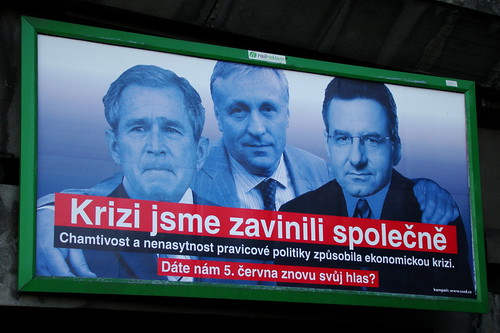
This weekend Czechs went to the polls to select a new government. They faced a stark choice between the centre-left Social Democrats who promised during the campaign to increase spending and social benefits, and the centre-right Civic Democratic Party (ODS) who pledged to make drastic budget cuts and reduce the deficit. It is a battle economists have been waging as well. As most countries emerge from recession, is it better to maintain state spending to fuel the recovery or to make drastic cuts to tackle the large deficits and public debt?
The campaign in the Czech Republic mirrored May’s election in the UK. Centre-left Labour Prime Minister Gordon Brown told voters that the Conservatives risked undermining Britain’s economic recovery if they got into office and started making drastic cuts to public spending. On the other side, the Conservatives said the drastic cuts were necessary to avoid the UK meeting the same fate as Greece. Conservatives frequently pointed out that the UK’s debt is comparable to Greece’s, and if the country didn’t make drastic cuts soon to send a signal to the market, speculators would soon move in. In the end, though David Cameron remains personally unpopular and distrusted by the British public, they voted him and his Conservative party into power – albeit by a margin too low to enable them to govern without forming a coalition with the Liberal Democrats. (The UK is outlined because Cameron recently took his party out of the EPP to form the ECR).
Combine this with the recent centre-right victory in Hungary and you’ve got the map above. It’s a vast swathe of centre-right blue across most of the continent, with a smattering of liberal yellow in Northern Europe and Socialist red in Southern Europe. Considering the difficulties currently being experienced in Southern Europe, and the deeply unpopular cuts these governments are going to have to make, the Mediterranean Socialists have an uphill climb ahead of them. That leaves Austria and Slovenia.
 Compare this with the map to the left. This was the situation two and a half years ago in January 2008. The Social Democrats had already been defeated in Germany, but there was still a much more even mix between the right and the left within the EU. Flash forward to 2010, when the vast majority of member state governments are led by conservatives. Conservatives now dominate the European Parliament after a massive victory in the European election last year. The President of the European Commission is a conservative, as is the new President of the European Council Herman Van Rompuy. In the big three countries – France, Germany and the UK, the opposition centre-left parties remain disorganized and disillusioned, none more so than the French Socialists.
It’s hard to see where the European left goes from here, but the next few years will probably involve some serious soul-searching. How is it that, in an atmosphere which seems like it should have seen people flock to an ideology favouring more government restraint on unfettered capitalism, the public has turned away so profoundly from the left?

4 comments:
The problem is the left has failed to articulate its ideas to people. Unfortunately this crisis came at a time when the left in Europe is disorganised and has much infighting. It's cyclical, and eventually the left will come back as people tire of conservative governments. But it's a shame the crisis had to happen during a conservative cycle, because socialists would have used the crisis as an opportunity to have better protections for people and better regulation of financial institutions.
Yes because they are concentrated in Southern Europe, the remaining socialist governments are going to become hated by the publics there. It is a big problem for social democracy :-(
I'm disappointed by both the left and the right. But the shift to the right in times of economic downturn is not really surprising, it's what usually happens I think.
However, any politician, whether socialist or conservative, that does not want to cut in government expenses in this economic downturn is seriously dangerous. Nowadays governments no longer talk about billions, but trillions. That's a one with twelve zero's. That's like stacking one hundred euro bills tightly together.... for 10.000 km!! Our world is changing and we are in denial of what really needs to be done.
It's a shame what is going on in Europe at the moment.
Post a Comment